

Executive Overview
In the hyper-accelerated timeline of modern artificial intelligence infrastructure, few entities have captured the imagination—and capital—of Silicon Valley quite like Etched. Just months after commanding a staggering $21 billion valuation during a $700 million funding round, the four-year-old AI chip startup is reportedly entertaining a fresh wave of investment proposals valuing the company between $40 billion and $50 billion.
According to individuals close to the matter, top-tier venture capital funds and institutional investors are lining up with bids of $40 billion, while lesser-known backers have tabled aggressive offers reaching the $50 billion threshold. Though these preliminary fundraising deliberations remain fluid and terms are subject to change, the sheer velocity of Etched’s ascent highlights an unprecedented gold rush in specialized silicon.
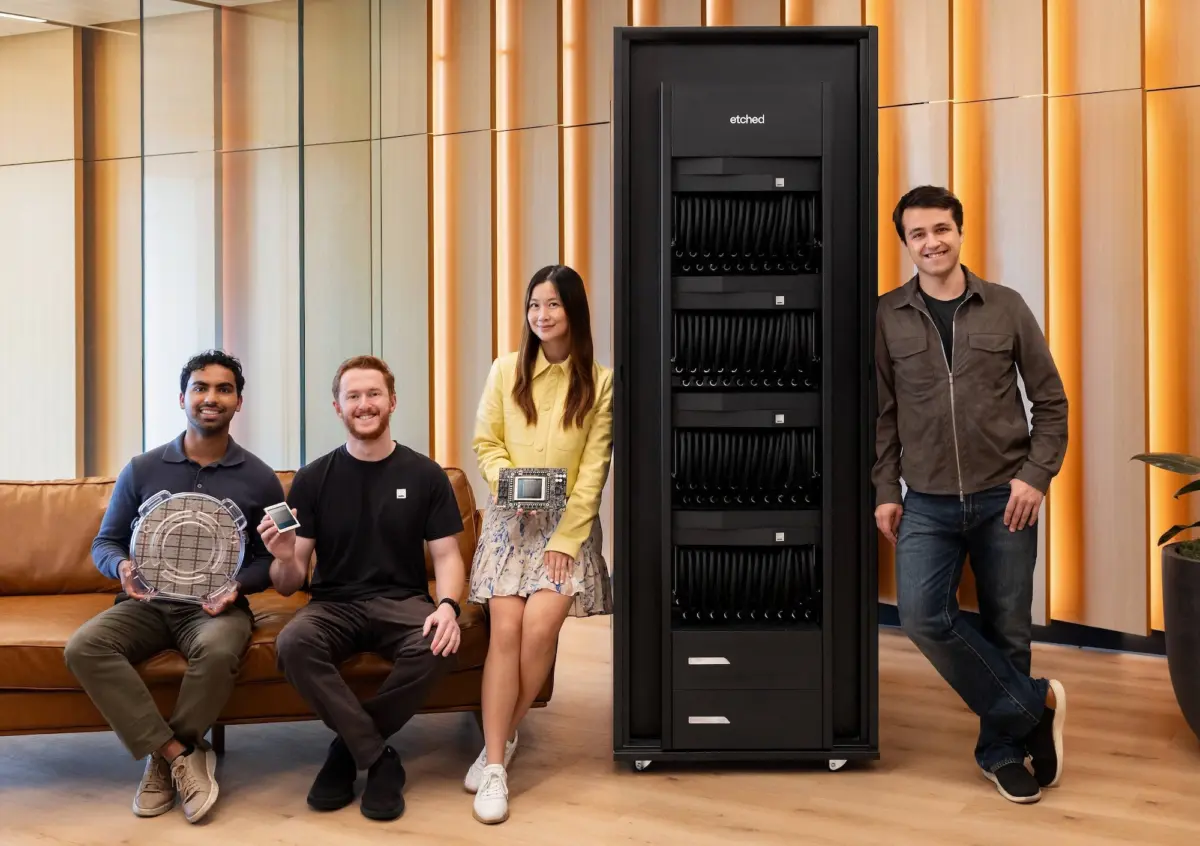
Etched is not merely designing semiconductors; it is attempting the exceptionally capital-intensive feat of building full, proprietary AI hardware systems from the ground up. By focusing exclusively on custom silicon optimized for model inference—the computational phase where AI models execute user prompts—the startup has positioned itself as a formidable, if audacious, challenger to Nvidia’s long-standing market dominance.
Backed by major institutional players, armed with a formidable war chest, and aggressively poaching elite semiconductor talent, Etched has quickly transformed from an academic spin-off into one of the most closely watched heavyweights in the global technology landscape.
Detailed Chronology: The Meteoric Rise of a Semiconductor Disruptor
The story of Etched is rooted in collegiate ambition and advanced theoretical mathematics. Co-founders Gavin Uberti and Chris Zhu crossed paths while navigating rigorous advanced math courses at Harvard University. Robert Wachen, who would go on to become the startup’s Chief Operating Officer, was Uberti’s roommate. Recognizing a profound structural bottleneck in the trajectory of artificial intelligence infrastructure, the trio made the consequential decision to drop out of Harvard and channel their energies entirely into architecting a new paradigm for AI hardware.
From Test Silicon to Commercial Validation
For years, the semiconductor industry has bowed to the sweeping hegemony of Nvidia, whose graphics processing units (GPUs) serve as the default engines for both AI model training and inference. However, Etched’s founders identified a critical inefficiency: general-purpose GPUs, while versatile, are inherently sub-optimal for the hyper-specific, high-throughput demands of running large-scale AI inference.
The startup’s turning point materialized this summer. After successfully manufacturing its initial test chips at a Taiwan Semiconductor Manufacturing Company (TSMC) fabrication facility, Etched achieved critical commercial validation. By July, the company announced it had already secured a formidable $1 billion in customer orders. Among these early adopters was Jane Street, the prominent quantitative trading firm, which not only integrated into Etched’s customer ecosystem but also took physical delivery of an early-generation system. For high-frequency quantitative traders, where microsecond advantages translate directly into massive financial returns, Etched’s architecture offered an irresistible value proposition.
Back-to-Back Funding Blasts
Etched’s financial trajectory has defied conventional Silicon Valley venture capital pacing through a series of compressed, high-stakes funding maneuvers:
- July: Etched announced a substantial $300 million funding round at a $10.3 billion valuation, spearheaded by premier venture capital firm Sequoia Capital.
- September: Barely two months later, the valuation doubled to $21 billion on the back of a $700 million mega-round led by Jane Street.
- Late Year / Current Talks: Industry insiders reveal that these successive capital injections functioned essentially as a single financing event split into distinct tranches with escalating valuations—a controversial yet increasingly prevalent structuring tactic among elite, high-demand AI startups.
Now, barely months after cementing its $21 billion status, Etched is reviewing inbound term sheets that would nearly double its valuation yet again. Should the company successfully close a round matching the magnitude of its previous capital intake, sources indicate it would secure a comfortable operational runway of up to 3.5 years, insulating it against macro-economic volatility as it scales production.
Supporting Context & Metrics: Architecture, Talent, and Infrastructure
Etched’s astronomical valuation is not merely a product of speculative AI hype; it is underpinned by concrete technological differentiators, targeted infrastructure investments, and a deliberate strategy to siphon institutional knowledge directly from legacy semiconductor giants.
Engineering Custom Inference Accelerators
At the core of Etched’s market appeal is its uncompromising focus on AI inference. While competitors build chips designed to handle the dual burdens of training and running models, Etched has designed two entirely new components from scratch specifically optimized to accelerate inference speeds.
According to technical briefings provided by the company, Etched’s proprietary processors are engineered to process significantly more tokens per second—and at a substantially lower total cost—than competing Nvidia hardware. Because inference represents the operational phase where commercial AI applications interact with end-users at scale, efficiency gains in this domain directly translate into billions of dollars in operational savings for major enterprise deployers.
Siphoning Nvidia’s Elite Talent Pool
Building breakthrough silicon requires specialized, scarce engineering talent. Etched has executed a calculated talent acquisition strategy, successfully recruiting heavily from the upper echelons of the semiconductor industry.
Reports from the Wall Street Journal indicate that approximately 15% of Etched’s 400-person workforce previously logged operational tenure at Nvidia. By positioning itself as an agile, high-upside alternative to legacy corporate structures, the startup has managed to attract top-tier circuit designers and system architects eager to work on clean-sheet hardware designs.
Expanding Global Footprint: Silicon Valley to Taiwan
Hardware startups must bridge the vast chasm between software-like iteration and the brutal physical realities of global supply chains. Etched has aggressively laid down physical infrastructure to support its scaling ambitions:
- Silicon Valley Datacenter: The company operationalized a state-of-the-art 10-megawatt datacenter in Silicon Valley, providing the necessary testing grounds for full-scale AI hardware integration.
- Taiwan Facility: To streamline manufacturing pipelines and maintain tight operational synergy with its primary fabrication partner, Etched established a specialized facility in Taiwan, ensuring close proximity to TSMC’s advanced fabrication lines.
Official Statements and Industry Perspectives
Corporate transparency has been characteristically tight-lipped as Etched navigates these high-stakes financial discussions. Management has maintained a strict posture of discretion, declining to comment on the specifics of the ongoing $40 billion to $50 billion inbound investment offers.
However, previous disclosures from co-founder and COO Robert Wachen illuminate the foundational thesis driving investor enthusiasm. Wachen has repeatedly emphasized that the market’s willingness to assign extraordinary valuations to a four-year-old startup stems from the fundamental bottleneck of AI scaling. As enterprise demand for real-time AI inference explodes, traditional architectures face diminishing returns, opening a wide window for purpose-built silicon architectures like Etched’s.
Venture capital observers note that Etched’s trajectory exemplifies a broader structural shift in the tech ecosystem. Mega-rounds executed in rapid succession—frequently characterized by dual-pricing structures pioneered or popularized by tier-one firms like Sequoia—have rewritten the playbook for capital deployment. While critics argue these compressed valuations risk inflating asset bubbles, proponents maintain that the immense capital requirements of building hardware systems from the silicon up demand unprecedented financial mobilization.
Future Outlook: The Road Ahead for Etched
As Etched evaluates whether to accept incoming bids ranging from $40 billion to $50 billion, the startup stands at a critical juncture in its corporate evolution. The coming months will test whether the company can successfully transition from a celebrated design house with promising test chips into a reliable, high-volume hardware manufacturer capable of challenging entrenched industry titans.
The primary challenges facing Etched moving forward include:
- Supply Chain Execution: Maintaining faultless operational synchronization with TSMC and its domestic Taiwan facility amidst a fiercely competitive global semiconductor supply chain.
- Customer Conversion: Expanding its order book beyond early believers like Jane Street to capture major hyperscalers, cloud providers, and enterprise software giants.
- Software Ecosystem Maturity: Ensuring that its proprietary hardware is seamlessly supported by robust software compilers and developer frameworks, neutralizing Nvidia’s formidable moat in CUDA and software integration.
If Etched successfully navigates these hurdles, a $50 billion valuation may ultimately look conservative in hindsight. Should execution falter, however, the heavy financial and operational commitments required to build full AI hardware systems will expose the startup to severe systemic risks. For now, Wall Street, Silicon Valley, and global technology conglomerates remain transfixed as Etched continues to write a bold, high-stakes chapter in the history of artificial intelligence infrastructure.








Belum ada komentar. Jadilah yang pertama berkomentar!