


Executive Overview
When cultural historians look back at 1980s cinema, they are often immediately blinded by the dazzling, high-gloss megawattage of Hollywood blockbusters. This was the decade that solidified modern franchise culture, defined by the Spielbergian wonder of E.T. the Extra-Terrestrial and Back to the Future, the relentless action-horror of Aliens and Predator, and the enduring cosmic mythologies of Star Wars and Star Trek. Studio executives spent vast fortunes building pristine, easily digestible speculative futures and space operas for the global multiplex.
Yet, far beneath the multi-million-dollar studio machinery thrived an insurgent, fiercely creative independent scene. Operating on shoestring budgets, using makeshift equipment, and fueled by raw punk-rock anti-establishment ethos, indie filmmakers injected the science fiction genre with unprecedented social satire, body horror, existential dread, and stylistic audacity. Without the studio gatekeepers policing their creative choices, these maverick directors blended genres in ways that mainstream Hollywood wouldn’t dare approach.
Curated by film critic Casey Chong, this retrospective examines ten essential, yet frequently overlooked, cult independent sci-fi masterworks of the 1980s. These pictures did not merely entertain; they interrogated the anxieties of the Reagan era, foreshadowed the digital and surveillance landscapes of the future, and launched the careers of cinematic legends.
Detailed Chronology & Retrospective Analysis
1. Liquid Sky (1982)
- Director: Slava Tsukerman
- Budget: $500,000 | Box Office: $1.7 million
Operating on a modest $500,000 budget, Russian emigré Slava Tsukerman engineered one of the most bizarre aesthetic experiments of the decade. Liquid Sky introduces viewers to a micro-spaceship—roughly the size of a dinner plate—that touches down on a Manhattan rooftop. The invisible, thermal-vision-bound aliens onboard are not here for territorial conquest; they are hunting for heroin, only to discover that human endorphins and brain chemistry offer a far more potent high.

The narrative centers on Margaret (Anne Carlisle), a drug-addicted fashion model who engages in sexual encounters while the extraterrestrials harvest her partners’ brain chemicals right at the moment of climax, reducing the victims to thin air.
While criticized upon release for stilted, robotic line delivery and an abrasive, ear-piercing synthesizer score, Liquid Sky remains an unmatched time capsule of New York City’s 1980s New Wave and post-punk subcultures. Carlisle delivers a stunning dual performance as both Margaret and her cisgender male counterpart, Jimmy. Bolstered by its vibrant Day-Glo expressionism, the film became an unexpected commercial triumph, tripling its production budget during its theatrical run.
2. Android (1982)
- Director: Aaron Lipstadt
- Budget: Low-budget independent
Released the same year as Ridley Scott’s monumental Blade Runner, Aaron Lipstadt’s Android takes a dramatically different approach to artificial intelligence. Eschewing grand, sprawling cityscapes for a claustrophobic, chamber-drama style, the film focuses on Max 404 (Don Keith Opper), an innocent, wide-eyed android serving as the solitary assistant to a cold, calculating mad scientist, Dr. Daniel (Klaus Kinski).
Max’s routine existence is upended when a trio of escaped convicts—played by Brie Howard, Norbert Weisser, and Crofton Hardester—infiltrate the space station. Max develops an intense fascination with one of the fugitives, Maggie, triggering a poignant yearning for human love and sexual awakening. Co-written by Opper himself, the film operates as a deliberate, slow-burn psychological exploration that culminates in a tense, morally ambiguous standoff.

3. Battle Beyond the Stars (1980)
- Director: Jimmy T. Murakami
- Production Company: Roger Corman’s New World Pictures
Produced by B-movie mogul Roger Corman, Battle Beyond the Stars achieved the seemingly impossible: it translated Akira Kurosawa’s Seven Samurai (and its Hollywood Western adaptation, The Magnificent Seven) into an interstellar space opera.
The plot follows Shad (Richard Thomas), a young farmer from the peaceful planet Akir, who embarks on a desperate mission to recruit a ragtag team of mercenaries to protect his world from the tyrannical warlord Sador (played with scenery-chewing glee by John Saxon).
Written by master genre scribe John Sayles (Piranha, Alligator), the screenplay strikes a brilliant balance between pulp adventure, sardonic humor, and distinct character work. It features memorable turns by Robert Vaughn as a stoic, aging assassin and George Peppard as a laid-back "Space Cowboy from Earth." Notably, the production served as an invaluable training ground for future industry titans, featuring early visual effects and art direction by a young James Cameron, alongside a stirring orchestral score by James Horner.
4. Galaxy of Terror (1981)
- Director: Bruce D. Clark
- Production Company: New World Pictures
Capitalizing on the monumental success of Ridley Scott’s Alien, Roger Corman greenlit Galaxy of Terror as a low-budget psychological sci-fi-horror hybrid. Helmed by Bruce D. Clark, the film follows a stressed-out, working-class space crew—featuring Edward Albert, Erin Moran, and a pre-Nightmare on Elm Street Robert Englund—stranded on a desolate, foreboding planet.

Rather than relying on a biological predator, the crew faces a mysterious monolithic pyramid that reads their minds and manifests their deepest, darkest psychological fears into corporeal weapons. Englund’s anxiety-ridden character, for instance, is forced to confront a monstrous doppelganger of his own neuroses. Like Battle Beyond the Stars, Galaxy of Terror boasts key early contributions from James Cameron as production designer and second-unit director, cementing its status as a vital stepping stone in the evolution of modern sci-fi horror.
5. The Brother from Another Planet (1984)
- Director: John Sayles
Written and directed by John Sayles, The Brother from Another Planet presents Joe Morton as a mute, gentle alien who crash-lands at Ellis Island. Though he possesses webbed, three-toed feet, he is no formidable conqueror; he is an interstellar refugee navigating the harsh realities of urban America.
Because his character cannot speak, Morton delivers a masterclass in physical acting, communicating purely through expression and body language. Sayles frames the narrative as a sharp social satire and a poignant allegory for the immigrant experience, examining marginalization, racism, and urban poverty. The film also features darkly comedic supporting performances by Sayles and David Strathairn as a pair of deadpan "Men in Black" hunting the protagonist through the streets of New York.
6. Xtro (1983)
- Director: Harry Bromley Davenport
Embracing the visceral body horror pioneered by David Cronenberg, Harry Bromley Davenport’s Xtro delivers a deeply unsettling, nightmarish vision of extraterrestrial invasion. The film centers on Sam (Philip Sayer), a father who was abducted years prior and returns home thoroughly colonized by an alien organism.

Sam initiates a toxic psychological war against his guilt-ridden wife (Bernice Stegers) and systematically corrupts his young son, Tony (Simon Nash). Through a series of graphic transformations and practical effects—including a terrifying sequence where Tony brings everyday toys to life—Xtro established itself as a legendary, boundary-pushing entry in the British "video nasty" canon.
7. Bad Taste (1987)
- Director: Peter Jackson
- Budget: Ultra-low DIY
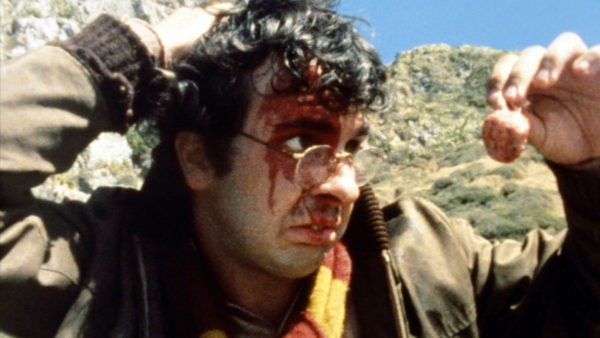
Years before commanding multi-million-dollar Middle-earth budgets, New Zealand auteur Peter Jackson launched his career with Bad Taste, an ultra-low-budget splatter-comedy about extraterrestrial culinary ambitions. In the film, aliens disguised as humans arrive in a small coastal town to harvest the local population as raw ingredients for an intergalactic fast-food chain.
Humanity’s defense falls to a bumbling, deeply incompetent four-man paramilitary team known as the Astro Investigation and Defence Service (AIDS)—played by Jackson himself alongside friends and locals. Shot on weekends over four years, Jackson utilized sheer ingenuity, baking rubbery alien masks in his mother’s kitchen oven and engineering makeshift camera rigs. The result is a gleefully grotesque testament to the power of DIY filmmaking.
8. Repo Man (1984)
- Director: Alex Cox
Alex Cox’s Repo Man remains one of the sharpest, most brilliantly eccentric satires of 1980s Reaganomics, consumerism, and nuclear paranoia. The story follows Otto (Emilio Estevez), a disillusioned Los Angeles punk rocker who drifts into the cynical, high-stakes underworld of automobile repossession under the guidance of veteran mentor Bud (Harry Dean Stanton).

Beneath its coming-of-age punk aesthetic lies a bizarre sci-fi MacGuffin: a vintage Chevrolet Malibu driven by a lobotomized nuclear scientist (Fox Harris) that contains otherworldly, radioactive cargo capable of vaporizing anyone foolish enough to open the trunk.
9. Scanners (1981)
- Director: David Cronenberg
David Cronenberg took the familiar sci-fi trope of telepathy and weaponized it into a biological nightmare in Scanners. The narrative pits rogue telepath Darryl Revok (played with chilling detachment by Michael Ironside) against a shadow organization of government-backed "scanners."
The film is permanently etched into cinematic history by its jaw-dropping opening sequence, in which Revok causes a rival’s head to violently explode. Achieved through ingenious practical effects—combining a gelatin head, a shotgun blast, and reverse editing—Scanners served as a clinical, paranoid allegory exploring corporate overreach, pharmacological experimentation, and loss of bodily autonomy.
10. The Quiet Earth (1985)
- Director: Geoff Murphy
Hailing from New Zealand, Geoff Murphy’s The Quiet Earth rejects bombastic post-apocalyptic tropes in favor of a quiet, existential character study. Bruno Lawrence stars as Zac Hobson, a scientist who awakens to find that a catastrophic global energy experiment has seemingly wiped out all human life on Earth.

Murphy brilliantly utilized the early morning, empty streets of Auckland and Hamilton to construct a hauntingly desolate atmosphere. Lawrence carries the film nearly single-handedly, delivering a masterclass in minimalist acting that explores isolation, madness, and redemption.
Supporting Context & Metrics
To truly appreciate the cultural weight of these 1980s indie sci-fi films, one must evaluate the industrial ecosystem from which they emerged. While major studios like 20th Century Fox and Universal poured upwards of $10 million to $30 million into films like Blade Runner and E.T., indie outfits operated on fractional resources:
| Film Title | Release Year | Estimated Budget | Box Office / Financial Milestone |
|---|---|---|---|
| Liquid Sky | 1982 | $500,000 | $1.7 million (Tripled production costs) |
| Battle Beyond the Stars | 1980 | $2 million | Commercial success; 5 Saturn Award nominations |
| Bad Taste | 1987 | Under $30,000 (DIY) | Cult sensation, launched Peter Jackson’s career |
| Repo Man | 1984 | $1.5 million | Critical darling, established a permanent midnight-movie legacy |
| The Quiet Earth | 1985 | Low-budget | International critical acclaim, defining New Zealand cinema |
These financial realities forced directors to substitute multi-million-dollar computer-generated imagery with practical ingenuity, stop-motion animation, physical makeup effects, and sharp, character-driven screenwriting.
Official Statements & Critical Reception
The enduring legacy of these underground features is reflected in how contemporary critics and filmmakers view their historical impact. Film historians frequently cite the 1980s indie circuit as the crucible that modern independent cinema relies upon.

"The beauty of independent science fiction in the 1980s was its absolute freedom. When you don’t have a studio executive breathing down your neck demanding four-quadrant appeal, you can explore the dark corners of human psychology, social decay, and cosmic absurdity."
— Retrospective Film Analyst Consensus
Furthermore, major industry figures have openly acknowledged their roots in these low-budget productions. Director James Cameron has frequently noted that his grueling physical production work on Roger Corman’s Battle Beyond the Stars and Galaxy of Terror directly forged his directorial style, teaching him how to extract maximum visual impact from minimal capital—a skill he later deployed on The Terminator (1984) and Aliens (1986).
Future Outlook & Preservation
As physical media formats transition toward 4K UHD restorations and boutique curation labels (such as The Criterion Collection, Arrow Video, Vinegar Syndrome, and Severin Films) continue to unearth lost cinematic artifacts, the 1980s indie sci-fi canon is experiencing a massive cultural renaissance.
Modern audiences, fatigued by homogenous studio franchise fatigue and algorithmic content curation, are increasingly seeking out the tactile imperfections, daring risks, and raw creative passion of these underground classics. Initiatives to digitally preserve and restore titles like Bad Taste, Liquid Sky, and The Quiet Earth ensure that future generations of filmmakers and cinephiles will continue to find inspiration in the margins of cinema history.
What are your favorite indie sci-fi movies of the 1980s? Let us know on social channels @FlickeringMyth…
Casey Chong







Belum ada komentar. Jadilah yang pertama berkomentar!