

Executive Overview
For decades, popular culture has oscillated between two extremes when depicting the digital age. On one end of the spectrum lie the hyperbolic thrillers of the early 2000s—such as CSI: Miami, Criminal Minds, and 24—which peddle in sci-fi tropes like instant high-resolution image enhancements from grainy security footage and omnipresent, frictionless surveillance. On the other end sit utopian tech-bro manifestos, promising that every societal ailment can be solved if we simply "move fast and break things."
However, a more grounded, nuanced framework has gradually emerged in media studies and cultural criticism: technorealism. Rooted in the late-1990s counter-movement pioneered by thinkers like Douglas Rushkoff and Andrew Shapiro, technorealism urges a sober assessment of technology’s social, political, economic, and cultural implications before and during its widespread implementation. Its foundational tenet is simple yet profound: technology is never neutral.
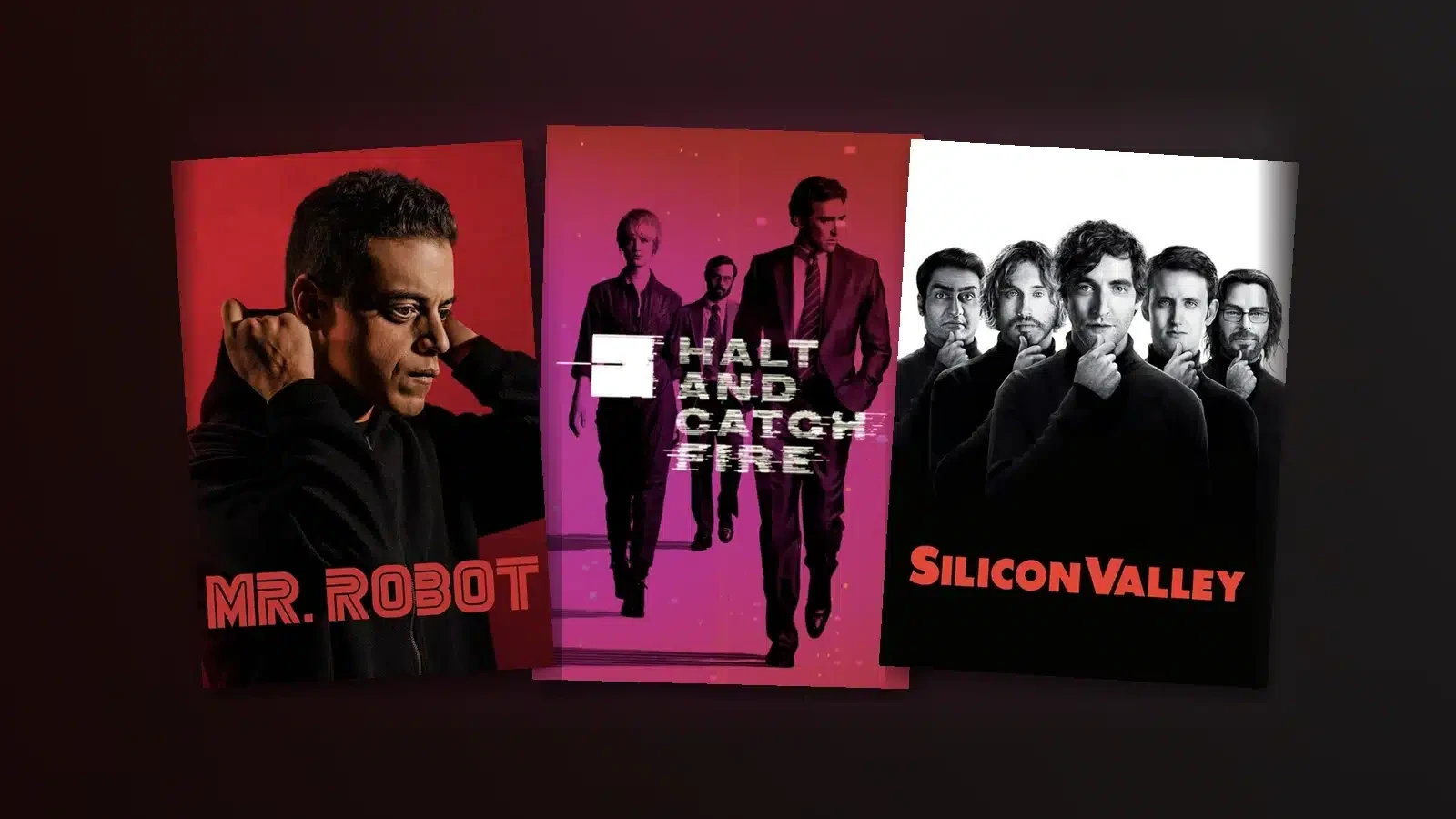
This analytical lens is exceptionally useful when examining how contemporary prestige television portrays the digital revolution. Rather than falling back on cheap tropes, a select group of modern television dramas—specifically Halt and Catch Fire (2014–2017), Mr. Robot (2015–2019), and Silicon Valley (2014–2019)—have embraced a technorealist approach. These series do not merely use computers, smartphones, and networks as set dressing or magical plot devices; they interrogate the human cultures, power dynamics, and systemic compromises that arise whenever humans build and deploy complex technologies.
Detailed Chronology: The Evolution of Tech on TV
To understand how modern television arrived at this sophisticated juncture, we must trace both the historical evolution of digital representation on screen and the theoretical milestones that shaped our understanding of technology’s social embeddedness.
1. The Naive Era and the Myth of Technological Neutrality (Pre-2010s)
Historically, mainstream television treated hardware and software as magic wands. In procedural dramas, typing furiously on a mechanical keyboard could instantly bypass any firewall or lock. Technology was portrayed as inherently neutral—a tool whose moral value depended entirely on the user.
During the dot-com boom and the subsequent rise of Web 2.0, cultural narratives were dominated by Silicon Valley boosterism. The prevailing cultural myth was that digital connectivity would inherently democratize society, flatten hierarchies, and usher in a golden age of frictionless communication.
2. The Turn Toward Technorealism: Academic and Critical Foundations
In 2012, political science researcher Rochelle Terman published her seminal article, Tech on TV: New Representations in Technorealism, arguing that visual media needed to move past lazy caricatures. Terman highlighted shows like The Wire (2002–2008), where wiretaps and surveillance tech were hamstrung by institutional bureaucracy, user error, and technological limitations.
This critical evolution drew heavily on established philosophy of technology:
- Raymond Williams: The cultural theorist argued that technology is shaped by social needs. Television did not simply appear because engineers invented cathode-ray tubes; it emerged because society demanded mass communication and mobile home entertainment.
- W. Brian Arthur: The economist asserted that technology must be defined not just as physical artifacts, but as an aggregate of the people, processes, and unexpected behaviors surrounding its use (e.g., the mobile phone evolving from a voice tool into a text-heavy messaging device).
- Langdon Winner: Known for his concept of the "social determination of technology," Winner argued that large-scale technical systems (like the World Wide Web or modern Artificial Intelligence) reflect existing power structures and are routinely driven by society’s most powerful stakeholders.
3. The Prestige Television Renaissance (2014–2019)
Armed with these frameworks, cable and streaming networks entered a golden age of tech-centric storytelling. Between 2014 and 2015, three landmark series debuted—Halt and Catch Fire, Silicon Valley, and Mr. Robot—that treated computing not as a superpower, but as a messy, highly human endeavor fraught with ego, systemic failure, and cultural transformation.
Supporting Context & Metrics: Analyzing the Trio of Technorealism
To rigorously test technorealism as a critical framework, we can evaluate how these three modern series handle both the hardware/software reality and the surrounding cultural ecosystem.
| Television Series | Core Technical Focus | Approach to Technical Accuracy | Portrayal of Tech Culture & Power |
|---|---|---|---|
| Halt and Catch Fire (AMC) | Personal Computing, Web Protocols, Search Engines (1980s–90s) | Extremely high; written by ex-tech workers with technical advisors from IBM and AT&T. | Emphasizes the emotional and relational impact of creation; technology as the "thing that gets you to the thing." |
| Mr. Robot (USA Network) | Cybersecurity, Hacking, Corporate Infrastructure | Meticulous; real-world exploit code and accurate syntax used on screen. | Critiques late-stage capitalism and power asymmetries, demonstrating that technical skill alone cannot dismantle entrenched corporate power. |
| Silicon Valley (HBO) | File Compression, Startups, Venture Capital | High; functional user interfaces and plausible algorithmic concepts developed with academic advisors. | Satirizes the toxic, insular culture of "Tech Bros," venture capital narcissism, and the systemic marginalization of women in STEM. |
Case Study 1: Mr. Robot and the Illusion of Hacker Uprisings
Mr. Robot follows Elliot Alderson (Rami Malek), a brilliant cybersecurity engineer battling dissociative identity disorder who joins a radical hacker collective, fsociety, to take down the megacorporation E Corp.
From a hardware and software perspective, the show is a masterclass in technical realism. Rather than resorting to Hollywood wizardry, the series employs technical consultants to write legitimate, real-world command-line scripts and exploitation code. Cybersecurity enthusiasts frequently freeze frames to analyze the exact Linux commands and networking protocols being utilized.
Culturally, however, Mr. Robot offers a sobering technorealist critique. Elliot and his peers possess immense technical prowess, operating under the implicit Silicon Valley ethos of "Move Fast and Break Things." Yet, when they successfully disrupt E Corp’s debt-management systems, they inadvertently cause widespread economic devastation for the very working-class people they intended to liberate. Furthermore, E Corp survives the onslaught, proving Langdon Winner’s thesis: technological disruption cannot easily overwrite entrenched socio-economic power structures. Technical competence is no match for systemic hegemony.
Case Study 2: Halt and Catch Fire and the Human Shaping of Hardware
Set against the backdrop of the Texas "Silicon Prairie," Halt and Catch Fire traces the turbulent history of the personal computer and early internet browsers. Co-created by former tech industry workers, the show captures the tactile reality of assembly language, motherboards, and acoustic couplers.
Yet the series shines brightest when viewed through Raymond Williams’ lens of social shaping. For visionary leader Joe McMillan (Lee Pace), brilliant engineer Cameron Howe (Mackenzie Davis), and corporate architects Gordon (Scoot McNairy) and Donna Clark (Kerry Bishé), technology is never an end in itself. As McMillan famously notes, technology is not the thing—it is the thing that gets you to the thing.
The series illustrates how personal computers and early online networks fundamentally alter human relationships, corporate ambitions, and personal identities. The joy of solving a complex engineering problem is balanced against the devastating human costs of missed market timing and corporate betrayal. Here, technorealism captures the emotional and cultural reality of living with and through technological transition.
Case Study 3: Silicon Valley and the Toxicity of the Tech Bro
HBO’s Silicon Valley approaches the tech industry through biting satire. Following Richard Hendricks (Thomas Middleditch) and his ragtag startup as they attempt to launch a revolutionary data-compression algorithm, the series dissects the absurdities of the modern startup ecosystem.
With the aid of computer science and industry advisors, the show maintains strict technical plausibility—even developing a fictional, mathematically sound compression metric. However, its true value lies in its ruthless deconstruction of tech culture.
The series exposes the insular, narcissistic, and often toxic behavior of venture capitalists and "Tech Bros" whose primary motivations are ego, valuation, and self-preservation rather than altruistic innovation. Moreover, Silicon Valley unflinchingly highlights the industry’s systemic gender disparity, skewering how major tech monoliths marginalize female programmers while occasionally performing superficial inclusivity. By mapping the egos of its characters directly onto the software they build, the show validates W. Brian Arthur’s assertion that technology is inseparable from the flawed human institutions that fund and deploy it.
Official Statements & Critical Perspectives
Academic and journalistic commentary underscores the necessity of applying a technorealist framework to modern media consumption.
Dr. Rochelle Terman, in her foundational media analyses, noted:
"Realistic portrayals of technology and its culture are not merely representations of the devices themselves; they are representations of our deep, messy engagement with these technologies. When television gets tech right, it reflects how those tools alter our daily lived experience."
Similarly, technology author Stephanie Hare argues in her 2022 book Technology Is Not Neutral that society must divest itself from the myth that code exists in a vacuum of objectivity:
"Technologies are shaped from the original concept, through design, to implementation by the societies that create them. They carry the biases, power dynamics, and blind spots of their creators. Recognizing this is the first step toward reclaiming democratic control over our digital future."
Media critic Peter Suderman has likewise emphasized that popular culture bears a responsibility to ground its depictions of technology:
"A little realism goes a long way. When TV shows respect the physical, legal, and bureaucratic limitations of digital tools, they tell stories that resonate with authentic human struggle rather than leaning on lazy, sci-fi crutches."
Future Outlook: Navigating the AI Era Through Technorealism
As television production marches further into the mid-2020s, the dominant technological anxieties have shifted away from personal computing and open-source hacking toward generative artificial intelligence, automated surveillance, algorithmic bias, and deepfakes.
The lessons drawn from Halt and Catch Fire, Mr. Robot, and Silicon Valley provide a vital roadmap for how audiences—and future television creators—should evaluate these emerging paradigms. As AI systems become deeply embedded in healthcare, finance, governance, and creative arts, the technorealist framework reminds us to ask critical questions before widespread adoption:
- Who holds the power? Mirroring Langdon Winner’s observations, we must ask which powerful stakeholders stand to profit from rapid AI deployment, and who bears the societal externalities.
- Is technology truly neutral? Acknowledging Rushkoff and Shapiro’s manifesto, we must recognize that large language models and machine learning algorithms inherit the biases, historical data anomalies, and ideological blind spots of their developers.
- What are the human costs? Following the narrative successes of prestige tech dramas, future media must continue to explore how automation reshapes human labor, interpersonal intimacy, and cultural identity—moving past both dystopian panic and utopian hype.
Ultimately, by demanding a higher standard of technical and cultural realism in our storytelling, television can help society navigate the complexities of the digital age. Shows like Halt and Catch Fire, Mr. Robot, and Silicon Valley prove that the most compelling stories do not emerge from magical machines that instantly solve our problems, but from the flawed, brilliant, and deeply human attempts to build a better world—one line of code at a time.








Belum ada komentar. Jadilah yang pertama berkomentar!