


Executive Overview
Every single week, an overwhelming tidal wave of independent and AAA titles floods the Steam storefront. For the casual browser, skimming through Steam’s unfiltered new release list exposes a sobering reality: a staggering volume of games launches to virtually zero commercial traction, earning little to no revenue. While platform giants like Valve rake in billions, the indie and mid-tier development landscape remains a high-stakes lottery.
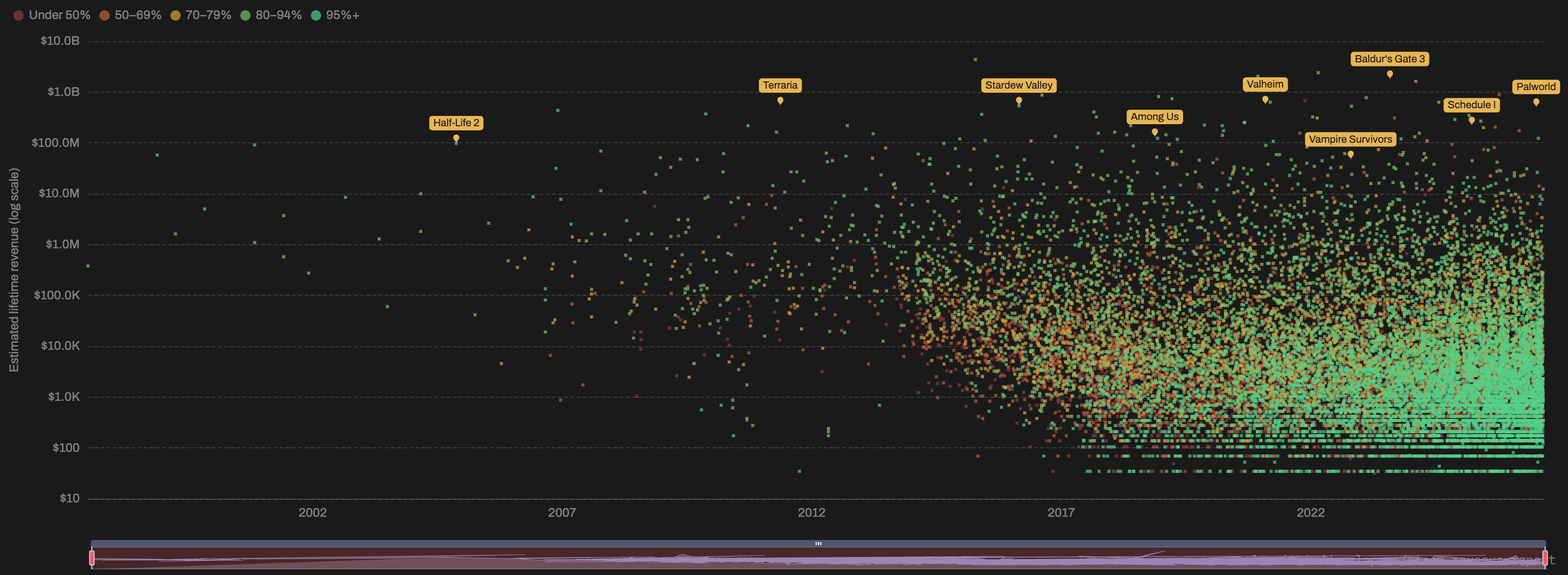
However, a groundbreaking new community-driven data project has finally pulled back the curtain on Steam’s opaque economy. Developed by industry analysts Ichiro Lambe, Matt Martindale, and Dr. Tim Ermilov, the newly launched analytics platform weloveit.io attempts to estimate the financial earnings of every single game on Steam featuring a price tag and at least one user review.
By leveraging time-tested econometric models, this comprehensive study maps out the financial success—or lack thereof—across more than 100,000 titles. The findings provide critical insights for game developers, investors, and industry watchers alike, answering the ultimate question: which game genres actually turn a profit, and which are financial death traps?
Detailed Chronology: How the Steam Revenue Report Came to Be
The genesis of the weloveit.io Steam revenue report began with a fundamental frustration shared by industry researchers: the absolute opacity of Valve’s internal financial architecture. Without direct access to Valve’s proprietary sales ledgers, external analysts have historically relied on indirect estimation methods to gauge market performance.
To overcome this information blackout, Lambe, Martindale, and Ermilov adopted the industry-standard Boxleiter method. Named after indie developer Simon Boxleiter, this predictive technique is rooted in a remarkably reliable statistical correlation: a game’s total user review count is roughly proportional to its overall unit sales. By applying a standardized multiplier—specifically, multiplying total user reviews by 35 to establish a baseline estimate—the trio successfully projected lifetime earnings for over 100,000 commercial Steam titles.

The resulting dataset paints a dramatic picture of economic disparity within the PC gaming ecosystem. At the pinnacle sits Larian Studios’ critically acclaimed Baldur’s Gate 3, which has generated an estimated $1,795,480,003 since its early access debut in late 2020. On the opposite end of the spectrum, niche experiments like Free Solo—a physics-based climbing game released earlier this year—limped away with a paltry estimated lifetime revenue of just $34.
Following the initial data aggregation, the research team implemented a granular "genre economics" breakdown, utilizing Steam user tags to evaluate how different categories perform commercially. Rather than relying on rigid, publisher-assigned classifications, the study defines a game’s genre membership dynamically: a title is categorized under a specific tag only when that tag ranks among its six most popular user-assigned markers. This stringent filter ensures a high degree of consensus within the Steam community before a game influences genre-wide performance metrics.
Supporting Context & Metrics: The Anatomy of a Steam Hit
To measure the commercial viability of different game types, the study introduces the concept of the "hit rate"—defined as the percentage of games within a specific tag that successfully cross the $100,000 revenue threshold.
The Top 10 Steam Genres by Hit Rate
| Rank | Genre / Tag | Hit Rate (Percentage Earning Over $100k) |
|---|---|---|
| 1 | Sandbox | 27.3% |
| 2 | FPS (First-Person Shooter) | 21.6% |
| 3 | RPG (Role-Playing Game) | 19.4% |
| 4 | Simulation | 16.9% |
| 5 | Visual Novel | 16.5% |
| 6 | Horror | 16.1% |
| 7 | Strategy | 16.1% |
| 8 | Racing | 15.8% |
| 9 | Roguelite | 15.3% |
| 10 | Sports | 14.8% |
Analyzing the Winners
At the top of the leaderboard sits the Sandbox genre, boasting an impressive 27.3% hit rate. While "sandbox" is notoriously broad—encompassing wildly disparate experiences ranging from Terraria and Project Zomboid to multi-million-dollar epics like Red Dead Redemption 2—the data clearly demonstrates that Steam users heavily favor agency and open-ended player freedom.
Close behind are First-Person Shooters (FPS) with a 21.6% hit rate, cementing the genre’s enduring market dominance. Notably, the FPS tag captures a wide variety of secondary experiences, including puzzle games like Portal 2 and tactical simulators, proving that gunplay and first-person perspectives remain exceptionally bankable.

Perhaps most surprising to casual observers is the strong performance of Visual Novels, which claim fifth place with a 16.5% hit rate. Despite being heavily saturated on the platform, visual novels have maintained remarkably steady consumer demand since 2014. Conversely, genres like Puzzle lag far behind with a meager 9.5% hit rate, while Hidden Object games (5.4%) and 2D platformers (5.5%) rank as some of the riskiest endeavors for modern developers.
Official Statements and Industry Analysis
While Valve Corporation maintains its characteristic silence regarding granular macroeconomic trends on its storefront, independent market analysts have embraced the weloveit.io study as a vital benchmarking tool.
In public breakdowns of the report, the research collective emphasized that low hit rates in specific genres—such as 2D platformers—do not necessarily mean players hate these games. Instead, experts point to a combination of oversaturation and low barriers to entry. Because 2D platformers and hidden object games are comparatively inexpensive to produce, thousands of them flood Steam annually. This hyper-saturation drastically dilutes discoverability, making it statistically difficult for individual titles to break through the noise and capture consumer attention.
Furthermore, recent weekly revenue charts underscore how quickly market dynamics can shift based on updates, price cuts, and viral hits. For instance, the physics-based fishing game How to Fish recently surged into the top revenue charts. Blending co-op mechanics with unexpected dark humor, the title proved that unique concepts can occasionally bypass traditional AAA monopolies to claim significant commercial space. Similarly, major content updates and steep discounts—such as the recent 2.0 overhaul for Stalker 2—demonstrate that post-launch lifecycle management can dramatically resurrect a game’s earnings profile.
Future Outlook: Navigating the Steam Marketplace
As the PC gaming landscape continues to expand at an unprecedented rate, the insights provided by weloveit.io offer a sobering roadmap for future game development. The era of building a game simply because an engine is accessible and hoping for organic discovery on Steam is rapidly drawing to a close.
For indie developers and mid-sized studios, the data highlights the absolute necessity of strategic genre positioning and deep market research. While sandbox and FPS titles offer statistically higher safety nets, they also demand higher production values and fiercer competition. Meanwhile, lower-tier genres require aggressive marketing, unique hooks, or micro-niche targeting to overcome the brutal reality of a 5% hit rate.
Moving forward, data platforms like weloveit.io will undoubtedly become indispensable assets for the gaming industry. By replacing guesswork with concrete statistical modeling, creators can better navigate the treacherous waters of digital distribution, ensuring that future creative visions don’t end up on the wrong side of the revenue divide.









Belum ada komentar. Jadilah yang pertama berkomentar!