

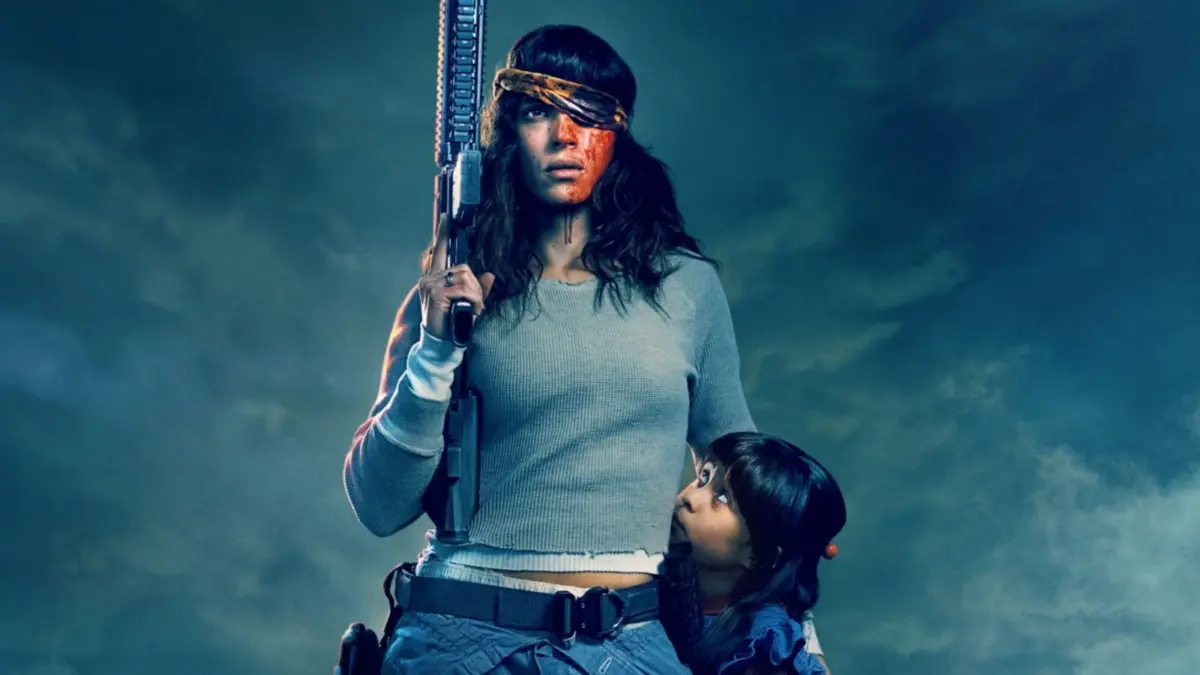
In the ever-evolving landscape of modern genre filmmaking, the intersection of gritty action and visceral horror often proves to be a delicate tightrope walk. With his 2026 feature Onslaught, director Adam Wingard returns to the thematic and stylistic sandbox he famously explored in his 2014 cult classic The Guest. Teaming up once again with co-writer Simon Barrett, Wingard delivers a gritty, grindhouse-inflected thriller that trades sweeping world-building for localized, pulse-pounding survival mechanics. Released via A24, Onslaught leans heavily into retro-styled action tropes, synthesizer-driven soundscapes, and uncompromising practical gore, while attempting to graft contemporary anxieties regarding government overreach, military exploitation, and post-traumatic stress disorder onto a classic creature-feature framework.
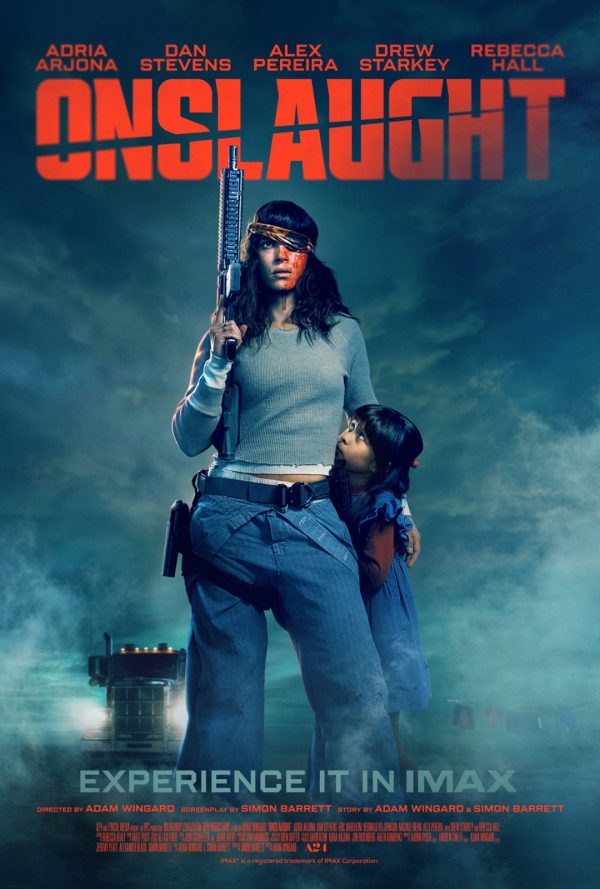
At its core, the film follows Celeste (Adria Arjona), a hardened former Army sniper living off-grid in a New Mexico trailer park. Her routine of morning marksmanship and quiet isolation is abruptly upended when a top-secret government experiment goes catastrophically wrong. A rogue squad of genetically engineered super soldiers—reanimated and mind-controlled test subjects engineered from fallen U.S. service members—breaks free from a nearby research facility. When these heavily armored, relentless juggernauts descend upon her community, Celeste must unlock a devastating level of maternal fury to protect her young daughter, Daisy (Blake Kennedy).
Despite a stellar ensemble cast featuring Dan Stevens, Rebecca Hall, Eric Wareheim, Reginald VelJohnson, Michael Biehn, and UFC star Alex Pereira, Onslaught ultimately struggles to reconcile its sprawling narrative ambitions with its lean, B-movie runtime. While Wingard demonstrates an expert command of cinematic tension, neon-soaked aesthetics, and shocking bursts of carnage, the film ultimately stumbles under the weight of an overcrowded sub-plot roster and half-baked socio-political commentary. Nevertheless, it stands as an unapologetic, adrenaline-fueled calling card for its star, Adria Arjona, establishing her as a formidable modern action protagonist.
Detailed Chronology: From Containment Breach to Trailer Park Carnage
To fully understand the narrative trajectory of Onslaught, one must examine how Adam Wingard and Oren Soffer construct the film’s geography and pacing. Operating under a chapter-like structure anchored by an ominous, unspecified ticking-clock mechanism, the narrative is deliberately bifurcated to build mounting dread before letting loose a torrent of industrial violence.

Phase One: The Setup and Institutional Hubris
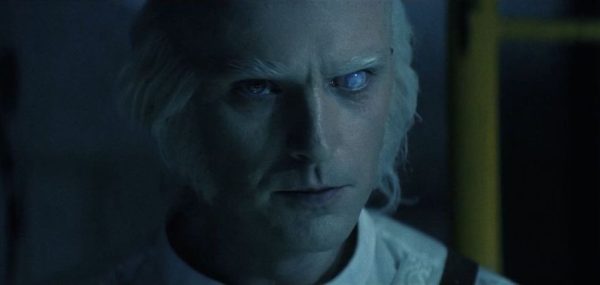
The opening act establishes the dual tracking of the film’s opposing forces. Within the subterranean confines of a secretive research installation, lead scientists Hans Kammler (Dan Stevens) and Dr. Evans (Rebecca Hall) oversee a clandestine military initiative. Their objective: harvesting the bodies of fallen U.S. soldiers and weaponizing them through cellular regeneration and neural-control implants. Stevens, leaning further into eccentric European villainy, exudes a mad-scientist fervor, desperate to witness his ghoulish creations reach operational maturity.
Simultaneously, the narrative grounds itself in the sun-baked, dusty isolation of a New Mexico trailer park. Here, we are introduced to Celeste, a battle-hardened ex-sniper who views the federal government with a deeply ingrained, fully justified paranoia. Her seclusion is complicated by domestic friction: her estranged ex-partner drops off their young daughter, Daisy, for an unexpected weekend stay due to a sudden work conflict. Unresponsive to frantic messages and unaware of impending custody battles that threaten to permanently relocate Daisy, Celeste is thrust into a state of emotional agitation that soon takes a backseat to far more immediate survival stakes.
Phase Two: The Outbreak and the Gas Station Massacre
As the clock runs down, the experiment’s flaws manifest violently. The super soldiers—designated by code-names reflecting their pre-mortem combat psychology—shatter their glass containment units and escape into the desert night. The trio is physically imposing, portrayed by Alex Pereira, Dave Campbell, and Tyler Hall. Wrapped in heavy tactical gear and operating largely in the dark, their movements are calculated, cold, and relentlessly efficient.
Before reaching the trailer park, the narrative establishes the unstoppable nature of these monsters through a harrowing set piece at an isolated desert gas station. Here, Wingard unleashes the film’s first major wave of bloodshed. The super soldiers slaughter civilians with chilling nonchalance, utilizing flashlights mounted to assault rifles and executing tactical sweeps that showcase their unfeeling, mechanical nature. It is a masterclass in slow-burn terror, reminiscent of John Carpenter’s minimalist suspense tactics.
Phase Three: The Siege of the Trailer Park
The narrative converges when the super soldiers track their targets to Celeste’s trailer park community. What follows is a frantic, blood-splattered siege that tests the limits of the community’s improvised defenses. Viewing the trailer park residents as entirely disposable collateral damage, the military attempts to manage the situation through handlers like Cyrus (Drew Starkey), an oddball government fixer who moonlights in underground dominatrix dens. Meanwhile, higher-ups like Baylor (Michael Biehn) demand immediate results, though the character’s 1980s action-hero pedigree ultimately feels underutilized, functioning more as a nostalgic cameo than a narrative engine.
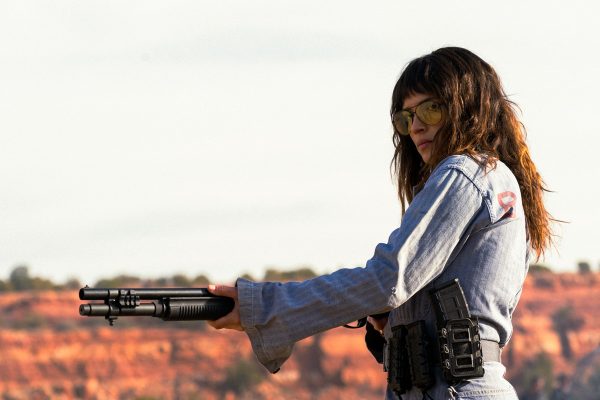
As darkness envelops the settlement, Celeste becomes a one-woman army. Utilizing her sniper training, household firearms, and eventually a grotesquely deployed chainsaw, she transforms her home turf into a lethal kill zone. The ensuing carnage is visually arresting, featuring wide-angle compositions that emphasize the stark contrast between the blinding muzzle flashes and the oppressive desert night. However, just as the kinetic energy reaches its zenith, the film accelerates toward an abrupt, anti-climactic resolution that leaves several character arcs dangling and thematic threads unresolved.
Supporting Context & Metrics: Production and Genre Placement
Box Office, Distribution, and Production Pedigree
- Release Year: 2026
- Studio: A24
- Director: Adam Wingard
- Writer: Simon Barrett (co-writer)
- Cinematographer: Oren Soffer
- Composer: Matthew Pusti (Synth/Electronic Score)
A24’s backing of Onslaught underscores the studio’s ongoing commitment to elevated genre fare, bridging the gap between independent art-house sensibilities and high-octane midnight movies. Made on a controlled budget typical of mid-tier action-horror productions, the film relies heavily on practical effects, atmospheric lighting, and strategic location shooting rather than bloated computer-generated spectacles. Matthew Pusti’s electronic, synthesizer-heavy score serves as the acoustic glue of the production, directly evoking the classic 1980s action and sci-fi soundtracks that heavily influenced Wingard’s creative vision.
Cast and Character Breakdown
- Adria Arjona as Celeste: An ex-Army sniper and protective mother whose grit anchors the film’s emotional core.
- Dan Stevens as Hans Kammler: A eccentric, morally bankrupt scientist spearheading the reanimation project.
- Rebecca Hall as Dr. Evans: A co-lead researcher caught in the ethical and practical fallout of the military experiment.
- Drew Starkey as Cyrus: A bizarre government fixer whose eccentric personal life contrasts with his cold operational duties.
- Michael Biehn as Baylor: A classic action-cinema icon whose presence serves as a nod to retro military thrillers.
- Alex Pereira, Dave Campbell, and Tyler Hall: The trio of genetically modified super soldiers whose silent, menacing presence drives the primary physical threat.
- Eric Wareheim, Reginald VelJohnson, and Jacob Scipio: Supporting figures rounding out the eclectic trailer park and institutional ecosystem.
Official Statements and Creative Vision
In promotional interviews surrounding the release of Onslaught, director Adam Wingard and co-writer Simon Barrett emphasized their desire to return to the lean, mean filmmaking style that initially defined their indie collaborations before jumping into blockbuster franchises like Godzilla vs. Kong.
Wingard noted that Onslaught was conceived as an exploration of "raw, unfiltered kinetic energy," designed to test how modern horror mechanics could be seamlessly grafted onto military-industrial paranoia. "We weren’t interested in making a grand, sprawling cinematic universe," Wingard explained during production discussions. "Instead, we wanted to look at a microscopic corner of a broken system and ask what happens when the chickens come home to roost—quite literally—at the doorstep of someone just trying to raise her kid."
Adria Arjona spoke extensively about the physical demands of embodying Celeste, a character who breaks away from traditional damsel-in-distress tropes without leaning into superhuman invulnerability. "Celeste isn’t a superhero; she’s a survivor who is deeply exhausted," Arjona stated. "Her superpower is simply her refusal to quit when faced with impossible odds. Training for the firearms handling and tactical movement in the New Mexico heat was grueling, but it gave the character an authentic, grounded weight that audiences can feel."
Simon Barrett addressed the film’s thematic undercurrents, noting that the choice to make reanimated war veterans the antagonists was an intentional critique of how society treats military personnel post-service. "We took the real-world tragedy of soldiers being discarded or suffering from untreated trauma and pushed it into grotesque sci-fi territory," Barrett remarked. "The monsters aren’t just terrifying because they’re physically unstoppable; they’re terrifying because they represent the ultimate institutional betrayal."
Future Outlook: Franchise Potential and Industry Impact
While Onslaught ultimately stumbles in its final act due to narrative overcrowding and unresolved subplots, its cultural footprint within the contemporary horror-action hybrid market remains significant. By proving that mid-budget genre films can secure theatrical distribution through prestige-leaning houses like A24, the film paves the way for more risk-taking, director-driven action cinema.
Critical Reception and Cultural Legacy
Critical consensus surrounding Onslaught has settled into a nuanced appreciation for its stylistic triumphs tempered by frustration with its narrative sprawl. Reviewers have widely praised Oren Soffer’s atmospheric cinematography and Adria Arjona’s breakout action performance, frequently citing the latter as a defining element that elevates the material above standard B-movie fare. However, the film’s rushed conclusion and the inclusion of superfluous characters—such as Michael Biehn’s Baylor—have led critics to argue that the project bit off more than it could chew conceptually.
Prospects for Future Entries in the Wingard-Barrett Universe
Given that Onslaught shares a thematic universe with 2014’s The Guest, industry analysts and fans have naturally speculated about whether Wingard and Barrett intend to expand this fictional sandbox into a broader anthology series. While Onslaught does not explicitly set up a direct sequel, its world-building hints at a vast, shadowy military-industrial complex operating just beneath the surface of contemporary American life.
Whether A24 and the creative team choose to revisit this grimy, synthesizer-scored universe will likely depend on home-video performance and streaming traction. Even if Onslaught remains a standalone experiment, it successfully re-establishes Adam Wingard’s credentials as a master of midnight-movie thrills while cementing Adria Arjona as one of the most exciting new faces in action cinema today.







Belum ada komentar. Jadilah yang pertama berkomentar!