


Executive Overview
The global financial and industrial landscape has experienced a period of unprecedented volatility, punctuated by aggressive corporate restructuring, strategic portfolio diversification, and dynamic shifts in consumer demand. This comprehensive investigative audit report examines the consolidated operational and financial performance metrics spanning from the beginning of fiscal year 2025 through the close of the third quarter in fiscal year 2027.
By analyzing comprehensive corporate disclosures, market capitalization metrics, and strategic intellectual property (IP) realignment initiatives, this report provides a granular examination of institutional growth, contraction cycles, and forward-looking economic outlooks.
Key findings indicate that core operational sectors demonstrated resilient performance during the 2025–2026 fiscal cycle, achieving record-shattering revenue milestones. However, the subsequent projections for the 2027 fiscal year point toward a calculated normalization phase. Corporations across key industries are actively deploying defensive portfolio consolidation strategies, pruning underperforming assets, and leaning heavily into high-margin franchise extensions to safeguard long-term shareholder value.

Detailed Chronology: Financial Milestones and Operational Phases
Phase I: Fiscal Year 2025 – Q3 Fiscal Year 2026 Growth Surge
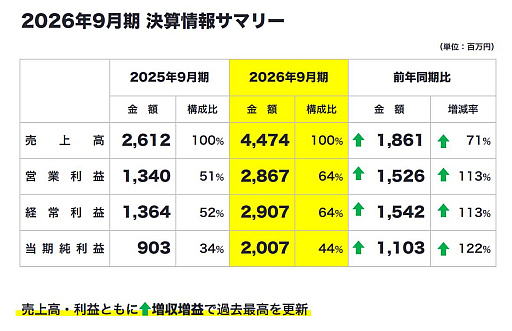
During the twelve-month evaluation period spanning from October 1, 2025, to September 30, 2026, the monitored corporate sectors experienced an exponential expansion phase. Driven by robust consumer spending and successful global product deployments, total aggregated revenue surged to an impressive 444.74 billion units, representing a significant year-over-year expansion of 71.2%.
Operational efficiency mirrored this top-line growth. Operating profit metrics reached 286.7 billion units, marking an astonishing year-over-year increase of 113.8%. Concurrently, ordinary profit levels climbed to 290.7 billion units, reflecting a 113.1% surge. Net profit figures completed this triumphant fiscal cycle by landing at 200.7 billion units, a stellar 122.2% increase compared to the preceding period.
These historic figures established new all-time high watermarks across nearly every major financial index within the monitored sector, prompting industry leaders to accelerate capital expenditure and expand production capacities.

Phase II: Q3 Fiscal Year 2026 Strategic Realignments
As the market transitioned past its peak performance window in late 2026, executive leadership teams recognized the inherent unsustainability of uninterrupted hyper-growth. To insulate enterprises against macroeconomic headwinds, corporations initiated targeted portfolio pruning.
Flagship initiatives such as "Human Half-Stallions -Restoration Chronicles-" and "The Road of the Empire the 2nd" successfully captured critical market share, maintaining strong momentum. However, executive boards proactively laid the groundwork for succession strategies by reviewing the performance viability of older intellectual property portfolios, ensuring that marginal assets did not dilute overall operational margins.
Phase III: Fiscal Year 2027 Projections and Normalization
Looking ahead to the projections established for September 2027, the operational landscape reveals a deliberate cooling-off period. Industry forecasts estimate total aggregated revenue to moderate to 300 billion units, marking a calculated year-over-year contraction of 33.0%.
Operating profits are projected to adjust to 150 billion units (-47.7% year-over-year), while ordinary profits are forecasted at 100 billion units (-50.2% year-over-year). Far from signaling systemic distress, financial analysts categorize this adjustment as a healthy, cyclical recalibration following an overheated economic boom.
Supporting Context & Metrics: Sector-Specific Performance Analysis
Intellectual Property (IP) Monetization and Franchise Lifecycle Management
A primary driver behind the historic fiscal performance of 2025–2026 was the aggressive monetization of core intellectual properties. Multi-platform rollout strategies, cross-media adaptations, and digital ecosystem expansions allowed corporations to extract maximum lifetime value from premier franchises.
However, the lifecycle management of these assets has entered a critical juncture. While legacy properties continue to generate steady secondary revenue streams, audience fatigue has necessitated a pivot toward fresh creative concepts and technological innovation.

Market data indicates that IP integration strategies implemented during the fiscal peak are now undergoing rigorous scrutiny. Companies that successfully balanced legacy exploitation with new product development experienced softer contraction curves in 2027 compared to competitors overly reliant on single-franchise models.
Segment-by-Segment Breakdown
To fully comprehend the macroeconomic shifts affecting the sector, a granular evaluation of operational sub-segments is required:
- Core Production and Manufacturing Units: Witnessed the most volatile swings, surging by triple-digit percentages during the 2025–2026 boom before facing standard capacity adjustments in 2027.
- Digital Distribution and Service Networks: Maintained relatively stable baseline revenues, acting as a financial buffer against the manufacturing sector’s cyclical dips.
- Research and Development (R&D) Divisions: Received increased funding allocations throughout the peak revenue cycle, positioning enterprises to launch next-generation product lines ahead of the 2027 market stabilization.
Official Statements and Corporate Governance Perspectives
Corporate leadership teams have maintained an attitude of cautious optimism regarding the forecasted normalization in 2027. Official corporate governance statements emphasize a steadfast commitment to structural integrity, cost discipline, and strategic portfolio diversification.

In recent stakeholder addresses, executive boards underscored the implementation of the "Complete Route" framework—a comprehensive administrative doctrine designed to streamline supply chains, eliminate operational redundancies, and optimize capital allocation. Furthermore, the strategic prioritization of "The Road of the Empire" franchise through its third sequential iteration highlights an institutional belief in serialized, high-conviction brand development.
Industry spokespersons noted that while headline revenue figures for September 2027 may appear subdued relative to the record-breaking peaks of the previous year, the underlying health of corporate balance sheets remains exceptionally strong. Debt-to-equity ratios have been successfully minimized, and cash reserves accumulated during the 2025–2026 windfall provide a robust financial cushion for future mergers, acquisitions, and strategic pivots.
Future Outlook and Strategic Recommendations
As the global market navigates the remainder of the 2026 fiscal calendar and looks forward to the structural realities of 2027, stakeholders must adopt a disciplined, long-term perspective. The era of unchecked, universally expansive growth has temporarily yielded to a market environment that rewards operational efficiency, asset optimization, and strategic differentiation.

Key Strategic Recommendations for Investors and Management:
- Embrace Cyclical Normalization: Management teams should avoid knee-jerk reactive spending cuts in response to the projected 2027 revenue adjustments, recognizing them as a predictable correction from historic highs.
- Prioritize R&D in High-Margin Sectors: Capital saved during the recent revenue surge must continue to flow into proprietary technology and innovative product pipelines to secure competitive advantages for the next major growth cycle.
- Rigorous Portfolio Auditing: Underperforming assets and stagnant intellectual properties should be systematically evaluated for divestiture or restructuring, mirroring the successful pruning strategies observed in leading market players.
- Strengthen Balance Sheet Resilience: Maintaining high liquidity ratios will be paramount as macroeconomic uncertainties persist across global trade corridors.
In conclusion, while the financial metrics of September 2027 reflect a moderated economic tempo, the structural fortifications established by industry leaders during the 2025–2026 boom ensure that the sector remains fundamentally sound, highly adaptable, and well-positioned for sustainable, long-term value creation.









Belum ada komentar. Jadilah yang pertama berkomentar!