

Executive Overview
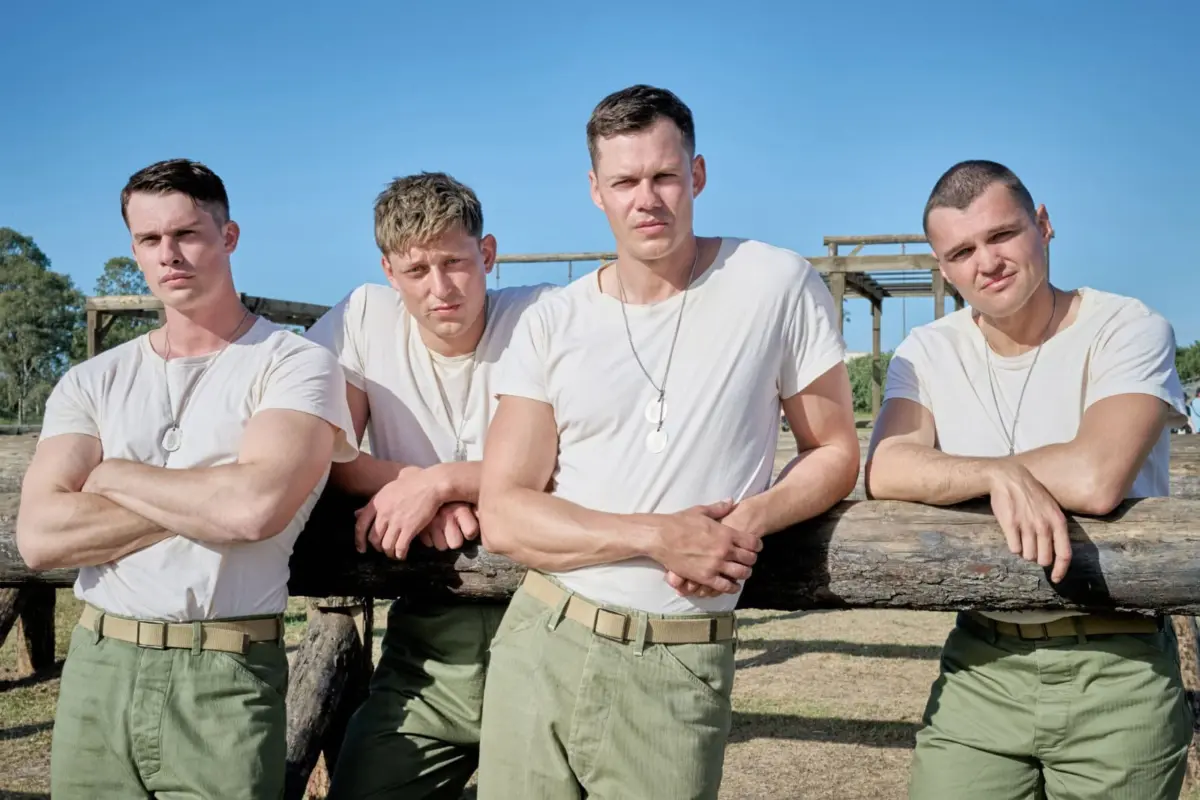
In the sprawling landscape of modern cinematic war dramas, few premises possess the unique, haunting juxtaposition of athletic prestige and brutal mortality quite like the true story of the "Mosquito Bowl." Based on the acclaimed non-fiction book by Buzz Bissinger and adapted for the screen by co-writer and director Peter Berg alongside Mark L. Smith, Netflix’s 2026 feature film The Mosquito Bowl attempts to capture this extraordinary historical anomaly. The film follows a group of elite college football players who, in the wake of the devastating attack on Pearl Harbor, cast aside their burgeoning sports careers to enlist in the United States Marine Corps. Before facing the horrific crucible of the Battle of Okinawa, these young men gathered on a makeshift beach gridiron to play one final, morale-boosting game—a match that would serve as a poignant, tragic farewell for many who took the field.
Yet, despite an ensemble cast featuring heavy hitters like Nicholas Galitzine, Bill Skarsgård, Ray Nicholson, and a surprise appearance by sports analyst Pat McAfee, The Mosquito Bowl ultimately fumbles its narrative potential. Directed with Peter Berg’s signature penchant for visceral, sensory-heavy action and explosive sound design, the film succeeds wildly as an immersive, gritty combat simulation while faltering deeply as a character-driven historical drama.
Critics and audiences alike are left grappling with a profound artistic paradox: a movie that expertly renders the bone-crunching physicality of both gridiron tackles and artillery blasts, yet utterly fails to differentiate its central figures or construct a cohesive emotional core. As The Mosquito Bowl streams to global audiences, it stands as a frustrating cinematic case study—a project boasting high-caliber talent, a fascinating historical hook, and top-tier technical craft, yet hindered by thin characterizations, tonal confusion, and a baffling underutilization of its titular centerpiece.
Detailed Chronology: From the Stadium Lights to the Pacific Theater
To understand the narrative ambitions and subsequent pitfalls of Peter Berg’s film, one must examine the timeline of events that inspired both Bissinger’s text and the cinematic adaptation.
The Prelude: College Glory and the Gathering Storm
Before December 7, 1941, the characters driving The Mosquito Bowl—such as the fleet-footed running back John McLaughry (played by Nicholas Galitzine) and the brash, arrogant rival played by chameleon actor Bill Skarsgård—lived in the insulated, celebrated world of American collegiate athletics. They were marquee names, household figures across campus networks, accustomed to the roaring crowds of packed stadiums. The film opens with quick, brisk establishing strokes, introducing these men on sunlit football fields and granting fleeting glances at the girlfriends they are forced to leave behind.

The Inflection Point: Pearl Harbor and Enlistment
The narrative pivot arrives with the Japanese attack on Pearl Harbor, a historic inflection point that abruptly alters the trajectory of an entire generation. Like thousands of able-bodied young Americans, the football stars of The Mosquito Bowl answered the call to duty, trading their pads and helmets for utility uniforms and combat boots. They joined the United States Marine Corps, transitioning overnight from pampered campus heroes to raw recruits thrust into the unforgiving machinery of military training.
The Training Camp and the McAfee Interlude
In the film’s midsection, viewers are introduced to the rigorous, often abrasive culture of military indoctrination. This phase of the movie features a memorable—if divisive—five-minute cameo by College GameDay analyst and former NFL punter Pat McAfee. Cast in the role of a hyper-intense drill instructor, McAfee brings his characteristic bluster to the screen. While his performance attempts to channel the manic energy of classic cinematic martinets, it frequently borders on stilted and overblown, drawing sharp critiques for its heavy-handed execution.
The Beach Game and the Okinawa Invasion
The narrative climax of the real-life historical event is the titular Mosquito Bowl—a rough-and-tumble football game played on a Pacific island beach shortly before the assault on Okinawa, organized by commanders eager to boost troop morale. In the film, however, this crucial event is given surprisingly short shrift. Rather than serving as the emotional anchor or a sprawling centerpiece of camaraderie, the game flashes by so quickly that an inattentive viewer might miss it entirely during a brief intermission.
Instead, the film rapidly pivots to the nightmare of the Okinawa campaign. Here, Galitzine, Skarsgård, Ray Nicholson (portraying "Touchdown Tony"), and their peers find themselves attempting to apply gridiron strategies—using football terminology and playbook formations to plot military flanks. The transition from the dusty athletic field to the bloody, smoke-choked terrain of the Pacific theater highlights the film’s central friction: the desperate attempt to find meaning in a senseless war through the lens of a game.
Supporting Context & Metrics: Behind the Scenes of a Cinematic War Epic
The Mosquito Bowl represents a massive undertaking for Netflix, utilizing cutting-edge production techniques and a sprawling ensemble cast designed to maximize cross-demographic appeal.

Cast and Crew Composition
The film’s roster is a fascinating hybrid of rising dramatic talent, recognizable character actors, and media personalities:
- Nicholas Galitzine as John McLaughry
- Bill Skarsgård as the narrative’s central arrogant rival
- Ray Nicholson as Touchdown Tony
- Tom Francis, Brent Comer, Claudia Ware, and Stacy Clausen in supporting roles
- Pat McAfee in a highly publicized cameo as a drill instructor
- Director/Co-Writer: Peter Berg, known for his kinetic, high-octane visual style (Lone Survivor, Friday Night Lights)
- Co-Writer: Mark L. Smith (The Revenant), adapting Buzz Bissinger’s best-selling non-fiction historical account.
Technical Metrics and Production Design
From a purely technical standpoint, The Mosquito Bowl showcases Peter Berg’s mastery of sensory immersion. The sound design is deliberately ear-ringing, capturing the distinct acoustic violence of artillery fire, whizzing shrapnel, and the visceral, bone-rattling thud of helmet-to-helmet collisions. The physical brutality of the football sequences is rendered with unflinching realism, emphasizing how dangerous and combative the sport was even before its modern safety evolutions.
However, this technical proficiency highlights a glaring narrative deficit. The film invests heavily in the sensory mechanics of violence while starving its audience of substantive character development. Supporting players, including the romantic interests introduced in the opening vignettes, are relegated to brief, perfunctory window dressing. They exist merely to establish stakes that the script never subsequently honors.
Critical Reception Matrix
Initial critical consensus—exemplified by reviews from outlets like Flickering Myth—has highlighted a stark dichotomy between the film’s technical execution and its storytelling mechanics:
- Action & Immersion: Rated highly for visceral battle scenes and sound engineering.
- Character Differentiation: Heavily criticized; soldiers frequently blur into generic archetypes despite recognizable lead actors.
- Titular Focus: Condemned for sidelining the actual Mosquito Bowl game.
- Tonal Consistency: Noted as deeply confused, wavering awkwardly between jingoistic wartime propaganda and a modern, somber tragedy.
Official Statements & Industry Perspectives
The release of The Mosquito Bowl has sparked significant industry conversation regarding how contemporary Hollywood chooses to portray World War II, especially when adapting historical non-fiction that highlights the intersection of sports and military service.

While Netflix executives and the film’s marketing teams have heavily promoted the project as a sweeping, emotionally resonant tribute to a forgotten generation of heroes, behind-the-scenes accounts and early critical analyses reveal a more complicated production reality. Peter Berg, speaking in promotional interviews about his attraction to the material, emphasized the sheer physical courage required of these young men, noting how the aggressive nature of 1940s football directly mirrored the reckless valor demanded by the Marine Corps amphibious assaults.
Yet, cultural critics have raised valid concerns regarding the film’s depiction of the Pacific War. Particular scrutiny has been directed at the script’s handling of opposing combatants. Dialogue echoing sentiments like "I’m going to turn them Christian, and the best way to do that is by killing them so they see God" underscores a troubling reliance on jingoistic tropes. By occasionally presenting Japanese soldiers through an animalistic, one-dimensional lens, The Mosquito Bowl struggles to reconcile a modern, nuanced anti-war perspective with the raw, propagandistic patriotism that fueled the era it seeks to depict.
Furthermore, the inclusion of media personality Pat McAfee generated considerable debate among sports and entertainment journalists. While some viewed his casting as a clever, meta-narrative nod to the modern intersection of football culture and broadcasting, others decried it as a distracting gimmick that pulled viewers out of the historical illusion, reinforcing the film’s occasional descent into tonal self-parody.
Future Outlook: The Legacy of The Mosquito Bowl in Modern Streaming
As The Mosquito Bowl establishes its footprint on Netflix’s global streaming charts, its long-term legacy within Peter Berg’s filmography and the broader genre of military drama remains complex.
The film proves that streaming platforms continue to have an insatiable appetite for high-budget, star-studded historical epics equipped with visceral action sequences designed to dominate home-theater audio systems. For viewers seeking pure sensory spectacle—ear-splitting explosions, mud-soaked skirmishes, and unrelenting kinetic energy—Berg delivers precisely what his fanbase has come to expect.

However, The Mosquito Bowl also serves as a cautionary tale for prestige adaptations. It demonstrates that marquee casting, recognizable source material, and explosive technical craft cannot compensate for a hollow narrative core, interchangeable characters, and a thematic identity crisis. When a film’s titular event can be entirely missed during a brief pause or a trip to the kitchen, it signals a fundamental structural miscalculation by its creators.
Looking forward, the reception of The Mosquito Bowl may prompt filmmakers to exercise greater narrative patience when adapting complex historical accounts. Buzz Bissinger’s book offered a profound, deeply human exploration of youth, duty, and sacrifice; the cinematic adaptation, by contrast, chose to prioritize explosive surface-level grit over genuine emotional resonance. Ultimately, The Mosquito Bowl will be remembered as a technically proficient cinematic battleground—a film that possessed all the right equipment for a championship run, yet ultimately fumbled on the one-yard line.




Belum ada komentar. Jadilah yang pertama berkomentar!