

Executive Overview
In the realm of advanced robotics and automated labor, the boundary between science fiction and industrial pragmatism continues to blur. For decades, popular culture has conditioned society to associate chainsaw-wielding automata with dystopian nightmares, apocalyptic runaways, and cinematic terror. However, the East Japan Railway Company (JR East) is flipping this trope on its head. By deploying heavy-duty, human-controlled humanoid robots equipped with industrial chainsaws to perform vital infrastructure maintenance, Japan is proving that these formidable machines are not harbingers of doom, but essential contributors to human mobility, safety, and operational efficiency.
Japan’s railway network is globally renowned for its exceptional safety records, precise scheduling, and unwavering reliability. Behind this world-class infrastructure lies a relentless, often invisible apparatus of preventive maintenance. Rail operators must constantly monitor thousands of kilometers of tracks, bridges, tunnels, and overhead catenary systems, identifying potential hazards long before they manifest into catastrophic failures. Traditionally, these labor-intensive tasks have fallen entirely on human maintenance crews, who brave harsh weather, hazardous heights, and grueling nocturnal schedules to keep the trains moving.
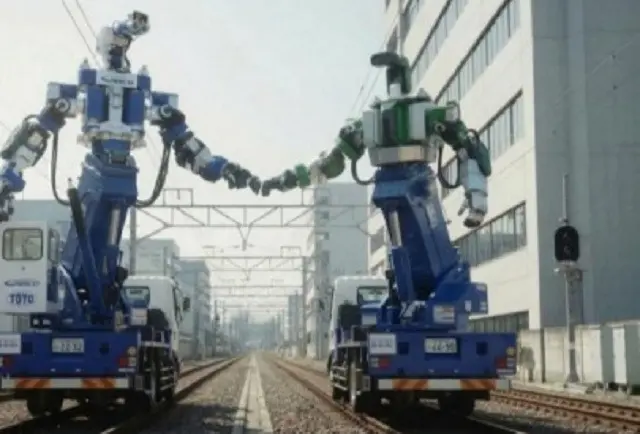
Enter JR East’s newest heavy machinery fleet: specialized dual-mode vehicles outfitted with articulated humanoid upper bodies. These mechanical workers feature asymmetric limbs—a multi-pronged gripping claw on the left and a fully operational, heavy-duty chainsaw on the right. Recently deployed near Nobeyama Station in Nagano Prefecture along the scenic Koumi Line, these robots have captured the public imagination while tackling mundane yet dangerous foliage-clearing operations.
This comprehensive report explores the technological architecture of JR East’s maintenance robots, the operational shifts driving their daytime deployment, public and pop-culture reactions, and the broader implications of integrating human-operated mecha into national infrastructure management.
Detailed Chronology: From Concept to Tracks
The evolution of Japan’s railway robotics did not happen overnight; it is the culmination of years of iterative engineering designed to address a looming demographic and labor crisis.
The Precursor Era: Addressing the Labor Shortage
Japan’s declining birth rate and aging population have severely impacted heavy industries, creating critical labor shortages across construction, manufacturing, and transportation sectors. Railway maintenance, traditionally reliant on large teams of young, physically robust workers, has felt this pinch acutely. To maintain rigorous safety standards without burning out human workforces, major rail operators began heavily investing in robotics and automation in the late 2010s.
The 2024 Milestone: JR West’s VR-Goggled Pioneers
The technological groundwork for JR East’s current fleet was laid in July 2024, when West Japan Railway (JR West) made headlines by introducing giant maintenance robots operated remotely via virtual reality (VR) goggles. These early units demonstrated that complex, high-reach overhead work—such as painting structures and trimming trees near live electrical wires—could be executed safely by an operator sitting comfortably in a mobile cockpit, translating their own movements to the machine via spatial computing and hydraulic actuators.
March 2025: JR East Expands the Fleet
Building upon the successes of its western counterpart, JR East integrated its own upgraded iterations of these multi-functional heavy railway machines into its maintenance division in March of this year. While initial rollouts were quiet and limited to closed testing environments, engineers fine-tuned the machinery’s responsiveness, grip strength, and cutting precision.
October 2026: The Nobeyama Station Deployment
The turning point for public visibility occurred in Nagano Prefecture. Maintenance crews identified an escalating hazard along the picturesque Koumi Line near Nobeyama Station: overgrown tree branches encroaching dangerously close to the rail corridor. Left unchecked, these branches posed severe collision risks to passing trains and could potentially damage overhead equipment or obstruct the engineer’s line of sight.
Rather than sending human workers up dangerous ladders or utilizing traditional, cumbersome cherry-picker trucks that might disrupt the delicate surrounding terrain, JR East dispatched its new multi-function heavy railway machine. The resulting operations were captured on camera, broadcasting the surreal sight of a robot wielding a chainsaw to a captivated global audience.
Supporting Context & Metrics: Engineering and Operations
To truly appreciate the significance of JR East’s robotic maintenance units, one must examine the hardware, the logistical frameworks of Japanese rail operations, and the socio-economic pressures forcing a shift in maintenance scheduling.
Anatomy of a Railway Robot
The machinery deployed by JR East is an engineering marvel designed for versatility. The apparatus consists of two primary components:
- The Dual-Mode Vehicle (DMV) Base: The robot is mounted onto a specialized heavy vehicle chassis capable of operating seamlessly in two distinct environments. It can drive on standard asphalt roads to reach remote or difficult-to-access railway crossings, and then lower specialized steel rail-wheels to travel directly on the train tracks.
- The Humanoid Upper Torso: Mounted on a hydraulic stabilization arm, the upper body mimics human proportions. The head houses high-definition cameras that feed real-time stereoscopic vision back to the human operator inside the vehicle’s cockpit or a remote control station.
The most striking feature of the robot is its asymmetrical arm configuration:
- The Left Arm: Equipped with a multi-pronged, highly articulate mechanical claw. This appendage is engineered with fine-motor feedback, allowing it to delicately grasp severed branches, clear away heavy debris, and stabilize foliage before the cutting phase begins.
- The Right Arm: Fitted with a robust, industrial-grade chainsaw. Controlled with millimeter precision by the human operator, this arm can angle, tilt, and slice through thick timber with an efficiency that rivals seasoned forestry workers, all while maintaining a safe distance from live infrastructure.
The Maintenance Window Dilemma
For decades, the golden rule of railway maintenance across Japan has been invisibility. To ensure absolute zero disruption to passenger services, operators like JR East have traditionally scheduled heavy maintenance projects exclusively during the dead of night. This "midnight window"—the brief span of time between the arrival of the last passenger train of the evening and the departure of the first commuter service at dawn—leaves very little margin for error.
Crews have had to race against the clock under artificial lighting, increasing the risk of fatigue-related accidents and placing immense psychological and physical strain on the workers. Furthermore, specialized tasks like precision tree-clearing are inherently difficult to execute safely in pitch-black conditions.
In response, an increasing number of maintenance workers and labor unions have petitioned JR East to transition more projects into daytime shifts. Accommodating these requests requires a fundamental rethinking of how railway lines are managed. Shifting work to daylight hours means that specific track segments must be temporarily closed or single-tracked during regular operating hours, forcing adjustments to train timetables.
By introducing visible, efficient robotics like the chainsaw-wielding humanoid, JR East hopes to buffer this operational transition. The novelty and undeniable utility of the machines serve as a public relations bridge, transforming what might otherwise be viewed as commuter inconvenience into an exciting opportunity to witness cutting-edge technological progress firsthand.
Official Statements and Public Reactions
The debut of the chainsaw-wielding maintenance robot has generated an unprecedented wave of media coverage and public discourse across Japan and international digital platforms.
Corporate Strategy and Public Engagement
JR East executives have emphasized that the integration of these robots is not merely about replacing human labor, but about augmenting human capabilities, eliminating high-risk tasks, and solving the systemic labor shortages plaguing the nation’s infrastructure sector.
In official statements regarding the shift toward daytime maintenance, company representatives noted:
"While shifting a greater number of maintenance projects to daylight hours will necessitate more frequent temporary closures of lines during regular operating hours, we are committed to transparent communication with our passengers. We hope for the public’s understanding, knowing that these measures are vital for long-term safety, and we believe our passengers will find excitement and reassurance in seeing our advanced robotic maintenance fleet actively protecting the network."
The Internet Reacts: Pop Culture Parallels
When footage of the robot in action near Nobeyama Station was broadcast via Teleasa News and shared across platforms like YouTube and Yahoo! Japan, online commentators flooded message boards with a mix of awe, humor, and deep nostalgia for classic science fiction tropes.
The reactions highlighted a collective fascination with seeing fictional mecha tropes manifest in real-world infrastructure:
- "All of a sudden, we’ve got the kind of awesome robots I’ve always dreamed about since childhood."
- "Yes! It’s so cool how the left and right arms are different—one to grab, one to chop. Peak industrial design."
- "Total R-O-B-O-T vibes. It honestly reminds me of the guardian robot from Studio Ghibli’s Laputa: Castle in the Sky."
- "Is this the prototype that the T-800 Terminator is going to get developed from? Better keep it on our good side!"
- "Should we officially start calling these ‘Labors,’ just like the mecha units in the classic anime Patlabor?"
- "Hey, didn’t I see that exact mechanical setup in the train stage of Contra: Hard Corps?"
- "It’s intimidating because it has a chainsaw, but the way it moves is also kind of surprisingly cute."
These varied reactions underscore a cultural predisposition in Japan toward viewing robotics not as cold, threatening interlopers, but as charismatic participants in daily life and technological evolution.
Future Outlook: The Next Generation of Rail Infrastructure
As JR East continues to analyze the performance metrics of its heavy-duty robotic fleet in Nagano and beyond, the trajectory for Japan’s railway maintenance is clear: automation and human-robot collaboration are no longer experimental concepts—they are operational necessities.
Scalability and Advanced AI Integration
While current models rely heavily on direct human teleoperation via VR and hydraulic feedback systems, research and development divisions are already looking toward the next phase of autonomy. Future iterations are expected to incorporate advanced artificial intelligence and computer vision algorithms capable of identifying diseased timber, calculating optimal cutting angles, and executing routine clearance tasks semi-autonomously. This will reduce the cognitive load on human operators, allowing a single supervisor to oversee a fleet of multiple robotic units simultaneously.
Expanding Beyond Foliage Clearance
The success of the chainsaw-wielding humanoid has opened the floodgates for brainstorming additional industrial applications. Engineers are currently exploring how similar robotic platforms can be adapted for:
- Tunnel Structural Integrity Checks: Utilizing ultrasonic sensors and percussion hammers mounted on robotic arms to detect internal concrete cracking or water seepage.
- Snow and Ice Removal: Equipping units with thermal lances or specialized clearing blades to keep switches and tracks operational during severe winter storms in northern Japan.
- Catenary Wire Maintenance: Deploying insulated robotic appendages to perform delicate repairs on high-voltage overhead lines without requiring complete grid shutdowns.
A Global Blueprint for Railway Maintenance
As nations around the world grapple with aging post-industrial infrastructure, shrinking labor pools, and rising maintenance costs, the Japanese model offers a compelling blueprint. By combining traditional engineering excellence with fearless innovation in robotics, JR East is demonstrating how legacy systems can adapt to the demands of the 21st century.
Ultimately, the chainsaw-wielding robots of the Koumi Line represent more than just a viral internet sensation or a clever solution to overgrown branches. They stand as a testament to a future where technology works in harmony with human expertise, ensuring that the trains continue to run safely, precisely, and brilliantly on time.




Belum ada komentar. Jadilah yang pertama berkomentar!