

Executive Overview
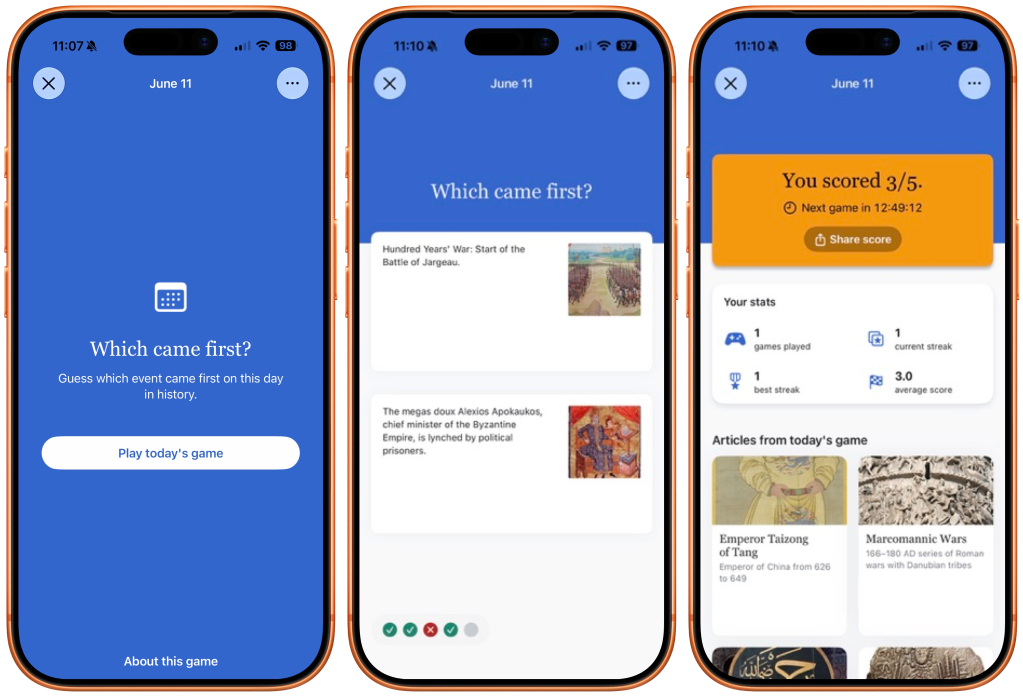
The Wikimedia Foundation has officially expanded its interactive engagement footprint on Apple devices with the rollout of its popular daily historical trivia game, "Which Came First?", to the official Wikipedia iOS application. Following its successful deployment on Android platforms, the feature brings a fresh, gamified approach to world history, inviting iPhone and iPad users to test their chronological reasoning through daily bite-sized challenges.
Integrated directly into the latest version of the Wikipedia app, the game presents users with five curated historical questions each day. True to Wikipedia’s educational mission, the puzzles are anchored in real-world history, specifically drawing from events that occurred on the exact calendar day in years past. By combining the addictive mechanics of modern word and trivia games with the vast archival depth of the world’s largest crowdsourced encyclopedia, the feature aims to turn passive reading into active, daily discovery.
Beyond simply guessing answers, the feature includes robust stat-tracking metrics—such as gameplay streaks and average scores—alongside a comprehensive archive that allows history enthusiasts to revisit past rounds. For mobile users looking to sharpen their historical acumen while picking up obscure trivia along the way, "Which Came First?" transforms the standard encyclopedia app into an interactive daily destination.
Detailed Chronology: From Concept to iOS Debut
The journey of "Which Came First?" from a conceptual expansion of Wikipedia’s mobile features to a cross-platform daily staple highlights the organization’s ongoing evolution in mobile user engagement.
The Android Blueprint and Early Prototyping
Long before touching Apple’s ecosystem, the engineering and product teams behind the Wikipedia Android app recognized a growing demand for interactive, low-friction content. While long-form reading remains the core utility of Wikipedia, mobile users increasingly favor micro-interactions—such as daily puzzles, streak counters, and quick-fire trivia—popularized by media mainstays like The New York Times games division.
To bridge the gap between heavy academic research and casual mobile gaming, developers devised "Which Came First?". The core premise was deceptively simple: take pivotal historical occurrences, pair them against one another, and challenge the user to determine which event preceded the other. By tying the daily questions to "On This Day" milestones, the developers ensured that the content would dynamically refresh every 24 hours, offering infinite replay value grounded in actual history.
The iOS Rollout
Following a stable and well-received run on Android, the Wikimedia Foundation turned its attention to iOS. Bringing the feature to Apple devices required seamless integration with the app’s native user interface, particularly the Explore feed, which serves as the central hub for curated content, featured articles, and media of the day.
Starting today, users who update their Wikipedia application to the latest version via the App Store will find the game embedded natively within this Explore feed. The transition preserves all core functionalities established in the Android release, including responsive touch targets, smooth animations during card transitions, and immediate feedback loops that reveal the historical context behind each correct or incorrect chronological deduction.
Supporting Context & Metrics: Gamifying the Encyclopedia
The introduction of "Which Came First?" arrives at a fascinating intersection of digital education, user retention strategy, and the psychology of mobile gaming. In an era dominated by algorithmic feeds and short-form video, static reference apps face an uphill battle to maintain daily active users (DAU). By introducing gamification elements, Wikipedia is tapping into proven retention mechanisms.
Mechanics of the Game
The gameplay loop of "Which Came First?" is designed for accessibility:
- The Daily Five: Players are given a sequence of five distinct rounds each day.
- Chronological Deduction: In each round, the user is presented with two or more historical events and must correctly identify which one happened first.
- Thematic Grounding: The events are not random; they are explicitly curated to match the current calendar date, drawing connections across centuries, continents, and disciplines (ranging from ancient political treaties to modern technological breakthroughs).
- Streak Tracking: To encourage habit formation, the app tracks consecutive days played, appealing to the psychological drive not to break a hard-earned streak.
- Performance Analytics: Users can view their lifetime average scores, allowing them to gauge their historical intuition over time.
- The Archive: For users who miss a day—or simply want more than five questions—a built-in archive grants access to previously published daily rounds, ensuring that content is never truly "lost" behind a time wall.
Engaging the "On This Day" Legacy
Wikipedia has long featured "On This Day" sections on its desktop homepage and mobile apps, but these sections have traditionally been read-only. "Which Came First?" actively revitalizes this archival data. Instead of passively scanning a list of births, deaths, and historical occurrences, the user becomes an active participant, mentally reconstructing timelines and testing their assumptions about how history unfolded.
This shift transforms the encyclopedia from a static repository of human knowledge into a dynamic, participatory platform. It lowers the barrier to entry for complex historical topics, making education feel less like studying and more like a game of wits.

Official Perspectives and Educational Impact
While Wikipedia has historically functioned as a neutral, non-profit reference utility, its product design teams have increasingly explored ways to make the platform more engaging for younger, mobile-first generations.
Bridging Education and Entertainment
Digital learning experts have frequently praised the integration of gamified mechanics into foundational knowledge platforms. By presenting history as a series of comparative puzzles, "Which Came First?" encourages cognitive flexibility. Players cannot rely solely on memorizing exact years; instead, they must synthesize context, understand civilizational trajectories, and deduce relationships between seemingly unrelated global events.
For instance, a player might be asked whether the invention of the printing press preceded a specific maritime exploration, or whether a particular artistic movement emerged before a political revolution. These comparisons foster a deeper, more interconnected understanding of world history rather than rote memorization of isolated dates.
Accessibility and Open Access
True to the Wikimedia Foundation’s foundational ethos, "Which Came First?" is entirely free to play, with no hidden microtransactions, paywalls, or disruptive advertisements. It requires only the free Wikipedia mobile application, reinforcing the organization’s mission to make educational content universally accessible to anyone with a smartphone.

Future Outlook: What’s Next for Wikipedia Mobile?
The successful cross-platform deployment of "Which Came First?" on both Android and iOS begs the question: what lies ahead for Wikipedia’s mobile ecosystem?
Potential Feature Expansions
As user feedback rolls in from the new iOS integration, product analysts anticipate several potential avenues for growth:
- Expanded Categories: While current questions heavily emphasize global historical events, future iterations could introduce themed daily challenges focusing on science, literature, pop culture, or geography.
- Social Sharing Integration: Many popular daily puzzle games thrive on social media sharing, where users post anonymized grid results or streak numbers. Integrating similar share sheets into the Wikipedia app could organically amplify awareness of the game across platforms like X (formerly Twitter), Mastodon, and Instagram.
- Multiplayer or Competitive Elements: Though Wikipedia remains primarily an individual reference tool, light social or cooperative features could further elevate user engagement, turning historical trivia into a shared community experience.
Cementing Mobile Relevance
As mobile devices continue to serve as the primary gateway for global internet access, apps that successfully blend utility with entertainment are best positioned to retain user loyalty. By respecting its core mission while adopting modern mobile design paradigms, Wikipedia has ensured that its iOS app remains not just a tool for looking up facts, but a daily habit for curious minds around the globe.
iPhone and iPad users eager to test their historical instincts can experience the feature immediately by downloading or updating the official Wikipedia app via the App Store and navigating to the Explore feed to start their first "Which Came First?" challenge.








Belum ada komentar. Jadilah yang pertama berkomentar!