

Executive Overview
In the rapidly evolving landscape of content creation, live streaming, and remote professional communication, the hardware barrier separating consumer-grade webcams from dedicated mirrorless or DSLR setups has steadily narrowed. For years, professional content creators, competitive gamers, and ambitious live streamers faced a binary choice: settle for the plug-and-play convenience of standard webcams—often compromised by subpar low-light performance and limited resolution—or invest heavily in complex, expensive mirrorless camera rigs complete with capture cards, dummy batteries, and convoluted lens configurations.
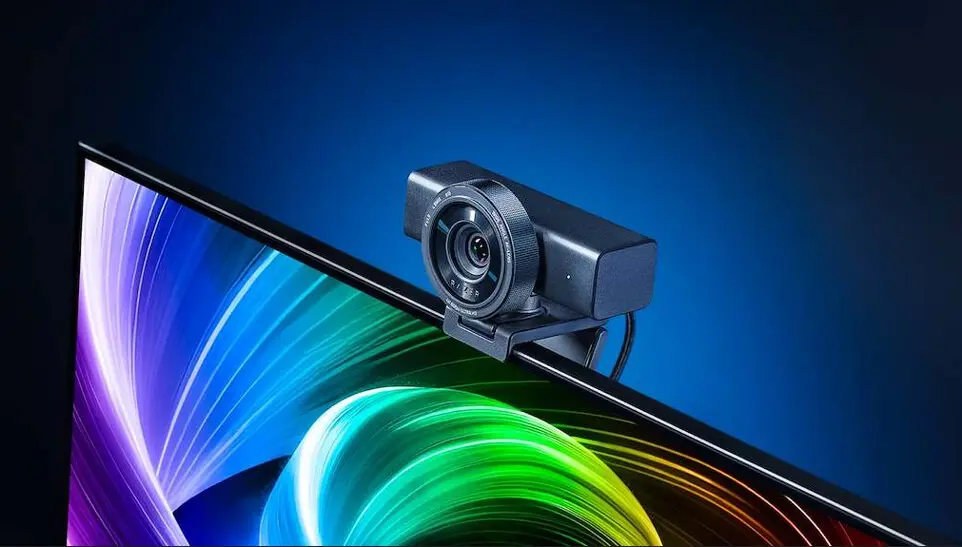
Razer, a dominant force in high-performance gaming peripherals and lifestyle hardware, has stepped forward to challenge this dichotomy with its latest flagship launch: the Razer Kiyo V2 Pro. Designed from the ground up to satisfy the uncompromising demands of modern digital creators, this professional-grade webcam introduces a suite of cutting-edge optical and computational technologies. At the heart of its spec sheet is ultra-crisp 4K video recording at a buttery-smooth 60 frames per second, underpinned by an advanced Sony STARVIS 2 sensor engineered to conquer challenging illumination environments.
Positioned as an all-in-one powerhouse, the Kiyo V2 Pro aims to eliminate the friction associated with high-end video production. By blending broadcast-quality resolution, intelligent software-driven auto-framing, dynamic High Dynamic Range (HDR), and versatile mounting hardware into a unified plug-and-play device, Razer is targeting a broad spectrum of digital professionals. This comprehensive report explores the architectural design, optical capabilities, software integrations, market positioning, and future implications of the Razer Kiyo V2 Pro, providing an exhaustive look at how this device intends to reshape the desktop video standard.
Detailed Chronology & Technological Breakdown
The Genesis of the Kiyo V2 Pro: Pushing Beyond Traditional Limits
The evolution of Razer’s Kiyo webcam lineage reflects the shifting demands of the streaming community. While the original Kiyo introduced integrated ring lighting to address the perennial issue of creator illumination, subsequent iterations sought to enhance resolution and sensor fidelity. The Kiyo V2 Pro represents a quantum leap forward, abandoning gimmicks in favor of heavy-duty imaging hardware and sophisticated computational photography.
The development of the Kiyo V2 Pro centered on resolving three primary pain points reported by creators:
- The Low-Light Dilemma: Traditional webcams utilize small sensors that struggle immensely in dimly lit gaming dens or home offices, resulting in heavy digital noise and washed-out color profiles.
- Motion Blur and Frame Rate Compromises: Many early 4K webcams forced users to choose between ultra-high resolution (capped at a choppy 30 frames per second) or fluid motion (relegated to 1080p).
- Complex Ergonomics and Privacy Concerns: Creators demanded greater flexibility in positioning and physical security assurances.
Razer’s engineering team tackled these hurdles systematically, leveraging industrial-grade imaging components traditionally reserved for security systems and high-end consumer video cameras.
Optical Architecture: The Sony STARVIS 2 Advantage
The undisputed crown jewel of the Kiyo V2 Pro’s hardware suite is the inclusion of a Sony STARVIS 2 sensor. Renowned in the security and low-light surveillance industries, the STARVIS 2 architecture features backside-illuminated (BSI) pixel technology that dramatically increases light-gathering efficiency per pixel.
When paired with the camera’s ability to record at 4K resolution at 60 frames per second, the sensor ensures that fast-moving action—whether it is intense hand movements during a competitive gaming clutch or animated reactions during a Just Chatting stream—is rendered with razor-sharp clarity and zero motion artifacting. At 4K/60fps, the data throughput is immense, ensuring that even when content is downscaled to 1080p for streaming platforms like Twitch or YouTube, the resulting image exhibits incredible oversampled sharpness, reduced noise, and superior color depth.
Complementing the sensor is a bespoke 86-degree wide-angle lens. Razer carefully calibrated this focal length to strike a delicate balance: it is wide enough to capture an expansive view of a creator’s custom streaming desk, acoustic panels, and ambient lighting rigs, yet narrow enough to prevent the unflattering "fisheye" edge distortion that plagues wider consumer lenses. Geometric distortion correction is baked directly into the optical and software pipeline, ensuring straight lines remain straight even at the far edges of the frame.
Computational Imaging & Intelligent Software Integration
Hardware is only half the battle in modern video capture; computational processing dictates how well a camera adapts to real-world chaos. The Kiyo V2 Pro integrates several automated and manual tuning layers designed to optimize footage instantaneously:
- One-Click Image Enhancement: Recognizing that many creators do not have the time or technical expertise to fiddle with ISO, shutter speed, and gamma curves, Razer implemented a smart auto-adjustment suite. This system dynamically evaluates ambient lighting, instantly tweaking exposure levels, white balance parameters, and noise reduction filters to maintain a balanced, natural skin tone.
- Ultra-High Dynamic Range (HDR): Backlit streaming setups—such as a creator sitting in front of a brightly lit RGB wall or a window—frequently cause subjects to be plunged into shadow while blowing out background highlights. The Kiyo V2 Pro’s HDR capabilities preserve extreme dynamic range, pulling detail out of deep shadows without overexposing bright elements.
- Granular Manual Controls: For professional environments and studio setups where color accuracy is paramount, Razer provides deep manual overrides. Users can fine-tune color saturation, sharpness, contrast, and manual focus parameters to match their specific aesthetic.
- Dynamic Auto-Framing: Utilizing an intelligent software crop and pan-tilt-zoom (PTZ) algorithm, the webcam can dynamically track the user within its 86-degree field of view. As the creator leans in, shifts, or stands up, the software smoothly pans and zooms to keep them perfectly centered in the frame, mimicking the behavior of a dedicated camera operator.
To bolster these features, Razer is bundling access to Camo Pro, a third-party software integration renowned for advanced webcam control, auto-framing precision, and virtual camera routing. While Razer’s announcement left the exact subscription duration of the Camo Pro bundle unspecified, its inclusion signals a commitment to software-driven versatility.
Ergonomics, Mounting Flexibility, and Physical Privacy
Beyond pixels and sensors, physical design dictates how easily a piece of hardware integrates into an existing workflow. The Kiyo V2 Pro features a heavy-duty, universal pivoting mount designed to clamp securely onto thin laptop bezels, thick desktop monitors, studio studio-grade mounting arms, and standard camera tripods via a threaded screw interface. This multi-axis pivot gives creators absolute freedom to position the camera at eye level, overhead, or from unconventional side angles.
Privacy and security have also become paramount concerns for digital creators and remote professionals. Rather than relying solely on software toggles that can be bypassed or fail due to driver crashes, Razer has integrated a twist-operated physical privacy shutter. A simple mechanical rotation slides a physical barrier across the lens elements, providing total visual isolation when the camera is not in active use.
Supporting Context & Metrics
To fully appreciate the market position of the Razer Kiyo V2 Pro, it is essential to examine the broader macroeconomic and technological trends driving the professional webcam market.
Market Dynamics: The Professional Creator Economy
The global live-streaming and content creation market has matured past its pandemic-era boom into a highly competitive, professionalized industry. According to recent digital media research, over 30 million active content creators broadcast regularly across platforms like Twitch, YouTube, Kick, and TikTok. Furthermore, the corporate shift toward hybrid work models has permanently elevated the demand for high-end video conferencing hardware.
Historically, creators seeking to upgrade their visual fidelity faced steep financial and logistical hurdles:
- DSLR/Mirrorless Setup Cost: A typical entry-to-mid-tier mirrorless camera costs between $600 and $1,200, before factoring in a clean HDMI capture card ($100–$200), a continuous power supply (dummy battery), and a high-grade prime lens ($300+). Total investment routinely exceeds $1,000.
- Setup Complexity: External cameras require specialized software drivers, external power cables, capture card routing, and frequent troubleshooting regarding audio-video sync drift.
By comparison, the Razer Kiyo V2 Pro enters the market at US$299.99 / €319.99, positioning itself as a high-end plug-and-play alternative that undercuts the total cost of a mirrorless rig by upwards of 70%, while eliminating hardware clutter.
Technical Performance Benchmark Comparison
| Feature / Specification | Standard Budget Webcams (1080p) | Mid-Tier Streaming Webcams (4K/30fps) | Razer Kiyo V2 Pro (4K/60fps) | Entry-Level Mirrorless Camera Setup |
|---|---|---|---|---|
| Max Resolution & Frame Rate | 1080p at 30fps | 4K at 30fps | 4K at 60fps | 4K at 60fps / 1080p at 120fps |
| Sensor Technology | Standard CMOS (Small) | Standard CMOS (Medium) | Sony STARVIS 2 (BSI) | Large APS-C / Full-Frame Sensor |
| Low-Light Performance | Poor (Heavy grain/noise) | Moderate | Exceptional (STARVIS 2) | Superior (Interchangeable lenses) |
| Field of View (FOV) | 65° – 78° | 75° – 82° | 86° Wide-Angle | Variable (Depends on lens) |
| Auto-Framing & PTZ | Rare / Basic Digital Crop | Software-Dependent | Advanced Dynamic PTZ | Requires external motorized head |
| Physical Privacy Shutter | Optional / Rare | Sometimes Included | Integrated Twist Shutter | Lens cap required |
| Estimated Total Cost | $40 – $70 | $150 – $200 | $299.99 / €319.99 | $800 – $1,500+ |
As demonstrated by the matrix above, the Kiyo V2 Pro occupies a distinct "sweet spot" in the market—delivering frame rates and sensor technologies that bridge the gap between traditional consumer webcams and professional cinema hardware.
Official Statements and Industry Reception
Razer’s official product launch communications emphasize the democratization of professional broadcasting tools. While specific executive commentary from Razer’s product development leads highlights the grueling testing phases required to stabilize 4K/60fps pipelines over standard USB protocols, the overarching corporate narrative centers on accessibility and uncompromising quality.
"Content creators should not have to be optical engineers or IT specialists to look professional on camera," noted a representative close to Razer’s peripheral division during the product roll-out. "With the Kiyo V2 Pro, we wanted to deliver cinematic fidelity—uncompromising 4K at 60 frames per second paired with Sony’s revolutionary STARVIS 2 sensor—in a package that anyone can unbox, mount, and run instantly via USB."
Early reactions from the tech and streaming communities have been largely positive, though industry analysts have noted a few caveats:
- USB Bandwidth Requirements: Pushing 4K video uncompressed at 60fps demands a robust USB 3.0 (or higher) port and a stable controller architecture. Creators on older motherboard configurations or using USB hubs may encounter bandwidth bottlenecks, requiring careful port management.
- Pricing Perception: At nearly $300, the Kiyo V2 Pro sits at the absolute premium tier of webcams. Reviewers emphasize that while it is significantly cheaper than a mirrorless setup, buyers must be serious about their video production needs to justify the investment over standard 1080p alternatives.
- Camo Pro Subscription Uncertainty: The lack of clarity regarding the duration of the bundled Camo Pro access has raised minor questions. Creators will want to know whether the advanced software features remain permanently unlocked or revert to a paid subscription model after an introductory trial period.
Future Outlook & Market Implications
The launch of the Razer Kiyo V2 Pro signals several critical trends for the future of desktop video hardware and the content creation ecosystem:
1. The Death of the 1080p Ceiling for Mainstream Webcams
For years, 1080p was considered the ceiling for standard webcams, with 4K models treated as niche luxury items restricted to 30 frames per second. By successfully packaging 4K/60fps capability with advanced low-light sensors into a streamlined peripheral, Razer has raised the baseline expectation for flagship webcams. Competitors in the streaming space—such as Logitech, Elgato, and Insta360—will inevitably be forced to respond with their own high-refresh-rate 4K sensor iterations.
2. Computational Photography Dominating Hardware Design
As physical lens sizes remain constrained by the ergonomics of sitting atop a computer monitor, the future of webcam innovation lies squarely in computational imaging. Technologies like Sony STARVIS 2, AI-driven auto-framing, neural noise reduction, and real-time HDR processing are replacing large glass optics. The Kiyo V2 Pro demonstrates that software and sensor synergy can replicate the cinematic depth and lighting adaptation once exclusive to physical studio cameras.
3. Regional Availability and Pricing Strategy
At the time of writing, the Razer Kiyo V2 Pro is officially priced at US$299.99 / €319.99, available immediately through Razer.com, RazerStores, and select global online retail partners. However, regional rollouts remain staggered; Razer has yet to announce official pricing or authorized local retail partners for key emerging markets, such as Malaysia and broader Southeast Asia. Localized pricing strategies, import duties, and regional warranty support will heavily dictate adoption rates among international creator communities.
Conclusion
The Razer Kiyo V2 Pro is more than just an incremental hardware update; it is a strategic statement on the convergence of gaming peripherals and professional broadcast equipment. By marrying the high-end light-gathering prowess of the Sony STARVIS 2 sensor with 4K/60fps fidelity, intelligent computational framing, and robust physical ergonomics, Razer has crafted a compelling proposition for modern creators.
For streamers, remote executives, and digital artists tired of choosing between grainy budget webcams and expensive, complex mirrorless camera rigs, the Kiyo V2 Pro offers a sophisticated middle ground—proving that professional-grade video production can indeed fit neatly on top of a monitor.







Belum ada komentar. Jadilah yang pertama berkomentar!