

Executive Overview
Half a century after its initial release in 1974, Roman Polanski’s Chinatown continues to occupy a towering, almost mythic position in the landscape of American cinema. While contemporary criticism upon its release frequently interpreted the film through the narrow lenses of post-Watergate cynicism or as a direct dramatization of the early-20th-century Owens Valley water scandals, such historical anchoring risks reducing a monumental work of art to a mere period piece. Great cinema transcends its moment of creation; much like Casablanca is not merely valued as a study of North Africa during World War II, Chinatown endures because its thematic architecture addresses the fundamental limits of human knowledge, the nature of systemic power, and the terrifying elasticity of institutional corruption.
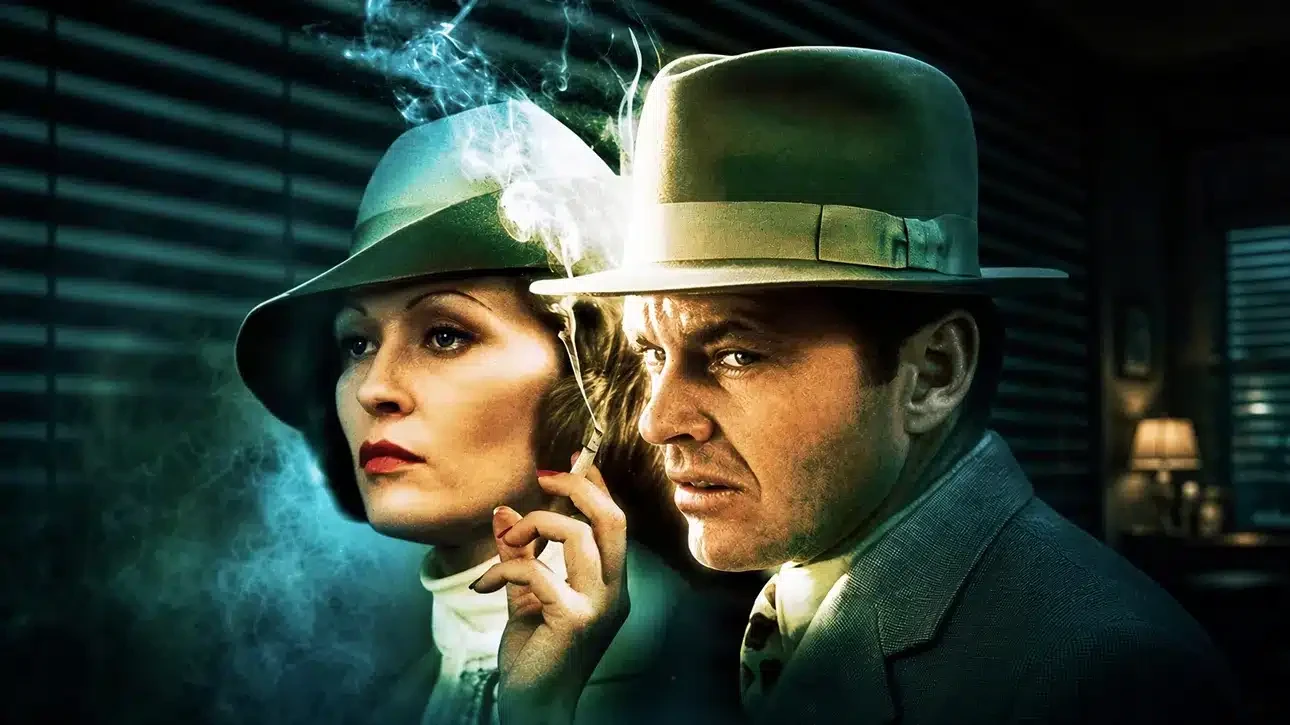
Written by Robert Towne, whose masterclass in screenwriting earned him an Academy Award, the narrative follows private investigator Jake Gittes (Jack Nicholson) as he descends from investigating a seemingly mundane case of marital infidelity into the murky, systemic underworld of Los Angeles real estate, water manipulation, and generational trauma. Alongside stellar performances from Faye Dunaway as Evelyn Mulwray and John Huston as the chillingly patriarchal Noah Cross, the film presents an unyielding meditation on futility.
This retrospective analysis explores Chinatown not just as a definitive neo-noir masterwork, but as a rare artistic achievement—a film that operates simultaneously on realistic, allusive, and archetypal levels. Through an examination of its narrative structure, thematic depth, and character archetypes, we evaluate why this bleak portrait of Los Angeles remains arguably the greatest Hollywood movie ever made.
Detailed Chronology: The Unraveling of Jake Gittes
To understand the genius of Chinatown, one must trace the meticulously engineered trap laid out by Robert Towne’s script. The chronology of the film mirrors the traditional noir trajectory of investigation and discovery, yet subverts it at every turn by proving that knowledge, in a world dominated by absolute power, is not an instrument of liberation, but a catalyst for tragedy.
Phase One: The Inciting Incident and the Imposter
The film opens with private eye Jake Gittes operating in his element—a sleek, sun-drenched Los Angeles office where he specializes in matrimonial surveillance. Hired by a woman claiming to be Evelyn Mulwray to expose her husband, Hollis Mulwray (chief engineer of the LA Department of Water and Power), Gittes successfully photographs the engineer meeting a young woman.
However, when the real Evelyn Mulwray appears at Gittes’s office threatening a lawsuit, the rug is pulled from beneath the protagonist. Gittes realizes he has been weaponized as a pawn in an elaborate scheme designed to discredit Hollis Mulwray. This initial deception establishes the film’s central motif: reality is constantly manipulated by unseen hands, and the detective is merely a tool operating within a constructed maze.
Phase Two: The Escalation and the Discovery of the Dead
As Gittes attempts to rectify his mistake, the mystery rapidly expands beyond a simple frame-up. Hollis Mulwray resists attempts to divert water to a newly proposed reservoir, championing public safety over corporate expansion. Shortly thereafter, Mulwray is found dead—drowned in a dry saltwater drainage basin.
Gittes’s subsequent sleuthing exposes a massive municipal conspiracy. The city is suffering through an artificial drought; land in the San Fernando Valley is being bought up on the cheap through dummy corporations by institutional elites; and the water supply is being systematically sabotaged. Gittes uncovers coroner reports, public land registry records, and police reports that confirm the conspiracy. Yet, every piece of information he unearths is already known to the architects of the plot. The illusion of discovery is maintained only because the powers that be allow it.
Phase Three: The Revelation of the Abyss
The emotional and narrative turning point occurs when Gittes uncovers the horrific personal dimensions of the conspiracy. Evelyn Mulwray is protecting a young woman named Katherine, who is simultaneously her sister and her daughter—the product of an incestuous assault by her own father, Noah Cross.
Cross, the titan who literally built Los Angeles and controls its lifeblood, represents a force of nature impervious to moral codes. When Gittes confronts Evelyn and attempts to secure her and Katherine’s escape to Mexico, the tragedy reaches its inevitable climax in the literal labyrinth of Chinatown.
Phase Four: The Climax in Chinatown
In the film’s devastating final moments, police lieutenant Lou Escobar and his forces converge on Chinatown. When Evelyn attempts to drive away with Katherine, a volley of police gunfire shatters the windshield, killing Evelyn instantly—a bullet piercing her eye, visually echoing the ocular motifs that saturate the film.
Gittes, restrained and utterly defeated, is left holding the broken pieces of a puzzle he solved too late. Cross calmly takes custody of Katherine, stepping over the corpse of his daughter/victim into the waiting car. The narrative loop closes with the iconic, chilling admonition delivered to a stunned Gittes: "Forget it, Jake. It’s Chinatown."
Supporting Context & Metrics: The Triple Structure of Art
What elevates Chinatown above the standard detective thriller is its rare "triple structure"—a rare formal achievement wherein nearly every element of the film is simultaneously realistic, allusive, and archetypal. This tripartite depth is a quality arguably matched in modern English-language narrative only by George Orwell’s Animal Farm.
| Narrative Element | Realistic Level | Allusive Level | Archetypal Level |
|---|---|---|---|
| The Plot / Mystery | Corrupt municipal land speculation and water diversion in 1930s LA. | The historical Owens Valley water wars orchestrated by William Mulholland. | Power’s eternal capacity to organize the material world for its own self-perpetuation. |
| Noah Cross | A wealthy, predatory Californian real estate oligarch and industrialist. | The ruthless robber barons of early 20th-century American capitalism. | The dark demiurge, the corrupt patriarch, and the Satanic tyrant who violates natural law. |
| Evelyn Mulwray | An abused, traumatized woman fighting to protect her child from a monster. | The classic cinematic femme fatale subverted by patriarchal oppression. | The tragic bearer of a terrible secret, caught in the gears of fate. |
| Chinatown | A historical multi-ethnic district of Los Angeles where Gittes once served. | The margins of society where institutional police authority faces its own ignorance. | The symbolic zone where reason fails, misdirection reigns, and chaos triumphs. |
The Mechanics of Misdirection
Towne’s script utilizes systematic misdirection to mirror Gittes’s cognitive limitations. Every character misinterprets the motives of others:
- Noah Cross believes Gittes is simply shaking down Evelyn.
- Lieutenant Escobar believes Gittes is an accessory to murder.
- The imposter Evelyn believes she is merely executing an acting job.
- Gittes believes Evelyn is a dangerous femme fatale rather than a terrified survivor of incest.
This cascading series of misapprehensions underscores the film’s central thesis: within a society built upon systemic corruption, human agency is an illusion. Gittes has professional skills, courage, and wit, but he is ultimately an agent-for-hire operating within a universe whose foundations were poured long before his arrival.
Official Statements & Critical Reception
Upon its October 1974 release by Paramount Pictures, Chinatown was met with widespread critical acclaim, though its dark, uncompromising vision baffled some mainstream audiences accustomed to Hollywood redemptions. Directed by Roman Polanski from a screenplay by Robert Towne, the film earned 11 Academy Award nominations, ultimately winning Best Original Screenplay.
Reflecting on the film’s enduring legacy, industry retrospectives frequently cite the turbulent creative partnership between Polanski and Towne. In archival interviews discussing the production, Towne noted the deliberate choice to remove Gittes’s original internal voiceover narration:
"We realized that the moment you let the audience experience the story exclusively through the over-the-shoulder medium shots alongside Gittes—learning only what he learns, when he learns it—the impact of the tragedy intensifies. You aren’t being told how to feel; you are experiencing the suffocation of the trap in real-time."
Paramount executives initially worried about the bleakness of the conclusion, famously clashing with Polanski over the tragic fate of Evelyn Mulwray. However, Polanski stood firm, recognizing that any Hollywood-mandated happy ending would strip the film of its philosophical weight. Decades later, film historians routinely rank Chinatown alongside Citizen Kane and The Godfather in pantheons of cinematic excellence. As critic Roger Ebert noted in his Great Movies essay, the film captures "the absolute bottom line of human corruption," refusing to offer comfort where none exists.
Future Outlook: The Enduring Relevance of Chinatown
As we look toward the future of narrative art and cultural criticism, Chinatown remains an essential diagnostic tool for understanding the interplay between power, truth, and institutional apathy. In an era dominated by corporate conglomerates, complex data manipulation, and environmental crises reminiscent of the Owens Valley water grab, the film’s central warning feels more urgent than ever.
The lessons of Chinatown for contemporary storytelling and investigative journalism are profound:
- The Limits of Exposure: The assumption that uncovering the truth automatically leads to justice is revealed as a naive liberal illusion. In complex bureaucratic and oligarchical structures, exposure often changes nothing if the ruling elite dictate the terms of reality.
- The Danger of Complicity: Gittes’s past failure in Chinatown—where his attempts to help resulted in tragedy—teaches that well-meaning intervention without systemic dismantling frequently exacerbates harm. Professionals operating within corrupt systems inevitably "swim in the same water."
- The Preservation of Artistic Rigor: The film serves as a benchmark for modern screenwriting, proving that high-concept allegories can be successfully fused with gritty, grounded realism without sacrificing narrative propulsion or emotional resonance.
Ultimately, Chinatown survives because it refuses to lie to the audience. It stares directly into the sun of human depravity, accepts the blinding agony of absolute corruption, and delivers the ultimate cinematic elegy for justice: "Forget it, Jake. It’s Chinatown."








Belum ada komentar. Jadilah yang pertama berkomentar!