

Executive Overview
The portable gaming landscape has experienced a profound shift over the past half-decade. While smartphones have historically dominated the mobile competitive gaming segment due to their ergonomic form factors, optimized operating systems, and developer preference, dedicated gaming tablets have often struggled to find their footing. Traditional slates typically rely on standard 16:10 aspect ratios. While functional for media consumption, office productivity, and web browsing, these conventional displays place mobile gamers at a distinct disadvantage.
Titles built for the modern smartphone ecosystem—particularly Multiplayer Online Battle Arena (MOBA) games such as League of Legends: Wild Rift and Honor of Kings—are engineered around wider fields of view. Tablet users running standard aspect ratios frequently find themselves suffering from restricted peripheral vision, handing opponents using smartphones an unfair tactical advantage.
Enter Lenovo and its aggressive expansion into the dedicated gaming ecosystem. Alongside the anticipated rollout of its cutting-edge Legion Y90 smartphone, Lenovo is officially preparing to introduce the Legion Y700, a specialized, compact gaming tablet designed from the ground up to challenge conventional mobile computing limitations.
Teased extensively by Lenovo executive Lin Lin via official channels on Weibo, the Legion Y700 aims to bridge the gap between pocket-sized smartphones and larger, cumbersome productivity tablets. Armed with Qualcomm’s reliable and performance-proven Snapdragon 870 System-on-Chip (SoC), a vivid 8.8-inch high-refresh-rate display, and a revolutionary proprietary feature that allows on-the-fly aspect ratio adjustments, the Legion Y700 is shaping up to be one of the most intriguing hardware releases in the mobile tech sphere.
This comprehensive analysis explores every facet of the upcoming Lenovo Legion Y700, dissecting its display technology, internal processing capabilities, software-driven aspect ratio innovations, and the broader implications this device holds for the future of portable competitive gaming.
Detailed Chronology: The Evolution of the Legion Y700 Leaks
Understanding how the Legion Y700 progressed from an internal concept to one of the most anticipated mobile gaming devices of the year requires examining the timeline of official teasers, executive leaks, and promotional disclosures.
Phase 1: The Initial Teasers and Display Specifications (Early January 2022)
The journey of the Legion Y700 began with Lenovo’s strategic decision to broaden its gaming sub-brand, Legion, beyond traditional high-performance laptops and specialized accessories. In early January 2022, promotional marketing materials surfaced on Chinese social media platforms, courtesy of Lenovo’s product management teams.
These early leaks established the device’s physical footprint. Eschewing the massive 11-inch to 13-inch display formats common to modern productivity tablets, Lenovo opted for a much more manageable 8.8-inch form factor. Technical data accompanying these initial marketing banners confirmed that the device would utilize an LCD panel boasting a crisp 2560 × 1600 resolution. Furthermore, the hardware specs promised a blistering 120Hz refresh rate, a 240Hz touch sampling rate for ultra-responsive inputs, and 100% coverage of the DCI-P3 color gamut, signaling that display fidelity would not be sacrificed for processing economies.
Phase 2: Lin Lin Reveals the Silicon and the Aspect Ratio Dilemma (Mid-January 2022)
As anticipation mounted within the tech community, Lenovo executive Lin Lin took to Weibo to provide deeper technical insights into the Legion Y700. Addressing a primary concern among mobile enthusiasts, Lin confirmed that the tablet would be powered by Qualcomm’s acclaimed Snapdragon 870 SoC. While not Qualcomm’s absolute newest flagship chipset at the time, the Snapdragon 870 had already earned a stellar reputation for delivering phenomenal thermal stability, sustained high-frame-rate performance, and exceptional energy efficiency—making it an ideal choice for a compact gaming slate.
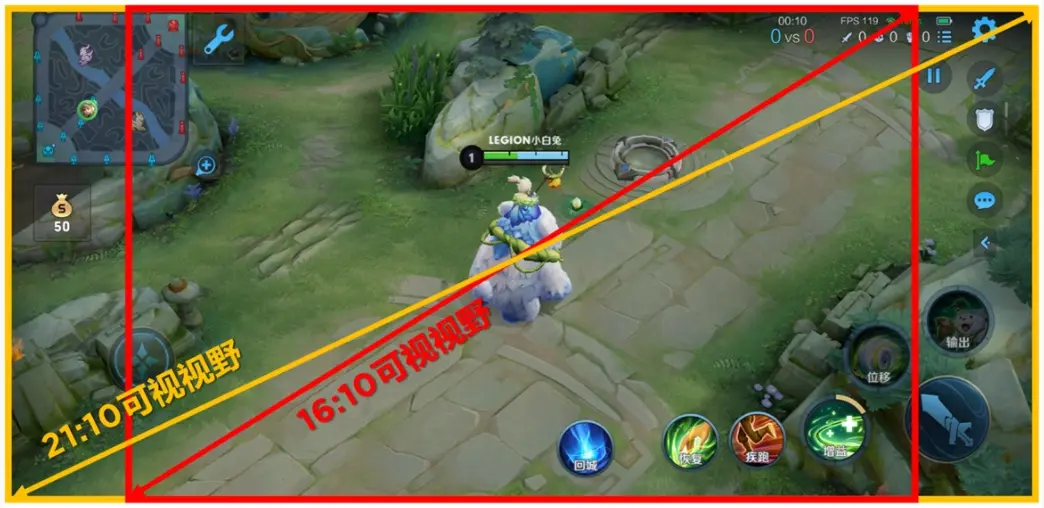
Crucially, Lin Lin’s disclosures did not stop at hardware. The executive openly acknowledged a critical flaw inherent to gaming on standard tablets: the 16:10 aspect ratio bottleneck. By sharing detailed software breakdown images, Lenovo showcased how traditional tablet layouts compromise competitive integrity in titles like Honor of Kings and League of Legends: Wild Rift.
Phase 3: The Introduction of Ultra-Wide Viewing Modes
Following the identification of the aspect ratio bottleneck, subsequent leaks from Lin Lin detailed Lenovo’s software engineering countermeasure: the Ultra-Wide Viewing Mode. Detailed instructional graphics published via Weibo demonstrated how users could dynamically override standard tablet display parameters, scaling games down to a wider 21:10 aspect ratio.
By offering customizable alignment tools—allowing players to pin game windows to the center or shift them toward the bottom of the screen for better thumb ergonomics—Lenovo demonstrated a deep understanding of mobile gaming ergonomics. As of writing, while a definitive, concrete commercial release date has yet to be officially announced, the steady cadence of executive disclosures indicates that the device is moving rapidly through its final validation phases.
Display Technology and Ergonomics: The 8.8-Inch Advantage
To truly appreciate what Lenovo is attempting to achieve with the Legion Y700, one must analyze the unique engineering challenges of designing a dedicated gaming tablet.
Striking the Golden Mean in Screen Size
For years, the tablet market has been polarized into two distinct camps: compact media consumption devices (typically ranging from 7 to 8 inches) and productivity-focused workhorses (10 inches and above). Traditional 7-inch tablets often feel redundant in an era where modern smartphones routinely feature 6.7-inch to 6.8-inch displays. Conversely, 11-inch and 12.9-inch tablets provide massive screen real estate, but their sheer physical size and weight make them unwieldy for extended gaming sessions that require rapid thumb movements and multi-finger gestures.
The Lenovo Legion Y700’s 8.8-inch display represents a masterclass in compromise. It provides significantly more surface area than any smartphone, allowing intricate game UIs, mini-maps, and skill-shot indicators to be rendered with absolute clarity. At the same time, it remains compact and lightweight enough to be comfortably gripped for hours without inducing hand fatigue or wrist strain.
High Refresh and Touch Sampling Rates
Competitive mobile gaming demands absolute precision. A microsecond of input lag or a dropped frame can mean the difference between victory and defeat in fast-paced titles like Call of Duty: Mobile, PUBG Mobile, or Wild Rift.
- 120Hz Refresh Rate: The Legion Y700’s display updates 120 times per second, ensuring buttery-smooth motion rendering. This high refresh rate drastically reduces motion blur, allowing players to track fast-moving targets across the screen with exceptional visual clarity.
- 240Hz Touch Sampling Rate: While the refresh rate dictates how fast the image changes, the touch sampling rate determines how frequently the digitizer checks for finger inputs. At 240Hz, the tablet registers touch commands every 4.16 milliseconds. This ensures that every swipe, tap, and multi-touch combo is translated instantly into on-screen actions.
- Color Accuracy and Visual Fidelity: Spanning 100% of the DCI-P3 color gamut, the Legion Y700’s LCD panel delivers vibrant, lifelike colors, deep contrasts, and exceptional HDR content consumption capabilities. Whether exploring richly textured open-world RPGs or participating in vibrant, particle-heavy team fights, visual presentation is consistently top-tier.
Software Innovation: Conquering the 16:10 Aspect Ratio Bottleneck
The most groundbreaking revelation concerning the Legion Y700 involves neither its processor nor its refresh rate, but rather its software-driven approach to screen geometry.
The Inherent Disadvantage of Standard Tablet Displays
Most modern tablets—including the Legion Y700 in its native configuration—feature a 16:10 aspect ratio. While this format is optimal for viewing cinematic media (minimizing black bars) and running split-screen productivity applications, it introduces a severe competitive handicap in modern multiplayer gaming.
Titles such as League of Legends: Wild Rift, Honor of Kings, and Arena of Valor are designed around the native aspect ratios of contemporary smartphones, which typically range from 20:9 to 21:9. Smartphone players benefit from an extended horizontal field of view. They can spot approaching ganks, target enemy champions from afar, and monitor map objectives much earlier than a tablet user.
On a standard 16:10 tablet, the game image is vertically stretched or horizontally cropped, meaning the tablet user effectively sees less of the battleground than their smartphone-wielding opponents. For a device marketed explicitly as a "gaming tablet," this represented an unacceptable design contradiction.
The Ultra-Wide Viewing Mode Solution
Lenovo’s engineering team tackled this dilemma not by redesigning the physical hardware, but through intelligent software engineering. The Legion Y700 introduces a proprietary feature known as Ultra-Wide Viewing Mode.
- Dynamic Ratio Conversion: This feature allows users to programmatically adjust the active display area of supported games, shifting the aspect ratio from the standard 16:10 up to an ultra-wide 21:10 ratio. By rendering the game within this wider window, the tablet matches—and in some cases surpasses—the horizontal field of view enjoyed by smartphone users.
- Customizable Screen Positioning: Recognizing that an ultra-wide letterboxed image on an 8.8-inch screen can leave empty black space, Lenovo built advanced positioning controls directly into the Legion UI. Users are not forced to keep the letterboxed game centered; instead, they can choose to align the gameplay window toward the center of the display or anchor it firmly toward the bottom edge.
- Ergonomic Integration: Shifting the game window toward the bottom of the tablet creates a more natural thumb-rest posture, mimicking the lower-third weighting common to larger smartphones. This thoughtful attention to detail ensures that competitive players do not have to stretch their fingers unnaturally across the entire vertical span of the screen during intense matches.
Hardware Performance: Why the Snapdragon 870 is the Ideal Choice
When executive Lin Lin confirmed that the Legion Y700 would be powered by Qualcomm’s Snapdragon 870 processor, some industry purists questioned why Lenovo did not select the ultra-flagship Snapdragon 8 Gen 1. However, a closer examination of thermals, power efficiency, and practical gaming benchmarks reveals that the Snapdragon 870 is arguably the most sensible and robust choice for a compact gaming tablet.
Thermal Dynamics and Sustained Performance
Ultra-high-end chipsets like the Snapdragon 8 Gen 1 and Snapdragon 8 Gen 2 offer staggering peak performance benchmarks, but they are notoriously difficult to cool in slim, passively cooled mobile chassis. When pushed to their limits in mobile gaming scenarios, these cutting-edge chips frequently trigger thermal throttling, causing frame rates to plummet mid-game as the device heats up.
The Snapdragon 870, built on a highly refined 7nm manufacturing process, strikes an enviable balance between raw computational power and thermal stability:
- Clock Speeds: Featuring an overclocked Prime Kryo 585 core running at up to 3.2 GHz, alongside three performance cores and four efficiency cores, the Snapdragon 870 easily chews through demanding 3D titles like Genshin Impact, Honkai: Star Rail, and Diablo Immortal.
- Sustained Output: Because the chipset generates significantly less waste heat than its 4nm successors, the Legion Y700 can maintain high frame rates over hours of continuous gameplay without requiring aggressive, noisy active cooling fans (though specialized vapor chamber cooling is still expected to be integrated into the chassis).
- Power Efficiency: Lower thermal output translates directly to superior battery endurance. Gamers can expect extended play sessions without needing to tether the tablet to a wall charger.
Official Statements and Industry Reception
The tech community’s reaction to Lenovo’s drip-fed marketing campaign for the Legion Y700 has been overwhelmingly positive. Industry analysts and mobile gaming enthusiasts alike have praised Lenovo for addressing long-standing pain points that competitors have historically ignored.
Insights from Lenovo Executive Lin Lin
Lin Lin’s strategic utilization of Weibo to engage directly with consumers has established a transparent dialogue rarely seen in the consumer electronics space. By openly discussing the 16:10 aspect ratio handicap and demonstrating the software tools designed to fix it, Lenovo positioned the Legion Y700 not merely as a generic tablet with a gaming sticker slapped on the back, but as a thoughtfully engineered tool crafted by gamers, for gamers.
In official statements translated from Chinese tech forums, Lenovo representatives emphasized that the Legion ecosystem is dedicated to eliminating compromise. Whether through the uncompromising performance of the Legion Y90 smartphone or the ergonomic and software innovations packed into the Legion Y700 tablet, the company aims to solidify its dominance across the entire mobile hardware spectrum.
Reviewer and Community Reactions
Early community responses across platforms like Reddit, Weibo, and major tech blogs highlighted several key takeaways:
- The Form Factor is a Winner: The consensus among mobile gamers is that an 8.8-inch tablet hits the "sweet spot" that bridges the gap between pocket portability and desktop-class immersion.
- Software Innovation is King: Many tech commentators noted that while other manufacturers focus purely on raw hardware specs, Lenovo’s willingness to tackle software-level display geometry (Ultra-Wide Viewing Mode) demonstrates true engineering leadership.
- Apprehension Regarding Global Availability: The primary concern raised by international tech journalists centers on regional distribution. Historically, many of Lenovo’s dedicated Legion mobile devices launch exclusively within the Chinese domestic market or experience significant delays before receiving global rollouts. Consumers outside of Asia remain vocal in their demand for a worldwide release.
Future Outlook: What the Legion Y700 Means for the Mobile Gaming Industry
As the boundaries between console gaming, PC gaming, and mobile entertainment continue to blur, specialized hardware like the Lenovo Legion Y700 points toward a fascinating future for the tech industry.
The Rise of Dedicated Portable Gaming Slates
For years, the tablet market was stagnant, dominated almost exclusively by Apple’s iPad lineup and a smattering of productivity-focused Android devices. Lenovo’s entry—alongside competing efforts from brands like ASUS and RedMagic—signals the birth of a brand-new product category: the dedicated gaming tablet.
As mobile games grow increasingly complex, featuring console-quality graphics, intricate control schemes, and massive multiplayer maps, the limitations of standard smartphone screens become increasingly apparent. Gamers want larger canvases, better thermal headroom for longer battery life, and superior audio-visual immersion without sacrificing the tactile responsiveness of mobile controls. The Legion Y700 proves that manufacturers are finally listening.
Setting a Precedent for Software Adaptability
Perhaps the most lasting legacy of the Legion Y700 will not be its processor or its refresh rate, but its pioneering approach to software adaptability. By proving that aspect ratios can be dynamically altered and customized on a system level to level the competitive playing field, Lenovo has set a new industry benchmark.
Moving forward, consumers and tech critics alike will likely demand similar aspect-ratio adjustment tools from every manufacturer entering the gaming tablet space. If competitors fail to offer comparable software solutions, they risk alienating the hardcore mobile gaming demographic that values competitive advantage above all else.
Conclusion
The Lenovo Legion Y700 stands as a testament to thoughtful, user-centric product engineering. By combining a highly optimized 8.8-inch 120Hz display, the thermally reliable Snapdragon 870 SoC, and the game-changing Ultra-Wide Viewing Mode, Lenovo has transformed what it means to game on a tablet.
While questions surrounding global pricing, official release dates, and international availability remain open, one thing is certain: the Legion Y700 has irrevocably raised the bar for mobile gaming hardware. As we await further announcements from Lenovo’s executive team, the tech world watches with bated breath, eager to see how this revolutionary device performs in the wild.









Belum ada komentar. Jadilah yang pertama berkomentar!