

Executive Overview
Navigating the historic, serpentine streets of Kyoto has always presented a unique logistical challenge for travelers. Unlike the labyrinthine, rail-heavy urban grids of Tokyo or Osaka, Kyoto features a comparatively sparse network of train and subway lines. Combined with buses that frequently reach capacity during peak tourist seasons, visitors often find that the most efficient—and historically rewarding—way to experience the city is on foot.
Now, traversing Japan’s ancient capital has transformed from a mere navigational task into a whimsical artistic journey. Released as a special companion piece to the blockbuster Zen and Ghibli art and cultural exhibition currently hosted at the Kyoto City Kyocera Museum of Art, the newly unveiled Kyoto Zen Guide Presented by Zen and Ghibli (affectionately dubbed the "Zen Map") offers a breathtaking bird’s-eye view of the city.
Crafted with the unmistakable aesthetic signature of Studio Ghibli, this illustrated guide blends practical wayfinding with high art. Featuring hand-drawn renderings of Kyoto’s most treasured sacred sites alongside iconic animated characters from The Boy and the Heron, the map functions simultaneously as an invaluable travel compass and a stunning mini-poster. Best of all, thanks to a nationwide distribution partnership with 7-Eleven Japan, anime enthusiasts and travelers across the country can acquire this rare piece of collectible art for a nominal fee of just 400 yen (approximately $2.50 USD).
Detailed Chronology
The Intersection of Zen Philosophy and Animation
The genesis of the Zen Map traces back to the curation of the Zen and Ghibli exhibition, a high-profile cultural event held at the Kyoto City Kyocera Museum of Art. The exhibition itself explores the profound philosophical underpinnings connecting traditional Japanese Zen Buddhism with the thematic motifs frequently explored in Studio Ghibli’s cinematic masterpieces—themes of nature, impermanence, introspection, and spiritual harmony.
As part of the promotional and experiential rollout for the exhibition, organizers sought a way to bridge the gap between indoor gallery appreciation and real-world exploration of Kyoto’s sacred geography. The result was a collaborative cartographic project that reimagines standard city navigation through the imaginative lens of Studio Ghibli’s artistry.
Unveiling the Cartographic Masterpiece
The physical roll-out of the Zen Map began in tandem with the exhibition’s peak season. Unlike standard tourist pamphlets printed on glossy, disposable paper, the Zen Map was designed to be preserved as a keepsake.
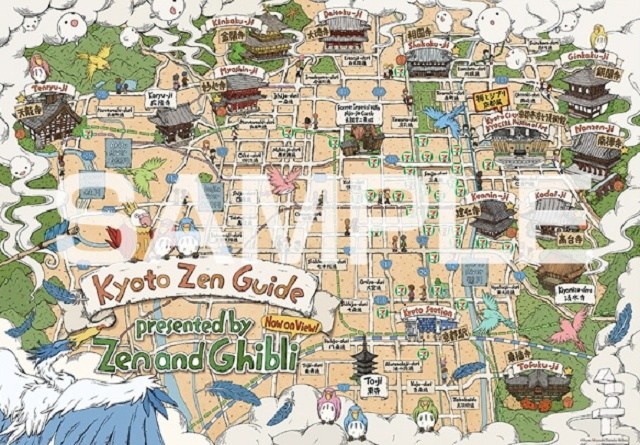
Upon unfolding the guide, users are immediately greeted by a sweeping, overhead perspective of Kyoto. Soaring across the stylized skyline are avian characters directly lifted from Hayao Miyazaki’s Academy Award-winning The Boy and the Heron, accompanied by clusters of endearing, fluffy warawara spirits. Rather than reducing the city to a sterile grid of digital coordinates, the map honors Kyoto’s architectural heritage by placing hand-drawn, highly detailed illustrations of legendary temples—such as Kiyomizudera, Kinkakuji (the Golden Pavilion), and Tenryuji in the western Arashiyama district—at the forefront.
Furthermore, the map acknowledges the unique layout of Kyoto. Unlike the vast majority of Japanese cities where streets remain unnamed and navigation relies strictly on blocks and landmarks, Kyoto retains a historic grid system complete with labeled street names. The Ghibli map meticulously integrates these street names, providing an authentic tool for travelers who prefer the joy of spontaneous wandering across Japan’s cultural heartland.
The 7-Eleven Distribution Innovation
To ensure broad accessibility for both on-the-ground tourists and passionate collectors nationwide, the project utilized Japan’s ubiquitous convenience store infrastructure. Rather than restricting availability to museum gift shops—which would lock out fans unable to visit Kyoto immediately—organizers partnered with 7-Eleven Japan.
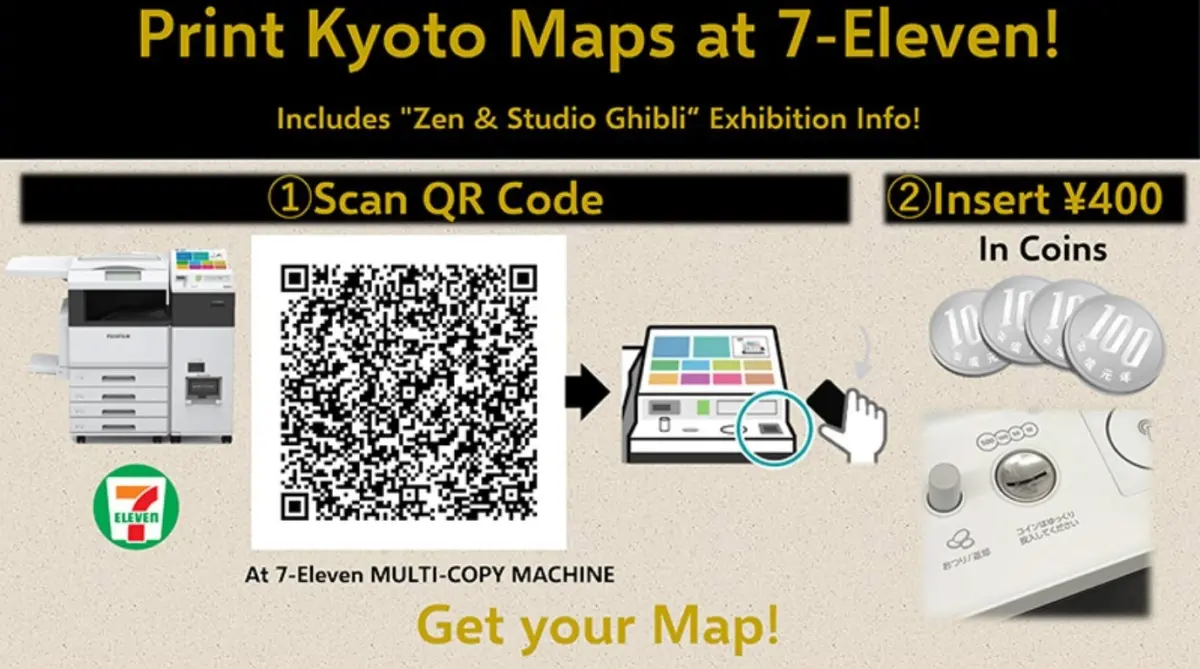
By leveraging the multi-copy machines found inside every 7-Eleven branch across the country, fans gained immediate, on-demand access to the map. By scanning a designated QR code originating from the official Zen and Ghibli web portal at any store kiosk, paying the 400-yen printing fee, and retrieving the fresh printout, supporters nationwide could secure a high-quality copy of the map instantly.
Supporting Context & Metrics
The Logistical Realities of Kyoto Tourism
To understand why a specialized walking map holds such immense value for visitors, one must examine Kyoto’s unique infrastructural landscape. Founded in 794 as Heian-kyo (the capital of peace and tranquility), the city was laid out in a symmetrical grid modeled after the Chinese capital of Chang’an. For over a millennium, it served as the imperial capital of Japan, accumulating an unparalleled density of UNESCO World Heritage sites, Shinto shrines, and Zen Buddhist temples.
However, modern infrastructure has struggled to accommodate the massive influx of 21st-century global tourism while preserving the city’s historic aesthetic.

- Rail Limitations: Unlike Tokyo, where underground subway lines form an impenetrable web, Kyoto’s underground network is limited to just two primary municipal lines (the Karasuma and Tozai lines).
- Surface Congestion: Surface buses, historically the backbone of public transit for tourists visiting sites like Kinkakuji or Gion, frequently suffer from severe overcrowding, leading local authorities to launch initiatives encouraging walking and alternative transit.
- The Walkability Factor: Many of Kyoto’s most historically significant zones—such as the eastern Higashiyama strip or the western Arashiyama bamboo groves—are best experienced on foot. Navigating these districts requires precise spatial awareness, turning a well-designed map from a luxury into an essential utility.
Studio Ghibli’s Cultural Footprint
Studio Ghibli’s integration into Japanese civic and cultural projects is a testament to its status as a national treasure. Under the direction of co-founders Hayao Miyazaki and Isao Takahata, the studio has consistently woven elements of Japanese folklore, Shinto animism, and Zen principles into its films.
- The Boy and the Heron (2023), which heavily inspires the motifs on the Zen Map, deals deeply with grief, acceptance, and spiritual transitions—themes that heavily parallel traditional Zen Buddhist philosophy taught in Kyoto’s historic monasteries.
- The inclusion of characters like the warawara bridges the gap between whimsical fantasy and the ethereal, unseen spirits that traditional Japanese folklore attributes to sacred natural spaces like forests and temple gardens.
Convenience Store Culture in Japan
The utilization of 7-Eleven’s multi-copy machines for art distribution highlights an innovative intersection of modern technology and convenience culture. Japan’s convenience stores (konbini) operate far beyond traditional retail spaces; they serve as community hubs equipped for utility bill payments, package delivery, event ticketing, and high-resolution document printing. By utilizing this infrastructure, the Zen and Ghibli exhibition organizers bypassed traditional supply-chain bottlenecks, ensuring that paper conservation and inventory management remained optimal while democratizing access to limited-edition artwork.
Official Statements & Cultural Impact
While formal corporate press releases from Studio Ghibli regarding minor merchandise tie-ins are traditionally sparse—staying true to the studio’s understated marketing philosophies—representatives from the Zen and Ghibli exhibition committee have emphasized the educational and philosophical goals of the crossover.
Exhibition organizers noted in promotional materials that the collaboration aims to "encourage a meditative, mindful approach to exploring Japan’s ancient capital." By pairing the rigorous, contemplative discipline of Zen Buddhism with the imaginative, life-affirming wonder of Studio Ghibli animation, the project seeks to transform routine sightseeing into an intentional, mindful pilgrimage.
Cultural analysts and tourism boards in Kyoto have praised initiatives that encourage visitors to disperse across the city on foot. Overtourism has been a persistent point of contention for local residents in recent years, particularly in congested historic quarters like Gion. By highlighting lesser-known pathways, named side streets, and outlying temple districts alongside major landmarks like Kiyomizudera and Nijo Castle, the Zen Map subtly encourages tourists to explore a wider geographical footprint, thereby alleviating localized congestion.
Future Outlook
As the Zen and Ghibli exhibition at the Kyoto City Kyocera Museum of Art barrels toward its scheduled conclusion on December 6, questions loom regarding the long-term availability of the Zen Map and potential future collaborations.

Availability and Collectibility
With the exhibition drawing to a close in early December, print operations via 7-Eleven’s multi-copy machines are widely expected to conclude simultaneously or shortly thereafter. This temporary availability window has instantly elevated the map from a simple travel accessory to a highly sought-after collector’s item. Animation memorabilia collectors, cartography enthusiasts, and Japan travel aficionados have taken to social media platforms to document their acquisition of the print, ensuring its status as a viral piece of memorabilia for late 2026.
The Future of Ghibli Cultural Crossovers
The success of the Zen Map and its companion items—such as specialized goshuin (shrine and temple stamp) papers decorated with Ghibli crossover artwork—demonstrates a lucrative and culturally resonant avenue for future partnerships. As Studio Ghibli continues to expand its physical installations (exemplified by the massive success of Ghibli Park in Aichi Prefecture), collaborations with traditional Japanese cultural institutions may become a recurring theme.
For travelers fortunate enough to be visiting Kyoto before the exhibition closes, or for those quick enough to utilize a 7-Eleven print kiosk before the deadline, the Zen Map offers an irreplaceable souvenir. It serves as both a practical compass through the ancient alleys of Japan’s cultural capital and a portal into the enchanting, meditative worlds imagined by Hayao Miyazaki and Studio Ghibli.









Belum ada komentar. Jadilah yang pertama berkomentar!