

Executive Overview
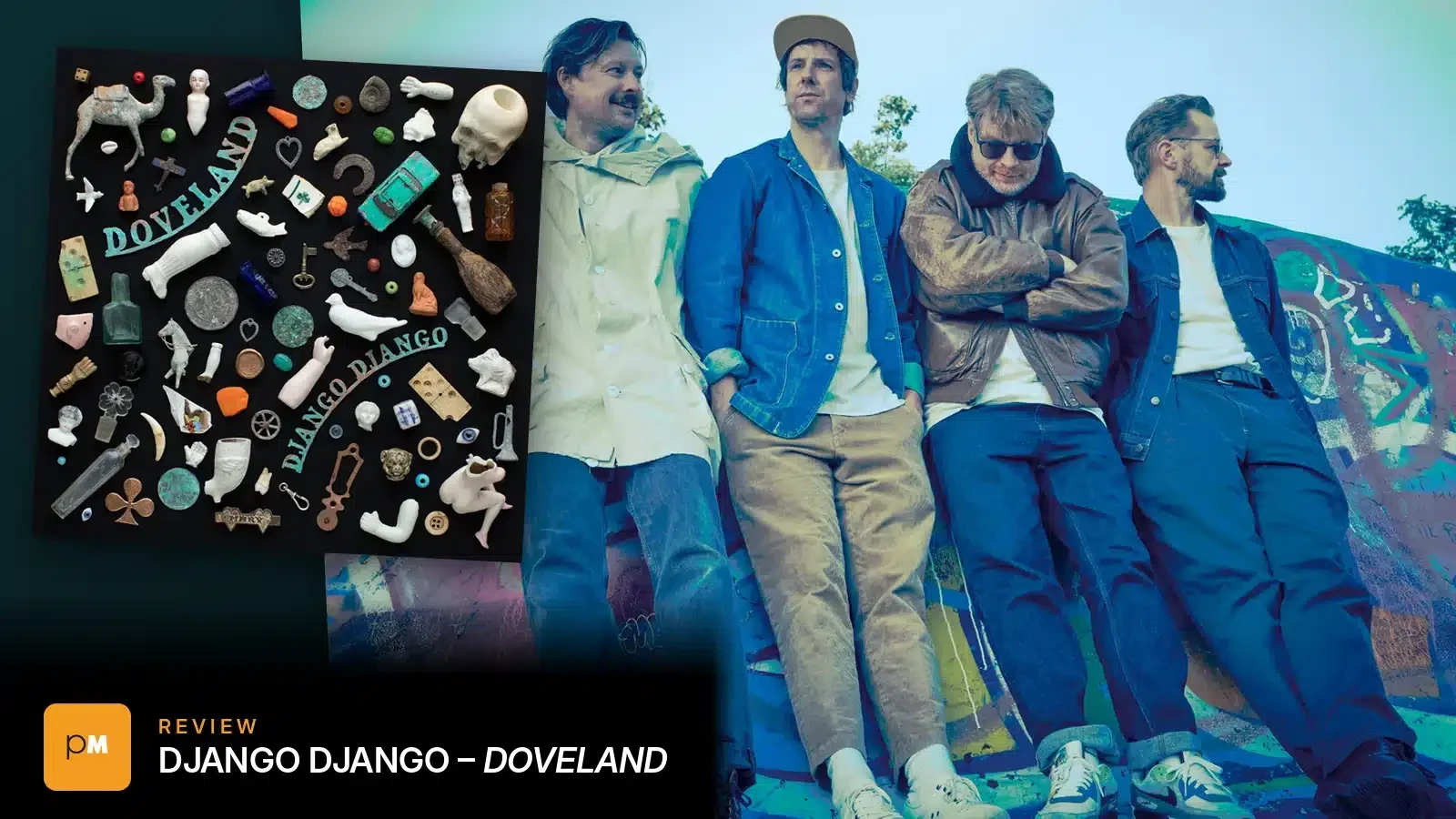
When art-rock innovators Django Django announced their sixth studio album, Doveland, the title alone conjured images of pastoral tranquility—a sun-drenched, lost corner of the American plains where traditional folk songs might drift lazily across an open landscape. Yet, true to the band’s unpredictable stylistic history, the record takes a profoundly circuitous route to get there.
At first glance, track titles such as "Meteorite," "Quicksand," and "So Heavy" point toward a darker, heavier, and more muscular sonic palette. Listeners bracing themselves for a heavy-rock record, however, will find themselves quickly disabused of that expectation. Just as the album seems poised to anchor itself in traditional rock arrangements, Django Django steers the vessel into stranger, more uncharted waters. "Meteorite" dissolves into an expansive wash of space rock; "Quicksand" is anchored by an unnerving, atonal piano motif; and "So Heavy" unexpectedly yields to a delicate, jazz-inflected flute. Beneath these textures, the percussion throughout the record owes far more to jazz syncopation than to conventional rock and roll four-on-the-floor rhythms.
Doveland is not a heavy-rock album in the traditional sense; rather, it is the product of seasoned musicians who treat genre not as a fixed destination, but as an expansive network of roads worth traveling. Paradoxically, this eclectic sprawl emerged from an explicit studio mandate to simplify. Moving away from their established modus operandi—where members historically worked in silos on electronic experiments and acoustic demos before producer David Maclean wrestled the disparate elements into a cohesive whole—the band set out to "go back to basics."
The resulting record manages to sound less like a contraction of Django Django’s musical vocabulary and more like a relaxed, effortless demonstration of just how vast that vocabulary truly is. Yet, despite its warmth, immediate catchiness, and rich sonic palette, Doveland leaves critics and listeners grappling with a central, lingering question: does immediate gratification equal long-term indispensability? This critical retrospective explores the anatomy of Doveland, tracing its conceptual roots, its structural execution, its stylistic lineages, and its ultimate place within the contemporary alternative landscape.
Detailed Chronology: From Concept to Execution
To understand the architecture of Doveland, one must first trace the evolutionary timeline of Django Django’s creative process. Since their self-titled 2012 breakout, the Anglo-Scottish art-rock outfit has carved out a distinct niche by marrying infectious dance grooves with left-field electronic experimentation. Their previous records were defined by a rigorous collage technique—individual members constructed tracks in isolation, leaving co-founder and producer David Maclean the formidable task of stitching disparate stylistic fragments into a unified, high-definition whole.
For album number six, however, the band experienced a collective fatigue with maximalism. The primary objective shifted from complex studio construction to a streamlined, back-to-basics approach. The goal was to capture a live, room-oriented energy that relied less on digital intervention and more on raw, foundational interplay.
The Conceptual Roadmap: The Fictional American Road Trip
Central to this new phase was a conceptual framework that guided the sessions: Doveland was envisioned as a fictional American town—the final destination of an imaginary road movie that exists purely within the minds of the band members.
While the lyrics do not spell out a literal narrative, this imaginary landscape provided a crucial tether for the album’s disparate stylistic experiments. It reframed their output as Americana viewed through a distinctly British lens. In this conceptual space, folk, blues, psychedelia, and electronic rock constantly bleed into one another without strict geographic or stylistic borders.
The Studio Sessions and Structural Shifts
As tracking commenced, the "back-to-basics" ethos immediately collided with the band’s irrepressible urge to tinker. While the initial tracking phases focused on simpler, stripped-down arrangements, the impulse to introduce complex textural layers quickly took over.
- The Heavy Opening Phase: The album’s early tracks—“Meteorite,” “Quicksand,” and “So Heavy”—were designed to establish a muscular, earthbound foundation.
- The Deconstruction: Rather than maintaining a straight rock trajectory, the band systematically subverted expectations. "Meteorite" builds toward a cosmic, soaring finale that evokes classic space rock; "Quicksand" leans heavily on an unsettling, dissonant piano motif that disrupts any traditional verse-chorus flow; and "So Heavy" dissolves into breezy, jazz-club flute arrangements.
- The Nostalgic Detours: As the tracklist progresses, the album stretches backward and forward through musical history. "Still Life" features a buoyant, cascading orchestral finale that summons the playful, surrealist psychedelia of the 1960s, while "Dirty Hotel Blues" drops into a greasy, swaggering blues-rock groove.
By the time the listener arrives at "Feel All Right"—a track defined by loose, joyful folk-rock energy—the initial promise of a simplified, stripped-back record has gracefully transformed into a kaleidoscopic tour through decades of alternative music history.
Supporting Context & Metrics
Evaluating Doveland requires looking at both the band’s historical output and the broader critical conversation surrounding modern retrospective pop.
Critical Reception and Streaming Metrics
Upon its release, Doveland met with warm critical reception, currently holding a strong aggregate score across major music review platforms. Industry metrics indicate healthy opening-week streaming numbers, particularly in the UK and Western Europe, where Django Django’s blend of danceable rhythms and art-rock sensibilities has historically resonated most deeply.
| Metric / Indicator | Context / Status |
|---|---|
| Album Number | 6th Studio Release |
| Primary Influences Cited | 1960s Psych-Rock, 1990s Dance-Rock, The Beatles (Sgt. Pepper’s) |
| Core Production Philosophy | "Back-to-basics" pivot toward simplified tracking |
| Primary Geographic Concept | Fictional American town ("Doveland") |
| Critical Consensus | Highly melodic, warm, and texturally rich, but debated for long-term memorability |
Stylistic Lineages: From 1960s Psych to 1990s Dance-Rock
Stylistically, Doveland occupies a fascinating temporal limbo. It would sit comfortably in a record collection alongside foundational 1960s psychedelic rock records or 1990s British dance-rock crossover albums.
Listen to the record, and echoes of cult British acts who updated classic 1960s adventurousness for the alternative era—such as Primal Scream during their Screamadelica or Vanishing Point eras—come immediately to the surface. Like those bands, Django Django demonstrates an acute fascination with how much atmosphere, color, and emotional resonance can be packed into a concise, hook-driven pop song. They are not merely imitating the past; they are mining a generational musical language for fresh structural possibilities.
Official Statements and Band Commentary
Speaking on the creative philosophy behind Doveland, co-founder and producer David Maclean has been open about the band’s ongoing dialogue with music history, explicitly citing The Beatles’ Sgt. Pepper’s Lonely Hearts Club Band as a formative touchstone.
"We’ve always chased that sense of structural perfection—how a record can take you through entirely different emotional and sonic landscapes while keeping the listener utterly gripped," Maclean noted in promotional interviews surrounding the album’s rollout.
Discussing the pivot away from their dense, multi-layered digital collage techniques toward a more direct approach, Maclean emphasized that the intention was never to strip the music of its personality, but to find a more honest center:
"We wanted to see what happened if we stripped away some of the safety nets. We thought we were making something straightforward and direct. But once you get four musicians in a room together with all these shared influences, the tangents are bound to take over. Doveland is where those tangents met in the middle."
Future Outlook
As Django Django looks toward the touring cycle supporting Doveland, the album presents both exciting live opportunities and lingering artistic questions.
On one hand, the record’s sonic diversity and warm, inviting production make it an ideal vehicle for dynamic live performances. Tracks like "Dirty Hotel Blues" and "Feel All Right" offer immediate, crowd-pleasing energy, while the space-rock crescendo of "Meteorite" and the orchestral flourishes of "Still Life" provide ample room for theatrical staging and extended instrumental jams.
On the other hand, the long-term legacy of Doveland within the band’s catalog remains an open question. As noted by listeners and critics alike, the album functions brilliantly as an immediate sensory experience—a succession of clever rhythmic turns, warm textures, and instrumental colors that keep the listener engaged from moment to moment. Yet, a day after listening, distinguishing which specific tracks demand an immediate return visit can prove surprisingly difficult.
Is Doveland ultimately a "very good snack"—tasty, varied, and satisfying in the immediate term, but leaving the listener craving a more substantial narrative core? Or does it represent a mature band gracefully settling into a comfortable mastery of their craft, where proving a point matters less than enjoying the journey itself?
For a band whose entire career has been built on defying easy categorization, the ambiguity may be the point. Django Django have successfully found the stylistic focus they sought when entering the studio. Whether this particular road trip ultimately stands as a definitive milestone in their discography, or merely a pleasant scenic detour through an imaginary American town, will be decided not by the creators, but by the longevity of the songs themselves as they echo out into the wider world.





Belum ada komentar. Jadilah yang pertama berkomentar!