

Executive Overview
Two decades after terraforming the contemporary punk landscape into sharp, chaotic, and fiercely intellectual new shapes, post-hardcore pioneers The Blood Brothers are experiencing a cultural resurgence that is as vindicating as it is bittersweet.
What began as an abrupt, last-minute 2024 festival appearance snowballed into a triumphant, multi-generational reunion tour that shattered attendance expectations. Yet, as the dust settled on packed venues filled with both original devotees and teenage fans accompanied by their parents, co-vocalist Johnny Whitney found himself confronting a familiar artistic crossroads. When plans for a permanent Blood Brothers revival faltered due to differing paths among members, Whitney did what he has always done: he channeled his boundless creative energy into a new vehicle.
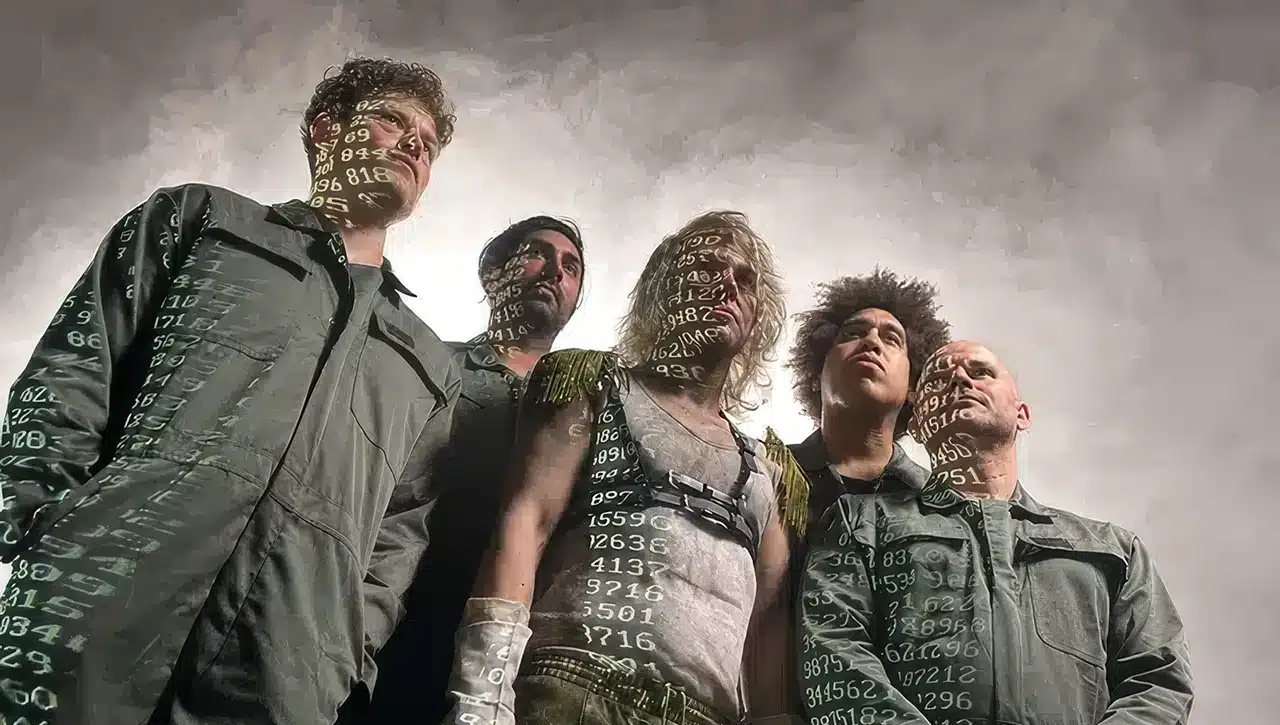
Enter Evil Island—an explosive new project uniting Whitney with Blood Brothers bandmates Cody Votolato and Mark Gajadhar, alongside post-hardcore royalty Autry Fulbright II (formerly of OFF! and …And You Will Know Us By The Trail of Dead) and Todd Weinstock (Glassjaw). Re-enlisting legendary producer Ross Robinson—the mastermind behind landmark records like Burn, Piano Island, Burn—Evil Island represents not merely a continuation of Whitney’s sonic legacy, but a radical evolution.
This piece explores the turbulent genesis of Evil Island, the complex economic and emotional realities of underground music legacies, Whitney’s evolving approach to lyricism and politics, and an exciting return to the studio that features legendary guest contributions from Fugazi’s Guy Picciotto.
Detailed Chronology: From Accidental Reunion to Evil Island
The resurrection of Johnny Whitney’s musical footprint began not with meticulous planning, but with a frantic, high-stakes phone call.
In late 2024, The Blood Brothers were tentatively discussing the possibility of regional reunion shows when the Best Friends Forever Festival came calling. Indie-rock heavyweights Bright Eyes had been forced to drop out of their headlining slot on the festival’s final day, leaving a gaping hole at the top of the bill. The Blood Brothers were thrown a lifeline with a catch: they had precisely 48 hours to decide whether to accept, with zero active tour preparation underway.
"We only had 48 hours to decide, and we hadn’t even started to prepare for the tour when they asked us," Whitney recalls. "It was kind of touch-and-go whether or not we were going to make it."
Against all odds, the band pulled off a masterclass of a performance. Stepping onto the stage immediately after a crushing set by The Jesus Lizard—a sequence Whitney admits felt utterly insane—the group was met by an ecstatic, overflowing crowd. That singular festival slot catalyzed a full reunion run that fundamentally shifted Whitney’s perspective on the band’s historical footprint.
Crucially, the massive reception exposed a generational shift. No longer playing exclusively to the insular, aggressive hardcore purists of the early 2000s, Whitney began spotting teenagers in the crowd alongside their own parents. The Blood Brothers had quietly mutated from a volatile, misunderstood cult act into a canonical, multi-generational institution.
Yet, this late-stage adoration carries a heavy emotional toll. Reflecting on the band’s original 10-year run, Whitney paints a sobering picture of artistic sacrifice:
"I’m not gonna lie, being in that band was a struggle for all of us. We sacrificed everything in terms of life plans to do it. We ended up very broke at the end of it… You give up everything—college, relationships, family time. If you do it for as long as we did, ten years, by the time you are done, you are like, ‘What the fuck did I do?’ It’s definitely amazing, but it comes at a cost."
Hoping that the overwhelming energy of the reunion tour would permanently reignite The Blood Brothers, Whitney expected the momentum to translate into a brand-new studio album. Instead, shortly after the tour concluded, Jordan Blilie and Morgan Henderson indicated they did not wish to pursue further material.
The rejection hit Whitney hard, plunging him into a depressive slump for months. Yet out of that creative purgatory, Evil Island was born. Whitney reconnected with guitarist Cody Votolato, who had a vault of unreleased instrumental ideas. From March through May, the duo traded demos back and forth, building eleven foundational tracks before recruiting drummer Mark Gajadhar. The creative engine was once again running at full throttle.
Supporting Context & Metrics: Navigating the "Cursed Time" of Independent Music
To understand Evil Island’s mission is to understand the economic reality of operating within the fringes of underground rock in the mid-2020s.
During their initial decade of existence, The Blood Brothers existed in a frustrating liminal space. Too abrasive, chaotic, and avant-garde for mainstream indie rock, yet too theatrical and weird for the cookie-cutter confines of the Warped Tour era, the band forged a completely autonomous path with minimal institutional media support. Critical acclaim vastly outpaced commercial returns, leaving the members financially depleted when the band initially dissolved.
Fast-forward to 2026, and Whitney approaches Evil Island with clear-eyed pragmatism. Launching a new project under the shadow of a beloved legacy band is a notoriously difficult uphill battle:
"I desperately hope that we can break out," Whitney admits. "Just trying to start a new project after being in a band like the Blood Brothers… you are going to get, hopefully, half of those people to notice you, and then maybe half of those people just want you to do the thing they fell in love with."
To circumvent the traditional, costly cycle of immediate touring—which yields diminishing returns when audiences are unfamiliar with unreleased material—Evil Island and their label adopted an innovative, multimedia rollout strategy. Rather than hitting the road blind, the band crafted a series of subversive, high-concept, and darkly comedic short videos to build a distinct visual world around the music.
Leaning into his personal pop-culture affinities, Whitney drew inspiration from reality television and internet subcultures to construct video treatments for tracks like "Tiger Baby" and "Animal."

- "Tiger Baby" was envisioned as a satirical, high-strung pastiche styled after The Real Housewives of Evil Island.
- "Animal" serves as a horrifying, sneering critique of modern TikTok content culture.
Most notably, the video rollout features "T-Hexx," which boasts a historic guest vocal performance from Fugazi’s Guy Picciotto. Marking Picciotto’s first recorded vocal performance in two decades—following his role producing The Blood Brothers’ final LP, Young Machetes—the collaboration underscores the deep, cross-generational respect commanded by Whitney’s network.
Official Statements: Ross Robinson and the Art of Talk Therapy
When it came time to cement Evil Island’s debut studio recordings, Whitney turned to an old friend and catalytic figure: producer Ross Robinson.
Robinson is historically credited with discovering The Blood Brothers near obscurity and helming their breakout masterpiece, Burn, Piano Island, Burn. For Whitney, bringing Robinson aboard was an essential move rooted in deep gratitude and psychological safety. However, the dynamic between artist and producer has drastically matured over the past twenty years.
"When we worked with him the first time, we were kind of elitist assholes, 19-year-old punk purist types. We didn’t let him loose like we did this time," Whitney explains. "He’s more like the fifth member of the band."
Known widely within the heavy music community for operating as much like a psychological counselor as a traditional record producer, Robinson utilized his trademark intensive interview techniques to force the band into a state of raw emotional vulnerability.
According to Whitney, every single vocal tracking session was preceded by 35 to 40 minutes of deep-dive talk therapy. Robinson probed into Whitney’s current life stressors, the psychological weight of his lyrics, and the personal grief he was actively navigating.
"All these songs are very meaningful to me. So there was a lot to talk about. And that got me into a very elevated headspace to do vocal tracking… He was the person I talked to for the five months where we were making the record."
This therapeutic rigor directly influenced Whitney’s approach to songwriting. While his lyrics in The Blood Brothers historically leaned toward surrealist, highly visual tone poems—free-associated imagery designed to fit the frantic real estate of dual-vocal arrangements—Evil Island demanded a leaner, more direct discipline.
Facing the challenge of carrying the vocal load entirely on his own live, Whitney intentionally stripped away verbal clutter. More importantly, he broke through a lifelong psychological barrier regarding personal vulnerability:
"I was really uncomfortable sharing who I was at that time. That discomfort showed itself by just not really being able to write about anything that was going on in my life… For Evil Island, I wrote a lot about people that I had met that year. I wrote a song about a friend who completed suicide shortly before the record writing started. I would have never really done those kinds of very personal things in Blood Brothers."
Future Outlook: Political Disillusionment and the Road Ahead
As Evil Island prepares to fully unleash its debut material onto the world, Johnny Whitney finds himself grappling not only with personal growth, but with a deeply disillusioned view of contemporary American socio-political landscapes.
Earlier this year, Whitney teamed up with longtime collaborator Justin Pearson on the harrowing, politically charged single "War’s Coming Home." Featuring the chilling, sneering hook—"Fake-ass G.I. Joe / I.C.E. war’s coming home"—the track directly targets the casual cruelty and systemic failures of modern domestic enforcement agencies.
Reflecting on his shifting political consciousness, Whitney outlines a profound weariness with institutional structures:
"We are on our own; there is nobody. No one in the government gives a fuck about us. It’s easy to just throw your hands up… I was a lifelong Democrat until this last election, where I sat it out because of genocide that’s happening in our name."
Describing the subject matter of "War’s Coming Home," Whitney evokes imagery of a "Gestapo of 40-year-old alcoholics that just got fired from Safeway"—a scathing indictment of petty authority run amok. Yet, rather than retreating entirely into cynicism, Whitney continues to use art as his primary mechanism of resistance and self-preservation.
As for the moniker Evil Island, Whitney dispels any internet conspiracy theories or heavy-handed topical associations with a laugh. Derived simply from a working list of evocative phrases, the name stuck because it matched the concise, punchy urgency of the music itself.
With a stellar supporting lineup, a newly unlocked reservoir of emotional honesty, and a creative partnership with Ross Robinson that reached unprecedented depths, Evil Island stands as Johnny Whitney’s definitive artistic statement for the modern era.
"If it were up to me, this would be all I do for the rest of my life," Whitney concludes with absolute conviction. "I truly feel that this is the best record I’ve ever made. It was the most creatively gratifying experience of my life."



Belum ada komentar. Jadilah yang pertama berkomentar!