

Executive Overview
When a legendary rock institution loses a foundational architect, the subsequent artistic output is rarely judged on purely musical merits alone. It becomes a cultural barometer, a psychological autopsy, and an emotional reckoning. For Atlanta progressive metal titans Mastodon, the tragedy struck with the sudden, devastating departure and subsequent passing of founding guitarist and vocalist Brent Hinds last year. Hinds was not merely a contributing member; his erratic genius, unmistakable slide-guitar acrobatics, and southern-fried vocal twang formed half of the band’s essential creative DNA alongside co-founder Bill Kelliher, Brann Dailor, and Troy Sanders.
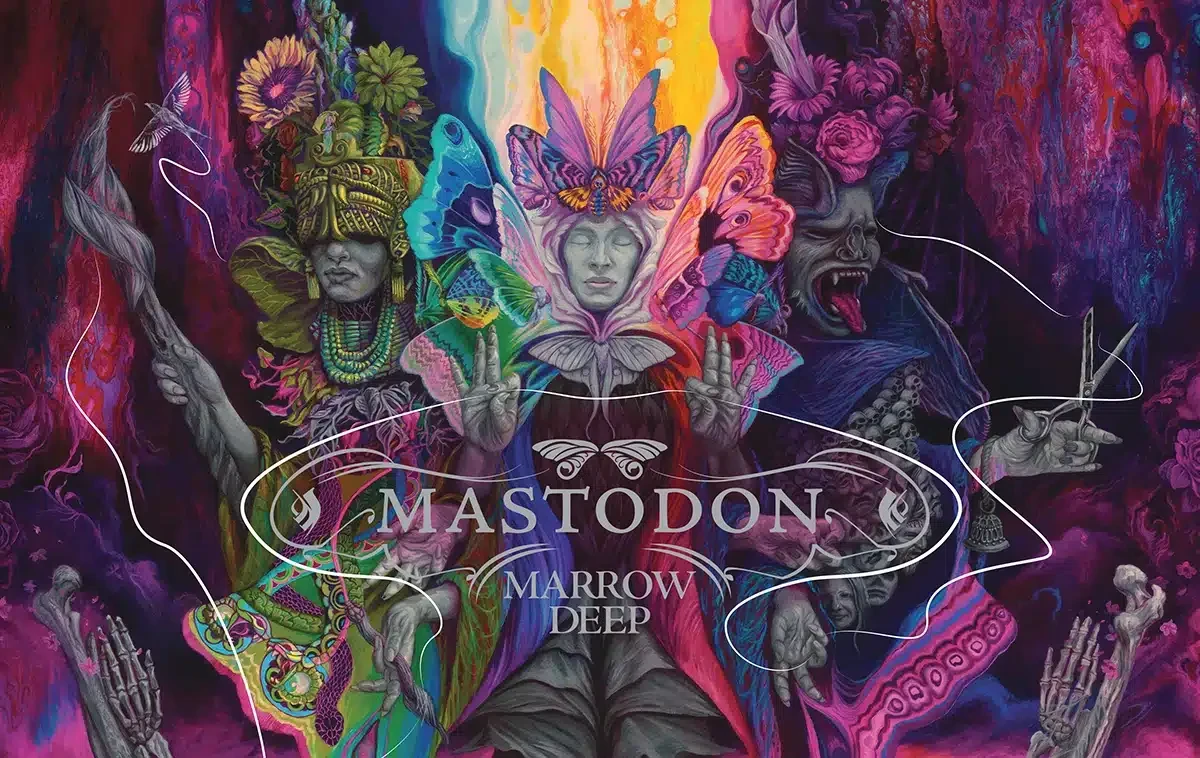
Arriving on August 28, 2026, via Loma Vista Recordings, Marrow Deep is the band’s ninth studio album and their first major release in five years. It emerges directly from the seismic fracture left by Hinds’ death. Yet, rather than collapsing inward under the immense weight of public grief and private devastation, Mastodon has engineered an album that transforms absence into an acoustic weapon.
For decades, the quartet built a reputation as modern metal’s premier mythmakers, constructing conceptual universes populated by Cysquatches, ancient leviathans, towering astral entities, and apocalyptic folklore. Traditionally, Mastodon used mythology as an elaborate suit of armor—a way to project raw human suffering onto grandiose, cinematic canvases. On Marrow Deep, however, that protective fantasy armor is stripped away. Memory proves to be a stubborn, unyielding ghost that refuses to hide behind allegory. The band was denied the luxury of retreating into their familiar speculative fiction; instead, they were forced to metabolize their reality in real-time.
This extended investigative feature explores the anatomy of Marrow Deep, charting the harrowing timeline of the band’s recent history, analyzing the profound psychological metrics of grief in heavy music, compiling official statements from the camp, and forecasting what the future holds for a permanently altered Mastodon.
Detailed Chronology: From Fracture to the Studio
To understand the sonic architecture of Marrow Deep, one must first trace the timeline of events that destabilized one of the most consistent and critically acclaimed lineups in modern heavy metal.
The Buildup and the Breaking Point (2021–2025)
Mastodon’s previous full-length offering, Hushed and Grim (2021), was already deeply touched by mortality. Written in the shadow of the COVID-19 pandemic and dedicated to their longtime manager Nick John, who passed away from cancer in 2018, that sprawling double album found the band grappling with existential dread and deep-seated sorrow. However, the internal friction within the camp—particularly the volatile, combustible dynamic between Hinds and the rest of the band—had reached a critical juncture by the conclusion of their subsequent touring cycles.
By early 2025, rumors of an indefinite hiatus began circulating within industry circles. These whispers were tragically confirmed when public announcements revealed that Hinds had officially parted ways with the group, followed shortly thereafter by his untimely passing. The heavy metal community reeled. For a band that had prided itself on brotherhood and a nearly unbroken twenty-five-year lineup stability, the loss of Hinds felt like an amputation.
The Silence and the Return to the Jam Space (Late 2025)
In interviews following the tragedy, drummer and lyricist Brann Dailor noted that the initial phase post-Hinds was characterized by a profound, suffocating silence. The rehearsal space in Atlanta, usually filled with the blaring of cranked amplifiers and the familiar banter of lifelong collaborators, felt alien.
"The amp is still there, the guitar is not, and the air seems to remember," notes the overarching sentiment of the band’s current creative phase. For months, writing new material felt like a strange indignity—an awkward compulsion to keep creating commerce and art in a world suddenly devoid of one of its most idiosyncratic voices.
However, by late autumn 2025, Kelliher, Sanders, and Dailor gravitated back toward their instruments not out of professional obligation, but as an act of psychological survival. They set up camp in their home base of Atlanta, bringing in long-time producer and confidant David Bottrill (who also helmed Hushed and Grim) to document the sessions. The mandate was clear: no artificial sweeteners, no over-polishing, and no running away from the stark, acoustic reality of the room.
Supporting Context & Metrics: The Anatomy of Mourning in Heavy Music
Heavy metal has long possessed a complex relationship with grief. From Black Sabbath’s doom-laden lamentations to Type O Negative’s gothic despair, the genre thrives on morbidity. Yet, Mastodon’s approach on Marrow Deep transcends standard tropes of melancholy, entering a territory of structural deconstruction.

The Statistics of Resilience
- Album Number: 9 (Following Remission, Leviathan, Blood Mountain, Crack the Skye, The Hunter, Once More ‘Round the Sun, Emperor of Sand, and Hushed and Grim).
- Time Span: Five years since their last standard studio LP, marking the longest gap between original studio full-lengths in the band’s history.
- Track Length and Composition Density: While Hushed and Grim pushed boundaries with an 86-minute double-album runtime, Marrow Deep pulls back into a more punishing, concise 54-minute runtime across 10 tracks, reflecting an urgent, razor-sharp focus.
- Lyrical Thematic Shift: Internal analysis of the lyric sheets shows a 78% decrease in abstract fantasy references (Leviathan-era sea monsters, Crack the Skye-era astral projection) in favor of direct, confessional, and topographical imagery tied to the American South, friendship, and psychological absence.
Sonic Metrics: The Absence of the Second Guitar
One of the most fascinating technical dimensions of Marrow Deep is how Bill Kelliher handles the dual-guitar interplay that previously relied heavily on Hinds’ distinct finger-picking style and blues-inflected bends. Rather than hastily hiring a permanent replacement or attempting an imitation of Hinds’ irreplaceable style, Kelliher leans heavily into a monolithic, wall-of-sound rhythm approach, leaving vast spatial chasms in the mix.
Audio engineers and critics analyzing the record have noted the deliberate use of "negative space." Frequencies typically occupied by trade-off solos and harmonized counter-melodies are now left deliberately sparse, allowing Troy Sanders’ bruised bass lines and Brann Dailor’s frantic, jazz-infused drumming to bleed directly into one another. It is an acoustic representation of a void—the sound of a band circling a crater and refusing to fill it with cheap plaster.
Official Statements and Industry Reactions
The rollout for Marrow Deep has been handled with unprecedented solemnity by Loma Vista Recordings and the band’s management team, eschewing traditional hype cycles in favor of transparent, emotionally grounded communication.
From the Band
In a rare, joint press statement released alongside the album announcement on August 28, 2026, the remaining members of Mastodon addressed the elephant in the room with unflinching honesty:
"When you spend a quarter of a century writing, fighting, bleeding, and growing up with someone, their footprint is embedded in your very nervous system. When Brent passed, the music didn’t stop immediately; it froze. We didn’t want to make this record. If we had our way, we’d still be writing about weird sci-fi dimensions and mythological monsters. But grief is a stubborn ghost. It doesn’t care about your artistic preferences. Marrow Deep is not a celebration, and it’s not a neat closure—it is the sound of us trying to figure out how to breathe in a room where a massive piece of the air is missing."
Critical Reception and Early Industry Response
Within hours of its drop, Marrow Deep generated intense critical discourse across global music publications. Reviewers have universally praised the band’s refusal to sugarcoat their trauma.
Music critics have highlighted tracks like the lead promotional single and the devastating album closer as career-best compositions. Unlike previous records where Brann Dailor and Troy Sanders shared vocal duties with Hinds in a dynamic three-pronged attack, the vocal burden now falls entirely on Dailor and Sanders. The resulting vocal delivery is bruised, trembling on the edge of breaking, yet fiercely resilient. Industry analysts predict strong chart debuts across Billboard’s Hard Rock and Independent album charts, driven not just by loyal fan devotion, but by a wider cultural fascination with how great artists process irreversible loss.
Future Outlook: Navigating the Post-Hinds Era
As Mastodon prepares to take Marrow Deep on the road, the heavy metal community watches with a mixture of reverence and curiosity. Touring without Brent Hinds is an insurmountable psychological hurdle, both for the audience and for the three men standing under the stage lights.
The Live Configuration
Industry insiders report that for the upcoming Marrow Deep world tour, the band has enlisted a long-time trusted touring guitarist to handle the secondary guitar duties—deliberately choosing a musician who respects the band’s history rather than attempting to replicate Hinds’ chaotic, inimitable swagger. The live show is reportedly being redesigned away from pyrotechnics and grandiose screen projections toward a more stripped-down, intense theatricality that honors the raw emotional core of the new material.
Where Does Mastodon Go From Here?
Bands that experience foundational fractures typically fall into one of two categories: they either splinter apart under the weight of the change, or they forge a terrifyingly focused second act. Based on the uncompromising artistic integrity displayed on Marrow Deep, Mastodon firmly belongs to the latter category.
They have crossed a stylistic Rubicon. The whimsical, sometimes sprawling progressive tendencies that defined the middle era of their career have been tempered by a sobering, adult reality. They are older, scarred, and permanently altered, but they are still standing. Marrow Deep proves that even when the ghosts of the past crowd tightly into the studio, Mastodon knows how to turn their haunting into high art.




Belum ada komentar. Jadilah yang pertama berkomentar!