In the grand pantheon of Hollywood cinema, few productions evoke the same mixture of awe, schadenfreude, and logistical terror as Kevin Reynolds’s 1995 post-apocalyptic epic, Waterworld. Starring and co-produced by Kevin Costner at the absolute peak of his global box-office dominance, the film stands alongside legendary financial and operational catastrophes like Heaven’s Gate and Ishtar.
Yet, Waterworld is far more than a cautionary tale of hubris and bloated budgets. It represents a watershed moment in the history of the Hollywood blockbuster—a time when studios were willing to pour unprecedented fortunes into original, unfranchised intellectual properties built entirely on practical effects and audacious scale.
What began in the mid-1980s as a gritty, Mad Max-inspired indie script evolved into a $175 million leviathan. It faced off against destructive hurricanes, open-ocean logistical nightmares, a mutinous production schedule, and an explosive creative rift between its star and director. Though it ultimately failed to recoup its exorbitant production and marketing costs during its initial theatrical run, Waterworld has aged into a fascinating cinematic time capsule. It serves as a reminder of an era when Hollywood took colossal, dangerous creative swings—and paid a heavy price when they missed.
Detailed Chronology
Chapter One: The Genesis on the Open Sea
The conceptual roots of Waterworld trace back to the mid-1980s, when screenwriters Peter Rader and Brad Krevoy began conceptualizing a high-octane, post-apocalyptic action narrative set entirely on a drowned planet. Drawing inspiration from Peter Milligan’s cult comic book series Freakwave—essentially Mad Max on a surfboard—alongside Old Testament flood myths and the classical Greek legend of Helen of Troy, Rader completed a preliminary draft in 1986.
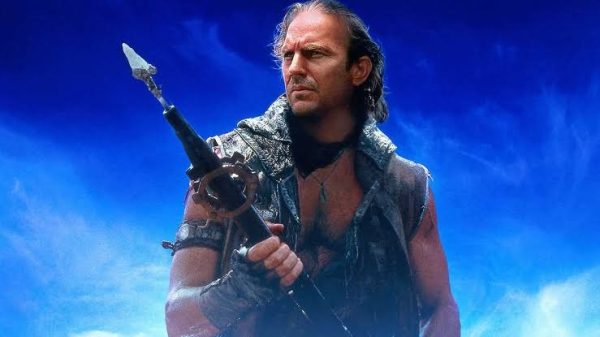
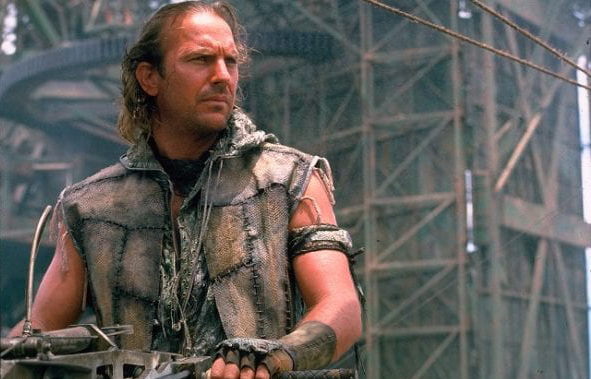
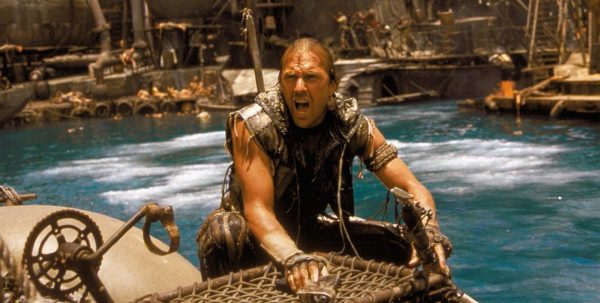
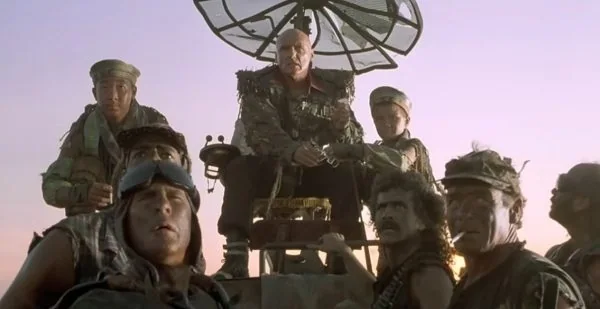
The premise was radically simple yet logistically terrifying: Earth’s polar ice caps had melted, driving sea levels up by more than 25,000 feet and completely submerging all terrestrial landmasses. Humanity survived in scattered, floating communities known as atolls. The narrative follows an enigmatic, web-footed drifter known only as "The Mariner" (Kevin Costner), who begrudgingly aids Helen (Jeanne Tripplehorn) and her adopted daughter, Enola (Tina Majorino). The trio becomes the target of "The Smokers," a ruthless, oil-dependent pirate gang led by the scenery-chewing Deacon (Dennis Hopper). The Smokers believe Enola holds a map to dry land tattooed on her back.
Initially, legendary low-budget auteur Roger Corman flirted with the script, only to quickly recognize that the financial requirements of filming on water made the project an economic impossibility at the time. The script languished in development hell until 1992, when Kevin Costner and director Kevin Reynolds—riding high on the massive success of Robin Hood: Prince of Thieves—pounced on the property.
Chapter Two: The Two Kevins and the Escalating Budget
Universal Studios originally envisioned seasoned filmmakers like Lawrence Kasdan or Robert Zemeckis steering the helm. However, Costner, flexing his considerable muscle as a certified Hollywood megastar, insisted on his friend and frequent collaborator Kevin Reynolds.
Cracks in the Costner-Reynolds partnership had already begun to form during the editing room battles of Robin Hood. Reportedly, those tensions grew so severe during pre-production on Waterworld that Reynolds briefly suggested casting another actor as The Mariner. Universal, however, remained uncompromising: the film’s massive greenlight hinged entirely on Costner’s marquee value.
With both men officially attached, Waterworld transformed overnight from a modestly budgeted genre picture into a $100 million studio blockbuster—equivalent to roughly $257 million today. This financial inflation necessitated sweeping script rewrites to accommodate grander action set-pieces, larger sets, and an increasingly complex production pipeline.
Chapter Three: A Masterclass in Maritime Misery
Before cameras rolled, Steven Spielberg—drawing directly from his infamously grueling experiences directing Jaws out on the open ocean—reportedly pulled Costner and Reynolds aside to offer a blunt warning: Never shoot a movie on open water.
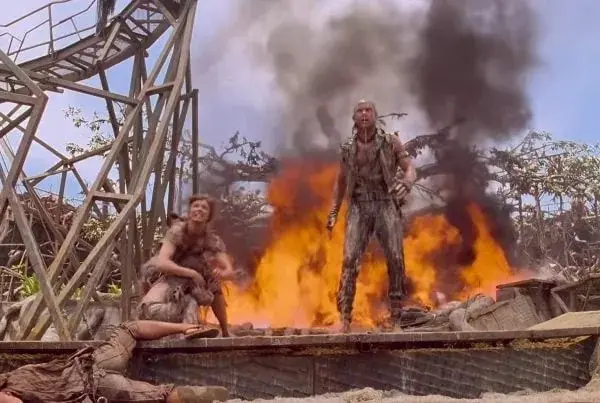
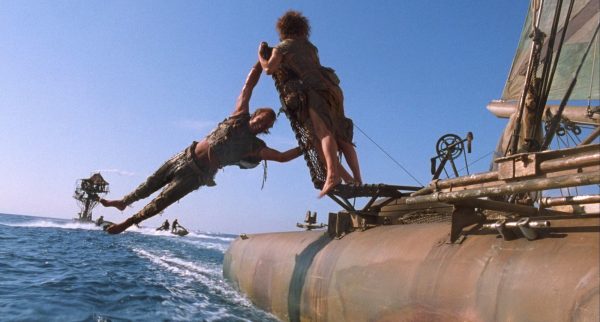
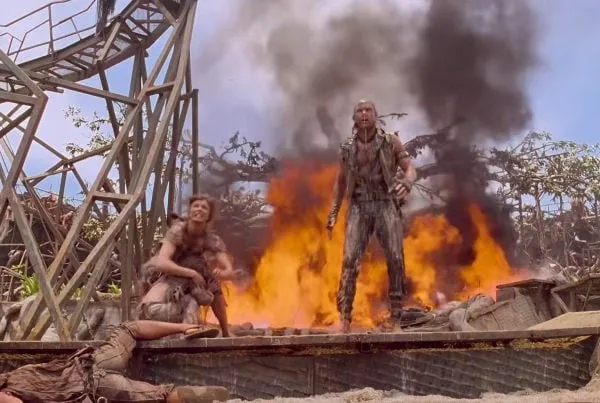
The filmmakers ignored the advice. Production commenced off the western coast of Hawaii, where Universal constructed colossal floating atolls costing millions of dollars apiece. These architectural marvels proved to be shockingly fragile. Worse still, production was scheduled squarely in the middle of hurricane season. True to form, a tropical storm pulverized one of the primary sets, forcing millions of dollars in emergency reconstruction and bloating the budget to $135 million.
The weather refused to cooperate. Relentless high winds frequently knocked camera rigs out of alignment, dragging shooting schedules down to a glacial pace. During one harrowing sequence on a sailing vessel, high winds ripped away the bowsprit, launching Jeanne Tripplehorn and young Tina Majorino out into the open ocean. They were forced to swim for hours before rescue watercraft could locate and retrieve them.
Costner himself endured the hazardous conditions. Working grueling six-day weeks, he fell victim to the set’s lax safety measures when a sudden gust of wind blew him far out to sea while he was tied to the mast of his boat for a stunt, narrowly avoiding tragedy. Meanwhile, pro-surfer Laird Hamilton, serving as Costner’s stunt double, routinely commuted forty miles to the set via jet ski. On one occasion, Hamilton forgot to refuel halfway through his journey, leaving him stranded and drifting on ocean currents for hours before a frantic crew tracked him down.
By the time principal photography finally wrapped, the schedule had ballooned from a projected 96 days to a punishing 150 days. Though the cast and crew were exhausted and deeply fractured, the local Hawaiian economy reaped an estimated $35 million windfall from the prolonged production.
Chapter Four: Creative Collisions and the Directorial Walkout
Nature was not the only force tearing the production apart; the relationship between Costner and Reynolds deteriorated into open warfare. Costner was concurrently navigating a bitterly expensive divorce, a personal strain that did little to temper his mood. His demands—including a luxury five-star villa, a $14 million salary, and daily commutes to the set aboard his personal yacht—drove expenditures even higher.
Creative differences eventually reached a boiling point over the edit. Reynolds delivered a rough cut that leaned heavily into moody world-building, portraying The Mariner as a cynical, anti-heroic drifter reminiscent of Snake Plissken or Clint Eastwood’s Man with No Name. Costner, favoring a conventional popcorn-action crowd-pleaser, utilized his contractual leverage to wrestle control of the project, hacking the 170-minute rough cut (later known as the "Ulysses Cut") down to a brisk 135 minutes.
Disgusted by the studio interference and his star’s heavy-handed dominance, Kevin Reynolds walked off the project before post-production concluded. Universal brought in a flurry of uncredited script doctors, including a young Joss Whedon (pre-Buffy the Vampire Slayer), who famously recalled the production as an unmitigated disaster that required a total structural overhaul. Costner himself stepped in to direct remaining pickups, pushing the final production budget to an astronomical $175 million.
Supporting Context & Metrics
To understand the sheer financial extremity of Waterworld in 1995, one must look at comparative data from the era. Most tentpole blockbusters of the 1990s were produced for significantly less capital:
Terminator 2: Judgment Day (1991): ~$102 million
Jurassic Park (1993): ~$63 million
The Matrix (1999): ~$63 million
Dark City (1998): ~$27 million
When factoring in global marketing, distribution prints, and star salaries, Waterworld required an unprecedented global box office haul simply to break even.
Box Office Performance & Critical Backlash
The film opened at number one domestically with a respectable $21.6 million opening weekend, briefly sparking hopes of profitability. However, momentum quickly collapsed. Word-of-mouth soured rapidly as entertainment media fixated on the production’s ballooning costs rather than its cinematic merits. The press christened the film mockingly as "Fishtar" and "Kevin’s Gate," echoing historic box-office disasters like Ishtar and Heaven’s Gate.
Ultimately, Waterworld grossed roughly $260 million worldwide—a respectable gross under normal circumstances, but a catastrophic failure relative to its total expenditures.
Official Statements & Industry Reception
Critical reception at the time was deeply polarized, though a few discerning critics recognized the film’s undeniable ambition.
Renowned critic Roger Ebert awarded the film two out of four stars, writing:
"The cost controversy aside, Waterworld is a decent futuristic action picture with some great sets, some intriguing ideas, and a few images that will stay with me. It could have been more, it could have been better, and it could have been made me care about the characters."
Conversely, Mick LaSalle defended the film upon its home video release, arguing that it had been unfairly maligned by a bloodthirsty press:
"Waterworld… has an elusive, appealing spirit that holds up for more than two hours. It’s a genuine vault at greatness that misses the mark—but survives."
Director Kevin Reynolds later offered a pragmatic assessment of the film’s reputation:
"My own personal take on the picture is that I don’t think it’s any better, any worse than most summer blockbusters, it’s somewhere in the middle… But by the end, people… they wanted it to be a disaster."
Future Outlook & Legacy
The Reappraisal of Waterworld
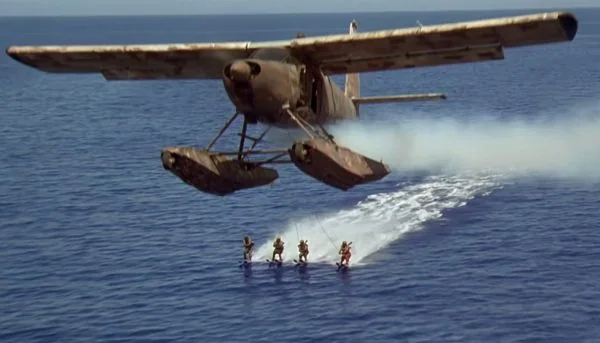
In the decades since its theatrical release, Waterworld has undergone a massive critical reappraisal. Modern audiences, fatigued by homogeneous, CGI-heavy green-screen spectacles, look back at Waterworld with genuine nostalgia. The tangible heft of its handmade sets, the daring ingenuity of its practical stunt work, and its committed world-building represent a lost era of Hollywood craftsmanship.
Furthermore, the release of the "Ulysses Cut" on home media radically altered the film’s reputation. Restoring nearly 40 minutes of excised footage, this version recontextualizes The Mariner as the complex, gritty anti-hero Reynolds originally intended, transforming a choppy theatrical misfire into a cohesive, atmospheric epic.
Career Aftershocks
For Kevin Costner, Waterworld marked the first major crack in his infallible box-office invincibility—a decline finalized two years later by his post-apocalyptic follow-up, The Postman. While Costner has maintained a stellar, enduring career characterized by acclaimed supporting turns and prestige television work (such as Yellowstone), he never quite reclaimed his mid-1980s and early-1990s apex as an undisputed marquee titan.
Kevin Reynolds experienced a similarly eclectic post-Waterworld career, directing criminally underrated gems like 187 (1997), a magnificent adaptation of The Count of Monte Cristo (2002), and Tristan & Isolde (2006). Happily, time healed old wounds: Costner and Reynolds officially buried the hatchet in the 2010s, collaborating on the critically acclaimed, Emmy-winning historical television mini-series Hatfields & McCoys (2012).
Today, Waterworld stands not as a cautionary tale of total failure, but as a monument to cinematic ambition. It proved that even when a movie sinks beneath the crushing weight of its own budget, a bold, beautifully crafted vision can ultimately stay afloat.









Belum ada komentar. Jadilah yang pertama berkomentar!