

Executive Overview
Throughout his prolific and structurally distinct solo discography, singer-songwriter, multi-instrumentalist, and bandleader Charlie Kaplan has rarely repeated himself. Each successive release has acted as a sonic thesis statement, an exercise in aesthetic world-building. His 2020 debut solo LP, Sunday, introduced listeners to a loose, electric guitar-driven atmosphere. The 2023 follow-up, Country Life in America, pivoted toward a lighter, Beatles-esque indie-folk touch, while 2024’s Eternal Repeater injected open-ended, shimmering psychedelic gestures into his writing. That same year yielded what many critics consider his magnum opus: A Hat Upon the Bed, a sprawling, emotionally heavy double album grappling with the profound existential bookends of life and death, inspired in equal measure by the passing of his father and the birth of his son.
Given this trajectory of grand thematic ambition, how is one to categorize Dobro, his lean, kinetic, 28-minute, nine-song LP?
At first glance, it might be tempting to dismiss Dobro as a default Kaplan record—a distillation of his greatest strengths as a vocalist, lyricist, and arranger. Yet, to view it as merely a summary statement is to miss the radical simplicity of its creation. Born out of an intimate Brooklyn creative community and recorded with an absolute minimum of fuss, Dobro stands as perhaps Kaplan’s most effortlessly enjoyable record to date. It balances biting social commentary with serene observation, proving that an artist doesn’t need a sprawling double-album runtime to capture the surreal juxtapositions of modern life.
Detailed Chronology: From Brooklyn Workshop to Figure Eight Studios
To understand the genesis of Dobro, one must look away from the grand halls of traditional commercial recording environments and focus instead on a cramped Brooklyn studio apartment. There, over the course of several months, as many as 25 local artists would routinely huddle together to participate in grassroots songwriting workshops hosted by Winston Cook-Wilson, Kaplan’s bandmate in the critically acclaimed project Office Culture.
These monthly gatherings were designed to foster artistic accountability and community. Writers would bring rough sketches, half-formed verses, and nascent chord progressions to share with their peers, stripping away the isolation that so frequently plagues modern independent musicians. It was within this crucible of constructive critique that Kaplan’s core collection of songs began to take shape.
During these workshops, fellow musician and recording engineer Nate Mendelsohn offered a piece of advice that would fundamentally alter the trajectory of the project: the songs Kaplan was bringing to the table were strong enough to stand on their own without heavy ornamentation. Mendelsohn urged Kaplan to record the material as simply, directly, and unpretentiously as possible.
The resulting tracking sessions took place at Figure Eight Studios in Brooklyn, engineered by Mendelsohn. Rather than relying on distant studio mercenaries or sterile digital programming, Kaplan convened a tight-knit cadre of longtime musical conspirators who have orbited his creative world for years. The core lineup includes Winston Cook-Wilson on keyboards, Andrew Daly Frank on guitar, Julian Cubillos on bass, Jason Burger on drums, and Ivy Meissner providing rich, warm backing vocals, while Kaplan anchors the center with his distinctive lead vocals and rhythm guitar.
The resulting chemistry is palpable. Because these players understand the idiosyncratic rhythmic and melodic contours of Kaplan’s writing, the tracking process required very little overthinking—yielding a record that crackles with live-room energy.
Supporting Context & Metrics: The Thematic Landscape of Dobro
Despite its brisk 28-minute runtime, Dobro covers a staggering amount of emotional and stylistic ground. It maps a jagged terrain between unbridled optimism, kinetic rock-and-roll propulsion, political disillusionment, and quiet, domestic intimacy.
The Duality of Place and Pace
The album opens with "Why Not Try L.A.", a track that subverts modern cynicism by painting Los Angeles in a warm, genuinely hopeful light—not as a shallow city of broken dreams, but as a fertile ground for reinvention. Kaplan croons:
"Sunset after dark / And Griffith Park / That’s where you’ll find the spark / To make a life from a lark."
This dreamy, contemplative reverie is abruptly shattered by the second track, "On Sunday," a kinetic, driving rocker partially inspired by the structural punch of Chuck Berry, anchored by a muscular, pulsating bass line from Julian Cubillos. By the third track, "Sleepwalking," Kaplan splits the difference, delivering a winsome, mid-tempo rock track reminiscent of Jeff Tweedy at the height of his creative confidence. The track is elevated considerably by Cook-Wilson, who supplies a startling, inventive piano performance that acts as the track’s secret weapon.
Political Exhaustion and the Unreliable Narrator
While Kaplan’s public persona often exudes a comforting warmth—the musical equivalent of a trusted friend offering empathy over a turntable—Dobro does not shy away from anger, frustration, and socio-political malaise. Written in the shadow of the inauguration of a second Trump term, the single "Failed" serves as a biting snapshot of late-stage capitalist burnout.
According to Kaplan’s press notes, the track was born out of a simmering resentment toward deregulation, institutional inertia, and the broader cultural sense that "modernity has failed us." Rather than delivering a dry political lecture, however, Kaplan channels these grievances through an unreliable narrator who collapses grand systemic critiques into petty, highly specific personal annoyances. The result is a darkly humorous lyrical inventory:
"Failed by the New York Yankees / Failed by Dave Chappelle / Failed by the well-wishers by the wishing well."
The track gleefully takes stray shots at everything from the corporate omnipresence of the Geico gecko and traditional savings-and-loan institutions to former NFL quarterback Peyton Manning. It is a masterclass in using absurdity to mirror the bewildering nature of contemporary civic life.
Stylistic Versatility
Even within its self-imposed framework of simplicity, Dobro showcases remarkable stylistic dexterity. "Sick of You" borrows a punchy, 1990s indie-rock funk template, evoking comparisons to Mike Doughty propelled by tight, rhythmic breakbeats. Conversely, "Laura" pivots cleanly into the territory of a sincere, deeply felt country ballad exploring the timeless dynamics of love and loss.
The album concludes with "Let’s Play a Show Together," a rugged, campfire-style acoustic partnership featuring former Office Culture bandmate Pat Kelly. Singing in a warm, interlocking duet, Kaplan and Kelly celebrate the raw, romantic intimacy of planning and executing a live gig—turning a simple logistical chore into a genuine love song about the power of collaboration.
Official Statements & Conceptual Underpinnings
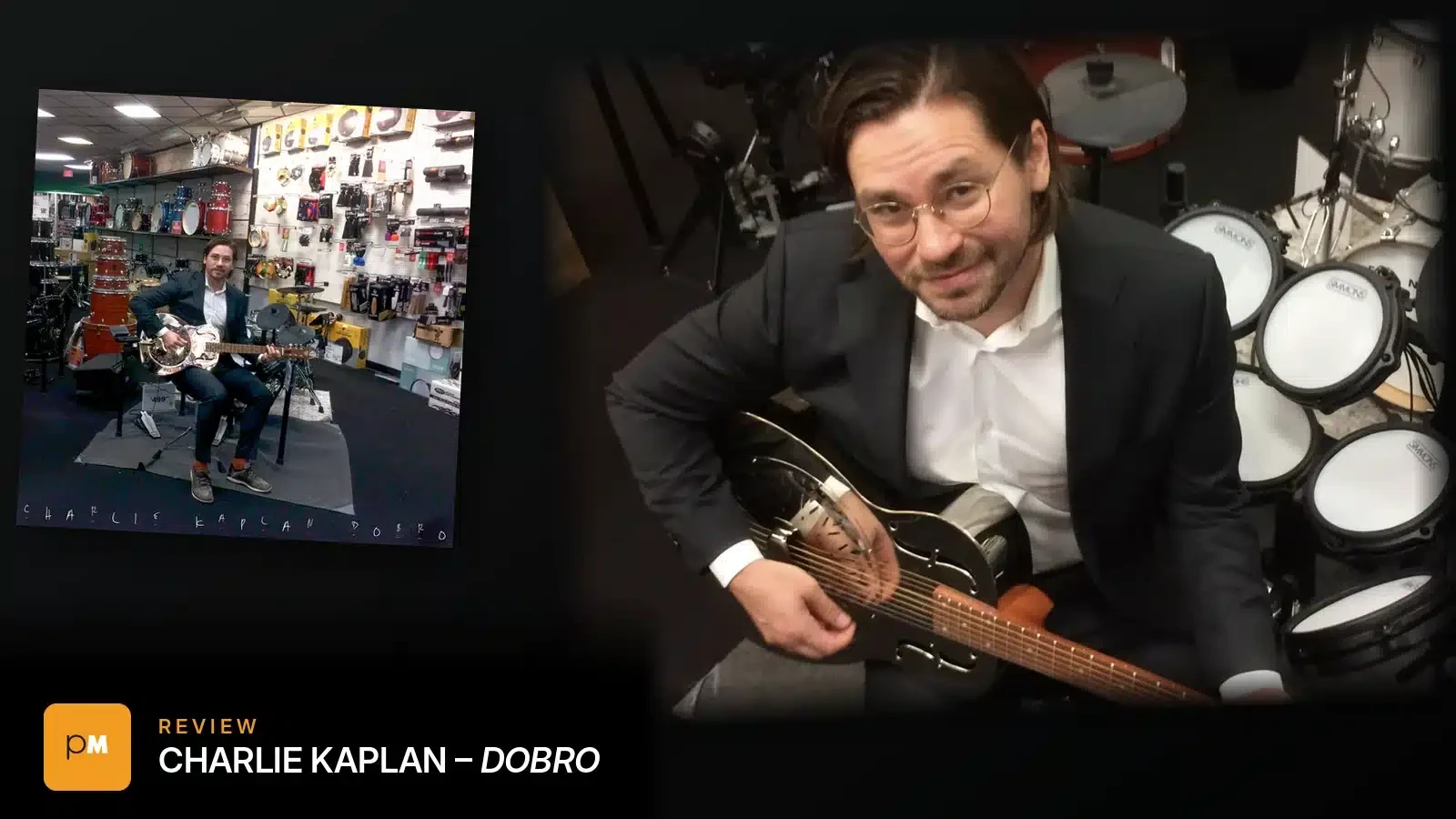
One of the most amusing footnotes to the release of Dobro is the literal absence of its titular instrument. Despite naming the record after the iconic resonator guitar, the album contains zero actual playing of a dobro.
Explaining this stylistic misnomer, Kaplan notes that he had long admired a vintage dobro hanging idly on the wall of his local Guitar Center. The sheer visual absurdity of placing a traditional, bluegrass-associated resonator guitar in the middle of a modern urban guitar shop—surrounded by sleek, contemporary electric axes—crystallized his artistic philosophy.
Kaplan has long been fascinated by surreal juxtapositions: the way grand existential absurdities rub shoulders with the mundane, relatable realities of everyday life. Dobro is, at its core, an exercise in acute observation and community connection. By stripping away extraneous production layers, Kaplan allows the peculiar, beautiful textures of real life to bleed directly into the grooves of the vinyl.
Future Outlook: A Gateway to an Expanding Canon
As Charlie Kaplan continues to refine his artistic vision, Dobro occupies a fascinating space in his discography. Coming on the heels of the sprawling, emotionally demanding double album A Hat Upon the Bed, this concise, 28-minute offering acts as a palate cleanser—a reminder that an artist can pivot from monumental grief and renewal to light, community-driven rock-and-roll without losing an ounce of emotional resonance.
For longtime followers, Dobro offers a masterclass in economy, demonstrating how trusted collaborators and stripped-down arrangements can breathe fresh life into a songwriter’s catalog. For newcomers, it serves as the ultimate gateway drug—an accessible, deeply engaging, and instantly rewarding entry point into a rapidly expanding, brilliantly eclectic musical universe.







Belum ada komentar. Jadilah yang pertama berkomentar!