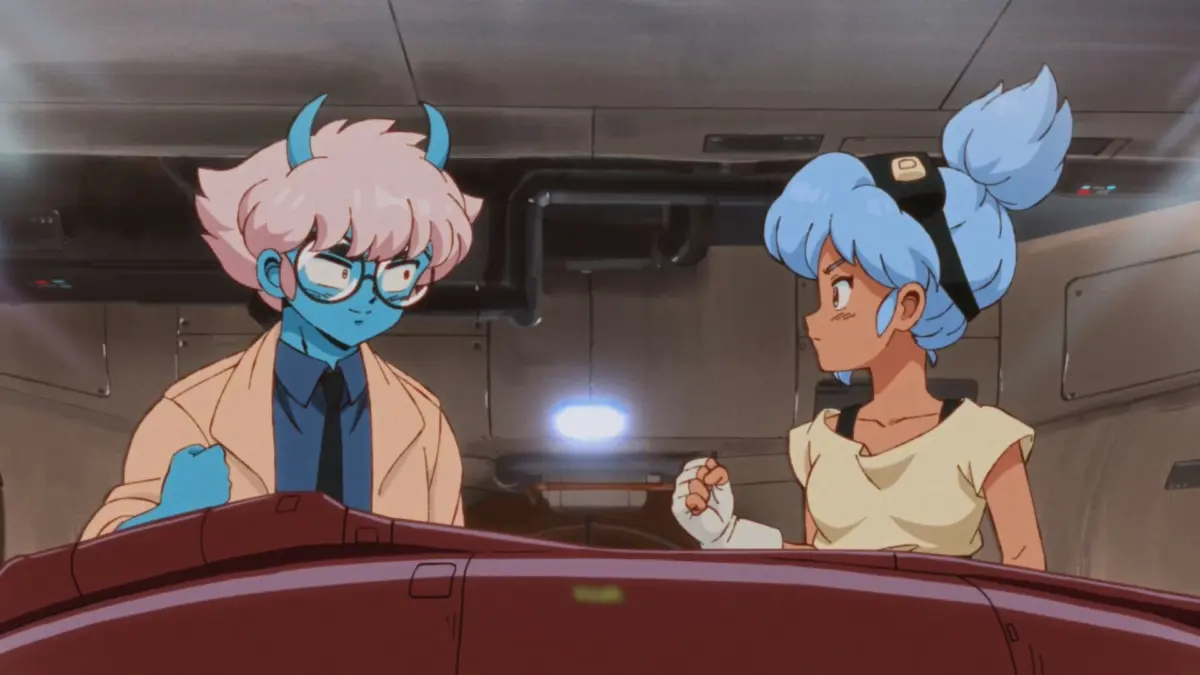
In an era increasingly dominated by asynchronous online multiplayer and live-service frameworks, the traditional couch co-op genre is undergoing a noticeable renaissance. The latest entry in this movement is Orbitals, an atmospheric split-screen adventure developed by Tokyo-based studio Shapefarm and published by Kepler Interactive. Released as a key exclusive title for the Nintendo Switch 2, Orbitals arrives with high expectations, attempting to merge nostalgic late-20th-century anime visual design with modern co-op mechanics.
Receiving a solid 7 out of 10 in critical evaluations, Orbitals succeeds primarily as a visual and auditory showcase, delivering a stylized, relaxing experience tailored for local two-player sessions. The game centers on two space explorers, Maki and Omura, who must navigate chaotic environments within a destructive cosmic storm to save their home colony.
While the title achieves high artistic marks—drawing direct design inspiration from iconic 1990s animation series such as Cowboy Bebop and Revolutionary Girl Utena—it experiences structural friction in its narrative pacing. Specifically, the game’s core lore mechanic regarding body "reprinting" undermines the immediate dramatic tension of its central threat. Nevertheless, Orbitals stands as a charm-filled, polished addition to the Nintendo Switch 2 software library, proving that local split-screen experiences remain a vital format for contemporary platforms.
Detailed Chronology: The Journey of Maki and Omura
+-----------------------------------------------------------------------------------+
|                            ORBITALS: GAMEPLAY PROGRESSION                         |
+-----------------------------------------------------------------------------------+
|  [ ACT I: THE COLONY & REPRINTING LORE ]                                          |
|  - Introduction to Maki & Omura's shared background                               |
|  - Establishment of the "Reprinting Machine" (in-universe respawn mechanic)       |
|  - Tutorialization of split-screen communication and basic controls               |
+-----------------------------------------------------------------------------------+
                                         |
                                         v
+-----------------------------------------------------------------------------------+
|  [ ACT II: EXPEDITIONS INTO THE COSMIC STORM ]                                    |
|  - Traverse planetary fragments and environmental hazards                         |
|  - Engagement with hybrid mechanics: 3D exploration & side-scrolling puzzles      |
|  - Discovery of fallen precursor colonies (establishing true stakes)             |
+-----------------------------------------------------------------------------------+
                                         |
                                         v
+-----------------------------------------------------------------------------------+
|  [ ACT III: THE HUB EXPERIENCE & FINAL DESPERATION ]                              |
|  - Decompression phases aboard the pair's customizable space vessel               |
|  - Optional minigames and audio-visual exploration                                |
|  - Concluding push against the cosmic storm's epicentre                           |
+-----------------------------------------------------------------------------------+
Act I: The Prelude and the Lore of Body Reprinting
The narrative begins within the confines of Maki and Omura’s home colony. Bounded by a lifelong friendship rooted in a shared childhood disaster, the duo is introduced as dedicated space explorers. Early gameplay introduces the core narrative premise alongside the mechanical framework: the colony utilizes a advanced technology capable of "reprinting" biological bodies upon death or severe injury.
While this narrative device cleverly solves the ludonarrative dissonance common to video game respawn systems, it inadvertently slows early dramatic momentum. Players are informed of an existential threat facing their community, yet the omnipresence of the reprinting apparatus minimizes any immediate sense of personal mortality or urgent peril during the opening hours.
Act II: Traversing the Cosmic Storm and Planetary Puzzles
As Maki and Omura venture into the heart of the cosmic storm, the campaign transitions into a series of environmental traversal challenges. Gameplay alternates between full 3D split-screen exploration and constrained 2D side-scrolling sequences. Players must coordinate actions to solve intricate environmental puzzles, including sequence-based music challenges embedded in subterranean caverns.
During these expeditions, the narrative gains necessary weight through environmental storytelling. As the protagonists traverse ruined planetary fragments, they uncover the remnants of previous, long-forgotten colonies whose reprinting infrastructure was completely obliterated. This visual evidence reframes the stakes: while individual deaths are temporary, the total destruction of the colony’s core power unit represents permanent extinction.
Act III: Hub Dynamics, Minigames, and Climax
Between hazardous missions into the storm, the gameplay loop routes players back to Maki and Omura’s spaceship, which serves as an interactive hub world. Here, the pacing deliberate shifts from survival to lighthearted relaxation. Players can participate in various optional minigames, interact with aesthetic ship components, and engage in ambient conversations.
This structural balance prepares players for the final campaign sequences, where environmental puzzles require high synchronization between both players to survive the storm’s most severe anomalies.
The most significant achievement of Shapefarm’s development team lies in Orbitals‘ visual pipeline. The game blends classical 2D hand-drawn animation techniques with modern real-time 3D rendering.
+-------------------------------------------------------------------+
|                   SHAPEFARM VISUAL ENGINE PIPELINE                |
+-------------------------------------------------------------------+
|  [ 2D Hand-Drawn Concept Art ]                                    |
|  Inspired by 80s/90s cel animation (Cowboy Bebop style)           |
+-------------------------------------------------------------------+
                                  |
                                  v
|  [ Shader & Texture Mapping Pipeline ]                            |
|  Translates pencil-hatch shading and vintage color palettes       |
+-------------------------------------------------------------------+
                                  |
                                  v
|  [ Real-Time 3D Cel-Shaded Engine Rendering ]                     |
|  Maintains 2D hand-drawn silhouettes in full 3D split-screen     |
+-------------------------------------------------------------------+
Art Style Directives: Character models preserve the distinct line-weight, cross-hatching, and muted pastel palettes characteristic of 1980s and 1990s anime features.
Dimensional Consistency: The transition from hand-drawn cutscenes to controllable 3D models is seamless, avoiding the flat or rigid appearance often associated with cel-shaded titles.
Hardware Performance on Nintendo Switch 2
As an exclusive title designed specifically for Nintendo’s successor platform, Orbitals showcases the underlying system architecture’s ability to handle simultaneous split-screen rendering without compromise.
Metric
Performance / Implementation
Target Frame Rate
Stable 60 FPS across both split-screen viewports
Rendering Resolution
Dynamic resolution targeting native output in docked mode
Load Times
Near-instantaneous transitions between hub areas; brief loading at major planet checkpoints
Camera Control
Independent dual-analog camera; minor occlusion issues in tight indoor sections
Software Stability
High stability; rare, non-game-breaking visual artifacts in lighting shaders
Gameplay Mechanics and Co-Op Dynamics
Orbitals builds upon the foundation established by cooperative milestones such as Hazelight Studios’ It Takes Two and modern split-screen benchmarks like Split Fiction. However, Shapefarm tailors its interaction design toward accessibility rather than high-dexterity platforming.
The game avoids punishing fail states. When a player falls during a platforming challenge or puzzle sequence, the "reprinting" mechanic instantly redeploys the character near their partner, keeping the flow accessible for players of varying skill levels.
Official Statements and Design Philosophy
In technical commentary regarding the title’s production, representatives from Shapefarm highlighted the design goals behind the game’s unique artistic direction and mechanical pacing:
"Our objective with Orbitals was to craft a world that felt fundamentally inviting, even when framed against the backdrop of cosmic catastrophe. By combining the aesthetic language of classic 90s anime with accessible split-screen design, we wanted to build a space where players could explore together without feeling constantly stressed by mechanical punishment."
— Shapefarm Development Team
Addressing the gameplay integration of the reprinting system, developers noted that lore-backed respawn mechanics were chosen intentionally to remove friction for casual play:
"In many co-op games, death creates friction between players. By making body reprinting an established part of the universe’s technology, we convert failure into a narrative beat rather than a penalty. While this flattens traditional dramatic tension early on, it allows players to experiment freely with environmental puzzles without fear of progress loss."
Publisher Kepler Interactive similarly re-emphasized their commitment to supporting distinct, creative co-op experiences:
"Orbitals represents the type of creative, artist-driven project we strive to champion. As local co-op continues its resurgence on modern hardware like the Nintendo Switch 2, titles that prioritize shared physical-space experiences are proving to be extraordinarily resilient in the market."
Strategic Analysis & Future Outlook
The Renaissance of Couch Co-Op Gaming
The reception of Orbitals underscores a broader industry shift back toward local cooperative gaming. For years, major publishers prioritized online-only multiplayer frameworks to drive recurrent user spending. However, the critical and commercial success of titles like It Takes Two highlighted a persistent, underserved demand for dedicated, shared-screen experiences.
+-------------------------------------------------------------------+
|                 LOCAL CO-OP EVOLUTION TIMELINE                    |
+-------------------------------------------------------------------+
|  2010s: Online-Only Shift                                         |
|  - Decline of split-screen modes due to hardware constraints      |
+-------------------------------------------------------------------+
                                  |
                                  v
|  2018–2021: Narrative Co-Op Resurgence                            |
|  - Titles like 'A Way Out' and 'It Takes Two' re-establish genre  |
+-------------------------------------------------------------------+
                                  |
                                  v
|  Present Era: Next-Gen Integration                                |
|  - 'Orbitals' on Nintendo Switch 2 expands couch co-op into       |
|    stylized, chill, artistic sub-genres                           |
+-------------------------------------------------------------------+
Orbitals carves out a specific niche within this market: the "chill co-op" sub-genre. Rather than demanding high-stress execution, the title leverages its soundtrack, retro-anime visuals, and low-stakes puzzle design to target couples, families, and casual gaming pairs looking for an engaging, low-stress cooperative experience.
Platform Impact and Market Positioning
As a Nintendo Switch 2 exclusive, Orbitals serves a key strategic purpose for the hardware platform:
Hardware Showcase: Demonstrates the system’s ability to seamlessly render dual complex 3D viewports simultaneously without dropping target frame rates.
Demographic Reach: Broadens the system’s launch-window appeal by offering a non-violent, art-focused alternative to high-intensity action titles.
Intellectual Property Expansion: Establishes Shapefarm as a premiere studio for stylized art direction on next-generation Nintendo hardware.
Final Assessment
While Orbitals does not fundamentally alter the mechanical blueprint of the split-screen adventure genre, its stylistic ambition elevates it above standard co-op entries. Its minor flaws—a slow-burning narrative arc and occasional camera quirks—are easily overshadowed by its stunning 90s anime presentation, delightful audio landscape, and stress-free cooperative loop. For owners of the Nintendo Switch 2 seeking an artistic, accessible journey to share on the couch, Orbitals offers a charming and memorable expedition into the cosmos.








Belum ada komentar. Jadilah yang pertama berkomentar!