

Executive Overview
For decades, the cinematic action genre has relied on a delicate balance between escapist choreography and kinetic realism. While mainstream blockbusters frequently favor glossy, sanitized confrontations designed to secure family-friendly box office ratings, a distinct counter-movement has persisted. This gritty, uncompromising subgenre strips away Hollywood polish to expose the raw, visceral mechanics of physical conflict. These sequences do not merely serve as plot devices; they are grueling endurance tests that define character arcs, exhaust performers, and push the boundaries of practical stunt work.
In this comprehensive retrospective, renowned film critic and action cinema analyst Casey Chong compiles and deconstructs ten of the most brutal, technically demanding, and culturally significant fight scenes ever captured on film. Spanning over two decades of international filmmaking—from the neon-drenched alleys of Hong Kong to the claustrophobic corridors of Seoul and the blood-spattered sets of Hollywood—these sequences represent the gold standard of kinetic storytelling. By examining the choreography, technical hurdles, and performances behind these masterclasses in violence, we uncover why these cinematic brawls continue to haunt and captivate audiences worldwide.
Detailed Chronology of Cinematic Carnage
1. The House of Blue Leaves Showdown — Kill Bill: Vol. 1 (2003)
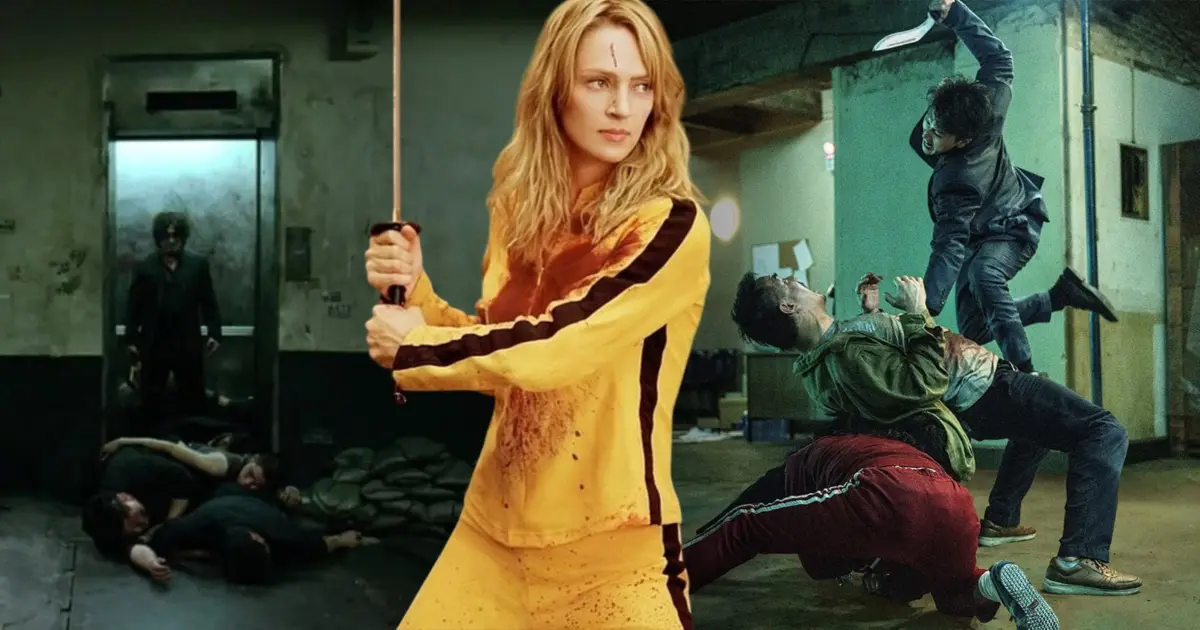
Quentin Tarantino’s reverence for classic martial arts cinema reached its fever pitch in the explosive climax of Kill Bill: Vol. 1. Donning a yellow-and-black jumpsuit explicitly paying homage to Bruce Lee in Game of Death, Uma Thurman’s Beatrix Kiddo (The Bride) steps into the snow-and-neon-lit Tokyo restaurant-bar known as the House of Blue Leaves. Armed with a custom Hattori Hanzo katana, The Bride faces an impossible architectural and mathematical equation: one warrior against an entire army of masked Yakuza foot soldiers known as the Crazy 88, led by Johnny Mo (Gordon Liu), alongside the sadistic schoolgirl bodyguard Gogo Yubari (Chiaki Kuriyama) and Yakuza boss O-Ren Ishii (Lucy Liu).

Masterminded by legendary action choreographer Yuen Woo-Ping, the sequence spans roughly ten minutes of unrelenting, blood-soaked orchestration. Tarantino famously shifted the visual presentation into stark black-and-white for the latter half of the carnage to circumvent an NC-17 rating from the MPAA, transforming arterial spray into graphic, high-contrast art. The result is a masterclass in spatial awareness and escalation, cementing its status as a cornerstone of modern action cinema.
2. The Hallway Hammer Fight — Oldboy (2003)
South Korean auteur Park Chan-wook redefined the parameters of psychological revenge thrillers with Oldboy, the staggering second installment of his celebrated Vengeance Trilogy. Beyond its central, devastating narrative twist involving Oh Dae-su (Choi Min-sik) and Mi-do (Kang Hye-jung), the film is permanently etched into cinematic history via its iconic single-take hallway sequence.
Armed with nothing more than a claw hammer, a physically exhausted Oh Dae-su must hack, slash, and bludgeon his way through a claustrophobic, dimly lit corridor swarming with armed thugs. Eschewing the hyper-stylized wire-work of Hong Kong action, Park’s camera tracks the violence horizontally in a flat, theatrical plane. The sequence exposes the agonizing reality of physical combat: exhaustion, pain, and mutual degradation. Achieving the sequence required 17 rigorous takes spanning three days of intensive physical labor, resulting in an unvarnished portrait of survival.
3. The Trailer Park Brawl — Kill Bill: Vol. 2 (2004)
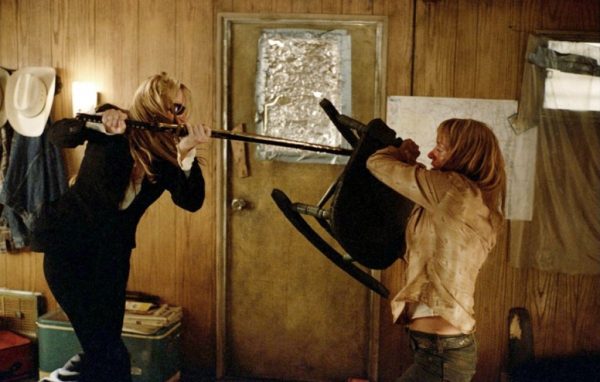
While Kill Bill: Vol. 1 operates as an operatic explosion of martial arts energy, Kill Bill: Vol. 2 consciously shifts its tonal architecture toward the slow-burn, dusty cadence of a Spaghetti Western. Yet, Tarantino ensures that the narrative stakes remain physically punishing. The confrontation between Beatrix Kiddo (Uma Thurman) and her rival assassin Elle Driver (Daryl Hannah) takes place not in an open arena, but inside the suffocatingly cramped confines of a rundown desert trailer.
The confined space entirely strips away the graceful, sweeping choreography traditionally associated with samurai swordplay. Instead, the duel becomes a messy, desperate, improvised brawl where furniture, walls, and household objects dictate the movement. The claustrophobic cinematography amplifies the tension, culminating in a visceral, stomach-churning climax that leaves the viewer entirely breathless.
4. The Alleyway Combat — SPL: Sha Po Lang (2005)
Directed by Wilson Yip, SPL (released in North America as Kill Zone) revitalized the gritty Hong Kong crime thriller by anchoring its police procedural elements in brutal, uncompromised hand-to-hand combat. Donnie Yen stars as the uncompromising Inspector Ma Kwun, whose trajectory collides violently with the syndicate enforcer Jack, played with chilling precision by Wu Jing.
The film’s third-act alleyway showdown is a masterclass in physical efficiency. Armed with a collapsible police baton, Ma Kwun faces off against Jack, who wields a concealed blade. Because both actors possess extensive, elite martial arts backgrounds, the choreography bypasses the traditional Hollywood crutches of sped-up undercranked cameras and excessive editing cuts. Instead, the sequence relies on lightning-fast, raw physical execution, offering viewers an authentic masterclass in close-quarters knife-defense and bat-work.
5. The Naked Bathhouse Showdown — Eastern Promises (2007)
Following their acclaimed collaboration on A History of Violence, director David Cronenberg and actor Viggo Mortensen reunited for Eastern Promises, an unflinching exploration of the Russian mob operating within London. Mortensen delivers a career-defining performance as Nikolai Luzhin, a heavily tattooed fixer whose loyalties are constantly tested.
The film’s defining centerpiece occurs when Nikolai is ambushed by two knife-wielding Chechen assassins inside a traditional Russian bathhouse—while stark naked. Stripped of clothing, Nikolai is rendered intensely vulnerable, with every inch of his body exposed to potential stabs and lethal lacerations. Cronenberg films the grueling, blood-soaked struggle in wide and medium angles without editing sleight-of-hand. Mortensen’s commitment to performing the sequence completely unassisted by a body double elevates the scene from a standard action beat into a terrifying, animalistic fight for sheer survival.
6. The Church Massacre — Kingsman: The Secret Service (2014)
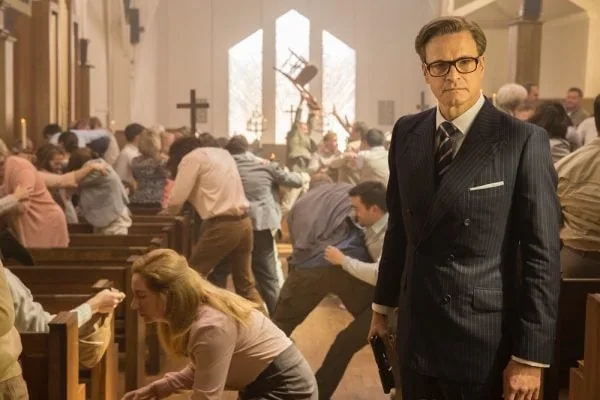
Director and co-writer Matthew Vaughn upended the gentlemanly tropes of the spy thriller genre with Kingsman: The Secret Service. While the film’s thesis is that "manners maketh man," its kinetic centerpiece proves that director Matthew Vaughn is willing to throw etiquette out the window entirely. When tech billionaire Richmond Valentine (Samuel L. Jackson) deploys a neurological mind-control signal via global mobile transmissions, it triggers unbridled homicidal rage among the patrons of a Westboro-esque hate group church.
Caught in the transmission frequency, veteran secret agent Harry Hart (Colin Firth) is forced into an agonizing self-defense scenario against an entire church of bloodthirsty zealots. Shot with hyper-kinetic, digitally stitched "one-take" long takes, the sequence transforms Firth’s traditionally suave, dramatic persona into an elite, ruthless killing machine. Vaughn leans heavily into the chaotic choreography, creating an unflinching ballet of unrelenting carnage.
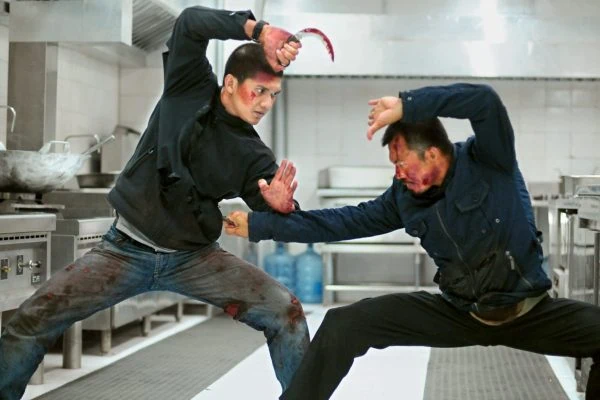
7. Kitchen Showdown: Rama vs. The Assassin — The Raid 2 (2014)
Gareth Evans’s The Raid 2 expands the scope of its predecessor into an epic, multi-layered crime saga while ratcheting up the technical ambition of its action choreography. Following brutal sequences like the muddy prison yard riot and the subway train battle, the film culminates in an unforgettable mano-a-mano duel between undercover cop Rama (Iko Uwais) and the enigmatic Assassin (Cecep Arif Rahman).

Set inside the pristine, sterile, stark-white interior of a commercial kitchen, the fight utilizes a brilliant visual juxtaposition: the clinical brightness of the kitchen contrasts sharply with the savage, brutal application of Indonesia’s traditional martial art, Pencak Silat. The Assassin wields a pair of curved Karambit knives, pushing Rama to his absolute physical limit. Evans captures the fight using sweeping wide angles, ensuring that every punch, kick, and agonizing stab is registered with absolute clarity.
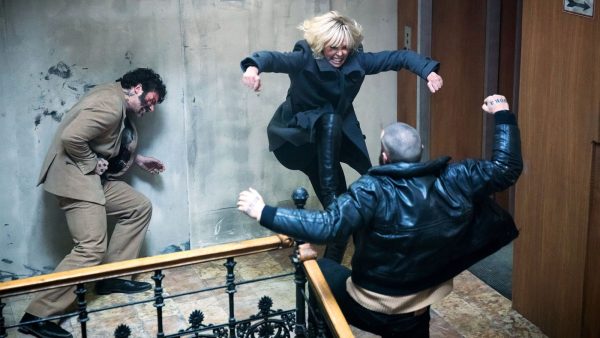
8. The Stairwell Survival Fight — Atomic Blonde (2017)
Based on Antony Johnston and Sam Hart’s graphic novel The Coldest City, Atomic Blonde was directed by David Leitch, a veteran stunt coordinator turned filmmaker who understands the visceral mechanics of physical impact. Charlize Theron stars as Lorraine Broughton, an elite MI6 field agent navigating the espionage minefield of Berlin in 1989.
The film’s emotional and physical anchor is a grueling seven-minute sequence set within a dilapidated apartment building stairwell, filmed to appear as a continuous, unbroken take. Leitch deliberately dismantles the myth of the indestructible cinematic spy. Broughton is highly trained, but she is fundamentally human; she tires, stumbles, bleeds, and sustains bone fractures. The choreography relies on desperate improvisation, with Theron famously executing roughly 98% of her own stunts to project genuine exhaustion and grit.
9. The Final Five-Way Brawl — The Furious (2025)
Premiering to widespread critical acclaim at the 2005 Toronto International Film Festival before its broader theatrical rollout in mid-2026, Kenji Tanigaki’s martial arts tour de force The Furious solidified its place in contemporary action cinema. The narrative centers on Wang Wei (Xie Miao), a mute father who teams up with investigative journalist Navin (Joe Taslim) to track down their abducted family members.
Tanigaki’s primary objective is to showcase diverse martial arts disciplines through uncompromised combat staging. The film’s climactic third-act showdown inside a police station—where Wang and Navin face off against three distinct antagonists played by Yayan Ruhian, Joey Iwanaga, and Brian Le—is a masterclass in multi-opponent choreography. Eschewing rapid-fire editing cuts, Tanigaki frames the combatants cleanly, allowing the audience to appreciate the unique tactical disciplines of each fighter in real-time.
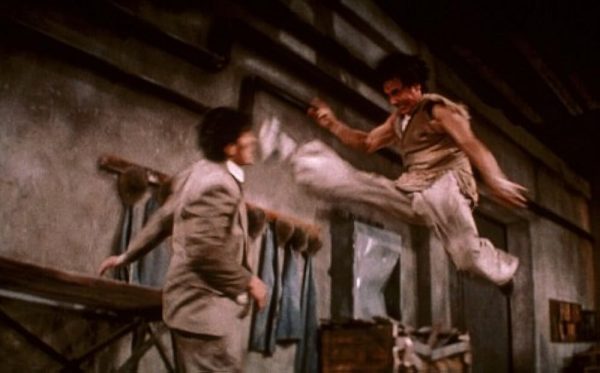
10. The Factory Showdown: Wong Fei-hung vs. John — Drunken Master II (1994)
Though cinematic icon Jackie Chan was well past the chronological age of playing a youthful, rebellious Wong Fei-hung, Drunken Master II (released internationally as The Legend of Drunken Master) showcases the actor-director at the absolute peak of his physical and creative powers. The film’s climactic finale takes place inside a searing steel factory, where Wong must dismantle a syndicate of smugglers before facing their primary enforcer, John, played by taekwondo master Ken Lo.

The ensuing battle is an uncompromising display of contrasting martial arts philosophies: Chan’s acrobatic, unpredictable Drunken Boxing against Lo’s blindingly fast, razor-sharp high kicks. Directed by Chan himself alongside Lau Kar-leung, the fight scene is famously brutal, featuring high-impact falls onto industrial machinery and burning coals. The sequence swept the industry, earning the Jackie Chan Stunt Team the Best Action Choreography prize at the Hong Kong Film Awards, cementing a legendary benchmark for physical performance.
Supporting Context & Metrics: The Anatomy of Action Engineering
To fully comprehend the cultural and technical weight of these ten sequences, one must examine the metrics of their execution. Action cinema is not merely a matter of throwing punches in front of a camera; it is an industrial art form requiring specialized engineering, risk mitigation, and physiological endurance.
| Film Title | Director / Choreographer | Primary Weapon / Style | Notable Production Metric |
|---|---|---|---|
| Kill Bill: Vol. 1 (2003) | Quentin Tarantino / Yuen Woo-Ping | Katana / Swordplay | 10-minute continuous battle sequence; converted to black-and-white to avoid NC-17 rating. |
| Oldboy (2003) | Park Chan-wook / Lee Kang-kuk | Claw Hammer / Street Brawling | 1 continuous tracking shot; required 17 rigorous takes over 3 days of filming. |
| Kill Bill: Vol. 2 (2004) | Quentin Tarantino / Yuen Woo-Ping | Improvised Weapons / Hand-to-Hand | Confined-space trailer choreography emphasizing desperation over grace. |
| SPL (2005) | Wilson Yip / Donnie Yen | Police Baton vs. Blade | Un-undercranked, real-time martial arts execution by elite practitioners. |
| Eastern Promises (2007) | David Cronenberg / Viggo Mortensen | Knives / Unarmed Combat | Completely naked combat sequence performed without body doubles. |
| Kingsman (2014) | Matthew Vaughn / Brad Allan | Multi-weapon / Church Mob Riot | Digitally stitched "one-take" style maximizing spatial chaos. |
| The Raid 2 (2014) | Gareth Evans / Iko Uwais & Yayan Ruhian | Karambit Knives / Pencak Silat | Sterile kitchen set design contrasting high-velocity hand-to-hand combat. |
| Atomic Blonde (2017) | David Leitch / Jonathan Eusebio | Improvised Environment / CQC | 7-minute stairwell sequence; actress Charlize Theron performed ~98% of her own stunts. |
| The Furious (2025) | Kenji Tanigaki / Kenji Tanigaki | Multi-discipline Martial Arts | Clean wide-angle framing prioritizing multi-fighter style appreciation without editing tricks. |
| Drunken Master II (1994) | Lau Kar-leung & Jackie Chan | Drunken Boxing vs. Taekwondo | Winner of Best Action Choreography at the 14th Hong Kong Film Awards. |
Official Statements and Industry Perspectives
The creation of sequences possessing this level of physical intensity requires a unique philosophy shared between directors, stunt coordinators, and performers. Industry veterans frequently emphasize that brutality on screen is paradoxically achieved through absolute safety and precision behind the camera.
Speaking on the grueling nature of shooting long-take action sequences, stunt veteran and director David Leitch noted during the press tour for Atomic Blonde:
"When you remove the illusion of fast cuts, you place the audience directly into the psychological and physical state of the character. If Lorraine Broughton is tired, bruised, and bleeding out in that stairwell, the audience has to feel the oxygen leaving the room with her. Safety is our primary language on set, but the illusion of danger only works when the physical commitment from the actor is 100% authentic."
Similarly, martial arts auteur Gareth Evans has frequently articulated his approach to framing violence in films like The Raid series:

"We don’t use camera tricks to hide a bad punch. If the camera is shaking violently or cutting every two seconds, it tells me the filmmakers don’t trust their performers. When you have masters like Iko Uwais and Cecep Arif Rahman moving at high velocity, your job as a director is simply to step back, get out of their way, and frame the action so the audience can appreciate the geometry of the discipline."
Future Outlook: The Evolution of Kinetic Storytelling
As the cinematic landscape continues to evolve through advancements in digital technology, virtual production, and AI-assisted pre-visualization, the value of practical, high-impact stunt work remains higher than ever. Audiences have grown increasingly sophisticated, developing a discerning eye for CGI enhancements versus genuine physical performance.
The future of the brutal action scene lies not in sanitized digital destruction, but in the continued elevation of practical stunt craftsmanship. Directors like Chad Stahelski (John Wick franchise), David Leitch, and international auteurs are setting new global benchmarks by integrating traditional martial arts disciplines with innovative camera engineering. As streaming platforms and global theatrical markets continue to demand high-octane content, filmmakers are challenged to find fresh spatial dynamics—moving beyond hallways and stairwells into novel environments where physical endurance remains the ultimate currency.
Ultimately, these ten sequences prove that cinematic violence, when choreographed with artistic intent and executed with physical mastery, transcends mere spectacle. It becomes a visceral language of survival, resilience, and human vulnerability that will continue to captivate audiences for generations to come.
What are your all-time favorite brutal fight scenes? Let the editorial team know on our official social channels @FlickeringMyth.
— Casey Chong


Belum ada komentar. Jadilah yang pertama berkomentar!