

Executive Overview
In the landscape of modern studio tentpoles, superhero cinema has long relied on the dramatic physics of sudden rupture. Tragic backstories are traditionally forged in loud, high-contrast crucibles: cataclysmic explosions, crossfire executions, or Faustian cosmic bargains. These narratives treat isolation as a temporary narrative hurdle—an emotional purgatory meant to be resolved by the arrival of a love interest or the reconstitution of a team in the subsequent sequel.
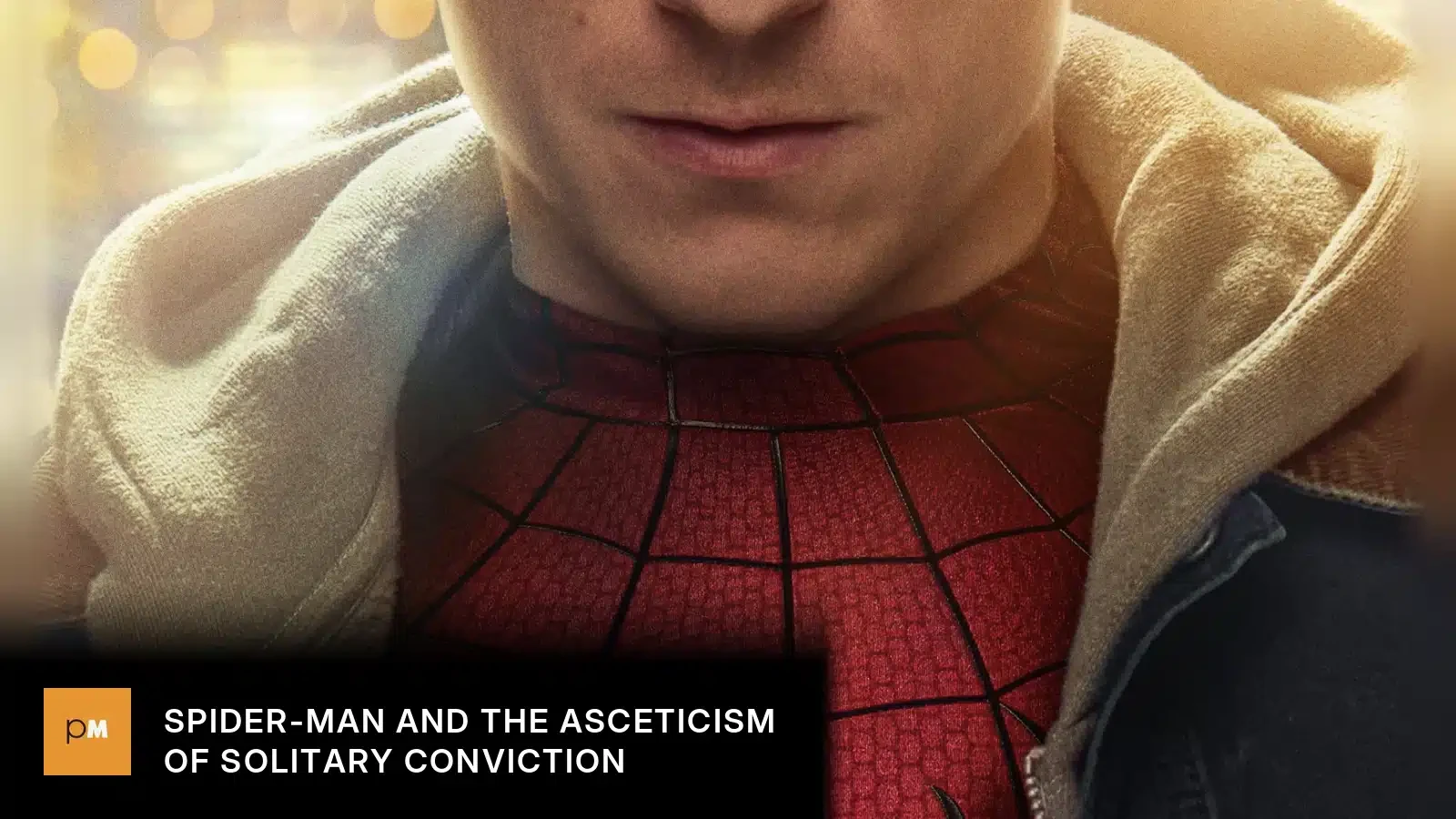
However, looking across the recent trajectory of Peter Parker—neatly bookended by the acute, systemic erasure of Jon Watts’s Spider-Man: No Way Home (2021) and the grinding, lived inertia of Destin Daniel Cretton’s upcoming Spider-Man: Brand New Day (2026)—pop culture has inadvertently stumbled into a remarkably candid sociological study of modern urban estrangement.
Together, these films form an unintended diptych examining the heavy toll of solitary vocations, metropolitan anomie, and the peculiar sorrow of the transient observer. They track a transition from the adrenaline-fueled shock of social death to the long, silent winter of chronic outsiderhood. By examining Parker’s descent from communal integration to the invisible margins of city life, contemporary cinema offers an unvarnished look at a psychological reality familiar to millions of modern urbanites, migrant workers, and intellectual nomads: the condition of walking through a crowded room acutely aware that your roots can never touch the soil.
Detailed Chronology: From Acute Rupture to the Chronic State
To understand the full weight of Peter Parker’s contemporary cinematic trajectory, one must map the psychological descent across its two distinct phases. This evolution traces a path from the radical, self-inflicted amputation of civic identity to the quiet, agonizing banality of chronic alienation.
The Incision: Erasure as a Monastic Vow (No Way Home, 2021)
The climax and resolution of Jon Watts’s Spider-Man: No Way Home stripped Peter Parker (Tom Holland) down to a terrifying existential zero. By electing to cast a spell that erased his very existence from the memories of everyone he loved, Parker underwent what sociologist Orlando Patterson termed in his foundational 1982 study Slavery and Social Death—the systematic severing of all relational ties, institutional recognition, and mutual memory.
The film’s final sequence captures this desolation with stark minimalism. Peter places a disposable coffee cup on a chipped windowsill in an unheated walk-up apartment, next to a GED preparation manual and a humming police scanner. It is a cinematic crystallization of Max Weber’s concept of innerweltliche Askese (inner-worldly asceticism). In his 1919 lecture Science as a Vocation, Weber argued that serious intellectual, artistic, or moral endeavors demand a form of secular monasticism: a voluntary renunciation of comfort, an inward withdrawal from the world’s frivolous distractions, and a willingness to let one’s entire existence be consumed by an abstract calling.
Yet, when viewed through the lens of philosopher Byung-Chul Han’s critique in The Burnout Society (2015), this asceticism reveals a contemporary psychological pathology. Peter Parker does not merely accept an external burden imposed by society; he morphs into the ultimate achievement-subject (Leistungssubjekt). Free from disciplinary masters, institutional mandates, or parental surveillance, he internalizes the panopticon.
As Han observes, the contemporary neoliberal subject exploits themselves under the illusion of radical freedom—an auto-exploitation that proves far more punishing than external coercion because it stems not from the ambition to succeed, but from the tyrannical demands of moral conviction. In that freezing apartment, hand-sewing his rudimentary suit and exhausting his physical limits without an audience or an employer, Parker’s solitary dedication transforms into a closed circuit where the calling feeds entirely upon the self.
No Way Home romanticizes this asceticism through the lens of adrenaline and ideology. Parker stitches a cheap mask, listens to the static of a radio, and leaps into the snow. It is the exhilarating, cinematic dawn of an exile carried forward by ideological purity. But asceticism cannot sustain itself indefinitely on adrenaline alone. Eventually, the sun rises, the temperature drops, and the daily grind of survival sets in.
The Chronic State: The Spectator at the Feast (Brand New Day, 2026)
Where No Way Home dramatizes the clean, surgical cut of isolation, Destin Daniel Cretton’s Spider-Man: Brand New Day forces the audience to endure the sensory discomfort of the scar tissue. The emotional center of this subsequent chapter is no longer the heroic leap into the dark; it is the agonizing banality of a house party.
In this sequence, Peter stands near the periphery of a brightly lit living room, clutching a plastic cup, observing his peers. Around him, the ordinary architecture of human survival is on full display: couples laughing with the casual intimacy of shared domestic routines; friends anchored in deep, effortless solidarity; individuals making future plans that assume permanence, continuity, and mutual belonging. Everyone in the room possesses a stable address in someone else’s life.
Peter, conversely, is merely passing through. He can crack a joke, nod politely, and perform the superficial gestures of sociality, but he cannot cross the threshold into genuine reciprocity. He carries a double life that acts as a lead apron over his chest. To let anyone truly close would mean endangering them, but more fundamentally, it would mean demanding they invest emotionally in someone whose life is anchored elsewhere.
What inflicts such acute pain in this scene is the exact crisis diagnosed in Axel Honneth’s 1995 sociological framework, The Struggle for Recognition. Honneth posits that a stable human identity rests upon three indispensable spheres of intersubjective recognition:
- Primary affective care (love, family, and somatic intimacy, which build fundamental self-confidence).
- Legal and institutional rights (which grant self-respect and social standing).
- Communal esteem (solidarity and shared appreciation of one’s contributions, which generate self-worth).
At the party, Peter experiences the quiet catastrophe of total misrecognition across all three axes. He is entirely deprived of a partner or family to hold his vulnerability; his civic existence has been legally wiped from public databases into non-being; and his heroic labor remains anonymous, uncelebrated, or reviled by the city he protects. He stands among his peers as an ontological phantom.
Supporting Context & Metrics: The Urban Loneliness Epidemic
The resonance of Parker’s cinematic journey extends far beyond the confines of comic book lore; it taps directly into a growing global crisis of urban isolation. Sociological data underscores the timeliness of this thematic exploration in modern storytelling.
| Metric / Indicator | Statistical Reality | Sociological Implication |
|---|---|---|
| Urban Loneliness | Over 30% of adults in major metropolitan centers report feeling chronically lonely (Global Health Service data). | High-density living frequently correlates with psychological fragmentation rather than community integration. |
| Transient Populations | Megacities see an average turnover of 15% to 20% of their renter populations annually. | Urban environments increasingly function as "waiting rooms" rather than permanent civic homes for young professionals and laborers. |
| Affective Deprivation | Rising trends in burnout and stress-related fatigue among knowledge workers and gig-economy laborers. | Auto-exploitation (Leistungssubjekt) often leaves individuals intellectually stimulated yet emotionally starved. |
Sociologist Georg Simmel, writing in his seminal 1903 essay The Metropolis and Mental Life, noted that the modern city creates a unique psychological paradox: the individual develops a blasé attitude—a defensive numbness—to survive the overwhelming, relentless tide of urban stimuli. Simmel observed that to shield the fragile emotional self (Gemüt) against psychic saturation, the metropolitan resident replaces feeling with the calculating, protective intellect (Verstand).
When applied to an individual inhabiting what might be termed an "interim city"—a metropolis where one’s stay is known to be temporary—Simmel’s protective shell transforms into an incubator for emotional starvation. Living in a city you know you will eventually leave turns physical geography into a waiting room. You ride the transit system, work your shifts, buy your groceries, and pay your taxes, but your relationship to the municipality remains strictly transactional. You exist in an ecological limbo: too present to be a tourist, too untethered to be a citizen.
Official Statements & Creative Vision
While Marvel Studios and Sony Pictures maintain strict confidentiality regarding the exact plot mechanics of Spider-Man: Brand New Day, key creative personnel have repeatedly signaled a desire to anchor the character in a more grounded, emotionally raw reality.
Speaking on the evolution of the franchise following the multiscale spectacle of No Way Home, director Destin Daniel Cretton emphasized the necessity of exploring the internal, psychological aftermath of Peter’s sacrifice:
"When you take away everything that anchors a hero to the ground—their name, their history, the people who remind them of who they are when they aren’t wearing the mask—you aren’t just leaving them alone. You’re forcing them to answer a fundamental question: When the costume comes off, is there anyone left underneath? Exploring that quiet space after the fireworks have faded is where the real human story begins."
Industry analysts have noted that this shift represents a calculated counter-programming strategy against "superhero fatigue." By scaling down the cosmic stakes in favor of intimate, urban alienation, the creative team aims to tap into the same universal resonance that made early comic book runs by writers like Brian Michael Bendis and J.M. DeMatteis enduring classics: the painful intersection of extraordinary responsibility and ordinary, grinding loneliness.
Future Outlook: The Resilient Solitude of the Modern Myth
As Hollywood looks toward the release of Spider-Man: Brand New Day in 2026, the cultural footprint of Peter Parker’s modern trajectory offers a fascinating template for future myth-making. Popular culture frequently treats the superhero’s isolation as a temporary inconvenience to be resolved by the arrival of a new ally or a restorative plot device.
What makes the transition from No Way Home to Brand New Day so quietly subversive is its refusal of easy absolution. It treats solitude not as a glitch in the narrative, but as an existential condition of purpose.
Parker endures the empty apartment, the drafty window, and the outsider’s gaze at the party because he understands that the path he has chosen cannot be negotiated halfway. For those engaged in ambitious creative, intellectual, or civic pursuits forged in solitary conviction, that realization carries an aching, unsentimental clarity. Ambition demands a visible audience and immediate rewards; true conviction demands only fidelity to the work in the dark.
Ultimately, when Peter slips away from the warmth and laughter of the party to return to the quiet shadows of his room, there is no self-pity in his step. There is only the sobering, adult recognition of a pact: the world needs what he does, and this quiet, solitary room is what it costs. To write, to fight, and to live from inside that solitude is not to mourn what was lost, but to catalog the heavy, invisible toll of choosing the long road home.







Belum ada komentar. Jadilah yang pertama berkomentar!