

Executive Overview
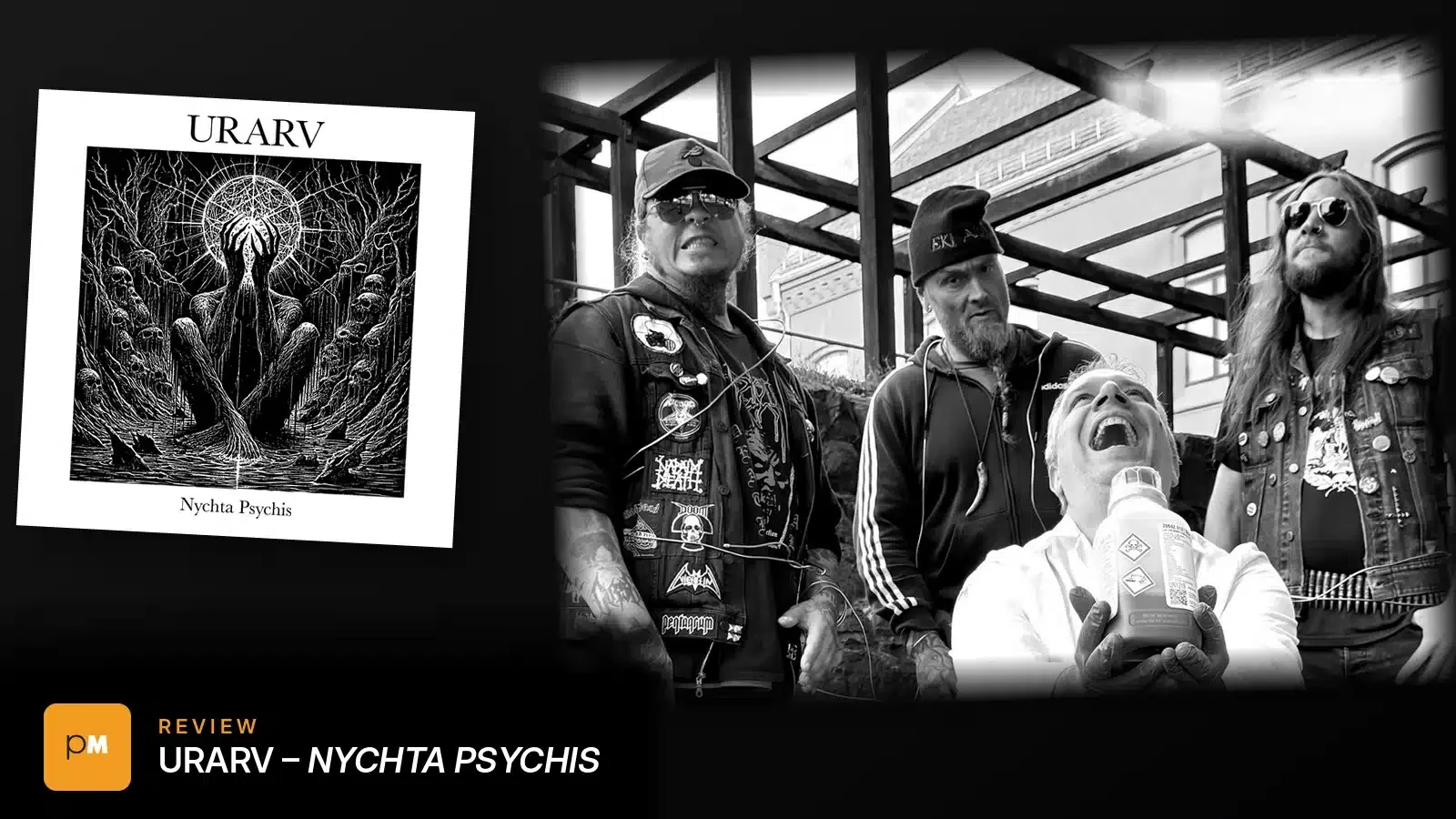
In the sprawling, often rigid landscape of extreme metal, true innovation is a rare and perilous commodity. Bands frequently attempt to cross genre boundaries, only to fall into the traps of self-indulgence or disjointed chaos. Yet, every so often, a release arrives that defies standard metrics of composition, remapping the borders of extremity with startling confidence. Nychta Psychis, the latest full-length offering from the Norwegian avant-garde project Urarv, is precisely such a record.
Released via Darkness Shall Rise on October 16, 2026, and spearheaded by the enigmatic vocalist and visionary Aldrahn—widely celebrated for his tenure with legendary acts like Dødheimsgard (DHG) and Zyklon-B—Nychta Psychis is an uncompromising masterclass in sonic juxtaposition. The album welds the frigid, dissonant foundations of Scandinavian black metal with the angular thrash of the 1980s, the raw urgency of punk, cinematic folk interludes, and an intricate, almost disorienting array of sound design.
On paper, the blueprint of Nychta Psychis reads like a recipe for unmitigated disaster: an erratic mosaic of acoustic guitars, harsh blast beats, throat-singing, and stray sonic anomalies like distant barks and synthetic pulsations. Yet, in practice, Urarv achieves the impossible, transforming a potentially catastrophic collision of disparate styles into a cohesive, mesmerizing triumph of avant-garde audacity. This review-analysis explores the anatomy of Nychta Psychis, contextualizing its place within Aldrahn’s storied career and examining how the record revitalizes the experimental fringes of modern metal.
Detailed Chronology: The Evolution of Urarv and the Path to Nychta Psychis
To understand the complex architecture of Nychta Psychis, one must first retrace the creative trajectory of its principal architect, Bjørn Dencker Gjerde, better known to the extreme metal underground as Aldrahn. For decades, Aldrahn has operated as one of the most unpredictable and theatrical vocalists in black metal. His contributions to Dødheimsgard’s seminal releases, particularly the mind-bending masterpieces 666 International (1999) and the much-lauded Black Medium Current (2023), established a standard for theatricality, psychological unease, and avant-garde songcraft.
However, even for devoted admirers of Black Medium Current, a distinct sentiment often lingered: the sensation that a vital, erratic component of Aldrahn’s singular creative DNA was restrained within the cleaner, highly polished parameters of modern DHG. Enter Urarv. Conceived as an outlet for unbridled, organic expression, Urarv allows Aldrahn to channel his most idiosyncratic impulses without commercial or structural compromise.
The developmental timeline of Nychta Psychis reflects a methodical gathering of these disparate artistic impulses. Over the months leading up to its October 2026 release, hints surfaced that Urarv was leaning deeper into a historically informed yet radically fractured sonic palette. When the album dropped on October 16 via Darkness Shall Rise, it immediately fractured expectations.
The chronological journey through the tracklist of Nychta Psychis is not a linear progression; rather, it is a descent through cascading layers of musical history. The opening track, aptly titled "Dødheimsgard," sets the thematic and sonic tone. Instead of offering a retrospective of his past band’s current output, the track radiates with the distinct, frostbitten DNA of Snorre Ruch’s legendary project, Thorns. Utilizing the same chilling combination of dissonant, mechanical riffs and quasi-industrial progression that defined Thorns’ self-titled 2001 debut, Urarv establishes a historical baseline. Yet, they immediately subvert it: the pacing is purposefully slowed down, replacing the cold, calculated momentum of Thorns with a warped, disquieting character that feels perpetually off-balance.
As the album progresses through tracks like "Operation Genocide," the chronology of extreme metal is hurled forward and backward simultaneously. Traditional black metal tropes—a flurry of blistering blast beats and razor-sharp tremolo-picked guitar lines—are deployed, but they are filtered through an underlying, maniacal sensibility that refuses to settle into comfortable genre conventions.
Supporting Context & Metrics: Deconstructing the Soundscape
The true brilliance of Nychta Psychis lies in its structural audacity. Musically, the album functions as a study in friction and release, drawing on a rich tapestry of influences that span multiple decades of underground music history.
Genre Convergence and Historical Lineage
Urarv’s approach on Nychta Psychis involves stripping black metal down to its primordial, latent components—specifically the volatile aggression of early punk and crossover thrash. However, they bypass traditional interpretations of these genres. By employing a heavily dissonant compositional language, the band reaches a volatile stage reminiscent of Canada’s sci-fi metal pioneers, Voivod.
During these passages, the record takes on a distinctly metallic heft:

- The Riffs: Thick, low-end heavy, and structurally jarring.
- The Chugs: Crisp and mechanical, channeling the off-kilter, futuristic groove of 1980s extremity.
This momentum dissolves fluidly into pure punk territory on tracks like "When Consciousness Identifies With Matter It Is Lost." Here, the stricter, more mathematical frameworks of thrash metal completely disintegrate, giving way to an unfiltered punk ethos reminiscent of American hardcore innovators Die Kreuzen. The transition is seamless yet jarring, demonstrating a profound understanding of how punk’s raw urgency can naturally bleed out of extreme metal’s intellectual dissonance.
Vocal Delivery and Sonic Spatial Awareness
Aldrahn’s vocal performance on Nychta Psychis remains central to the album’s identity. Eschewing standard extreme metal vocal archetypes, his delivery bounces dynamically between soaring, theatrical high registers—reminiscent of Attila Csihar at his most avant-garde—and subterranean, drone-like throat-singing. His presence is defined by an absolute fearlessness; he treats his voice not merely as a vehicle for lyrics, but as a textural instrument capable of shifting the gravitational pull of a song.
Beneath and around these vocal acrobatics lies an obsessively detailed sound design. The album is populated by unexpected acoustic passages and field-recording-style audio cues. Folk interludes featuring delicate acoustic guitars evoke the esoteric, cabaret-esque atmosphere of Dødheimsgard’s 666 International. Meanwhile, the peripheral soundscape is littered with surreal auditory details: blinking, modular synthesizers giving way to cinematic synth pads, and the haunting, ambiguous sound of distant animal (or human) barks echoing in the mix.
Official Statements and Critical Reception
The arrival of Nychta Psychis has sparked intense dialogue within the global extreme metal community, prompting critics and underground tastemakers to reevaluate the boundaries of avant-garde black metal.
In early statements regarding the conceptual framework of the album, the band emphasized a return to unfiltered, instinctual creation over clinical perfectionism. Rather than engineering a sterile product designed for algorithmic digestion, Urarv sought to capture the erratic pulse of human consciousness—flaws, contradictions, and all.
Critical reception has universally praised the album’s ability to walk the tightrope between genius and madness. Reviewers have frequently highlighted the paradoxical nature of the record, noting that Nychta Psychis represents "a big, colourful mess that showcases the band’s personality and creativity."
Musicologists and metal journalists alike have marveled at the record’s defiance of musical logic. The central critical consensus can be distilled into a single, striking paradox: the album simply should not work. The juxtaposition of fragile acoustic folk passages, soaring avant-garde sound effects, blast-beat-driven black metal, and jagged punk-thrash structures runs the risk of sounding profoundly out of place, disjointed, and borderline ridiculous. Yet, through sheer conviction, tight musicianship, and compositional wizardry, Urarv pulls it off entirely. That miraculous reconciliation of opposing forces is precisely what cements Nychta Psychis as a landmark release of the decade.
Future Outlook: The Legacy and Trajectory of Urarv
As the extreme metal underground digests the sprawling, multifaceted world of Nychta Psychis, the broader implications for the genre begin to take shape. In an era where modern metal is frequently homogenized by high-end digital production and predictable genre hybridizations, Urarv offers a vital corrective: a reminder that true extremity requires risk, discomfort, and a willingness to court chaos.
Looking forward, Nychta Psychis positions Urarv not merely as a side project or a nostalgic vehicle for former Dødheimsgard members, but as an essential, independent force within the avant-garde movement. The album sets a remarkably high bar for sonic experimentation, proving that black metal’s stylistic boundaries are infinitely elastic when handled by artists possessing both historical reverence and radical vision.
For Aldrahn and his collaborators, Nychta Psychis opens up a myriad of potential pathways for future exploration. Whether subsequent releases will push deeper into the acoustic, folk-infused abstractions hinted at on this record or plunge back into the dissonant thrash-punk abyss remains to be seen. What is certain, however, is that Urarv has carved out a singular, untouchable niche within the contemporary metal pantheon—one where rules do not apply, and the only constant is the unyielding pursuit of artistic truth through beautiful, chaotic noise.






Belum ada komentar. Jadilah yang pertama berkomentar!