

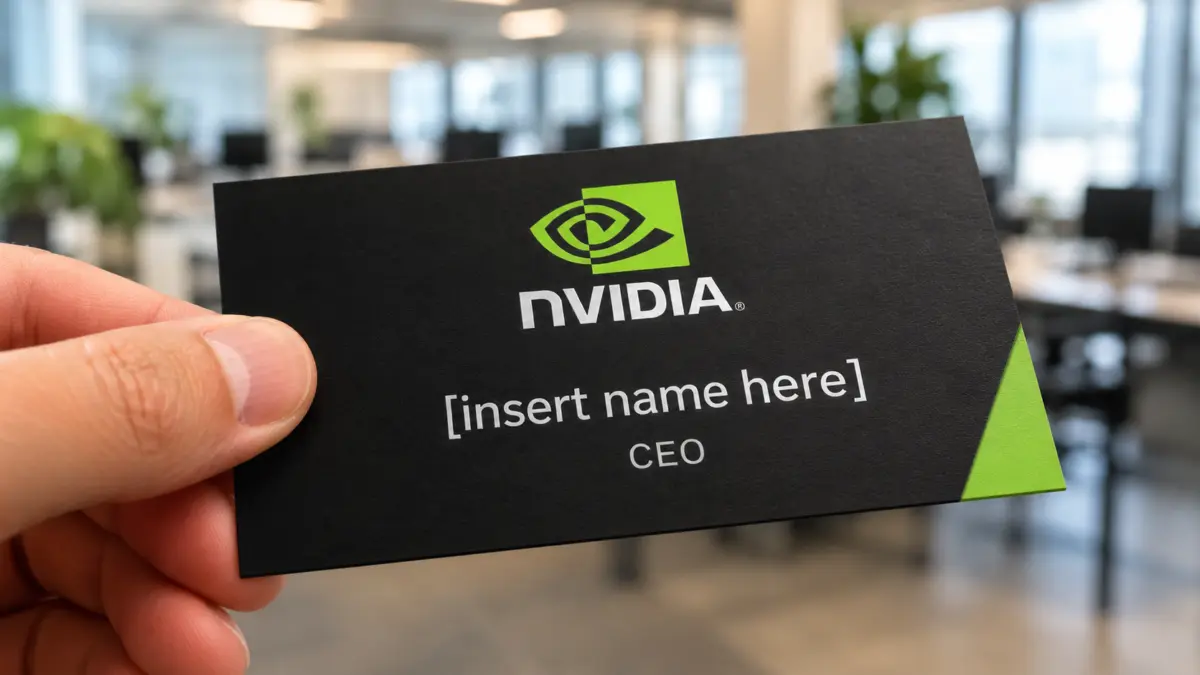
Executive Overview
For decades, the trajectory of modern computing has been inextricably linked to a single, magnetic figure: Jensen Huang. Sporting his signature leather jacket, the co-founder and long-serving CEO of Nvidia has transformed a niche graphics-card manufacturer into the beating heart of the global artificial intelligence revolution. Under his watch, Nvidia has ascended to become one of the most valuable—and, by many market and regulatory accounts, dangerously powerful—enterprises in human history.
Yet, the unthinkable is no longer just a theoretical exercise. Nvidia is standing on the precipice of a seismic leadership crisis. Prediction markets like Kalshi currently peg Huang’s odds of surviving the week as chief executive at a staggering low of 30%. The ground has entirely shifted beneath the feet of Silicon Valley’s most celebrated visionary.
The immediate catalyst is an explosive scandal involving personal indiscretions and intense geopolitical scrutiny. Huang has confessed to an extramarital affair, throwing the company’s internal governance and corporate stability into immediate chaos. Adding to the gravity of the crisis, the corporate power structure is grappling with a complete vacuum of a clear, formalized succession plan.
While the Nvidia board—lavishly enriched by the company’s historic market cap expansion—may seek to salvage the situation by elevating Huang to a newly minted chairman role, the operational leadership of the world’s premier AI hardware titan remains up for grabs. As investigators, congressional aides, and the media circle, the tech world is left engaged in a high-stakes parlor game: Who could possibly step into the shoes of a man who became synonymous with the AI boom?
Detailed Chronology: The Unraveling of an Empire
The descent from corporate invulnerability to existential crisis did not happen overnight, but the final, precipitous drop caught Wall Street and Silicon Valley entirely flat-footed.
The Explosive Revelations
The storm broke following a series of investigative reports and mounting pressure regarding executive conduct and potential conflicts of interest. Central to the crisis is Huang’s admission of an extramarital affair. As the situation compounded, compounding confusion erupted over the identity of the involved parties.
Publicly and internally, questions swirled around two distinct figures: Alice Huang, a Chinese executive under U.S. intelligence scrutiny for suspected espionage activities on behalf of Beijing, and Kimberly Powell, a high-ranking Nvidia executive reporting directly to Jensen Huang. An explosive report published by The New York Times detailed Powell’s involvement as a paramour, drawing immediate, sharp focus from corporate governance watchdogs, compliance committees, and federal investigators.
The Regulatory and Geopolitical Vortex
Nvidia’s products are the geopolitical oil of the 21st century. The company’s H100 and Blackwell-architecture chips fuel the foundational models of every major AI lab, from OpenAI and Microsoft to Google and Meta. Consequently, any hint of compromised personal security clearances, conflicts of interest involving foreign actors, or executive distraction instantly transforms from an HR issue into a matter of national security.
Congressional briefings were swiftly initiated, and regulatory scrutiny reached a boiling point. The board of directors, once fiercely loyal to a fault, found themselves cornered. The calculus shifted overnight: the very qualities that made Huang an irreplaceable visionary—his absolute centrality to Nvidia’s strategy, vision, and customer relationships—now represented an acute risk to the company’s license to operate on the global stage.
Supporting Context & Metrics: The Financial and Market Fallout
The market reaction to the unfolding drama has been swift and unforgiving. Investors who rode the wave of the generative AI boom are waking up to the reality of key-person risk on a historic scale.
Market Sentiments and Prediction Metrics
- Kalshi Survival Odds: As of Wednesday afternoon, prediction markets on Kalshi priced Jensen Huang’s odds of retaining his CEO title through the week at a fragile 30%.
- Succession Probabilities: Traders and speculators have begun handicapping internal and external successors, though liquidity and trading volumes indicate profound uncertainty across the board.
- Sector Ripple Effects: While Nvidia shares have faced intense downward pressure and high volatility, rival chipmakers and tech conglomerates are navigating the shockwaves differently. AMD, for instance, finds itself in a peculiar strategic holding pattern as its primary competitor absorbs a self-inflicted blow.
The Macroeconomic Environment
Compounding Nvidia’s internal strife is a broader, cooling macroeconomic climate for hardware manufacturers. The massive capital expenditure cycle dedicated to AI data center builds is facing intense ROI scrutiny from Wall Street. Meanwhile, traditional computing sectors are seeing localized pinches; Intel recently reported a staggering 20% post-earnings plunge after warning that PC market contractions and memory-chip shortages would severely dent fourth-quarter realizations.
Nvidia, however, is not suffering from a lack of demand—its chips remain the most sought-after commodities in tech. Instead, its vulnerability is entirely human.
The Successor Shortlist: Who Could Run the Chip Giant?
If the board decides that a clean break is necessary, or if Huang is kicked upstairs into a non-executive Chairman role (a position Nvidia currently lacks), the search for a new chief executive begins. Industry analysts, insiders, and governance experts have pointed toward several distinct archetypes.
1. Lisa Su (AMD)
The Information recently floated the CEO of Advanced Micro Devices as a radical, blockbuster possibility. Su is not only the architect behind AMD’s fierce competitive resurgence—chipping away at Nvidia’s monopoly with stellar MI300 series accelerators—she is also a distant cousin of Jensen Huang.
- The Catch: Why would Su leave her triumphant post at AMD to clean up Nvidia’s mess? Currently, AMD benefits immensely from every single day Nvidia spends bogged down in congressional briefings, internal probes, and media circuses. Her optimal strategic move remains standing back, sending a polite note of acknowledgment, and watching from her own corner office.
2. Eric Schmidt (Former Google CEO)
Championed by Jeffrey Sonnenfeld, senior associate dean for leadership studies at the Yale School of Management, the former Google chief executive is viewed as a seasoned institutional parachute. "He could parachute in tomorrow and do a very good job," Sonnenfeld noted. Schmidt boasts an expansive, cross-disciplinary resume: leading Google through its formative decade (2001–2011), chairing the National Security Commission on AI (2018–2021), and leading aerospace firm Relativity Space.
- The Catch: Schmidt brings heavy baggage of his own regarding past extramarital dalliances and personal conduct controversies. In the wake of a scandal-driven ouster, bringing in a leader with parallel vulnerabilities would likely draw intense pushback from institutional shareholders.
3. Lip-Bu Tan (Intel)
The chief executive of Intel understands the silicon supply chain inside and out. Following a brutal period for Intel—marked by severe stock retreats and lowered fourth-quarter guidance amid memory-chip supply crunches—a lateral move to the undisputed king of AI hardware could represent an extraordinary professional escape hatch.
- The Catch: Tan’s primary expertise lies in navigating legacy foundry operations and traditional x86 architecture, whereas Nvidia’s cultural and technological DNA is rooted in parallel processing, CUDA software ecosystems, and high-speed networking fabrics.
4. Bret Taylor (Sierra, ex-Salesforce, ex-OpenAI Chair)
When Silicon Valley needs an unflappable, universally respected adult in the room during an existential corporate crisis, they call Bret Taylor. Taylor’s resume reads like a hall of fame: co-creator of Google Maps, CTO of Facebook, board chair of Twitter through its chaotic sale to Elon Musk, and interim board chair of OpenAI following the infamous "Blip" involving Sam Altman’s short-lived ouster. He currently runs AI startup Sierra and commands deep relationships across Nvidia’s enterprise customer base.
- The Catch: While Taylor is a master of governance and crisis management, he is fundamentally a software and product executive rather than a deep-silicon hardware engineer.
5. Ian Buck (Nvidia VP of Hyperscale and HPC)
If the Nvidia board resolves that the company’s culture demands a "builder" who bleeds green, they need look no further than internal ranks. Ian Buck is the Nvidia vice president who helped develop CUDA—the proprietary programming model that unlocked general-purpose GPU computing and laid the absolute bedrock for the modern AI boom.
- The Catch: While backed by a Stanford PhD and revered by engineers, Buck lacks public-market CEO experience. However, he becomes a highly viable compromise candidate if Huang retains a Chairman title and acts as a stabilizing mentor.
6. Andrew Bell (Nvidia SVP of Hardware Engineering)
Another internal heavyweight, Bell arrived at Nvidia 25 years ago as a fresh Cornell graduate and has steadily climbed the engineering hierarchy. Reporting directly to Huang, Bell possesses the authentic chip pedigree that financial analysts often argue is missing in standard operational or financial successors—such as CFO Colette Kress, who is frequently cited by Wall Street but viewed by traditionalists as more financial than visionary.
7. The Wildcard: Lori Huang
While unmentioned in mainstream punditry, a compelling continuity argument exists. Jensen Huang met his wife as lab partners at Oregon State University, meaning she has been present for the genesis and evolution of the company since before its incorporation. A former microchip engineer at Silicon Graphics (who famously outearned her husband in their early careers) and co-leader of the family trusts, a move to elevate a foundational, highly technical insider could provide ultimate operational stability.
Future Outlook: What Happens Next?
The resolution of Nvidia’s crisis will set the tone for corporate governance, tech monopolies, and artificial intelligence development for the next decade.
If the board moves swiftly to bifurcate power—transitioning Jensen Huang to a purely symbolic or non-executive Chairman role while installing a seasoned crisis manager or a trusted internal lieutenant like Ian Buck—Nvidia may weather the storm with its market dominance intact. Conversely, a messy, litigious, or protracted power struggle risks fracturing the company’s elite engineering culture, opening the door for hungry rivals like AMD, custom silicon initiatives from hyperscalers (such as Google’s TPUs and Amazon’s Trainium), and emerging AI hardware startups.
One reality remains absolute: in the hyper-accelerated world of artificial intelligence, empires can scale to trillions of dollars in market capitalization in the blink of an eye, but they can be brought to their knees just as fast by human frailties. The world will know the outcome soon enough.







Belum ada komentar. Jadilah yang pertama berkomentar!