

Executive Overview
History often binds its most enduring cultural figures to the darkest chapters of their reception. In the collective memory of the 20th century, certain aesthetics, symbols, and icons remain inextricably shackled to the machinery of totalitarianism. Yet, history occasionally yields fascinating anomalies—cases where the intent of propaganda was subverted, neutralized, or ultimately rewritten by the sheer cultural gravity of an artistic performance.
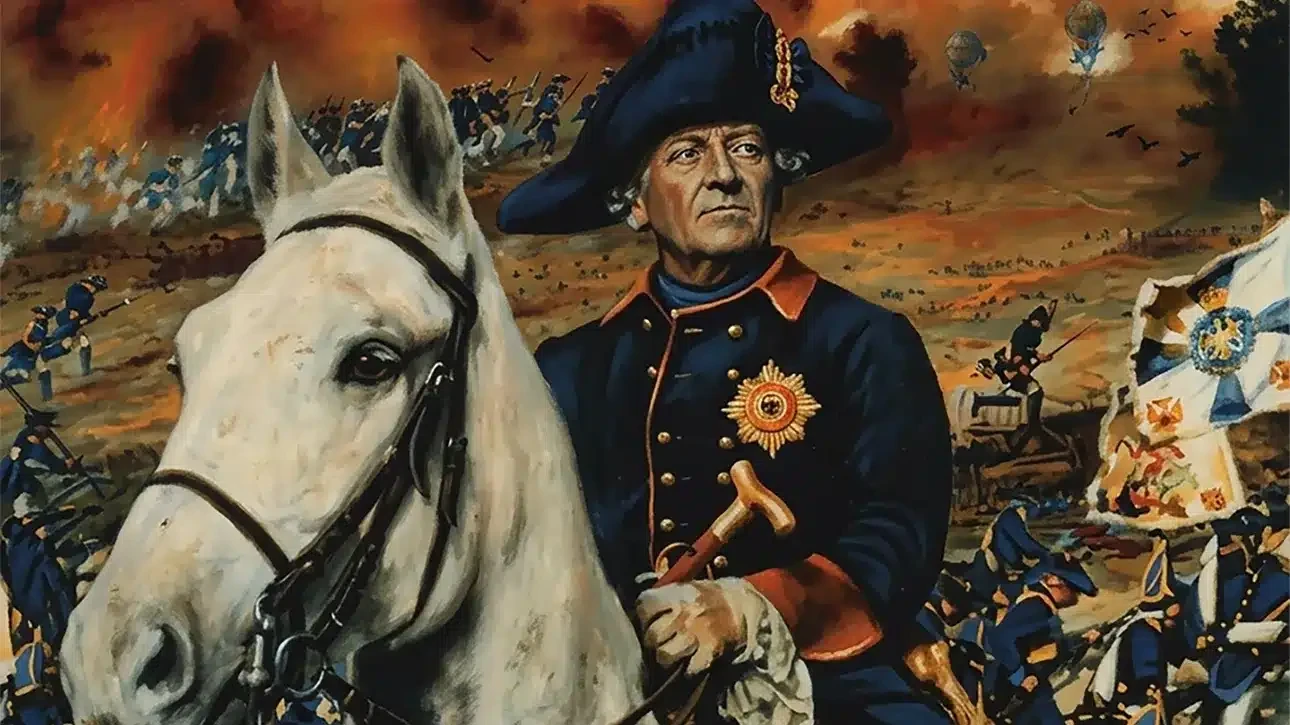
Few figures illustrate this paradox more clearly than Frederick the Great and his cinematic alter ego, actor Otto Gebühr. Remade across decades of sweeping political upheaval—from the fading twilight of the German Empire through the fragile democratic experiments of the Weimar Republic, and finally into the suffocating ideological grip of the Third Reich—Gebühr’s portrayal of the Prussian monarch achieved a rare feat. Despite being co-opted by Joseph Goebbels’s propaganda apparatus in films such as Veit Harlan’s 1942 wartime epic The Great King (Der große König), Gebühr’s interpretation managed to transcend its political cage.
When the machinery of the Nazi regime collapsed in 1945, the ideological context surrounding these cinematic works dissolved into an aesthetic vacuum. Yet, rather than pulling the image of Frederick II down into historical infamy, the vacuum was filled by the lingering humanity of Gebühr’s performance. To generations of German viewers, he did not embody a ruthless warmonger or a fascist precursor; instead, he represented a king of duty, quiet reflection, and endurance.
This investigation explores how a legendary actor and a Prussian monarch navigated the perilous waters of ideology, examining how early cinematic philosophies birthed an enduring cultural icon whose cinematic legacy outlived the very regime that sought to weaponize him.
Detailed Chronology: From Weimar Reflection to Wartime Instrument
To understand how Otto Gebühr became synonymous with Frederick II, one must trace the evolution of the cinematic representation of Prussia across three distinct political eras. The journey of the "Great King" on screen was never static; it shifted from a therapeutic cultural exercise in the Weimar years to a blunt instrument of martial mobilization under the swastika.
1. The Weimar Republic and the Birth of Cinematic Prussiana (1930)
Following the catastrophic defeat of World War I and the economic ruin of the early Weimar years, German society experienced profound social and psychological turmoil. In times of severe crisis, cultural institutions frequently turn backward to mine history for stability. This impulse birthed a new cinematic philosophy in the early 1930s—one that rejected the claustrophobic confines of contemporary "living-room dramas" (Zeitstücke) in favor of grand historical tapestries.
Cinemagoers of the era were tired of cinematic realism that mirrored their immediate, miserable reality. Instead, as noted in contemporary film journals like Die Filmwelt, intellectuals and artists sought the "tangible closeness of genius." The release of films like The Flute Concert of Sanssouci (Das Flötenkonzert von Sanssouci) in 1930 introduced audiences to a mature, culturally rich Frederick. Here, the king was not merely a military tactician, but a man of letters, arts, and profound personal burdens.
The ambition of these early films was atmospheric rather than ideological. As actress Renate Müller playfully recounted in contemporary press anecdotes regarding the meticulous adjustments of historical costumes—such as altering tricorne hats to achieve a dashing silhouette—the cinematic revival of the 18th century was treated as an immersive cultural aesthetic. The overarching message communicated to the public was one of quiet resilience: Frederick had endured existential crises, and so too could contemporary Germans survive their economic trials.
2. The Nazi Co-Optation and the Venice Biennale (1942)
As the National Socialists consolidated power throughout the 1930s, the subtle, reflective tone of Weimar-era historical films began to warp. The regime recognized the potency of Prussian iconography and sought to harness it to justify its own aggressive geopolitical ambitions. However, Goebbels’s propaganda ministry faced a subtle strategic miscalculation.
By 1942, amidst the grinding human cost of the Second World War, the regime commissioned Veit Harlan to direct The Great King. Pitched internationally—such as at the Venice Biennale—the film was framed as both a tribute to past German greatness and a psychological prop for the current war effort. Official statements from the period emphasized that even amid total war, the leadership recognized the necessity of preserving cultural achievements to prepare for the "political consolidation of the Axis powers."
Yet, the ideological narrowing was stark. While Weimar critics discussed philosophy, fashion, and psychological endurance, Nazi press organs reduced Frederick’s complex motivations to a singular directive: uncompromising victory through unyielding militaristic duty. The broader cultural framework was stripped away, leaving behind a raw propaganda message meant to steel the populace for total mobilization.
3. Collapse of Context and Post-War Reinterpretation (1954)
When the Third Reich fell in May 1945, the ideological scaffolding supporting films like The Great King collapsed overnight. Cultural artifacts tainted by Nazi association—from the Roman eagle to Gothic typefaces—were largely rejected by a society desperate to distance itself from the immediate past. Yet, the image of Frederick II, anchored decades deep by Otto Gebühr’s sympathetic performances, resisted complete contamination.
An obituary published in the influential German weekly Die Zeit on March 18, 1954, titled "The Curse of Resemblance" (Der Fluch der Ähnlichkeit), captured this historical reality. The author observed that because authentic historical records of Frederick II’s true appearance are sparse, the public visual identity of the king had become permanently fused with Otto Gebühr’s physical features and the engravings found in school textbooks.
Rather than remembering a fascist caricature, post-war audiences remembered a humanized monarch. The layers of wartime propaganda burned away, leaving behind the actor’s profound melancholy, his solitary burdens, and his portrayal as a "king of duty rather than a king of struggle."
Supporting Context & Metrics: The Mechanics of Screen Memory
To fully appreciate the transformation of Otto Gebühr’s career, one must examine the intersection of acting tradition, audience reception, and the shifting paradigms of early European cinema journalism.
The Evolution of Film Promotion (1930 vs. 1942)
A comparative analysis of film journalism from the Weimar era versus the height of World War II reveals a stark contraction in critical discourse:
| Metric / Dimension | Weimar Cinema (c. 1930) | Nazi Wartime Cinema (c. 1942) |
|---|---|---|
| Primary Thematic Focus | Cultural significance, philosophy, artistic patronage, and personal resilience. | Military steadfastness, state survival, and total victory in war. |
| Audience Appeal Strategy | Immersive historical atmosphere ("crinoline and tricorne") to ease economic anxiety. | Direct alignment of past martial sacrifice with current geopolitical struggle. |
| Portrayal of the Monarch | Deeply human, reflective, artistic (flute-playing, cultural burdens). | Stoic, decisive, military commander facing existential threats. |
| Critical Discourse | Broad discussions encompassing fashion, historical accuracy, and theatrical heritage. | Narrow ideological focus on propaganda utility and Axis solidarity. |
This shift demonstrates how an artistic tradition, once established across silent films and early talkies, developed an inertial momentum of its own. By the time the propaganda ministry attempted to weaponize Gebühr’s Frederick in the 1940s, audiences were not responding to a novel ideological creation; they were recognizing a familiar, comforting cinematic friend established a decade prior.
The "Miracle of the House of Brandenburg" for an Actor
Otto Gebühr was never politically radicalized, nor was he known for active anti-Nazi resistance. His survival as a respected cultural figure post-1945 is often described metaphorically as his own personal "Miracle of the House of Brandenburg"—a historical idiom denoting sudden, unexpected salvation from total ruin.
By consistently imbuing Frederick with vulnerability—such as the famous, deeply emotional scene in Fridericus (1937) where the king weeps openly over the death of his sister Wilhelmine before forcing himself back to work—Gebühr carved out a distinct space in the viewer’s psyche. He established the archetype of the "deeply human Frederick." When later Nazi films attempted to force him into a rigid, unyielding militaristic mold, the prior decade of empathetic character work softened the blow, shielding the actor’s legacy from permanent association with totalitarian brutality.
Official Statements & Archival Evidence
The ideological transformations of these cinematic projects are heavily documented in the contemporary press of the 20th century. Examining these archival fragments provides an unvarnished look at how institutions attempted to manipulate public consciousness.
The Weimar Philosophical Defense (1930)
In promotional materials accompanying the release of The Flute Concert of Sanssouci, industry analysts defended the turn toward historical drama against critics of contemporary realism:
"For many years the theatre was deprived of costume; what was called the ‘play of contemporary life’ (Zeitstück) prevailed. It was believed that only the man of today and his concerns were worthy of depiction. But time decided otherwise. As always, whenever the life of the present was thrown into turmoil, the finest minds turned to history and once again revived its figures in drama…"
— Die Filmwelt, November 30, 1930.
This statement highlights an enduring psychological truth: during systemic collapse, society looks backward not merely to escape, but to find structural frameworks capable of bearing the weight of contemporary reality.
The Wartime Mandate (1942)
Conversely, official coverage of German cinematic output during the height of the war stripped away the artistic philosophy, replacing it with stark geopolitical utility:
"Despite the severity of the war, which demands the exertion of all strength for victory, the German leadership recognized in good time the necessity of preserving cultural and artistic achievements wherever circumstances permitted, so that we might be well prepared for the new tasks arising from the political consolidation of the Axis powers…"
— Die Filmwelt, September 16, 1942.
Here, culture is explicitly instrumentalized. Yet, the irony remains: the films themselves relied on an actor whose persona had already been locked into a humanist, reflective register by years of prior cinematic tradition. The propaganda machine attempted to ride the coattails of Gebühr’s established popularity, only for that popularity to ultimately outlive the regime itself.
Future Outlook: Re-Evaluating Cinema Under Totalitarian Regimes
As contemporary film historians and cultural analysts continue to re-examine the artistic output of the Weimar and Nazi eras, the case of Otto Gebühr and Frederick the Great offers vital methodological lessons. It challenges simplistic binary interpretations that categorize all art produced under a totalitarian regime as purely fascist propaganda.
- The Autonomy of the Aesthetic: Artistic performances possess an internal momentum and emotional resonance that can slip the leash of ideological intent. Gebühr’s portrayal proved that an audience reads a performance through the cumulative lens of a long artistic trajectory, not just the immediate political demands of a single wartime release.
- The Danger of Retroactive Anachronism: Modern viewers must exercise caution when evaluating historical media. Dismissing films like The Great King solely as Nazi artifacts blinds us to the complex psychological mechanisms through which historical figures are co-opted, domesticated, and ultimately remembered by the public.
- The Longevity of Iconography: Just as the physical appearance of Frederick II became permanently intertwined with Gebühr’s visage—as noted in Die Zeit’s 1954 retrospective—cultural icons possess a stubborn vitality. They survive regimes, wars, and ideological rewritings by anchoring themselves in universal human themes: duty, grief, resilience, and the crushing burden of responsibility.
Ultimately, Otto Gebühr’s legacy stands as a testament to the complex interplay between artist and state. In the end, it was not the ephemeral decrees of Joseph Goebbels that defined the cinematic Frederick the Great for posterity, but the quiet, melancholic dignity brought to life by an actor caught in the crosscurrents of history.






Belum ada komentar. Jadilah yang pertama berkomentar!