The global entertainment landscape is undergoing a tectonic shift, and nowhere is this more pronounced than in India, where more than 118 million users now consume snack-sized, episodic microdramas every single month. Capitalizing on this explosive trend, EloElo—the parent company behind the surging vertical video platform Story TV—has successfully closed an $80 million Series C funding round.
Co-led by Hornbill Capital and entertainment giant NBCUniversal, with additional participation from MIT Investment Co. and existing backers like Play Ventures, Kalaari Capital, Waterbridge Ventures, Griffin Gaming Partners, and Kalaari Capital, this latest capital infusion brings EloElo’s total lifetime fundraising to an impressive $130 million. More notably, the transaction values the four-year-old startup at $500 million, placing it firmly among the elite tier of emerging media tech powerhouses in the region.
As smartphones supplant traditional television sets as the primary entertainment portal for the next generation of internet users, microdramas—consisting of high-octane, vertical episodes typically lasting just a minute or two—have transcended novelty status. They are now a multi-billion-dollar economic force. With a massive catalog exceeding 5,000 titles across six regional Indian languages, Story TV commands over 33 million active users, cementing its position at the vanguard of a cultural movement that is reshaping how stories are told, monetized, and consumed worldwide.
Detailed Chronology: From Pandemic Startup to Media Juggernaut
The genesis of EloElo traces back to 2020, a year defined by global upheaval and a massive surge in digital consumption. Founded by former Flipkart executive Saurabh Pandey, the platform initially set out to build interactive engagement models. However, recognizing the structural shift in mobile behavior, Pandey and his team pivoted aggressively toward serialized vertical video.
2020: Saurabh Pandey founds EloElo, aiming to capture the nascent creator economy and interactive media market in India.
The Pandemic Era & Pivot: As millions of locked-down consumers turned to their mobile screens, engagement metrics revealed an undeniable truth: audiences were moving away from long-form appointment viewing and toward bite-sized, on-the-go video formats.
The Rise of Story TV: Recognizing that short-form clips lacked the narrative depth of traditional shows—and that serialized storytelling was poorly optimized for mobile screens—EloElo launched Story TV. The platform quickly gained traction, scaling to a library of over 5,000 distinct titles.
Strategic Partnerships: To ensure high production values that could rival traditional television, Story TV formed strategic alliances with industry heavyweights, notably partnering with Indian TV production giant Balaji Telefilms to co-create premium content.
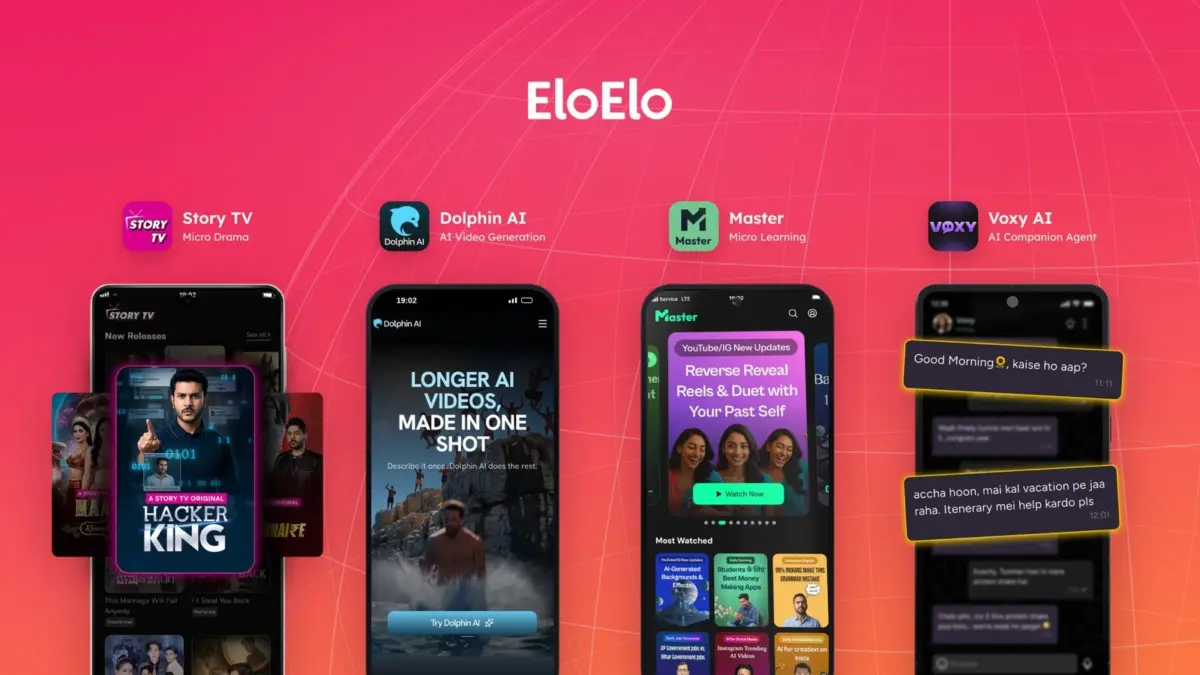
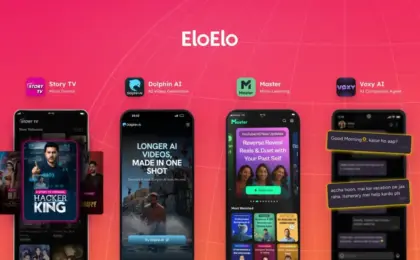
Diversification and Ecosystem Expansion: Beyond microdramas, EloElo expanded its digital footprint by launching Master, a vertical video learning app competing with the likes of Seekho and Kuku’s Guru, alongside an AI companion app named Voxy AI. Today, the combined ecosystem boasts over 40 million monthly active users.
November 2026: EloElo closes its landmark $80 million Series C round led by Hornbill Capital and NBCUniversal, officially hitting a $500 million valuation and setting the stage for aggressive artificial intelligence integration and original content production.
Supporting Context & Metrics: The Mathematics of Mobile-First Entertainment
The rapid financial backing of Story TV is rooted in compelling macroeconomic and behavioral data. India, boasting an internet population exceeding one billion people, presents an unprecedented playground for digital content creators.
According to comprehensive industry reports, including data from market intelligence firm Lumikai and Redseer:
Market Projections: The Indian interactive media and microdrama economy is on a steep upward trajectory, with annual revenues projected to cross $3 to $4 billion by 2030.
App Dominance: Dedicated microdrama apps—led by Story TV, Kuku TV, and Quick TV—ranked among the most downloaded video streaming applications in India, outperforming several legacy platforms.
User Engagement: Story TV users log an astonishing 95 minutes per day on the application, breaking down their consumption into multiple high-frequency sessions throughout the day.
The Monetization Hurdle: While engagement is remarkably high, monetization remains a complex hurdle in the Indian market. Industry analyses from Redseer and Ormax Media indicate that while more than 40 million individuals have paid for a microdrama at least once, only 15 to 17 million users convert into monthly paying subscribers. Furthermore, survey data suggests that 72% of consumers have never paid for microdrama content, relying instead on ad-supported models.
Despite the friction in converting free users to paid tiers, EloElo has successfully deployed a multi-tiered subscription model (monthly, quarterly, and yearly passes) alongside ad-supported free content, betting that unmatched production quality will naturally drive subscription conversion.
Official Statements and Industry Perspectives
The global appeal of the microdrama format is no longer confined to Asia. While markets in China pioneered the vertical serialization format—and platforms in the United States have attracted investments and starring roles from Hollywood heavyweights like Issa Rae, James Franco, and Kim Kardashian—the Indian adaptation is uniquely localized.
Reflecting on the psychological shift in media consumption, EloElo founder and CEO Saurabh Pandey offered a clear-eyed assessment of the future during an interview with tech publications:
"I fundamentally believe that the next billion users will probably not grow up on a diet of watching television; they will grow up on a diet of watching content on their phones, right? And this content has to be, and this entertainment, designed very differently. It’s not going to be appointment viewing. It’s going to be within certain slots throughout the day. And a lot of this was earlier solved for short clips, but serialized storytelling was never solved."
While acknowledging that traditional big-screen viewing will retain a niche space for communal family gatherings, Pandey maintains that the vast majority of daily entertainment consumption will inevitably migrate to mobile devices.
Addressing the fierce competition from tech giants and user-generated platforms like YouTube, Instagram, and TikTok—which are also testing episodic reels and free short-form video series—Pandey emphasized that quality and curatorial excellence will serve as the primary moats for dedicated apps like Story TV.
Future Outlook: Artificial Intelligence, Expansion, and the Human Element
As EloElo absorbs its $80 million capital injection, the company’s roadmap highlights two primary areas of deployment: expanding its original content catalog and aggressively scaling its proprietary artificial intelligence infrastructure.
The Role of Dolphin AI
While rival platforms—such as Google-backed Kuku and Dashverse’s Shortfree—are heavily leveraging video AI models and workflow automations to accelerate content pipelines, EloElo is taking a measured, hybrid approach via its internal toolset, Dolphin AI.
Initially built as an internal asset to streamline video creation, Dolphin AI is slated for a broader rollout. The platform acts as a sophisticated editing suite equipped with templates and a diverse array of generative models designed to synthesize images, audio, and video. EloElo envisions opening the tool beyond internal production, offering it to external brands and marketers for digital campaigns and ad creation.
The "Formula One Driver" Philosophy
Despite the rapid evolution of generative artificial intelligence, Pandey remains a staunch proponent of human-led creative direction. He rejects the notion that AI can independently manufacture cultural resonance, framing technology as an accelerator rather than a replacement for human storytellers:
"My belief in involving AI is that AI is a really fast race car where AI is the engine, but you need an extremely capable Formula One driver to be on the steering wheel. That, for me, is the creative director or the showrunner. AI is supposed to work with them, augmenting their skill set. AI can help write stories, but so far the best stories I have loved have all had a very high human x AI element to it."
Scaling Up
To execute this ambitious dual strategy of AI research and heavy content production, EloElo is actively expanding its workforce. The company currently employs 240 people and plans to use a substantial portion of its fresh Series C capital to bolster its machine learning research teams and engineering departments.
With deep-pocketed institutional backing, a proven valuation of half a billion dollars, and a firm grasp on the psychological habits of the mobile-first generation, Story TV and its parent company EloElo are exceptionally well-positioned. As the boundary between traditional cinema and snackable mobile content continues to blur, the company is not merely participating in India’s digital entertainment boom—it is actively writing the script for it.





Belum ada komentar. Jadilah yang pertama berkomentar!