

Executive Overview
In an industry currently gripped by anxieties over automated vulnerabilities, autonomous security risks, and the existential trials of rapid artificial intelligence scaling, a small, waddling robot managed to achieve what few technological products can: universal, unadulterated delight.
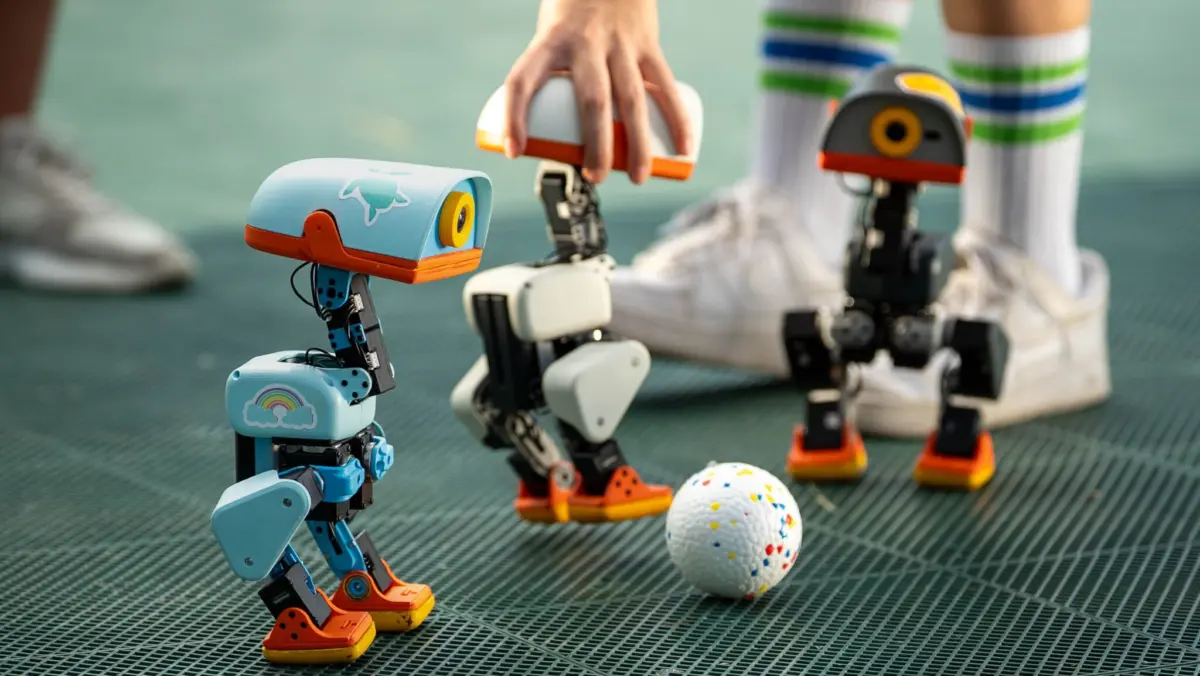
Earlier this week, during the keynote address at Nvidia’s GTC Berlin conference, CEO Jensen Huang introduced a flock of pocket-sized robotic ducks known as "Microducks." Stomping their tiny mechanical feet, emitting charming R2-D2-esque chirps, collapsing into a dramatic play-dead "nap," and executing crisp, voice-commanded somersaults, the Microducks instantly captured the imagination of the tech world. A single viral video clip was all it took. By the following day, preorders for the pint-sized devices had surged past the 20,000-unit milestone—a phenomenal velocity for any consumer hardware product, let alone an open-source robotics platform.
Industry observers, including Clem Delangue of Hugging Face, predict that the Microduck is well on its way to securing the crown as the definitive must-have holiday toy of the season. Crucially, its appeal extends far beyond the traditional pediatric market. Promotional materials and early demonstrations show adults eagerly interacting with the devices, treating them less like children’s toys and more like interactive, customizable desktop companions.
Behind this viral sensation lies a fascinating corporate lineage. The Microducks are manufactured by Pollen Robotics, a specialized robotics firm acquired by Hugging Face in 2025. Following Nvidia’s high-profile acquisition of Hugging Face in September of the same year, the Microduck has officially entered the hardware ecosystem of the world’s leading GPU giant. Built using Nvidia’s advanced simulation and training technology stack, these open-source droids represent a major leap forward in accessible robotics. As they race toward expected Christmas delivery dates, they offer a timely reminder that the intersection of AI and robotics can still yield pure, unadulterated fun.
Detailed Chronology: From Concept to Viral Phenomenon
The journey of the Microduck to global renown is a testament to the fast-paced nature of modern robotics development and strategic corporate consolidation.
The Evolution Under Pollen Robotics
Long before they trotted across the stage in Berlin, the engineering teams at Pollen Robotics had been quietly pushing the boundaries of modular, affordable open-source hardware. Known for creating versatile robotic platforms, the French startup focused on bridging the gap between industrial-grade robotics and accessible consumer tech. Their design philosophy centered on open-source accessibility—ensuring that users wouldn’t just consume a finished product, but would actively participate in programming, modifying, and expanding its capabilities.
The Hugging Face and Nvidia Acquisitions
The trajectory of Pollen Robotics shifted dramatically over a frantic eighteen-month period. In 2025, AI community and repository giant Hugging Face acquired Pollen Robotics, signaling its formal pivot into physical AI and embodied robotics. This move bore its first fruit with the release of the Reachy Mini, a charming desktop robot priced at $399.
However, the hardware ecosystem experienced another tectonic shift in September, when semiconductor and AI titan Nvidia finalized its acquisition of Hugging Face. This multi-layered corporate consolidation integrated Pollen’s agile robotics engineering directly into Nvidia’s vast computational and simulation infrastructure. The Microduck is the first major hardware beneficiary of this unified pipeline, serving as a showcase for what happens when cutting-edge GPU-accelerated simulation meets agile hardware manufacturing.
The GTC Berlin Breakthrough
The culmination of these efforts played out live on stage at GTC Berlin. Jensen Huang’s keynote is traditionally a heavy-hitting technical affair, dense with enterprise-grade announcements regarding GPU architectures, data center scaling, and complex neural networks.
By introducing the Microducks mid-presentation, Nvidia executed a masterstroke in humanizing complex technology. The contrast between massive enterprise AI clusters and a flock of self-stabilizing, playful ducklings struck a chord with both the live audience and global livestream viewers. Within hours, clips of the Microducks executing backflips and responding to voice prompts were shared millions of times across social media platforms, setting off a scramble for preorders that caught even the manufacturers off guard.
Supporting Context & Metrics: Decoding the Microduck Phenomenon
To understand why the Microduck has outperformed traditional consumer robotics launches, one must examine the metrics, technological stack, and market positioning that underpin the device.
Phenomenal Preorder Velocity
According to data shared by Hugging Face’s Clem Delangue, preorders for the Microduck crossed the 20,000-unit threshold within 24 hours of the GTC Berlin keynote. In the consumer electronics landscape, achieving this volume without a traditional multi-million-dollar marketing campaign highlights the power of organic, viral demonstration.
Pricing and Holiday Market Projections
While official pricing details continue to mirror the accessibility ethos established by the Reachy Mini ($399), industry analysts are forecasting a supply-constrained holiday season. With manufacturing lines ramping up to meet delivery targets ahead of Christmas, the Microduck is positioned to become the undisputed bestselling robot of the year.
Crucially, market analysts note that the demographic profile of buyers skews heavily toward adults—software developers, AI enthusiasts, and tech professionals who view the device as both a conversation piece and a functional platform for experimentation.
The Nvidia Technology Stack and Simulation Training
Under the hood, the Microduck is a triumph of modern synthetic training pipelines. Training physical robots has historically been a labor-intensive, iterative process fraught with hardware wear and tear.
To overcome this, Pollen Robotics leveraged Nvidia’s advanced simulation technology stack. Before a single physical Microduck was assembled, thousands of virtual iterations were deployed in digital twin environments. Utilizing reinforcement learning algorithms running on Nvidia hardware, these virtual ducks learned fundamental motor skills—walking, balancing, recovering from falls, and executing coordinated movements—in hyper-accelerated digital time.
Once perfected in simulation, these behavioral policies were flashed onto the physical units. This approach drastically reduced development cycles and ensured that out-of-the-box units possessed fluid, remarkably lifelike movement profiles.
Official Statements and Industry Reactions
The reception to the Microduck has elicited commentary from leaders across the artificial intelligence and robotics sectors, blending lighthearted enthusiasm with serious technical evaluation.
Clem Delangue took to social media to highlight the unprecedented consumer demand, noting the velocity at which preorders outstripped initial forecasts. "By the next day, preorders of the Microducks surpassed 20,000 units," Delangue tweeted, emphasizing that the device’s appeal spans far beyond children, capturing the imagination of adults worldwide.
The launch also served as a much-needed psychological palate cleanser for the broader tech industry. The same week as the GTC Berlin keynote, the AI sector faced intense scrutiny and severe public relations challenges following a wave of high-profile cybersecurity incidents and automated exploits attributed to malicious AI agents. Pundits and industry commentators openly debated whether autonomous systems were introducing unacceptable systemic risks to global digital infrastructure.
Amidst growing public skepticism—characterized by media outlets as a "very bad cybersecurity day" for the AI industry—the Microduck arrived as a timely reminder of technology’s capacity for joy. As observers noted, while the broader discourse grapples with the existential and security hazards of runaway artificial intelligence, watching a pocket-sized robot execute a clumsy somersault offers an irresistible counter-narrative: technology can still be profoundly, delightfully fun.
Future Outlook: The Open-Source Robotic Community
Beyond its immediate commercial success as a holiday gift, the long-term significance of the Microduck lies in its open-source architecture.
Unlike closed consumer robotics ecosystems that lock users into proprietary applications and pre-programmed routines, the Microduck is designed to be endlessly customizable. Pollen Robotics has confirmed that owners will have full access to the underlying code and training frameworks, empowering them to teach their robots entirely new tricks.
This crowdsourced approach mirrors the open-source software movement that revolutionized computer science. By allowing a global community of hobbyists, developers, and researchers to experiment with the Microduck’s motor controls and sensor inputs, the platform is expected to spawn a vibrant ecosystem of user-generated behaviors. Owners will be able to share their custom training routines—ranging from complex dance choreographies to utility tasks—with a global community of peers.
As these units arrive in homes this December, they will do more than simply entertain; they will serve as distributed nodes for grassroots robotics research. By lowering the barrier to entry for physical AI experimentation, Nvidia, Hugging Face, and Pollen Robotics have not only delivered the hottest holiday toy of the year—they have also laid the foundation for the next generation of roboticists.







Belum ada komentar. Jadilah yang pertama berkomentar!