

Executive Overview
The architecture of video game age ratings is undergoing a monumental paradigm shift in Europe. For decades, systems like the Pan European Game Information (PEGI) framework and North America’s Entertainment Software Rating Board (ESRB) were primarily designed to flag explicit material—evaluating titles through a strict moral lens centered on graphic violence, intense gore, strong language, and sexual content. However, the commercial and design evolution of the modern video game industry has rendered these traditional safeguards increasingly obsolete.
Today, the most insidious threats to consumers—particularly vulnerable demographics like children and adolescents—do not necessarily stem from blood and bullets, but from psychological monetization tactics. Recognizing this reality, PEGI has officially taken a hardline stance against monetized unpredictability. The ratings agency has begun aggressively escalating age classifications for titles that incorporate "paid random items," most notably loot boxes and gacha mechanics.
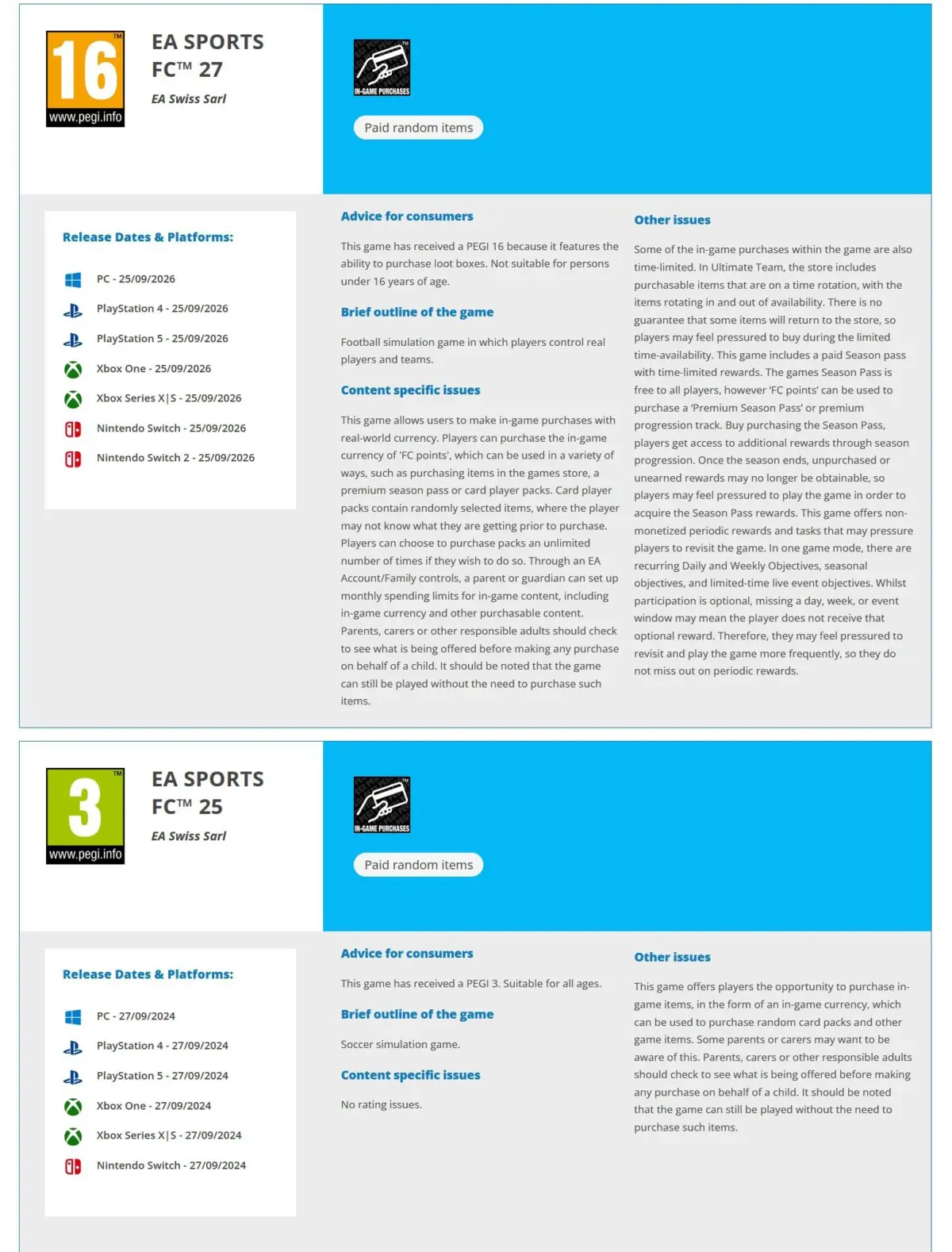
Under the newly expanded criteria implemented earlier this year, games that once enjoyed family-friendly, universally accessible ratings such as PEGI 3 are suddenly being bounced straight up to PEGI 16. A striking example of this policy in action is visible in Electronic Arts’ flagship sports franchise: whereas EA Sports FC 25 comfortably held a PEGI 3 designation, its successor, EA Sports FC 27, has landed squarely with a PEGI 16 rating due to its inclusion of digital currencies, seasonal upgrade passes, and randomized player packs.
This regulatory divergence exposes a widening chasm between European and North American consumer protection philosophies. While European regulators adapt to modern financial entrapment strategies in games, North America’s ESRB has elected to maintain the status quo, arguing that integrating monetization features into core age brackets risks confusing parents. As the industry grapples with these competing approaches, the debate over how to regulate digital gambling-adjacent mechanics in interactive entertainment has entered its most consequential chapter yet.
Detailed Chronology: How PEGI’s Framework Evolved
To understand how a soccer simulation featuring photorealistic athletes kicked off a sweeping regulatory crackdown, one must trace the timeline of consumer advocacy, legislative pressure, and industry adaptation that led to PEGI’s overhaul.
The Groundwork: Early Warnings and Legislative Protests (2018–2022)
The friction between video game monetization models and youth safety is not a new phenomenon. When games like Star Wars Battlefront II and FIFA 18 popularized aggressive microtransaction loops and pay-to-win loot boxes in the late 2010s, global pushback was swift. National regulatory bodies—most notably in Belgium and the Netherlands—classified loot boxes as a form of illegal gambling under existing national legislation, forcing publishers to scramble and alter their game loops for specific European territories.
Despite these localized interventions, overarching age-rating boards moved slowly. For years, content descriptors like "In-Game Purchases" were added as minor advisory notices, appended to existing ratings without altering the fundamental age classification. A game could contain casino-style pack openings and still be deemed entirely appropriate for a three-year-old, provided it lacked blood or profanity. Consumer protection groups, parents’ associations, and academic researchers heavily criticized this disconnect, arguing that the psychological pull of variable-reward schedules closely mirrors slot machine mechanics and poses a legitimate risk to developing minds.
The Shift: March 2024 Policy Announcements
The turning point for the European framework arrived in March 2024, when PEGI officially announced a comprehensive modernization of its evaluation criteria. Recognizing that the definition of "harm" in gaming had expanded far beyond mature visual content, PEGI introduced a series of newly formalized "interactive risk categories."
These revamped criteria specifically targeted systemic features designed to alter player behavior, prolong engagement, and extract capital. The new classifications formally encompassed:

- The direct purchase of in-game content and expansions.
- Paid random items (loot boxes, blind packs, and gacha mechanics).
- Unrestricted or moderately moderated online communication and chat features.
- Persistent design loops and psychological features explicitly incentivizing continuous, uninterrupted play.
Implementation and the June 2024 Rollout
Following the spring announcement, the framework transitioned from theory to practice. Connor Hindle, policy manager of the UK’s Games Rating Authority (the administrative body responsible for applying PEGI standards within the United Kingdom), outlined the rollout in a statement on professional networks.
"Since June, newly submitted games have been assessed against an expanded set of criteria within the PEGI rating framework, including new criteria relating to interactive risks," Hindle explained. "As the UK administrator of PEGI, the Games Rating Authority has now begun applying these updated criteria to selected existing digital products."
This operational phase signaled that regulatory enforcement was no longer limited to prospective, yet-to-be-released titles. Existing digital storefronts began facing comprehensive audits, with automated and manual re-evaluations sweeping through back-catalogs to catch titles that rely heavily on monetization and digital currency transactions.
Supporting Context & Metrics: The Case of EA Sports FC
The practical implications of PEGI’s updated framework are best observed by analyzing high-profile, annual sports franchises. Few series embody the modern monetization dilemma quite like Electronic Arts’ mega-hit soccer simulation, previously known as FIFA and currently published under the EA Sports FC banner.
The EA Sports FC 25 vs. EA Sports FC 27 Discrepancy
For years, sports titles thrived on a universal PEGI 3 rating. Because soccer matches are inherently family-friendly—devoid of graphic violence, crude language, or mature themes—games like EA Sports FC 25 sailed through the ratings process with "no rating issues." Parents across Europe could purchase the title for young children with absolute peace of mind, assuming the on-screen action was entirely benign.
However, beneath the wholesome surface of the pitch lay a fiercely lucrative engine: Ultimate Team. This mode encourages players to build fantasy squads by purchasing player packs through randomized drops, driving billions of dollars in recurring annual revenue for Electronic Arts.
When EA Sports FC 27 was submitted to the Games Rating Authority under the newly minted interactive risk guidelines, the safety net vanished. Because the title incorporates paid random items, its default age classification was instantly bumped up to PEGI 16.
An inspection of the official PEGI registry reveals a stark administrative contrast:
- EA Sports FC 25 (PEGI 3): Clean bill of health, designated suitable for all age groups, with minimal compliance warnings regarding basic online connectivity.
- EA Sports FC 27 (PEGI 16): Accompanied by a granular, explicit breakdown of the monetization features contained within the software. The registry notes the presence of digital currencies (FC Points), paid season passes, and randomized player packs designed to alter competitive team composition.
This massive jump—from age 3 to age 16—fundamentally alters how retailers can market, display, and sell the game, serving as a loud warning flare to major publishers relying on live-service revenue models.

Official Statements and Industry Reactions
The regulatory divide across the Atlantic has highlighted a philosophical split between European watchdogs and North American authorities. While PEGI is aggressively rewriting its rulebook, the American and Canadian systems are taking a deliberately cautious, divergent approach.
The North American Stance: ESRB Resists the Shift
While Europe tightens the screws on loot boxes, North America’s Entertainment Software Rating Board (ESRB) has explicitly indicated it will not follow suit. In statements released alongside PEGI’s initial spring announcements, an ESRB representative defended the board’s existing methodology.
According to ESRB research, integrating non-content-related features—such as monetization mechanics, in-game advertising, or design loops—directly into core age ratings runs a significant risk of confusing parents. The ESRB argues that a parent looking at an age rating wants to know if a game contains blood, explicit language, or sexual themes; conflating those traditional content warnings with financial transactional features could dilute the clarity of the rating system.
Consequently, North American ratings continue to treat monetization as an advisory notice rather than a catalyst for age restriction. For instance, EA Sports FC 27 carries an E (Everyone) rating from the ESRB, accompanied strictly by content descriptors noting the presence of user interactions and general in-game purchases, completely bypassing any age-level inflation.
Industry Concussions and Publisher Compliance
Major game publishers are now forced to navigate a fragmented global marketplace. Developing, marketing, and distributing titles that straddle different regional classifications presents logistical hurdles. A game classified as appropriate for a seven-year-old in the United States may suddenly require ID verification or strict parental locks in European territories due to its inclusion of digital card packs or randomized cosmetic crates.
Industry analysts suggest that this regulatory pressure may eventually force publishers to pivot their monetization design philosophy. If titles risk being locked out of younger demographics—or restricted to older audiences who may be more critical of gambling-adjacent mechanics—studios may explore alternative monetization models, such as transparent, direct-purchase cosmetic shops or non-randomized battle passes, to mitigate rating penalties.
Future Outlook: What Next for Digital Game Ratings?
As the dust settles on the initial wave of PEGI 16 reclassifications, the broader gaming industry faces a period of intense transformation. Several critical questions loom over the immediate future of interactive entertainment regulation:
- Will Other Global Regions Follow PEGI’s Lead?
While the ESRB has planted its flag against changing core age tiers, pressure from consumer watchdogs in North America, Australia, and Asia continues to mount. If European enforcement proves successful in curbing youth exposure to predatory monetization, lawmakers in other jurisdictions may introduce legislation compelling local rating boards to adopt similar interactive risk frameworks. - The Evolution of Live-Service Design:
Developers of mobile games, free-to-play titles, and massive annual sports franchises must now weigh the financial benefits of loot boxes against the market restriction of a PEGI 16 rating. In some cases, the allure of microtransaction revenue far outweighs the loss of younger players; in others, publishers may decouple randomization from core progression loops entirely to preserve family-friendly marketability. - Parental Awareness and Education:
Ultimately, age ratings are only as effective as the adults who enforce them. As digital storefronts are flooded with newly reclassified titles, consumer advocacy groups emphasize the need for robust educational campaigns. Parents must be taught to look beyond traditional visual metrics and understand that modern digital risks are increasingly financial, psychological, and behavioral.
The era of evaluating video games solely on the basis of pixels, blood, and dialogue is officially over. By recognizing that monetization mechanics can be just as hazardous to a young player’s well-being as mature artistic content, PEGI has set a new global standard—initiating a high-stakes battle over how the world protects the next generation of gamers.









Belum ada komentar. Jadilah yang pertama berkomentar!