

Executive Overview
Over the past decade, South London’s humble, 150-capacity music venue, The Windmill in Brixton, has evolved into the most culturally influential and heavily discussed incubator of modern rock music in the world. Long before international publications codified the venue as the epicenter of a new wave of eccentric art rock, it served as a crucible for boundary-pushing experimentation. It birthed globally renowned acts such as Black Midi, Black Country, New Road, and The Last Dinner Party, while simultaneously inspiring a global diaspora of jazzy, multi-instrumentalist troupes—from Leeds’ English Teacher to New York City’s Geese and Santiago, Chile’s Hesse Kassel.
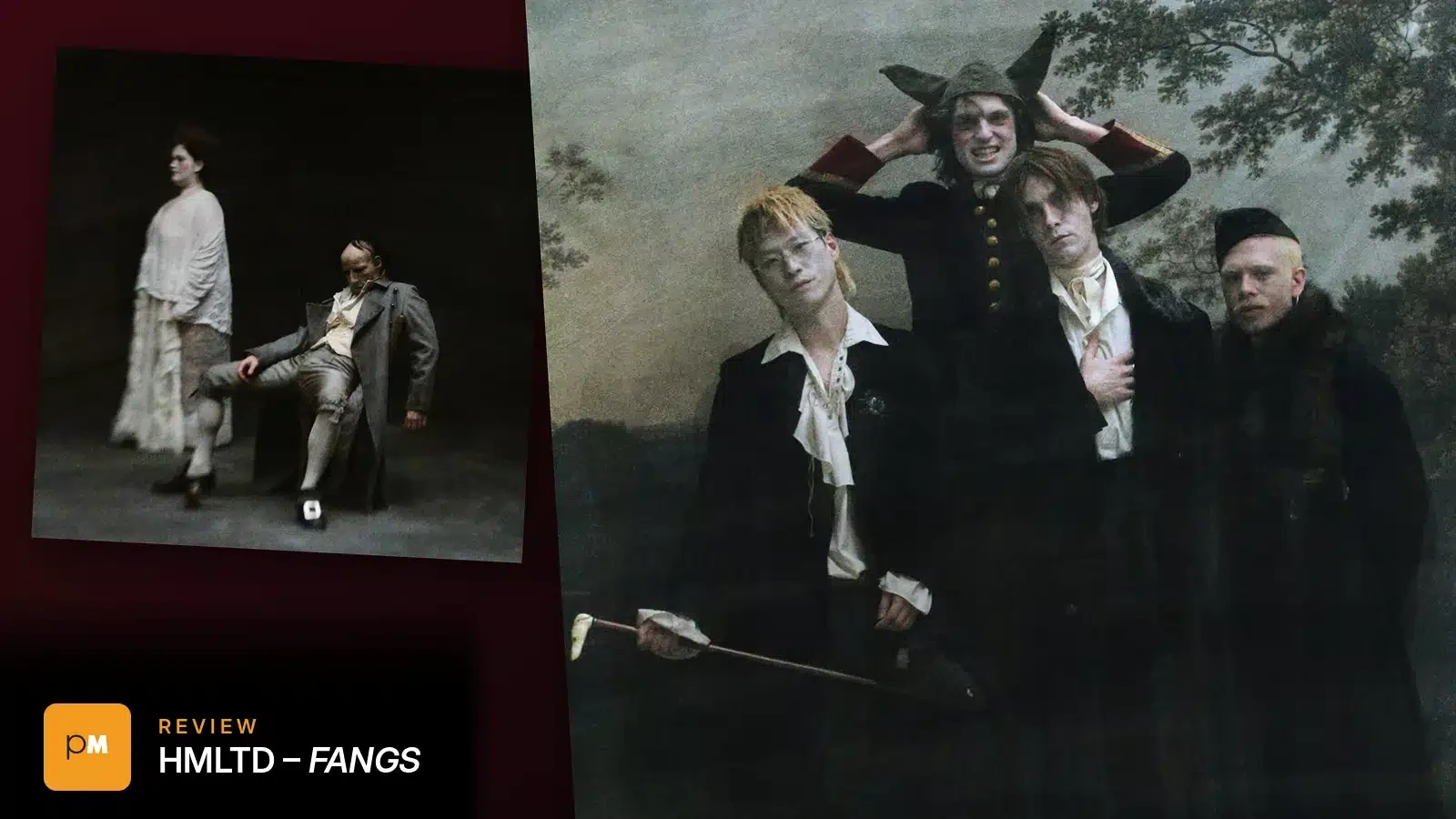
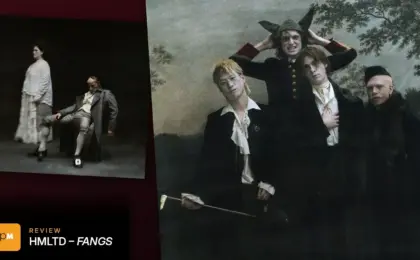
Yet, among the earliest architects of this movement, HMLTD stood out like aristocratic specters in a sea of drab, working-class post-punk signifiers. While their contemporaries donned muted garments and brooding demeanors for authenticity, HMLTD embraced multi-colored theatricality, operatic camp, and unrelenting genre-fluidity.
With the release of their latest album, Fangs, HMLTD has signaled a profound shift into the darker, mechanically driven aesthetics of goth, industrial, and darkwave. Coining the stylistic portmanteau “überth” (or the more verbose “götterdammerung”, marrying the German term for the "twilight of the gods" with "goth"), the band has anchored a broader cultural pivot across the post-2022 underground. Fangs stands as a masterclass in conceptual art-rock: a high-concept vampire narrative skewering late-stage capitalism, interwoven with post-hyperpop cadences, dark cabaret, and knowing meta-commentary. This piece explores the trajectory of HMLTD, the socio-musical ecosystem of the Windmill, and how Fangs cements its place as the definitive art-rock opera of the resurgent gothic generation.
Detailed Chronology: From Theater-Kid Anarchists to the Architects of ‘Überth’
Phase I: The Early Vanguard and the Brixton Crucible
When HMLTD first emerged from the primordial soup of the South London underground, the press had not yet unified the scene under a singular banner. Where contemporaneous groups championed a gritty, straightforward post-punk ethos—colliding traditional rock instrumentation with socio-political realism—HMLTD operated with an entirely different playbook.
Their early material was aggressively genre-agnostic. Tracks effortlessly collided the post-punk and Americana frameworks of their peers with trap, industrial rhythms, Electronic Body Music (EBM), and classical arrangements. In a scene that prided itself on unpredictability, HMLTD’s intentional refusal to be categorized became, ironically, its own defining category.
However, the broader South London scene took several years to catch up to HMLTD’s high-fantasy, dignified classical tendencies. It was not until the release of their high-fantasy art-rock opera, The Worm (2023), that the wider musical landscape mirrored their theatricality. The Worm laid a lush, baroque-pop foundation characterized by conscious image cultivation—whether channeled through regality, gothicism, or Hedi Slimane-inspired rock aesthetics—upon which acts like The Last Dinner Party would subsequently build their paths to mainstream fame.
Phase II: The Descent into Fangs
With Fangs, HMLTD completes a deliberate stylistic migration into the darker, harsher corners of goth and industrial rock. The album integrates the foundational tropes of these genres—mechanical rhythms, vintage DX7-synthesizer work, and cavernous, low-register vocal deliveries—without sacrificing the band’s signature theatrical zaniness and upbeat momentum.
Rather than serving as a nostalgic retread, Fangs maps directly onto the post-2022 global obsession with gothic resurgences. To contextualize this evolution, the band introduced the term “überth” (and the grander “götterdammerung”), capturing a three-year lineage of Windmill-adjacent groups incorporating non-rock instrumentation (such as brass, violins, and woodwinds) into dark, atmospheric frameworks. Artists like Tiss Vampyric, Heartworms, and Jesus and the Zealots all trace lineages back to this stylistic synthesis.
Supporting Context & Metrics: Deconstructing the Sound of Fangs
A Masterclass in Genre Pastiche
Fangs moves fluidly across the gothic spectrum, utilizing distinct sub-genre pastiches to evoke contrasting emotional responses.
- Deathrock Cabaret ("Chateau Vamp Freestyle"): This track serves as a theatrical, piano-centric centerpiece, heavily ornamented with brass and accordion-inflected crescendos. It draws direct lines to the gothic cabaret of Tiss Vampyric and the classic deathrock stylings of 1980s pioneers like Sex Gang Children.
- Darkwave Danceability ("Shudder"): In stark contrast, "Shudder" evokes the dance-floor-ready, radio-friendly darkwave of German electronic acts like Wolfsheim. Its elevated tempo aligns it with the genre’s recent adoption by former horror-hardcore acts, mirroring the gothic pivots seen in AFI’s "Holy Visions" or Creeper’s "Lover’s Led Astray."
Vocal Morphologies and Intertextual Soundscapes
Frontman Henry Spychalski’s vocal delivery on Fangs is an exercise in stylistic chameleonism. He occasionally adopts the ghostly, chest-voice lows of the genre’s forebears:
- Early tracks employ a Trent Reznor-esque vocal-fry approach.
- By the time "Closer to You" plays, his timbre shifts into the emotive cadence of Justin Warfield (She Wants Revenge), offering a refreshing alternative to the monotone Andrew Eldritch (The Sisters of Mercy) impressions that dominate contemporary goth.
- On the bridge of "Grab the Crucifix," Spychalski delivers a fleeting, high-register black metal croak, juxtaposed seamlessly against his classical musical-theatre tenor.
Beneath the gothic architecture, however, lies an unexpected contemporary pulse: post-hyperpop electropop. Rhythms and rap-sing cadences reminiscent of Charli XCX and Slayyyter permeate tracks like "What the Hell," "Umami," "Dancing on Your Grave," and "One Thousand White Horses."
While unorthodox on paper, this cross-pollination makes sense within the ecosystem of the Windmill. The internet-era neologism “indie sleaze” has long tethered the mid-2000s Hedi Slimane-influenced fashion of club kids and indie rockers to contemporary revivals. The opening guitar riff of "I Used to Ride in Limousines" nods directly to the New Rock Revival era, proving that darkwave, electropop, and indie sleaze all share a deep-seated genealogy rooted in synthpop.
Official Statements & Thematic Analysis
The Vampire as a Capitalist Allegory
Lyrically, Fangs is framed through the perspective of a hard-partying vampire, functioning as a razor-sharp conceptual critique of late-stage capitalism. The narrative equates the vampire’s biological imperative to convert humans with the Global North’s relentless culture of overconsumption and globalization.
This thematic choice bridges HMLTD with their Brixton peers, mirroring the vampiric motifs recently explored by bands like Opus Kink and Wednesday’s Child. Crucially, the album avoids self-serious preachiness by leaning heavily into camp and dark humor. Spychalski deadpans lines that juxtapose domestic absurdity with pop-culture ubiquity:
- "There is the chair, like a cuck, watching life fuck my wife." ("Grab the Crucifix")
- "Make me feel like 2012, the way she bad, like Joseph Kony." ("What the Hell")
Meta-Intertextuality and Scene History
On "I Used to Ride in Limousines," Spychalski turns his lens inward, crafting a meta-intertextual commentary on his own romantic and professional history. The song references his past relationship with The Last Dinner Party vocalist Abigail Morris. Its title and opening line directly mirror The Last Dinner Party’s track "Sail Away" (which opens with the line "We used to ride in limousines"), a song for which Spychalski holds a formal writing credit. This self-referential wink grounds the grand theatricality of Fangs in the very real, tightly knit interpersonal network of the South London scene.
Future Outlook: The Resurgent Goth Generation
HMLTD’s Fangs is more than just a stylistic pivot; it is a vital blueprint for the evolution of modern alternative music. By fusing dark cabaret, deathrock, darkwave, and hyperpop sensibilities into a cohesive conceptual framework, the band has proven that genre-fluidity does not require a sacrifice of historical reverence.
As the cultural shockwaves of the Windmill Brixton continue to ripple outward across the globe, HMLTD remains its most unpredictable and visionary architect. Fangs stands tall as the definitive progressive art-rock opera of the resurgent gothic generation—a testament to what happens when theatricality, political subversion, and unbridled musical curiosity are allowed to run rampant in a 150-capacity room.





Belum ada komentar. Jadilah yang pertama berkomentar!