

Executive Overview
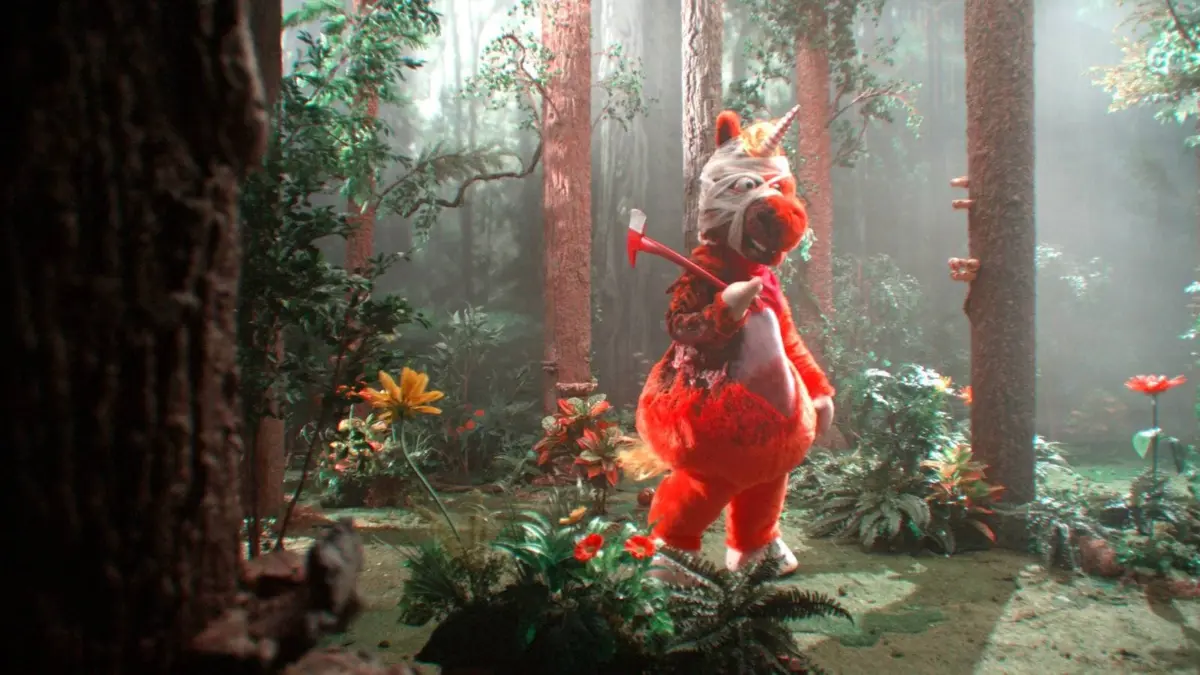
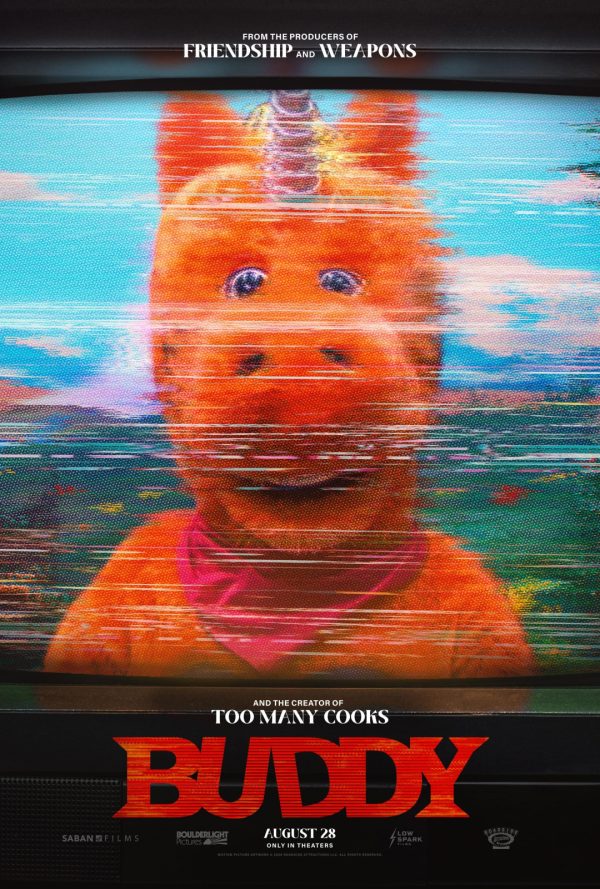
In the contemporary landscape of high-concept horror, few filmmakers possess the audacity to weaponize childhood nostalgia quite like writer and director Casper Kelly. Best known for his deeply unsettling and viral Adult Swim psychological descent Too Many Cooks, Kelly returns with his most ambitious project to date: Buddy. Slated for release in 2026, the feature-length film strips away the cozy, brightly lit aesthetics of 1990s educational children’s programming—reminiscent of PBS and early Nickelodeon staples—and replaces them with a ruthless, highly inventive slasher paradigm.
The premise of Buddy centers on "It’s Buddy!", a hyper-saturated, seemingly wholesome television program where a giant, friendly mascot named Buddy leads a troupe of children in songs, dances, and lessons about sharing and emotional resilience. However, this manufactured utopia fractures the moment a child steps out of line. When a young participant refuses to play along with the mandatory cheer, Buddy’s warm exterior dissolves into terrifying violence.
Boasting an ensemble cast that includes Cristin Milioti, Delaney Quinn, Patton Oswalt, Michael Shannon, Topher Grace, Madison Skyy Polan, and Keegan-Michael Key, Buddy transcends the standard "evil mascot" tropes popularized by independent horror games and straight-to-DVD B-movies. Instead, Kelly delivers a meticulously crafted, tonally balanced cinematic experiment. The film cleverly deconstructs the structural mechanisms of television production—utilizing vertical rolling credits not just as episode transitions, but as a supernatural reset button that heals the monstrous mascot and locks its victims into a perpetual loop of terror.
While the feature occasionally falters when it ventures outside the stylized confines of its primary television set into the broader real-world family drama, Buddy remains a triumph of production design, subversive storytelling, and uncompromising creature-feature suspense.

Detailed Chronology: The Anatomy of a Breakdown
To understand the narrative mechanics of Buddy, one must examine how Casper Kelly establishes the rules of his fictional universe before systematically breaking them. The film’s narrative arc can be cleanly divided into three distinct structural movements: the facade of the broadcast, the descent into the wilderness, and the bleeding of the screen into reality.
Act I: The Faux-Educational Broadcast
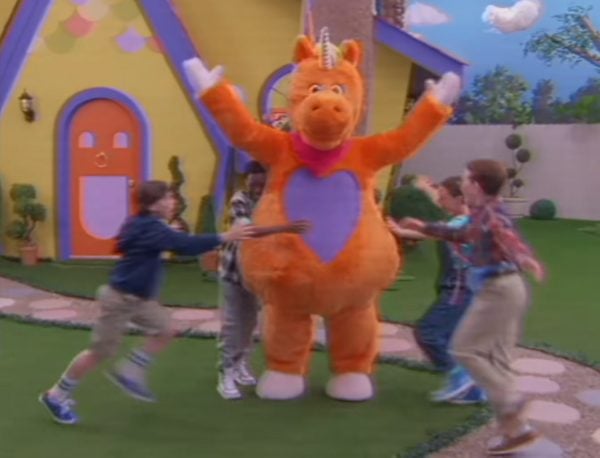
The film opens with an extraordinary commitment to period-accurate pastiche. Viewers are plunged into a series of simulated 10-minute television episodes that mimic the look, sound, and pedagogical philosophy of 1990s children’s television. The color palette is violently bright, dominated by primary reds, yellows, and blues, creating an environment that feels simultaneously nostalgic and claustrophobic.
Within this framework, Buddy—voiced with chilling versatility by Keegan-Michael Key and brought to physical life inside a massive, stifling suit by movement performer Sergey Zhuravsky—encourages children to sing about bravery, practice chores, and participate in synchronized dance routines. The subversion is introduced with brilliant tonal control: an innocuous refusal to practice a dance step or sing a song about "togetherness" results in a child being abruptly dragged off-camera to a brutal fate.
Crucially, the film establishes that there is no safety in traditional television production rules. There are no parents waiting off-stage to collect the children; once an episode concludes, Buddy embraces the kids as vertical rolling credits sweep across the screen. These credits serve a dual purpose: they signal the beginning of a new episodic loop and function as a cosmic reset, healing Buddy of any injuries sustained in previous skirmishes and locking the juvenile cast into an inescapable psychological and physical prison.
Act II: The Clubhouse Fracture and the Enchanted Woods
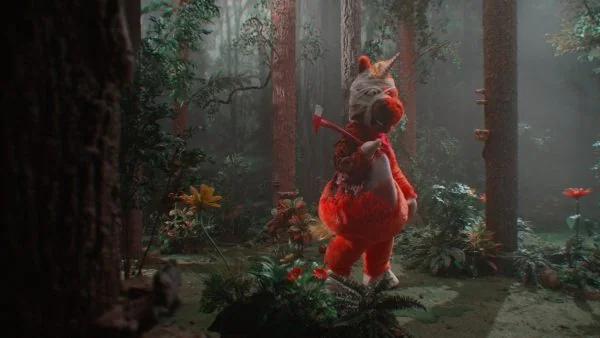
The illusion of control shatters when a group of children, led by the fiercely determined young protagonist Freddy (played with remarkable grit by Delaney Quinn), manage to escape the immediate perimeter of the clubhouse park. As the kids flee deeper into the set, the visual language of the film shifts drastically. The bright, sterile colors bleed into a darker, foreboding palette as the children wander through perilous, enchanted woods.
During this flight for survival, the children encounter a tragic remnant of the show’s past: an older man who was once a participant on the program as a boy. Having long outgrown his child-sized clothing, he remains trapped in the ecosystem, hopelessly hiding from Buddy with no knowledge of how to escape. This encounter raises the stakes, confirming that the television show is not merely a dangerous job, but a temporal and spatial trap from which there is no natural egress.
Act III: The Real-World Intrusion
While the children navigate the nightmarish woods, the narrative temporarily pivots to the real world, focusing on a mother, portrayed by Cristin Milioti, who is undergoing a severe psychological crisis. Convinced that something is fundamentally wrong with the broadcast and that children are disappearing, she cycles through therapists and psychic mediums in a desperate search for validation.
Her husband, played by Topher Grace in an intentionally restrained, skeptical role, dismisses her concerns as a mental breakdown, growing increasingly alienated by her erratic behavior around their own family. However, the film blurs the boundary between viewer and participant when the mother is literally sucked through her television screen, fusing the real-world domestic tragedy with the hyper-realist horror of the show itself.
Supporting Context & Metrics
The production of Buddy represents a significant milestone in modern satirical horror, drawing heavily on the viral DNA of Kelly’s past work while scaling up in budget, scope, and talent.
The Evolution of Casper Kelly’s Subversion
Casper Kelly first entered the cultural zeitgeist with Too Many Cooks, a 15-minute surrealist short that aired on Adult Swim in 2014. Initially masquerading as a relentlessly cheerful, nostalgic 1980s and ’90s family sitcom intro featuring an exponentially expanding cast of bizarre characters, the short slowly mutated into a psychedelic, gore-soaked slasher nightmare.
While Too Many Cooks polarized audiences—drawing immense praise from internet subcultures while alienating viewers who found its repetitive structure grating—it proved Kelly’s master-level understanding of pop-culture pastiche. Buddy applies these same psychological vectors to the children’s television genre, scaling the 15-minute sketch format into a feature-length narrative without losing its hypnotic, unsettling rhythm.
Production Design and Acoustic World-Building
A major triumph of Buddy lies in its meticulous recreation of late-20th-century broadcast aesthetics. The set design mirrors the foam-and-felt texture of classic educational sets, weaponizing the inherent creepiness of oversized mascot costumes.
Furthermore, the soundscape is enriched by elite voice-acting talent. Eric Bauza, renowned for his extensive work voicing classic cartoon characters including Bugs Bunny and Daffy Duck, lends his vocal talents to animate inanimate objects such as talking mailboxes and set pieces. Alongside Bauza, heavy-hitting dramatic actors like Michael Shannon contribute voice performances that ground the surrealism in authoritative, unsettling realism. This brilliant juxtaposition of comforting cartoon audio and predatory menace establishes a profound sense of unease long before the first act of violence occurs.
| Production Element | Detail / Contributor | Impact on Film |
|---|---|---|
| Director & Writer | Casper Kelly | Maintains creative continuity from viral works like Too Many Cooks. |
| Buddy (Voice) | Keegan-Michael Key | Balances uncomfortably cheerful warmth with sudden, chilling menace. |
| Buddy (Physical) | Sergey Zhuravsky | Delivers menacing, uncanny mascot choreography inside the suit. |
| Lead Child Protagonist | Delaney Quinn (Freddy) | Anchors the emotional core and survival stakes of the children. |
| Real-World Mother | Cristin Milioti | Drives the domestic breakdown and eventual crossover into the broadcast. |
| Supporting Voice Talent | Eric Bauza, Michael Shannon | Enhances the uncanny valley effect through anthropomorphic set pieces. |
Official Statements & Creative Vision
Speaking on the conceptual origins of Buddy, creative insiders note that the project was designed to subvert the passive consumption habits of children’s programming. By asking the simple, horrifying question—"What happens when the mascot’s unconditional love is mandatory?"—Kelly taps into a primal childhood fear: the realization that adult authority figures cannot always be trusted, and that institutional happiness can be enforced by any means necessary.
Cast members have similarly highlighted the unique challenges of maintaining tonal equilibrium. Balancing slapstick cartoon logic with brutal, consequences-free slasher logic required a delicate performance style. Milioti’s portrayal of a mother sliding into madness provides the emotional anchor for the film’s broader themes of maternal protection and gaslighting, even as the narrative descends into surrealist fantasy. Meanwhile, Quinn’s performance as Freddy provides the young audience surrogate necessary to keep the stakes grounded, ensuring that the horror registers as visceral rather than purely comedic.
Future Outlook
As Buddy prepares for its 2026 theatrical and streaming rollout, industry analysts are watching closely to see how mainstream audiences receive its complex tonal shifts. While early critical reviews note minor pacing issues during the film’s excursions into real-world family drama, the overall consensus points to an exceptional achievement in production design and high-concept horror.
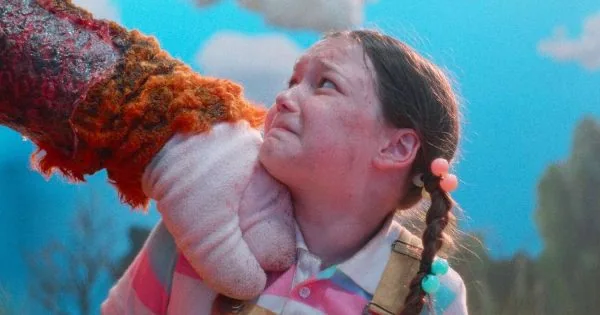
Buddy successfully avoids the trap of becoming a one-note internet meme. By treating its absurd premise with complete sincerity, Kelly has constructed a fully realized, deeply unsettling cinematic nightmare. As horror continues to find fertile ground in the deconstruction of childhood nostalgia, Buddy stands poised to define a new benchmark for subversive, elevated genre filmmaking.







Belum ada komentar. Jadilah yang pertama berkomentar!