

Executive Overview
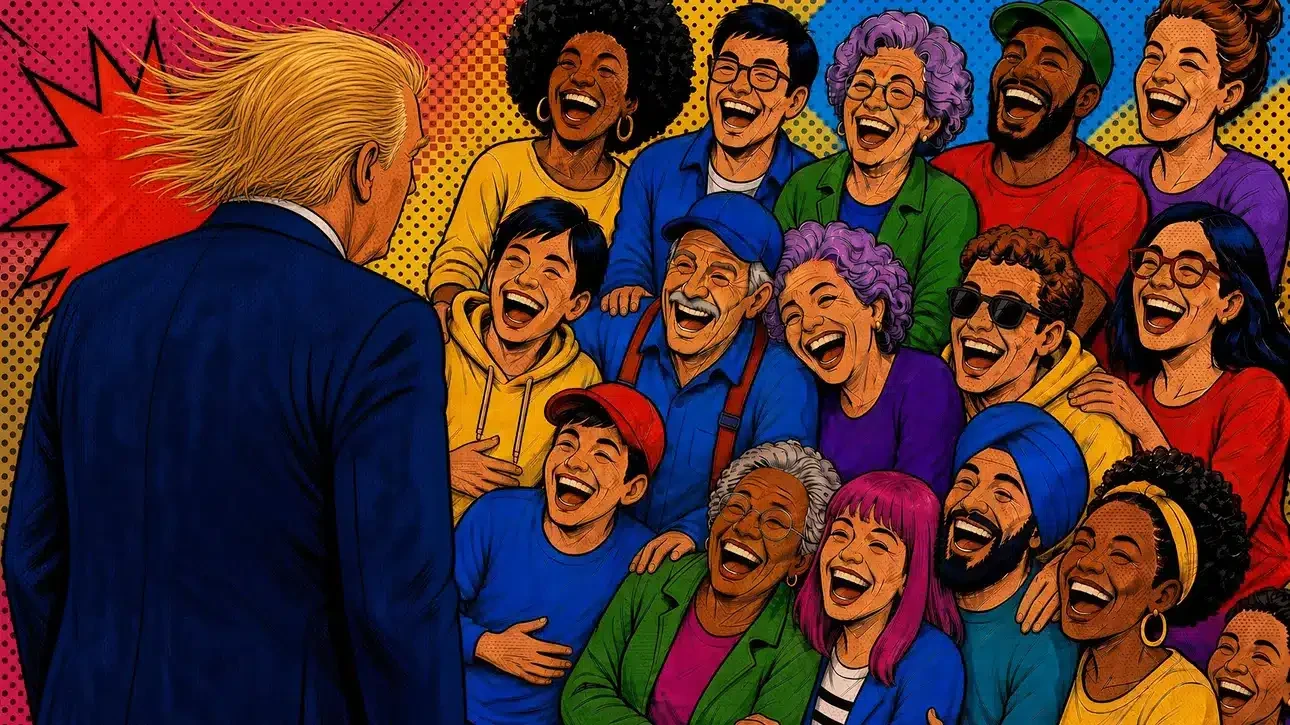
As democratic institutions strain under the weight of rising populist autocracy, political opposition frequently finds itself paralyzed by disorientation and despair. Traditional legislative checks—split or compromised congresses, captured judiciaries, and shifting institutional norms—have increasingly proven inadequate against the maneuvers of modern executive overreach. In the United States, this systemic paralysis has shifted the burden of resistance away from conventional political channels and onto the shoulders of the citizenry, who have embraced mass mobilization, public protest, and, crucially, political satire.
Far from being mere escapism, humor has emerged as a primary cognitive and cultural weapon against creeping authoritarianism. Throughout history, from ancient Athenian comic poets to medieval carnival mockers and the architects of American political cartooning, laughter has served as a formidable social corrective. It shatters the illusion of absolute authority, unmasks hypocrisy, and unites fragmented populations under a shared moral framework.
In the contemporary American landscape, this dynamic has crystallized around the late-night television talk show. As mainstream journalism has increasingly retreated from aggressive accountability due to institutional timidity and corporate consolidation, late-night satirists have stepped into the breach, functioning as the unofficial stewards of the public conscience.
The high-stakes clash between the second Trump administration and premier late-night host Jimmy Kimmel—culminating in a government-pressured corporate suspension and a subsequent, citizen-led mass backlash—illustrates the volatile intersection of state power, free expression, and consumer resistance. This comprehensive report examines the historical lineage of political humor, the cognitive incompatibility between authoritarianism and laughter, the transformation of the late-night monologue into investigative journalism, and the watershed Kimmel-Kirk saga that tested the limits of American democratic resilience.
Detailed Chronology: The Anatomy of the Kimmel-Kirk Crisis
The suppression and triumphant return of Jimmy Kimmel Live! in late 2025 stands as a watershed moment in the conflict between executive power and free expression in the United States. To understand the gravity of the event, one must trace the systemic erosion of late-night sovereignty that preceded it.
The Prelude: Silencing the Airwaves
The friction between the second Trump administration and late-night comedy transitioned from informal social media grievances to structural censorship in mid-2025. Recognizing that satirists retained the cultural capital to puncture executive impunity where traditional journalists hesitated, the administration utilized regulatory leverage to reshape the media ecosystem.
In July 2025, CBS’s parent company, Paramount, sought federal regulatory approval for a high-stakes corporate merger. Within the shifting calculus of Washington politics, compliance demanded sacrifice. Stephen Colbert’s long-running program on CBS was targeted for cancellation—an early casualty of corporate preemptive appeasement. With Colbert sidelined, the administration turned its sights toward ABC and Jimmy Kimmel, who had established himself as an unyielding critic of MAGA orthodoxy.
The Catalyst: The Charlie Kirk Shooting
The tipping point arrived in September 2025 in the wake of the Charlie Kirk assassination. The tragedy ignited immediate, incandescent fury across far-right information silos, generating an urgent demand for political retribution.
During his broadcast on September 25, 2025, Kimmel addressed the national fallout, explicitly noting that the "MAGA gang" was aggressively weaponizing the tragedy to score political points, regardless of factual context. The broadcast triggered an immediate, coordinated response from right-wing media ecosystems, quickly jumping from digital echo chambers to executive branch enforcers.
The Regulatory Pincer Movement
Seizing the manufactured outrage, Federal Communications Commission (FCC) Chairman Brendan Carr swiftly moved to penalize ABC and its parent conglomerate, Disney. Employing thinly veiled threats of regulatory retaliation, the administration pressured media conglomerates to police their own talent.
Nexstar Media Group, a major station group owner, pulled Jimmy Kimmel Live! from its ABC-affiliated stations. Simultaneously, Disney—mindful of pending regulatory decisions and corporate mergers—directed ABC to halt all broadcasts and suspend Kimmel indefinitely. The maneuver bore all the hallmarks of classic systemic coercion: an administration leveraging state regulatory apparatuses to force a private media giant into silencing an ideological adversary.
The Citizen Counter-Offensive
The Trump administration’s victory lap proved short-lived. In an unprecedented display of asymmetric civic warfare, the opposition forces mobilized with staggering speed.
- The Comedy Community Rallies: Competing networks and late-night hosts immediately broke ranks with corporate caution, offering full-throated, unified condemnation of the suspension as a direct assault on the First Amendment.
- Public Trust and Consumer Power: Having spent years establishing a reputation for moral clarity rather than partisan posturing, Kimmel retained the profound trust of the viewing public. Millions of citizens converted their outrage into direct economic leverage, threatening widespread boycotts of Disney products and services.
- The Corporate Retreat: The financial pressure proved immediate and devastating. Disney stock plummeted as the consumer boycott gained traction. Recognizing the existential threat to their bottom line, Disney, ABC, Brendan Carr, and the administration executed a hasty retreat.
Within weeks, Jimmy Kimmel returned to the airwaves as a national hero, his public approval ratings soaring while the administration’s attempt at censorship collapsed under the weight of organized consumer resistance.
Supporting Context & Metrics: The Mechanics of Satirical Resistance
To fully comprehend why political humor poses such an existential threat to aspiring autocrats, one must examine the cognitive, historical, and media-theoretical foundations that underpin satirical discourse.
Cognitive Incompatibility: Humor vs. Fascism
Philosopher and scholar John Morreall, in his foundational work Taking Laughter Seriously, observes that "[people] with a sense of humor can never be fully dominated." Authoritarianism and fascism demand two core psychological pillars: unthinking obedience and absolute hero-worship, fueled by manufactured rage against designated scapegoats.
Humor, conversely, is fundamentally incompatible with both fear and solemnity. It requires cognitive flexibility—the ability to perceive incongruity, hypocrisy, and logical fallacies. Satire forces the human mind to step outside the emotional cage of nationalist grievance and examine the absurdities of those in power.
Even under the most extreme historical conditions, humor has functioned as an irreducible survival mechanism. As scholar Chaya Ostrower documented in her research on Nazi concentration camp prisoners, gallows humor provided inmates with a psychological shield, allowing them to momentarily transcend unlivable circumstances through the sheer assertion of cognitive autonomy.
The Evolution of the Late-Night Monologue
The late-night talk show monologue has evolved from mid-20th-century variety entertainment into an essential vehicle for political critique. Originating in radio variety formats, the genre was pioneered on television by figures like Faye Emerson and Steve Allen, who introduced measured, non-partisan commentary into their evening broadcasts.
[1940s-50s: Variety & Gentle Wryness]
       ↓ (Faye Emerson, Steve Allen)
[1960s-70s: Parody & Direct Political Impact]
       ↓ (Johnny Carson, Dick Cavett)
[1990s-2010s: Discursive Integration & Fake News]
       ↓ (The Daily Show, Jon Stewart)
[Present Day: Moral Counterweight & Satirical Journalism]
       (Jimmy Kimmel, Stephen Colbert)
By the era of Johnny Carson, the cultural impact of late-night commentary was unmistakable. Carson’s biting coverage of the Watergate scandal measurably eroded Richard Nixon’s public approval ratings, establishing the precedent that comedians often provided a clearer, more objective lens on current events than institutional journalism. Subsequent hosts—from Dick Cavett matching wits with segregationist politicians to Jon Stewart and Stephen Colbert dissecting media complicity—expanded the medium into what media scholar Geoffrey Baym terms "discursive integration."
According to Baym’s research on The Daily Show, late-night satirists offer a modern model of deliberative democracy. By employing a "rhetoric of challenge," these programs strip away the false equivalencies and institutional sanitization characteristic of conventional "objective" reporting, meeting audiences at a moral rather than strictly partisan intersection.
The Journalistic Vacuum
The rise of satirical news as a trusted primary news source is not an accident of cultural taste, but a direct consequence of journalistic failure. In robust democracies like the United Kingdom, political journalists routinely hold elected officials accountable through relentless, adversarial questioning.
In the contemporary United States, however, political journalism has frequently atrophied into access-driven stenography. Fearing exclusion from favored press corps or Twitter-fueled backlash, mainstream reporters have often retreated from persistent inquiry when met with dismissive executive insults. This institutional timidity has left a vast vacuum, driving millions of citizens to look to late-night comedians for forthright rebuttals to undemocratic practices.
Official Statements & Public Discourse
The conflict over political satire has drawn sharp divisions across the political and media establishments, highlighting contrasting views on the boundaries of free speech and executive authority.
-
On the Administrative Mandate:
Defending the administration’s posture toward media critics, federal regulators have frequently framed satirical attacks not as protected political speech, but as bad-faith disruption that damages public trust in institutions. Following the suspension of Jimmy Kimmel Live!, FCC Chairman Brendan Carr defended regulatory scrutiny, emphasizing the agency’s mandate to ensure that public airwaves serve the broader public interest without inciting cultural division. -
On Executive Vindication:
Expressing satisfaction over the silencing of critical voices, a triumphant Donald Trump remarked following the initial suppression of late-night programming: "Great news for America," signaling the administration’s ongoing frustration with comedians who puncture executive myth-making. -
On the Defense of the First Amendment:
Reacting to the cascading censorship events, media defense organizations and civil liberties groups issued stark warnings. The National Coalition Against Censorship released a statement noting:"When state regulatory apparatuses are deployed to silence comedians, the boundary between democratic governance and authoritarian control has been breached. Satire is the immune system of a free society; attempting to eradicate it is an admission of moral and political fragility."
-
On the Resilient Response:
Upon returning to the airwaves following the successful consumer pushback, Jimmy Kimmel addressed his audience with characteristic defiance, underscoring the vital role of public vigilance:"Power hates a mirror because reflection reveals the cracks in the façade. They can threaten the corporations, they can twist the arms of the boardrooms, but as long as people refuse to look away—and refuse to let their wallets do the autocrat’s bidding—the Jester isn’t going anywhere."
Future Outlook: The Fragility of Authoritarian Control
The resolution of the Kimmel-Kirk crisis provides both a stark warning and a profound blueprint for democratic resilience in an era of institutional backsliding.
As aspiring autocrats increasingly master the art of leveraging corporate concentration, regulatory capture, and populist grievance to silence critics, the traditional defenses of democracy will face unprecedented stress tests. The institutional instinct of major media conglomerates will often lean toward appeasement, trading editorial independence for regulatory favor and market security.
However, the events of late 2025 demonstrate that the ultimate arbiter in this struggle remains the citizenry. Authoritarian systems require an absolute monopoly on narrative and complete compliance from both institutions and individuals. By weaponizing consumer power—withdrawing economic support from corporations that bend the knee to executive overreach—ordinary citizens proved capable of breaking the machinery of censorship.
Ultimately, political humor will continue to serve as the canary in the coal mine of democracy. As long as satirists retain the platform and the courage to hold up a mirror to power, absolute autocracy remains an unrealized ambition. Dictatorships are built on solemnity, fear, and unthinking obedience; they cannot survive a public that knows how to laugh. The preservation of American democracy hinges not merely on the actions of legislators or the rulings of courts, but on the enduring, defiant refusal of its people to surrender their right to laugh at those who would rule them.








Belum ada komentar. Jadilah yang pertama berkomentar!