

Executive Overview
Apple’s relationship with the video game industry has historically been defined by ambition shadowed by persistent friction. For years, the Cupertino giant has poured immense capital, engineering prowess, and marketing efforts into positioning the Mac as a viable, high-performance platform for AAA gaming. Yet, despite hardware architectures boasting unified memory, impressive raw compute power, and energy-efficient silicon, mainstream gamers and major studios have been slow to fully embrace macOS as a primary gaming destination.
The core challenge has rarely been about raw performance alone; rather, it has centered on developer tooling, API efficiency, and the complex calculus required to port massive, DirectX- or Vulkan-optimized engines onto Apple’s proprietary ecosystem.
Enter Metal 4, unveiled at Apple’s Worldwide Developers Conference (WWDC25). Representing a major evolutionary leap for Apple’s graphics framework, Metal 4 introduces two critical, highly practical capabilities to its MetalFX pipeline: frame interpolation and ray tracing denoising. These additions are not merely incremental patches; they are foundational shifts designed to address the heaviest performance bottlenecks in modern game development—frame rates and lighting overhead.
By bridging the gap between hardware constraints and high-end visual expectations, Metal 4 aims to make it significantly easier for developers to bring visually rich, demanding AAA titles to the Mac, iPad, and iPhone lineups without sacrificing performance or battery life.
Detailed Chronology: The Road to Metal 4
To understand the significance of Metal 4, one must trace the architectural trajectory of Apple’s graphics strategy over the past decade.
The Genesis of Metal (2014–2020)
When Apple introduced the original Metal API at WWDC 2014, it was designed to replace OpenGL and OpenGL ES, offering developers low-overhead, direct access to the GPU. Metal dramatically reduced CPU bottlenecks on iOS devices and eventually Macs, setting the stage for the transition away from Intel processors.
The Apple Silicon Revolution (2020–2023)
The launch of the M1 chip in 2020 unified the architecture across Macs and iPads, bringing discrete-class graphics capabilities to thin-and-light laptops. Recognizing the gaming potential, Apple introduced the Game Porting Toolkit at WWDC23, allowing developers to quickly evaluate how Windows games could run on macOS. This was accompanied by the debut of MetalFX Upscaling, Apple’s answer to NVIDIA DLSS and AMD FSR, allowing games to render at lower resolutions and upscale intelligently to save GPU cycles.
Refining the Pipeline (2024–2025)
As ray tracing became an industry standard for realistic lighting, Apple integrated hardware-accelerated ray tracing into the M-series and A-series chips. However, the computational cost remained a massive hurdle for mobile and integrated architectures. The realization that upscaling alone was no longer enough to push frame rates into the high-refresh-rate territory demanded by modern gamers led directly to the development of Metal 4, officially announced at WWDC25. Compatible with M-series chips (M1 and later) and A-series processors (A14 Bionic and later), Metal 4 represents Apple’s most comprehensive toolkit for high-performance graphics to date.
Supporting Context & Metrics: Decoding the Technology
At the heart of Metal 4’s performance enhancements are two advanced rendering concepts: MetalFX Upscaling, which serves as the foundational baseline, and the newly introduced Frame Interpolation and Ray Tracing Denoising systems.
1. The Foundation: MetalFX Upscaling Explained
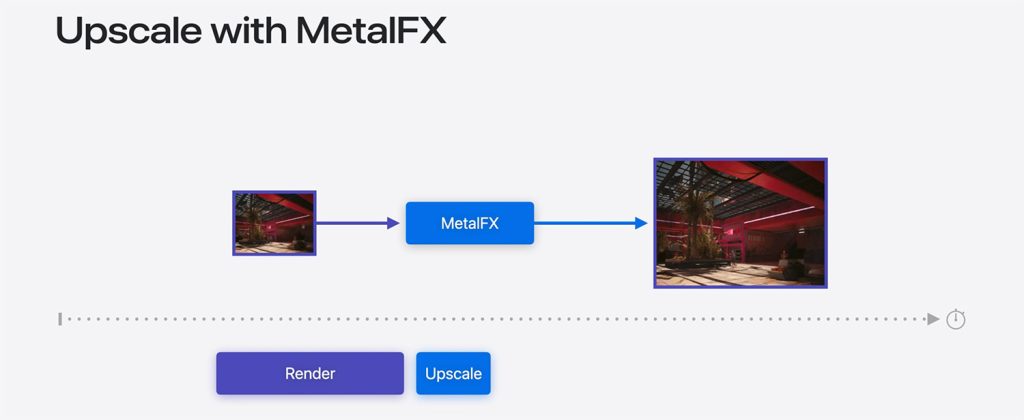
Before examining interpolation or denoising, it is vital to understand the underlying mechanics of MetalFX. Modern rendering of high-resolution images (such as native 4K) consumes vast amounts of GPU time, draining batteries and throttling thermal limits on compact machines like the MacBook Air.
As Apple engineers outlined during WWDC25 technical sessions:
"Rendering high resolution images can consume the GPU for a significant period of time. Instead, your app can render low resolution images and use MetalFX to upscale them. The combined time to render your final image is reduced and that means your app can save time for each frame it renders. You can use the time saved to render the next frame sooner."
This technique has become the baseline for performance-conscious game development. It does not magically transform a passive-cooled laptop into a dedicated desktop gaming rig, but it provides a reliable safety net for developers trying to maintain playable frame rates at acceptable visual fidelities.
2. Frame Interpolation: Generating Smooth Motion Without Heavy Renders
Gamers familiar with modern PC hardware will recognize the concept of frame generation. Rather than forcing the GPU to render every single frame from scratch—a computationally expensive process—interpolation generates intermediate frames between actual rendered frames.
MetalFX accomplishes this by meticulously analyzing motion vectors and depth data provided by the game engine. By tracking how objects shift positions across successive frames, the algorithm calculates and inserts synthetic transitional frames.
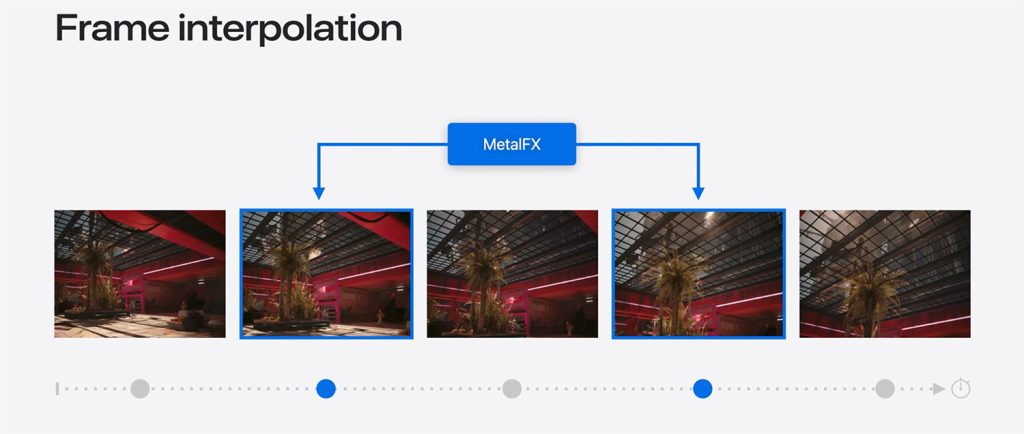
"This year, MetalFX adds support for frame interpolation. Your app can use it to generate intermediate frames in much less time than it would take to render each frame from scratch. You can use those intermediate frames to achieve even higher frame rates."
- The Player Experience: Gamers experience buttery-smooth animations and higher perceived frame rates. Even if the game’s core engine is natively outputting a stable 30 or 60 frames per second, interpolation can push the visual output to 90Hz, 120Hz, or higher.
- The Developer Advantage: Studios can deliver high-refresh-rate experiences on displays found across Apple’s ecosystem (such as ProMotion MacBook Pros and iPads) without doubling their base rendering workload, preserving both thermal headroom and power efficiency.
3. Ray Tracing Denoising: Squeezing Realism Out of Limited Rays
Ray tracing simulates the physical behavior of light, casting rays across a scene to generate hyper-realistic reflections, refractions, and shadows. While visually stunning, it is notoriously resource-intensive. The more rays a game casts, the more photorealistic the scene becomes—and the more severely the frame rate plummets.
To combat this, MetalFX in Metal 4 introduces a built-in denoising pipeline.
Instead of forcing developers to write custom denoising algorithms or execute heavy CPU-side post-processing, Metal 4 allows games to render scenes using significantly fewer rays. The resulting output is naturally noisy and speckled, but the MetalFX pipeline instantly cleans up the image during the upscaling phase.
This streamlined workflow grants developers the ability to incorporate complex, modern lighting effects into Mac and iOS versions of games without needing to completely re-engineer their lighting pipelines from the ground up.

Official Statements and Developer Guidance
Apple’s rollout of Metal 4 was accompanied by deep-dive technical sessions aimed at bridging the gap between console/PC development and Apple Silicon architecture.
In the official WWDC25 presentation Discover Metal 4 (Session 205), Apple emphasized that the architecture is built to scale seamlessly from pocket-sized mobile devices to high-end Mac Studio workstations. By standardizing advanced rendering features within the Metal framework, Apple is attempting to eliminate the friction points that traditionally discouraged multi-platform studios from targeting macOS.
Furthermore, sessions like Go further with Metal 4 games (Session 211) provide concrete code implementations and best practices for integrating motion vectors, optimizing ray-tracing workloads, and configuring MetalFX frame interpolation parameters. These resources signal a more mature, developer-centric approach from Apple, moving away from high-level marketing pitches and toward the gritty, practical tools engineers require.
Future Outlook: Can Metal 4 Finally Move the Needle for Mac Gaming?
The introduction of Metal 4 marks a pivotal moment in Apple’s ongoing campaign to capture the attention of the gaming community. However, technological capability is only half the battle.
The Technical Triumph
There is little doubt that Metal 4 provides exceptional technical primitives. Features like frame interpolation and ray tracing denoising put Apple’s graphics API on par with modern iterations of DirectX 12 and Vulkan in terms of advanced feature support. For current Apple Silicon owners—ranging from M1 veterans to users of the latest M-series processors—Metal 4 promises tangible improvements in visual fidelity, smoothness, and thermal management.

The Ecosystem Challenge
The remaining hurdles for Mac gaming are cultural and economic, rather than technical. Convincing major publishers to allocate resources for macOS ports requires not just good tools, but a proven market of paying gamers. While titles like Resident Evil, Death Stranding, and Cyberpunk 2077 (via various porting efforts) have proven that Apple Silicon can handle heavy hitters, the Mac App Store and Steam on macOS still lag far behind Windows ecosystems in terms of active gamer engagement.
Conclusion
Metal 4 lowers the barrier to entry significantly. By taking the heavy lifting out of frame generation and ray tracing cleanup, Apple has removed technical excuses for why AAA games shouldn’t run smoothly on its hardware. Whether major studios seize these tools to build a thriving gaming culture on the Mac remains to be seen, but with Metal 4, Apple has officially armed developers with everything they need to succeed.









Belum ada komentar. Jadilah yang pertama berkomentar!