

Executive Overview
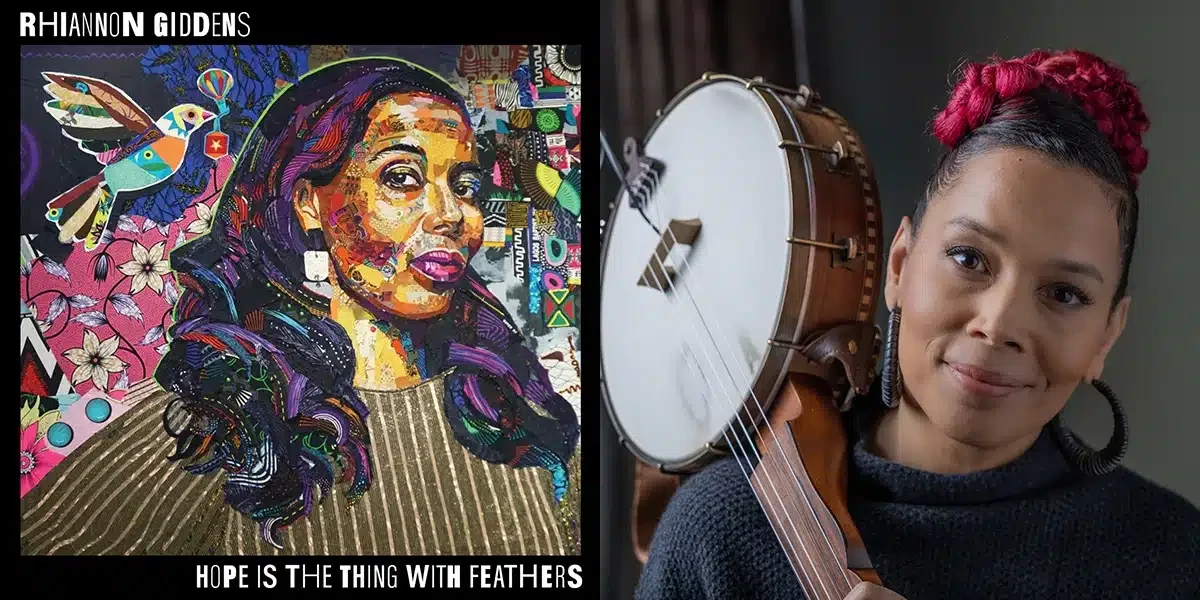
In an era defined by rapid technological disruption, cultural atomization, and a relentless 24-hour news cycle that frequently trades depth for acceleration, the return of a foundational artist like Rhiannon Giddens serves as both an artistic anchor and a cultural reckoning. Released on September 18, 2026, through Nonesuch Records, Giddens’ latest full-length album, Hope Is the Thing with Feathers, is a masterclass in historical reclamation, contemporary commentary, and acoustic mastery. Spanning a taut, highly focused 37 minutes across ten meticulously curated tracks, the album encapsulates the defining ethos of Giddens’ illustrious two-decade career: a fierce dedication to unearthing the forgotten narratives of the American South, refracting them through an intersectional lens, and proving that old songs are living, breathing organisms rather than dusty artifacts confined to museum display cases.
Named after Emily Dickinson’s iconic 1891 poem—which Giddens has adapted into the project’s enchanting second track—the album acts as a sonic meditation on the persistence of faith, fortitude, and human dignity in the face of systemic adversity. Throughout Hope Is the Thing with Feathers, the North Carolina native bridges the chasm between time-honored folk traditions, Appalachian folklore, gospel devotion, and progressive modern songwriting. This is not merely a collection of covers and originals; it is an interconnected tapestry of human experience that examines how past struggles with migration, injustice, and societal alienation mirror our current global crises.
Bolstered by a formidable cast of collaborators—including co-producer and multi-instrumentalist Dirk Powell, her sister Lalenja Harrington, Jason Sypher, Niwel Tsumbu, Justin Robinson, and longtime creative partner Francesco Turrisi—Giddens delivers a live-recorded aesthetic that strips away modern studio artifice. The result is an unvarnished masterpiece that demands multiple listens, rewarding the attentive ear with subtle instrumental interplay, stunning vocal arrangements, and an emotional gravity that lingers long after the final note fades.
Detailed Chronology
To fully understand the artistic weight of Hope Is the Thing with Feathers, one must trace the evolutionary arc of Rhiannon Giddens’ trajectory over the past twenty years—a timeline punctuated by high-profile milestones, cross-genre collaborations, and unprecedented institutional recognition.
Phase I: Foundations and the Carolina Chocolate Drops (Mid-2000s to 2010s)
Giddens first emerged on the national consciousness as a co-founder of the Grammy-winning string band the Carolina Chocolate Drops. Alongside Dom Flemons and Justin Robinson, Giddens dedicated herself to reviving the historically overlooked Black string band tradition of the Piedmont region and the broader American South. This foundational era established her bona fides as an ethnomusicological detective, rescuing African American banjo and fiddle traditions from near-obliteration.
Phase II: Solo Ascension and Genre-Defying Collaborations (2015–2020)
Transitioning to a solo career with critically acclaimed releases like Tomorrow Is My Turn (2015) and Freedom Highway (2017), Giddens expanded her stylistic palette. She incorporated Celtic folk, European classical music, and avant-garde jazz into her foundational Americana bedrock. During this period, she also co-created the acclaimed opera Omar—based on the autobiography of Omar Ibn Said, an enslaved Islamic scholar—which earned her and collaborator Michael Abels the 2023 Pulitzer Prize for Music.
Phase III: Institutional Honors and the Nonesuch Partnership (2020–2025)
As her list of accolades expanded to include a MacArthur Fellowship ("Genius Grant") and multiple Grammy Awards, Giddens assumed roles of broader cultural leadership, including serving as the Artistic Director of Silkroad Ensemble. Her partnership with Nonesuch Records cemented her status as a vital voice in modern American music, paving the way for deeply conceptual projects that challenge American historical mythologies.
Phase IV: The Genesis and Release of Hope Is the Thing with Feathers (2025–September 2026)
The creation of Hope Is the Thing with Feathers began in earnest following the touring cycles of her previous solo work. Seeking to capture the immediacy of live performance, Giddens convened a tight-knit circle of musicians in the studio. Rather than overdubbing layers of production, the ensemble recorded live-off-the-floor, emphasizing the raw mechanics of breathing, bowing, and vocal projection. Released on September 18, 2026, the album represents a synthesis of her lifetime commitments: historical rigor, socio-political awareness, and transcendent vocal artistry.
Supporting Context & Metrics
Evaluating a project of this magnitude requires looking beyond subjective artistic appreciation to examine the structural components, technical metrics, and cultural parameters that make Hope Is the Thing with Feathers a watershed release for contemporary roots music.

Production and Arrangement Metrics
- Runtime Efficiency: At precisely 37 minutes, the album rejects the streaming-era impulse toward bloated tracklists, choosing instead a concise, vinyl-friendly arc where every track serves an indispensable structural purpose.
- Track Composition: The ten-track sequence is evenly balanced between radical reinterpretations of foundational folk/gospel standards and pointed, forward-looking original compositions.
- Acoustic Fidelity: Captured primarily through live-recording techniques, the project prioritizes high dynamic range, minimal digital compression, and spatial realism, allowing instruments like Dirk Powell’s cutting fiddle and Giddens’ open-back banjo to occupy distinct acoustic spaces.
Thematic Matrix of the Tracklist
| Track Type | Title / Reference | Primary Themes & Collaborators | Cultural / Musical Significance |
|---|---|---|---|
| Adaptation | "Hope Is the Thing with Feathers" | Emily Dickinson poetry adaptation; core ensemble | Establishes the thematic bedrock of resilience and enduring faith. |
| Original | "Wish in Vain" | Global immigration, geopolitical injustice, helplessness | A sparse, mournful modern commentary proving the power of minimalist songcraft. |
| Original | "Carolina Rain" | Nature, community endurance, progressive Southern identity | Refutes regressive regional stereotypes, celebrating 21st-century human connection. |
| Original | "Step Away Blues" | Vulnerability, emotional exhaustion, systemic exposure | Features Dirk Powell on fiddle; showcases Giddens’ upper vocal registers and fierce poetic imagery. |
| Reinterpretation | "Freight Train" | Originally by Elizabeth Cotten; arranged by Giddens | Pays homage to Piedmont blues royalty while injecting fresh rhythmic urgency. |
| Reinterpretation | "High on a Mountain" | Originally by Ola Belle Reed; timeless Appalachian motif | Connects 20th-century mountain struggles directly to contemporary socio-economic realities. |
| Gospel Hymn | "Walk with Me" | A cappella duet with Lalenja Harrington | Highlights familial vocal blending and the sacred, communal roots of American gospel. |
Official Statements
The release of Hope Is the Thing with Feathers was accompanied by deep reflections from the artist and critical insights from industry observers regarding its cultural and musical impact.
In a recent press statement detailing the conceptual framework of the album, Rhiannon Giddens elaborated on the tension between historical weight and contemporary liberation:
"We carry the ghosts of these songs with us, but they aren’t meant to haunt us in a way that paralyzes us; they are meant to teach us how to walk through the fire. When Emily Dickinson wrote about that little bird that perches in the soul, she wasn’t writing about passive wishful thinking. She was writing about an indomitable survival mechanism. Whether we are looking at the migration patterns of people seeking safety across borders today or the women who built communities out of mud and music in the 19th-century South, the core question remains identical: How do we keep our humanity intact when the world is trying to skin us alive?"
Co-producer and multi-instrumentalist Dirk Powell discussed the collaborative methodology utilized during the tracking sessions at Nonesuch:
"With Rhiannon, there is no safety net, and that’s precisely why the music works so well. We didn’t spend weeks trying to fix things in post-production or layering synthetic textures. We stood in the room together, we listened to the air moving between our instruments, and we played the songs like they mattered to our survival. When we hit ‘Step Away Blues,’ that fire you hear isn’t a studio trick—it’s the sound of musicians pushing each other to the absolute edge of what can be expressed through wood, steel, and breath."
Music critics have universally praised the project’s stark economy. Industry analysts noted that in an entertainment landscape saturated with maximalist pop productions, Giddens’ uncompromising commitment to unadorned acoustic storytelling offers a vital counter-narrative, positioning roots music not as a reactionary retreat into the past, but as an active laboratory for societal healing.
Future Outlook
As Hope Is the Thing with Feathers establishes its footing across global charts and critical year-end roundups, its long-term trajectory points toward a permanent restructuring of how modern audiences engage with American folk traditions. Giddens has consistently demonstrated that looking backward is not an act of nostalgia, but a necessary prerequisite for charting a just future.
Key Implications for the Roots and Americana Sector
- Redefining Authenticity: By seamlessly blending 19th-century poetry, Appalachian folklore, and contemporary sociopolitical commentary (such as the commentary on migration in "Wish in Vain"), Giddens dismantles rigid genre boundaries, encouraging younger artists to treat heritage music as a living, malleable canvas.
- The Triumph of Minimalist Production: The commercial and critical reception of the album’s live-recorded, stripped-down aesthetic serves as a rebuke to over-produced mainstream formulas, proving that modern listeners retain a deep appetite for acoustic intimacy and raw emotional vulnerability.
- Institutional and Grassroots Synergy: Following her success with Omar and her ongoing leadership within the global music community, Giddens continues to leverage her platform to elevate marginalized voices, ensuring that future generations understand the diverse, multicultural foundations of American artistic expression.
Looking ahead, Giddens’ upcoming international tour in support of Hope Is the Thing with Feathers promises to translate this studio masterclass into immersive live experiences. As she breathes new life into the words of Emily Dickinson, Ola Belle Reed, and her own striking originals, Rhiannon Giddens solidifies her status as one of the most essential cultural architects of the twenty-first century—a voice reminding us that as long as we possess the courage to sing through the dark, the human spirit will stubbornly, beautifully take flight.









Belum ada komentar. Jadilah yang pertama berkomentar!