

Executive Overview
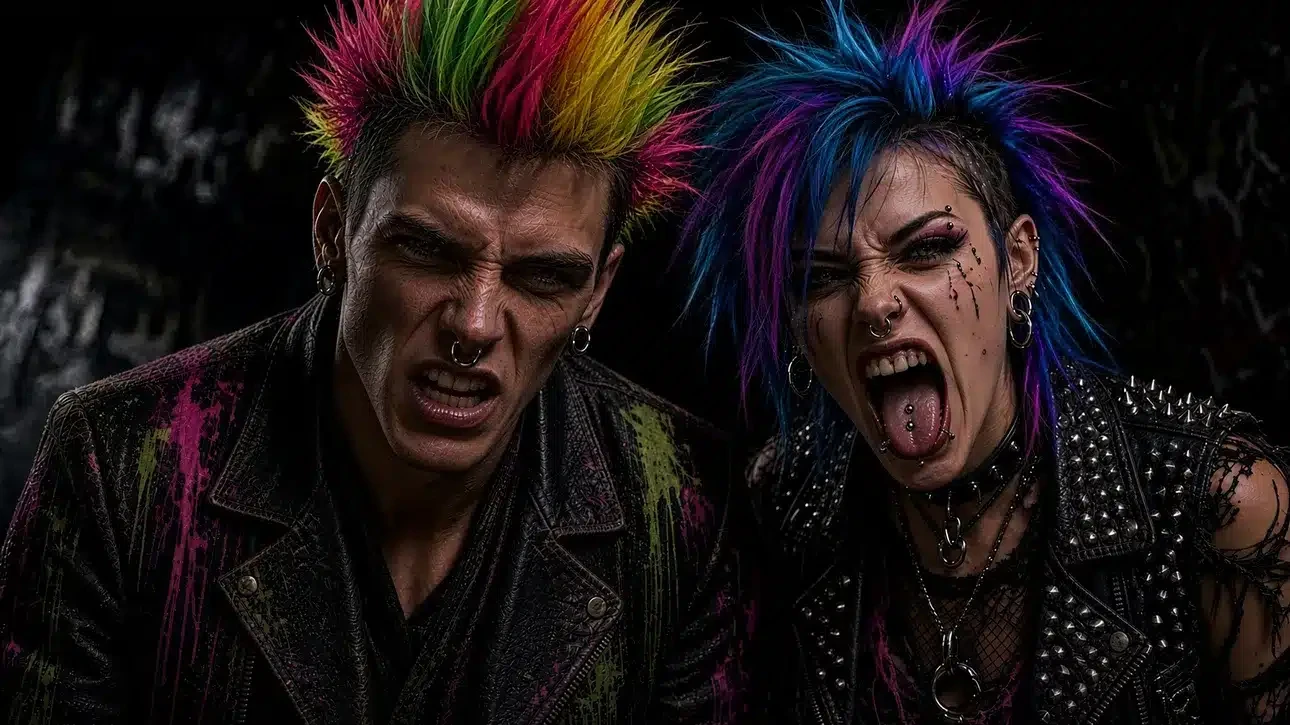
For half a century, punk rock has sustained a vibrant, self-consuming internal dialogue centered on a single, deceptively simple interrogative: Is that punk?
From the damp, sweat-soaked basements of 1970s London to the digital echo chambers of the modern internet, subcultural participants have dedicated themselves to auditing the purity of their peers. The criteria for exclusion are as flexible as they are arbitrary: a band grows too popular; a snare drum production sounds too polished; a founding member signs to a major label, secures a corporate desk job, buys a suburban home, or commits the cardinal sin of admitting an affection for mainstream pop culture.
While the specific markers of heresy mutate across generations, the underlying anxiety remains static. This obsessive policing exposes a profound paradox at the heart of the movement. Punk was forged as a direct, unyielding assault on dogma, conformity, and institutional authority. Yet, in practice, it has frequently manufactured its own rigid hierarchies, complete with self-appointed inspectors wielding clipboards of orthodoxy.
This investigative review explores the socio-cultural mechanics of punk rock, examining how anti-authoritarian spaces calcify into exclusionary clubhouses, how subcultural capital replaces monetary currency, and how the movement’s foundational question—"Who says?"—must ultimately be turned inward to survive. By analyzing historical flashpoints like Jawbreaker’s major-label migration and Green Day’s excommunication from 924 Gilman Street, we dissect the shifting architecture of subcultural authenticity. Ultimately, this piece argues that punk is most enduring not as a static credential to be verified, but as an active, critical practice of self-interrogation and structural defiance.
Detailed Chronology: Fifty Years of Policing the Margins
To understand how punk evolved from a chaotic rupture in rock-and-roll history into a heavily monitored subculture, one must trace its historical flashpoints. The tension between accessibility and autonomy has defined the movement across distinct eras:
- 1976–1977: The British Blueprint and the Invention of the Uniform. Early British punk, as brilliantly unpacked by sociologist Dick Hebdige in Subculture: The Meaning of Style, weaponized everyday mundane items—safety pins, school ties, garbage bags—stripping them of their polite social codes. However, as these acts of refusal achieved widespread recognition, a new grammar formed. The anti-uniform swiftly calcified into an official dress code, proving that collective rejection of societal authority often inadvertently lays the groundwork for brand-new, localized authorities.
- 1980s: The DIY Infrastructure. Recognizing that the commercial music industry was structurally hostile to independent voices, figures like Ian MacKaye and Jeff Nelson established Dischord Records in Washington, D.C. This era proved that negation (saying "no" to major labels) must be met with construction (building alternative ecosystems). Bands like Fugazi codified this ethos by capping ticket prices at five dollars, prioritizing all-ages accessibility, and treating fanzines with high journalistic respect.
- 1993: The Gilman Street Excommunication. Berkeley’s collectively run, non-profit venue 924 Gilman Street operated under an explicit, ironclad rule: no bands signed to major labels were permitted to perform. When Green Day signed with Reprise Records in 1993, they were promptly locked out of the venue that birthed them. The boundary was erected to protect a fragile independent ecosystem from corporate absorption.
- 1994–1995: Jawbreaker and the Major Label Backlash. Bay Area emo pioneers Jawbreaker released "Boxcar" in 1994, featuring the immortal line, "Who’s punk? What’s the score?" Intended as a lighthearted jab at the scene’s self-appointed inspectors, the lyric proved prophetic. When Jawbreaker signed to DGC Records the following year, fans boycotted their shows, turned their backs to the stage, and pelted the band with pocket change. The scorekeeper’s ledger had been updated.
- 2015: The Gilman Benefaction. More than two decades after their excommunication, 924 Gilman Street faced severe financial ruin. In a pragmatic display of subcultural survival, the collective voted to invite Green Day back to headline a critical benefit concert that saved the venue from closure. The event marked a monumental philosophical shift, proving that institutional dogmatism must occasionally yield to the preservation of the community itself.
Supporting Context & Metrics: Subcultural Capital and the Sellout Trap
The sociological machinery sustaining punk rock relies heavily on invisible currencies. In the 1990s, sociologist Sarah Thornton adapted Pierre Bourdieu’s theoretical framework to define "subcultural capital"—the social currency accumulated by individuals who master obscure trivia, discover underground acts months before the mainstream, and curate an aura of hyper-exclusivity.
Quantitative and qualitative observations of underground music scenes reveal several recurring behaviors:
- Scarcity as Integrity: A inverse relationship is frequently assumed between audience size and artistic worth. The transition from a limited 7-inch vinyl pressing to a widely distributed full-length LP is often treated as a moral failure, regardless of the music’s sonic evolution.
- The Anatomy of Compliance: While financial sellout narratives focus heavily on major-label advances and corporate mortgages, scenes enforce compliance through social leverage just as efficiently. Members regularly overlook ethical failings in local label owners, nod along to ideological consensus at merch tables, and feign hatred for commercially accessible records to maintain peer standing.
- The Demographics of Gatekeeping: Academic studies of alternative music scenes consistently highlight that subcultural capital functions as a generational hierarchy. Younger participants often overcompensate for their entry timeline by adopting hyper-dogmatic stances on authenticity, weaponizing esoteric knowledge to secure status within the community.
Official Statements and Theoretical Perspectives
The tension between punk dogma and intellectual deconstruction has long attracted philosophers and culture critics. Below are perspectives from key figures whose frameworks illuminate the scene’s internal conflicts:
"The moment we draw a boundary, somebody inevitably volunteers to stand next to it with a clipboard and tell everyone else which side they’re on."
— Contemporary Cultural Critique on Subcultural Boundaries
The late philosopher Jacques Derrida’s approach to deconstruction offers a vital lens through which to view punk’s obsession with binaries. At its core, deconstruction dismantles rigid oppositions—such as authentic vs. sellout, independent vs. major, or underground vs. mainstream—and exposes how quickly their structural borders collapse under scrutiny.
Furthermore, the ethos championed by Ian MacKaye of Fugazi and Dischord Records provides an essential structural counterweight to performative rebellion:
"If you don’t like the room, you build another one."
— Ian MacKaye, on the Necessity of Alternative Infrastructure
MacKaye’s stance emphasizes that true independence is not merely an aesthetic posture defined by what a musician rejects, but a tangible commitment to what they construct in the absence of corporate validation.
Future Outlook: Redefining Punk for the Next Fifty Years
As punk enters its sixth decade, the digital landscape has fundamentally transformed how subcultural capital is traded. In an era of algorithm-driven music discovery, the traditional barriers of the underground—obscure tape-trading networks, localized fanzines, and physical record shops—have been largely decentralized.
This digital democratization has made traditional gatekeeping increasingly obsolete. When a rare demo can be streamed globally within seconds of upload, the value proposition of owning a physical piece of underground history shifts from a badge of honor to a nostalgic hobby. Consequently, younger generations are redefining what resistance looks like.
The future of punk will likely depend on its ability to transition away from policing aesthetic choices and toward addressing systemic, material realities. The real challenges facing modern independent music communities—gentrification of urban spaces, economic inequality among touring artists, and the erosion of all-ages physical venues—cannot be solved by checking record collections or mocking major-label contracts.
Ultimately, punk’s survival relies on its foundational interrogative: Who says? If the movement is to remain a vital cultural force, that question must perpetually be turned inward. An alternative community remains genuinely free only when its participants retain the courage to ask what their spaces are actually for, whether their inherited rules still serve a constructive purpose, and whether they have quietly mutated into the very authorities they spent their youth dismantling.







Belum ada komentar. Jadilah yang pertama berkomentar!