

Executive Overview
For half a century, punk rock has operated as a cultural paradox: a movement founded on the violent rejection of rules, institutional gatekeeping, and arbitrary hierarchies that simultaneously generated its own hyper-vigilant bureaucracy of authenticity. Spend enough time in independent music scenes, and you will inevitably encounter the subcultural inspector—the self-appointed auditor of aesthetic purity who is ready to declare that a band, an album, a venue, or an individual lifestyle is "not punk."
This friction is more than mere adolescent posturing. It strikes at the fundamental existential question of what a subculture is, how it maintains its boundaries without calcifying into dogmatism, and what happens when the anti-authoritarian impulse quietly mutates into a fresh form of authoritarianism. From Jawbreaker’s 1994 anthem "Boxcar" to the shifting policies of iconic DIY spaces like Berkeley’s 924 Gilman Street, the internal policing of punk exposes a persistent tension between community preservation and creative autonomy.
This deep-dive investigation explores the sociology of subcultures, tracing how anti-uniforms become official dress codes, how "subcultural capital" functions as a currency of exclusion, and why the ultimate test of punk rock is not whether a band signs to a major label, but whether its participants retain the courage to interrogate their own dogmas.
Detailed Chronology: From Garage Rebellion to Subcultural Bureaucracy
To understand how punk arrived at its current state of self-regulation, it is necessary to examine the historical trajectory of how subcultures establish, enforce, and occasionally dismantle their own internal borders.
The 1970s: The Birth of the Anti-Uniform
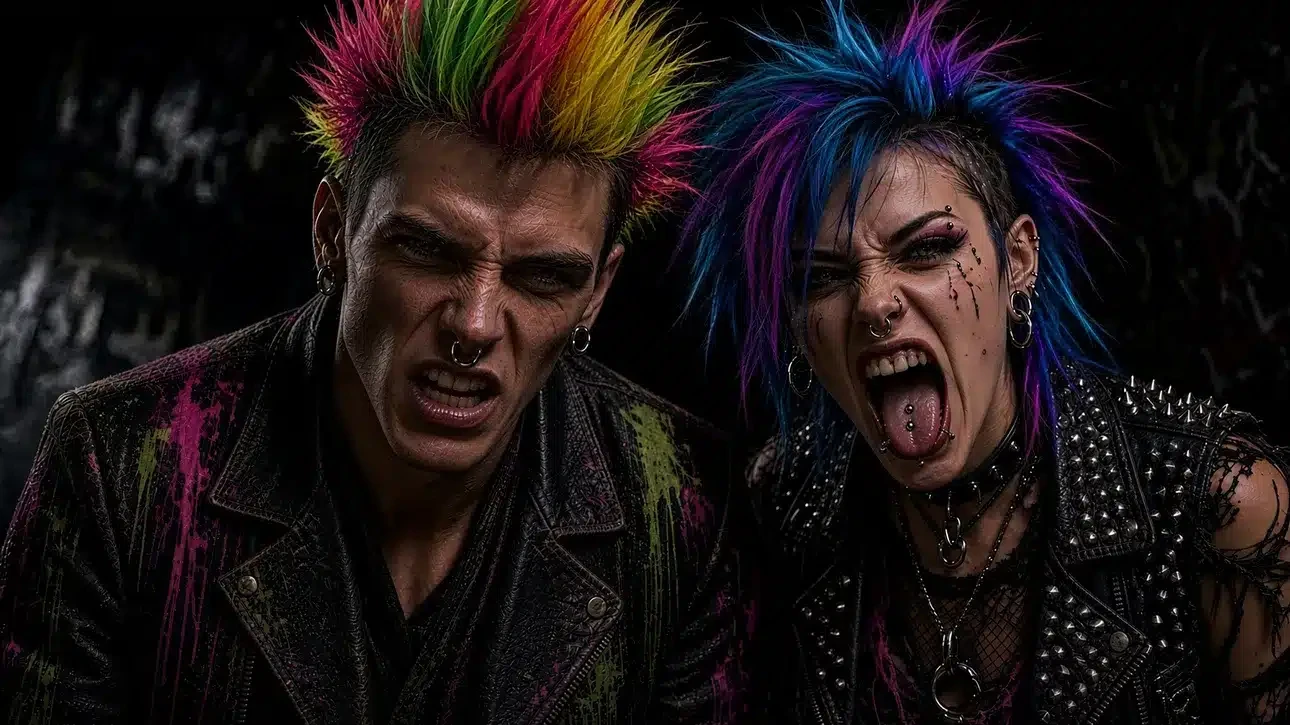
In the seminal 1979 sociological study Subculture: The Meaning of Style, Dick Hebdige documented how early British punk took everyday objects—safety pins, ripped garbage bags, school ties, and bondage gear—and stripped them of their polite social meanings. What began as a spontaneous, jarring visual refusal of postwar British social order quickly became codified.
As soon as enough people recognized the refusal, the symbolism hardened into a language. Once a language is established, dictionaries are written. The anti-uniform quickly calcified into an official dress code, proving that the collective rejection of societal authority could quietly install brand-new authorities of its own.
The 1990s: Major Label Panic and the "Boxcar" Reckoning
By the 1990s, the battle lines shifted from visual aesthetics to corporate affiliation. As the underground explosion catalyzed by Nirvana spilled over into the mainstream, independent punk bands faced a Faustian bargain: remain obscure and financially destitute within a self-contained ecosystem, or sign to a major label and risk excommunication from the scene that birthed them.
No band captured this existential dread better than Jawbreaker. In 1994, they released "Boxcar," featuring the iconic lyric: "Who’s punk? What’s the score?" Written as a satirical jab at the scene’s self-appointed inspectors, the band quickly discovered the punchline carried real consequences. When Jawbreaker signed to DGC Records the following year, fans boycotted their shows, sat with their backs to the stage, and threw pocket change at the band.
A similar drama played out at 924 Gilman Street, the collectively run, non-profit, volunteer-operated venue in Berkeley, California. Gilman operated under a strict, explicit rule: no major-label bands allowed. When Green Day signed with Reprise Records in 1993, they were promptly and permanently locked out of the venue that had nurtured them.
The 2015 Watershed: Re-evaluating Dogma
More than two decades after their excommunication, Gilman Street faced catastrophic financial ruin. In 2015, the venue’s collective membership faced a stark choice: maintain ideological purity and shut its doors forever, or make a pragmatic exception. The collective voted to invite Green Day back to headline a benefit show that ultimately saved the venue from bankruptcy.
This watershed moment proved that while establishing boundaries is vital for subcultural preservation, recognizing when dogmatism threatens to destroy the sanctuary the rule was designed to protect is the truest test of resilience. Survival superseded ledger purity.
Supporting Context & Metrics: The Sociology of Subcultural Capital
To map the mechanics of scene policing, sociologists often look beyond simple economics to analyze how social currency operates within underground spaces.
Sarah Thornton and Subcultural Capital
In the 1990s, sociologist Sarah Thornton borrowed Pierre Bourdieu’s framework of cultural capital to coin the term "subcultural capital." This refers to the invisible social currency individuals accumulate by possessing the right obscure trivia, acquiring rare vinyl test pressings, discovering bands before they break, and displaying the correct aesthetic and ideological alignments.
| Capital Type | Primary Currency | Mechanism of Exclusion | Ultimate Goal |
|---|---|---|---|
| Economic Capital | Fiat currency, corporate contracts | Major label vs. indie label status | Financial stability / Comfort |
| Subcultural Capital | Obscure trivia, early adoption, rarity | Derision of mainstream tastes | Social dominance / Scene status |
| Moral/Ideological Capital | Purity tests, sacrifices, compliance | Accusations of "selling out" | Belonging / Absolute authority |
As Thornton observed, underground scenes are paradoxical: they are built to dismantle mainstream hierarchies, yet participants immediately construct alternative status ladders inside the record bins. Scarcity is frequently confused with artistic integrity, and shrinking listenership is often treated as proof of moral superiority.
Official Statements & Theoretical Perspectives
The tension between institutional critique and internal conformity has long attracted philosophers and cultural critics. The punk ethos can be distilled into a single, highly corrosive interrogative phrase pioneered by the movement long before its participants opened academic texts: "Who says?"
- Who says music has to be technically complex?
- Who says you need a record company to release an album?
- Who says you need institutional permission to create?
This inquiry mirrors the foundational tenets of deconstruction, most famously articulated by philosopher Jacques Derrida. At street level, deconstruction asks practitioners to examine rigid binaries, identify what they exclude, and observe how quickly their borders collapse under pressure.
However, applying "Who says?" exclusively to external institutions—politicians, major record labels, and corporate bosses—is an incomplete exercise. True intellectual rigor requires turning the interrogation inward: Who says you get to decide what is punk?
Ian MacKaye and Jeff Nelson of Minor Threat and Fugazi recognized this early on. When they founded Dischord Records, they did not do so out of a belief that obscurity possessed inherent moral superiority. They founded it because Washington, D.C., bands needed a pragmatic mechanism to press and distribute records without waiting for industry validation. Fugazi institutionalized this philosophy by capping ticket prices at $5, insisting exclusively on all-ages shows, and treating independent fanzines with the same journalistic respect afforded to major publications. They did not retreat from the world; they constructed an alternative room within it.
Future Outlook: The Evolution of Scene Policing in the Digital Age
As punk enters its sixth decade, the battleground of authenticity has shifted from physical basements, vinyl bins, and zines to digital algorithms, social media discourse, and global streaming platforms.
1. The Decentralization of Gatekeeping
In the pre-internet era, scene gatekeepers were localized figures: the intimidating record store clerk, the zine editor, or the veteran booking agent. Today, subcultural policing has been democratized and accelerated by social media. Cancel culture, aesthetic micro-trends, and rapid ideological purity tests circulate globally in real-time. The "clipboard inspector" is no longer standing at the door of a brick-and-mortar venue; they are active in comment sections, judging whether a band’s TikTok presence violates underground ethics.
2. The Redefinition of "Selling Out"
The traditional definition of selling out—signing to a multinational corporation for a large cash advance—has largely dissolved. In an era where physical record sales have plummeted and streaming payouts render independent music financially unsustainable for the vast majority of artists, licensing a song for a commercial or a video game is often a matter of basic economic survival rather than artistic betrayal. Consequently, future subcultures are being forced to decouple economic survival from moral integrity.
3. Punk as a Living Practice, Not a Museum Exhibit
Ultimately, the future viability of punk rock depends on its willingness to abandon static definitions. If punk becomes a rigid historical reenactment society—complete with standardized uniforms, approved vinyl variants, and certified ideological checklists—it ceases to be punk and becomes just another conservative institution wearing safety pins.
The movement remains vital only so long as it functions as an active, breathing practice: making things without waiting for permission, building functional alternatives when existing institutions rot, protecting physical and digital spaces where people can exist authentically, and refusing to confuse genuine community with compulsory obedience. The moment we stop turning our skepticism inward is the exact moment we become the very authorities we spent our youth screaming against.









Belum ada komentar. Jadilah yang pertama berkomentar!