

Executive Overview
Nearly three decades after hitting theaters in the winter of 1997, Roger Donaldson’s volcanic disaster epic Dante’s Peak remains a fascinating cultural artifact. Starring Pierce Brosnan and Linda Hamilton, the film was largely a standard formulaic entry into the late-90s disaster-movie boom, overshadowed commercially and critically by its temporal rival, Volcano. Yet, for a specific pocket of the United States—the Inland Northwest—Dante’s Peak is far more than a cinematic footnote featuring molten lava and gravity-defying vehicle stunts. It is a cinematic time capsule of a rugged, fiercely independent region.
Shot on location in the historic, narrow-canyoned mining town of Wallace, Idaho, the film captured the authentic texture of blue-collar rural life, utilizing local extras, vernacular architecture, and breathtaking wilderness vistas. However, revisiting the film today carries a sobering weight. As severe regional wildfires—such as the Spokane blazes of 2026—increasingly threaten the physical landscape of Washington and Idaho, the fictional ash-choked ruins of Dante’s Peak transition from mere Hollywood spectacle into an unsettlingly familiar mirror of real-life ecological vulnerability. This retrospective examines the genesis of Dante’s Peak, its deep-seated ties to the real geology and tragedies of the Pacific Northwest (specifically Mount Saint Helens), its affectionate economic and cultural impact on Wallace, and its permanent place in the regional consciousness.
Detailed Chronology: From Mountain Desolation to Silver Valley Production
The 1980 Cataclysm and Its Cinematic Shadow
The spiritual and narrative foundation of Dante’s Peak lies firmly in the geological history of the Pacific Northwest. On May 18, 1980, Mount Saint Helens violently erupted, shearing off its summit and unleashing a lateral blast that instantly flattened 230 square miles of pristine forest. According to the United States Geological Survey (USGS), the cataclysm effectively eradicated every living thing within the immediate blast zone. The ecological devastation left behind—vast expanses of grey, skeletal timber and suffocating blankets of ash—imprinted a profound psychological scar on the region’s inhabitants.
When director Roger Donaldson and screenwriters crafted Dante’s Peak sixteen years later, they borrowed heavily from the mechanics of the Mount Saint Helens disaster. The film’s fictional stratovolcano unleashes identical hazards: devastating pyroclastic flows, toxic lahars (volcanic mudflows), and acidic lakes capable of dissolving organic matter.
Scouting and Transforming Wallace, Idaho (1996)
In 1996, the production team scoured the region for a setting that could authentically embody a charming, isolated mountain settlement. They selected Wallace, Idaho, a tiny mining community nestled deep within the steep, densely forested slopes of the Coeur d’Alene Mountains.
In a 1996 interview with The Spokesman-Review, director Roger Donaldson explained the unique logistical challenges and creative triumphs of utilizing the location:
"We wanted a place that would feel very enclosed, with the forest coming right down to town. Wallace really fitted that very well. The only problem Wallace had for us is that it had a freeway running through it, which really wasn’t the way I had originally seen it. So we went back and re-wrote the script and made the freeway part of the story."
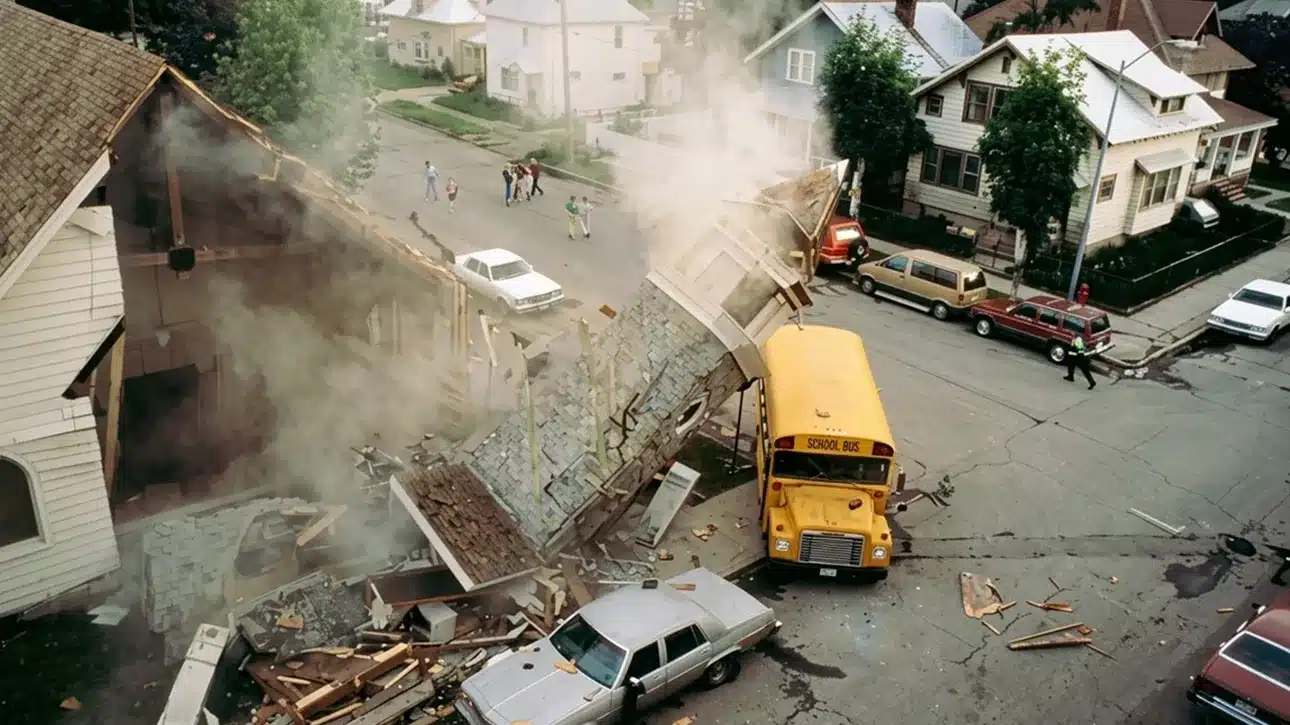
That freeway was Interstate 90, America’s longest transcontinental highway. In the narrative framework of Dante’s Peak, the I-90 bypass collapses during the initial eruptions, cutting off escape routes and trapping fleeing residents. To dress Wallace for its fictional doomsday, the production crew constructed a temporary church (destined for cinematic destruction), erected a Ferris wheel, and introduced vibrant floral landscaping. These careful touches successfully transformed the historic mining town into a cinematic contender for Money Magazine’s "Second Most Desirable Place to Live in the United States, Population Under 20,000."
Supporting Context & Metrics: Economic and Cultural Footprint
While national critics routinely dismissed Dante’s Peak as a formulaic B-movie, its arrival in the Inland Northwest was treated as a major civic event. The production injected vital financial resources into a local economy transitioning away from traditional heavy industries.
- Economic Injection: According to retrospective data published by the Coeur d’Alene Press, the production of Dante’s Peak added approximately $5 million directly to Wallace’s local economy through direct wages, regional construction contracts, and service industry expenditures.
- Box Office Reception: During its opening weekend in February 1997, local theaters across Northern Idaho and Eastern Washington experienced sell-out screenings. In towns like Coeur d’Alene, audiences eagerly lined up, often waiting up to 45 minutes to catch a glimpse of their neighbors, local landscapes, and familiar landmarks on the silver screen.
- Tourism Integration: Recognizing the marketing potential, the Idaho Division of Tourism and regional non-profit groups like Silver Country rapidly incorporated filming locations into official tour bus routes, transforming the fictional tragedy into a tangible tourist draw.
Official Statements and Local Perspectives
The reception of Dante’s Peak among Inland Northwesterners was characterized by a healthy mix of local pride, affectionate mockery, and critical detachment.
The Industry vs. The Inlanders
Director Roger Donaldson expressed immense appreciation for the authenticity of the local populace, remarking to the Los Angeles Times in August 1996: "Look at these extras! You couldn’t get extras like that in L.A. They look like real people."
This sentiment was mirrored by local residents who viewed Hollywood with a mixture of amusement and detachment. Sandy Zeller, a Wallace resident during filming, famously summarized the local perspective: "Those Hollywood people are not like us."
Media and Critical Commentary
Regional reviewers struggled to reconcile the film’s preposterous narrative beats—such as driving a heavy-duty US Forest Service truck across active, cooling lava flows—with its faithful rendering of local blue-collar culture.
- D.F. Oliveria, writing for The Spokesman-Review in February 1997, awarded the film a generous 7/10 primarily for its practical effects and "boiled bodies," though he dryly noted that the film "wasn’t worth waiting in line for 45 minutes… unless you’re an extra in the flick or you know someone who is."
- Carl Wilgus, administrator for the Idaho Division of Tourism, praised the production’s broader utility, stating that Dante’s Peak "further establishes Idaho’s credentials as a first-class film location."
- Tom Magnuson, president of the regional non-profit Silver Country, emphasized the promotional alignment: "Our goal is to tie our area as closely as possible with the filming of Dante’s Peak, because they have really done a wonderful job of portraying the natural beauty of the area and Wallace’s hometown nature."
Future Outlook: Wildfires, Memory, and Regional Resilience
As the Inland Northwest moves further into the 21st century, the physical realities of living in America’s forested corners have intensified. Recent environmental crises—such as the devastating Spokane, Washington wildfires—have brought the terrifying imagery of Dante’s Peak out of the realm of cinematic fiction and into the daily lives of residents. The suffocating blankets of grey ash and the blackened skeletons of pine forests are no longer confined to 1990s celluloid; they are recurring ecological challenges driven by changing climates.
Yet, just as the characters in Dante’s Peak and the real-life survivors of Mount Saint Helens demonstrate stubborn resilience, the spirit of the Inland Northwest remains unbroken. The quiet solitude of the pine forests, the crisp scent of sweet-sharp pine sap settling over silver mist, and the fierce attachment locals feel toward their land continue to define the region’s cultural identity.
Dante’s Peak may have begun as a Hollywood vehicle designed to exploit public anxieties about natural disasters, but for Idahoans and Washingtonians, it has evolved into something permanent. It is a cinematic monument to a landscape that refuses to be forgotten—percolating quietly in the collective regional consciousness like slow-moving magma that never fully cools.









Belum ada komentar. Jadilah yang pertama berkomentar!