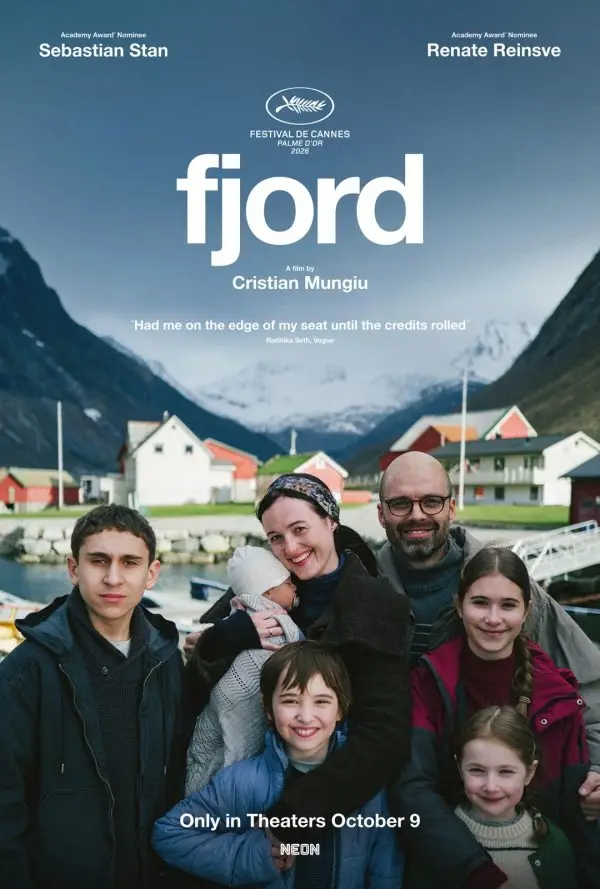
In the cinematic landscape of 2026, few releases have generated the intellectual fervor, moral vertigo, and critical polarization of Cristian Mungiu’s Palme d’Or-winning masterwork, Fjord. Clocking in at a rigorous, unyielding 146 minutes, the Norwegian-set sociopolitical drama operates as a chilly, clinical collision course between devout evangelicalism, traditional parenting philosophies, and the bureaucratic machinery of the modern state. Anchored by powerhouse performances from Sebastian Stan and Renate Reinsve, the film examines the precarious tightrope walked by an immigrant-mixed family living under the watchful gaze of Norway’s Child Protective Services (CPS).
Mungiu, renowned for his unflinching explorations of systemic oppression and moral compromise (4 Months, 3 Weeks and 2 Days, Graduation), turns his microscopic lens northward. He crafts a narrative that forces audiences to actively wrestle with deeply uncomfortable dichotomies: Where does the legitimate protection of a child end and cultural or religious persecution begin? Can we maintain empathy for parents whose ideological frameworks—ranging from strict anti-modernity stances to antiquated disciplinary methods—clash violently with contemporary progressive standards? And ultimately, when an institution steps in to "save" children, does it risk committing a graver violation of the human soul?
Through its methodical pacing, stark cinematography, and razor-sharp screenplay, Fjord has firmly established itself not merely as a high-water mark of contemporary European cinema, but as a cultural flashpoint. It questions the limits of societal tolerability, holding a mirror up to a world increasingly polarized between dogmatic tradition and unyielding systemic orthodoxy.
Detailed Chronology: The Unraveling of the Gheorghiu Family
The Pastoral Illusion and Ideological Enclave
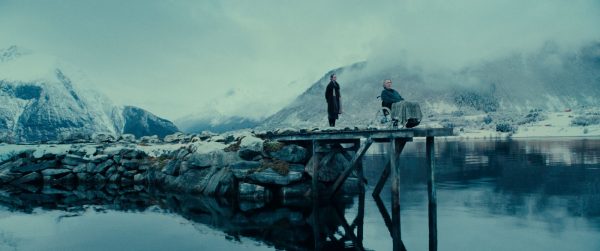
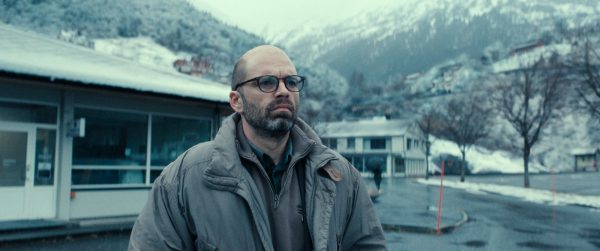
The narrative of Fjord unfolds against the breathtaking, yet inherently desolate backdrop of rural Norway. Cinematographer Tudor Vladimir Panduru captures the majestic fjords and snow-capped peaks not as a picturesque postcard, but as an isolating, freezing perimeter. Here we meet Mihai Gheorghiu (Sebastian Stan), a Romanian software developer who has relocated to his Norwegian wife’s homeland, alongside his nurse wife, Lisbet (Renate Reinsve), and their five children of varying ages.
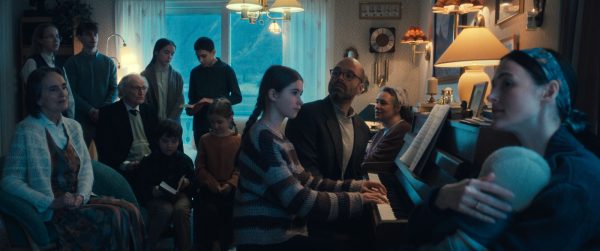
Despite living in a modern European democracy, the Gheorghiu household exists in an intentional temporal vacuum. The children’s world does not revolve around peer socialization, contemporary music, or digital connectivity; instead, it is governed by a strict, points-based behavioral system tied to biblical study and Christian devotion. The family’s lifestyle is undeniably austere. They forbid modern technology, instill socially conservative views regarding gender and sexuality, and adhere to an orthodox worldview that treats secular modernity as a spiritual threat.
Yet, Mungiu carefully resists painting them as cartoon villains. The film takes pains to demonstrate that while their domestic structure is rigid, they are not hermits disconnected from basic human decency. Lisbet spends her days acting as a compassionate caregiver to Ake (Øyvind Venstad Kjeksrud), a depressed, immobile neighbor, illustrating that the family functions smoothly within the local economy and treats outsiders with pragmatic respect. They do not proselytize aggressively; their insularity is self-contained.
The fragile ecosystem of the Gheorghiu household shatters one morning when middle child Elia (Vanessa Ceban) arrives at school bearing a visible, unexplained mark on her hand. In the hands of a lesser filmmaker, this incident would serve as a straightforward plot device; under Mungiu’s direction, it becomes a Rorschach test for institutional paranoia.
The school administration, spearheaded by headmaster Mats (Markus Tønseth), and local CPS worker Gunda (Ellen Dorrit Petersen) immediately swing into motion. Viewing the family through a lens of prior suspicion regarding their religious conservatism, the authorities leap to the conclusion of physical abuse.
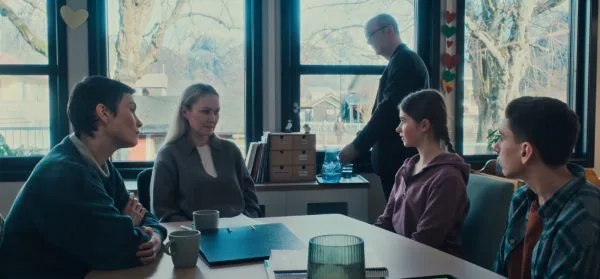
What follows is one of the most agonizing, masterclass sequences in modern drama: a devastating, continuous one-take sequence framed against a backdrop where a Norwegian flag billows in the window. In this clinical execution of state authority, Gunda breaks the news to Lisbet. Pending a formal civil trial, all five children—including an infant still entirely dependent on breastfeeding—are to be immediately stripped from their parents and placed into state-sanctioned foster care.
The Bureaucratic Trials and the Courtroom Crucible
The second half of Fjord transitions into a dynamically composed, claustrophobic courtroom drama. Frida (Lisa Loven Kongsli)—Mats’s own pragmatic wife—sets aside ideological friction to serve as the Gheorghius’ defense attorney, attempting to navigate a legal system predisposed to view non-conformist parenting as inherently abusive.
During the investigation, Mihai struggles to articulate his reality. Not entirely fluent in Norwegian, his testimony is fraught with cultural translation errors. Under intense cross-examination, he admits to having occasionally "slapped them on the butt" as a disciplinary measure in the past—a statement that Gunda and the prosecution deliberately weaponize, inflating the admission into violent, systematic physical abuse.
Mungiu masterfully exploits the grey areas of this testimony. The audience is forced into a state of internal wrestling:
Is Mihai’s disciplinary action an unforgivable relic of patriarchal violence, or is it being unfairly equated to draconian, mid-20th-century corporal punishment?
Does the state have a legitimate mandate to intervene when children are taught deeply problematic, exclusionary views—such as traditional definitions of marriage—or is this ideological policing masquerading as child protection?
As the children are funneled into the foster care system, their perspectives are deliberately sidelined, mirroring their physical removal from agency. We catch glimpses of Elia and her brother Emmanuel (Jonathan Ciprian Breazu) interacting with Noora (Henrikke Lund-Olsen), the rebellious, self-harming daughter of Mats and Frida. This narrative parallel introduces a biting irony: while the conservative Gheorghiu children are clinically detached, the progressive, permissive parenting style of Mats and Frida has produced its own deeply troubled, rebellious youth.
Supporting Context & Metrics
To fully appreciate the cultural and cinematic weight of Fjord, one must examine the production metrics, thematic lineages, and socio-legal frameworks underpinning the project
.
Runtime & Pacing: 146 minutes. Despite its sprawling runtime, critics note that the film’s meticulous construction causes it to fly by, relying on intellectual engagement rather than cheap narrative thrills.
Geographical and Cultural Context: The film taps directly into real-world anxieties surrounding Nordic child welfare systems (such as Norway’s Barnevernsevnet), which have historically faced international scrutiny and diplomatic friction regarding cross-border custody disputes involving immigrant families.
Cinematic Lineage: Cristian Mungiu’s body of work has consistently focused on institutional betrayal and the erosion of individual autonomy under systemic pressure. Fjord synthesizes the moral ambiguity of The Hunt (Thomas Vinterberg) with the clinical realism of the Romanian New Wave.
Official Statements & Critical Reception
The critical reception of Fjord following its triumph at the Cannes Film Festival has been characterized by intense debate among cultural critics, legal scholars, and film theorists.
In his review for Flickering Myth, critic Robert Kojder awarded the film three out of four stars, praising its fearless ambiguity:
"Whether or not Norway’s Child Protective Services acting morally suspect with an ulterior motive of religious persecution is a culturally specific dilemma to the country itself or the result of something broader on the filmmaker’s mind is also worth pondering… The limits of tolerability are put on trial just as much as the parents."
Kojder further highlighted the performances of the central duo, noting:
"It is also a remarkable testament to Sebastian Stan and Renate Reinsve, alongside a carefully crafted script, to find the humanity in people who could have come across as cartoonishly evil."
Industry analysts have noted that Fjord marks a significant artistic pivot for Sebastian Stan, who sheds Hollywood gloss to inhabit a gritty, morally compromised European everyman. Concurrently, Renate Reinsve continues her meteoric rise following The Worst Person in the World, delivering a performance of quiet, devastating maternal fortitude that grounds the film’s ideological skirmishes in raw, biological desperation.
Future Outlook: Cultural Impact and Awards Trajectory
As Fjord makes its theatrical rollout—spearheaded by its October release window—its trajectory points firmly toward the upcoming international awards circuit. Beyond its prestigious Palme d’Or win, industry insiders predict strong Academy Award consideration in major categories, including Best International Feature Film, Best Original Screenplay, and potential acting nods for both Stan and Reinsve.
More importantly, Fjord is destined to remain a touchstone in sociological and legal discussions. By refusing to offer easy moral resolutions, Mungiu ensures that audiences leave the theater not with answers, but with deeply unsettling questions about the nature of family, the reach of the state, and the price of non-conformity in a homogenizing global culture. In an era of cinematic comfort food, Fjord stands as a monumental, freezing monument to artistic courage—a film that burns long after the credits roll.









Belum ada komentar. Jadilah yang pertama berkomentar!