

Executive Overview
Chiba Prefecture, sweeping eastward from the sprawling density of the Tokyo metropolitan area into the embrace of the Pacific Ocean and Tokyo Bay, is a region defined by profound geographical contrasts. Framed by the rugged contours of the Boso Hills and an extensive, wave-swept coastline, Chiba functions as an ecological and cultural bridge between urban Japan and wild, maritime landscapes. While globally recognized for its aviation gateway—Narita International Airport—and its agricultural bounty, the prefecture undergoes a breathtaking metamorphosis each spring.
As winter recedes, Chiba emerges as one of Japan’s earliest and most diverse seasonal destinations for sakura (cherry blossom) viewing. Due to its maritime climate and southern latitude relative to northern Honshu, the prefecture hosts an extended viewing window that spans from mid-February through early April. This unique temporal spread makes Chiba an indispensable focal point for domestic and international travelers alike.
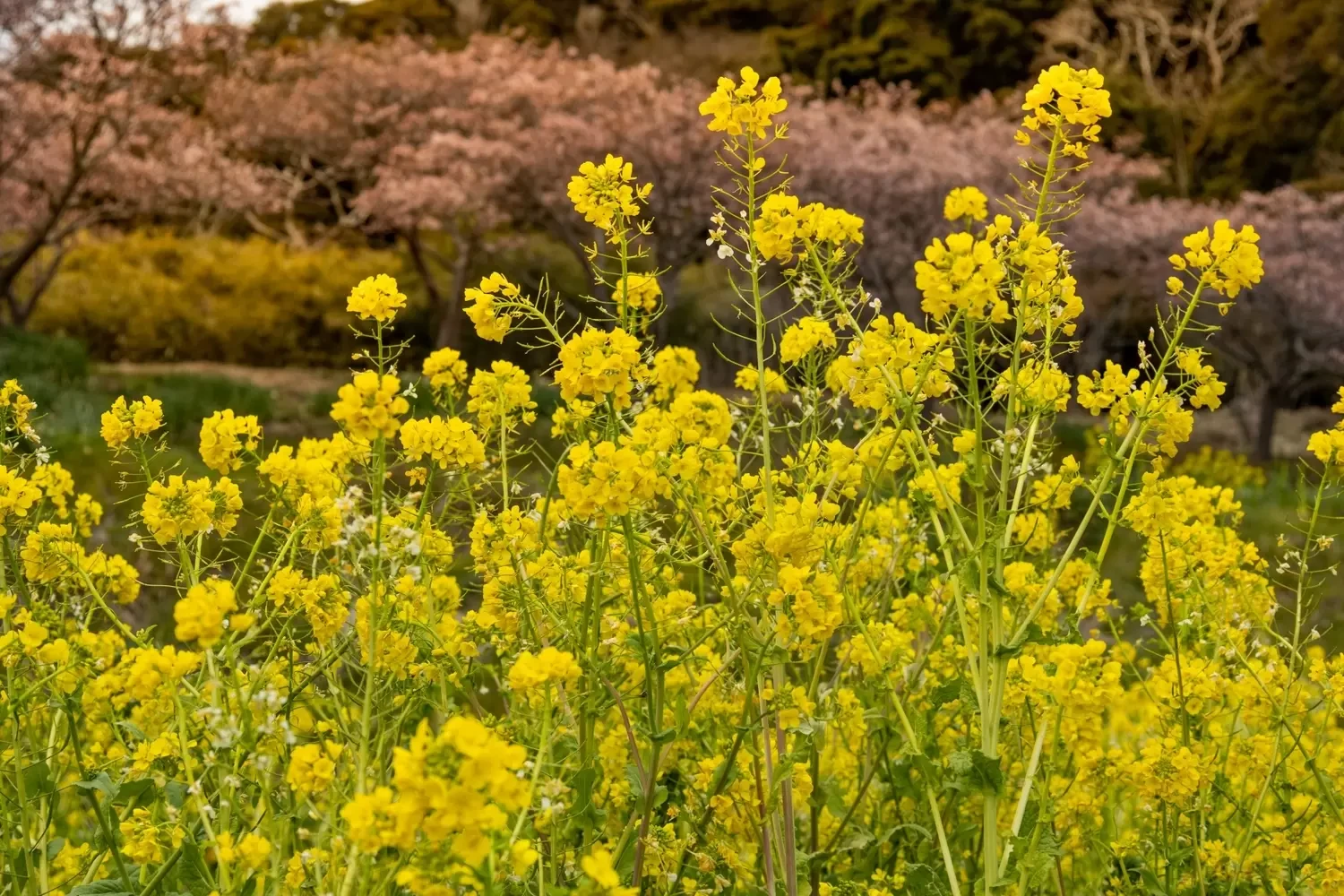
Furthermore, Chiba’s topography allows for rare botanical pairings. In several coastal and inland microclimates, the arrival of early-blooming cherry cultivars coincides precisely with the blooming of vibrant yellow nanohana (canola flowers), generating striking dual-chromatic landscapes of pink and gold. This comprehensive guide investigates the top ten cherry blossom viewing locations across Chiba Prefecture, analyzing their historical contexts, horticultural compositions, logistical accessibility, and peak seasonal metrics to offer an authoritative roadmap for the spring travel season.
Detailed Chronology & Destination Analysis
The cherry blossom season in Chiba does not arrive uniformly; rather, it unfolds in a rolling wave dictated by regional elevations, proximity to oceanic currents, and the genetic diversity of the planted flora. Below is the granular analysis of the prefecture’s ten premier hanami (flower-viewing) locations, ordered chronologically by their peak viewing windows.
1. Shinkawa Senbonzakura (Yachiyo City)
- Peak Viewing Window: Mid-February to Mid-March
- Primary Cultivars: Somei Yoshino, Kawazu-zakura, Yoko
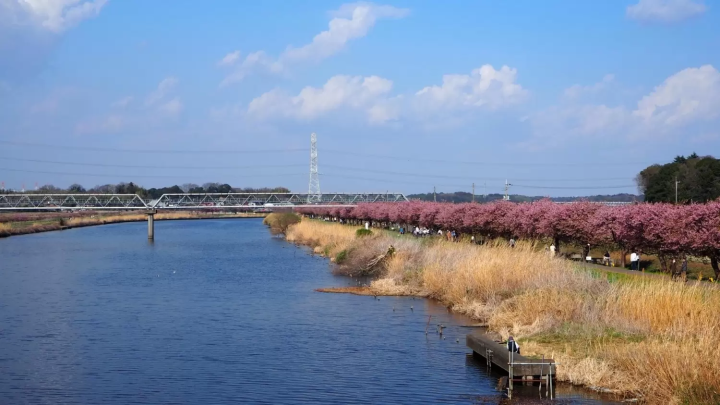
Stretching along a dramatic nine-kilometer (5.6-mile) corridor of the Shinkawa River in Yachiyo City, the Shinkawa Senbonzakura project represents a monumental civic landscaping achievement. Originally engineered to manage excess watershed runoff and protect communities from the historical flood risks associated with Lake Inba-numa, the riverbanks have been systematically transformed into a horticultural sanctuary.
The installation features approximately 1,000 mature cherry trees. Because the collection incorporates early-blooming variants like the Kawazu-zakura, the site breaks open its season as early as mid-February. Visitors walking the paved paths are treated to a prolonged transitional period where the robust pinks of the early cultivars gradually yield to the lighter hues of the Somei Yoshino.
The destination reaches its cultural crescendo during the annual Yachiyo Shinkawa Senbonzakura Festival. During this period, approximately 700 individual trees are subjected to strategic architectural illumination after dark. This nocturnal yozakura display casts ethereal reflections across the calm surface of the Shinkawa River, offering a stark and dramatic counterpoint to daytime sightseeing.
2. Hokoen Garden (Minamiboso City)
- Peak Viewing Window: Late January to Late February
- Primary Cultivars: Genchozakura (Winter Cherry)
Tucked away in the southern expanse of Minamiboso City within the Wada-cho district, Hokoen Garden is an agricultural landmark carrying profound historical weight. The property was originally established by Shichirohei Mamiya, a visionary pioneer credited with introducing commercial floriculture to the Boso Peninsula. Mamiya’s rigorous horticultural experimentation ensured that the soil would support exotic flora and resilient arboreal species.
Among the botanical assets of Hokoen is the rare Genchozakura, colloquially known as the "New Year Sunrise Cherry Blossom." True to its local moniker, this cultivar historically burst into bloom on the morning of New Year’s Day under the traditional lunar calendar.

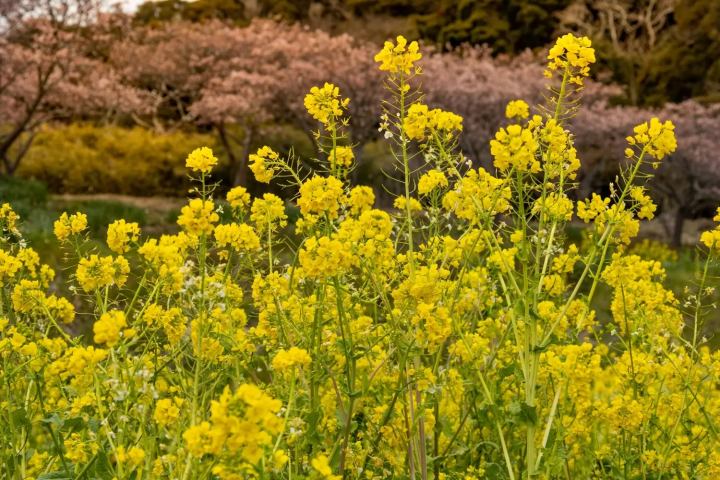
The primary draw for contemporary travelers, however, is the simultaneous convergence of the Genchozakura and vast fields of brilliant yellow canola flowers. Occurring reliably between late January and late February, this botanical juxtaposition provides one of the earliest full-scale spring spectacles in the entire Kanto region. Visitors arriving via Wadaura Station or driving from the Tomiura Interchange find an intimate, unhurried environment that completely predates the hectic rush of the national April blossom season.
3. Sakuma Dam Park (Kyonan Town, Awa District)
- Peak Viewing Window: Mid-February to Early April
- Primary Cultivars: Yoritomo-zakura, Yaezakura, Somei Yoshino, Shidarezakura (Weeping Cherry)
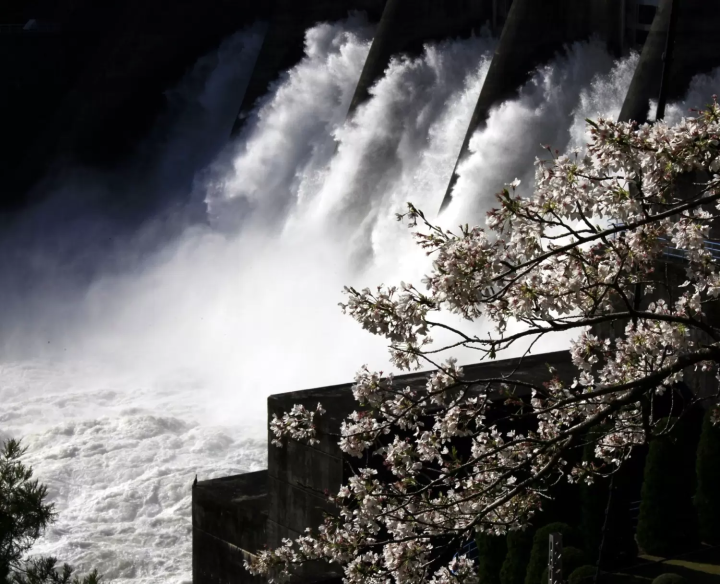
Centered around a massive agricultural reservoir holding a storage capacity of 1.27 million metric tons, Sakuma Dam Park in Kyonan Town functions as a year-round recreational hub that reaches its aesthetic zenith in early spring. The perimeter of the dam and its surrounding parklands are populated by an astonishing collection of roughly 2,200 cherry trees.
Because the park management has cultivated a wide spectrum of species—ranging from the early-arriving Yoritomo-zakura to standard Somei Yoshino and cascading Shidarezakura—the viewing season here is exceptionally elongated, stretching uninterrupted from mid-February through early April. This extended window serves as an operational buffer for travelers whose itineraries are vulnerable to unpredictable meteorological shifts.
The local municipality capitalizes on this botanical longevity by organizing a tiered series of seasonal events, including the Yoritomo Cherry Blossom Festival, the main Cherry Blossom Festival, and an open-air Hanami Market. Supported by comprehensive family infrastructure—including monument plazas and designated campsites—Sakuma Dam Park marries ecological immersion with functional accessibility.
4. Shimizu Park (Noda City)
- Peak Viewing Window: Late March to Early April
- Primary Cultivars: Somei Yoshino, Shidarezakura, Oshima-zakura
Operating under the guiding philosophy of "Friends with Nature," Shimizu Park in Noda City is a historic public facility that has earned a prestigious designation among Japan’s Top 100 Cherry Blossom Spots. Operating with a free-admission policy for its primary grounds, the park welcomes hundreds of thousands of domestic and international visitors annually.
The arboreal inventory boasts approximately 2,000 cherry trees distributed across nearly 50 distinct botanical varieties. When the Somei Yoshino, Shidarezakura, and Oshima-zakura reach simultaneous maturity between late March and early April, the park dissolves into a dense canopy of delicate whites and pinks.
The visitor experience is heavily enhanced by the annual Shimizu Park Cherry Blossom Festival. As twilight falls, traditional paper bonbori lanterns ignite along the pathways, casting a warm, nostalgic glow over picnickers. Beyond passive viewing, the park integrates expansive outdoor amenities, including field athletics, botanical gardens, and aquatic recreation zones, making it an ideal destination for multi-generational travelers.
5. Narita Sakura-no-Yama Park (Narita City)
- Peak Viewing Window: Late March to Early April
- Primary Cultivars: Somei Yoshino, Yamazakura, Shidarezakura, Higanzakura, Kawazu-zakura
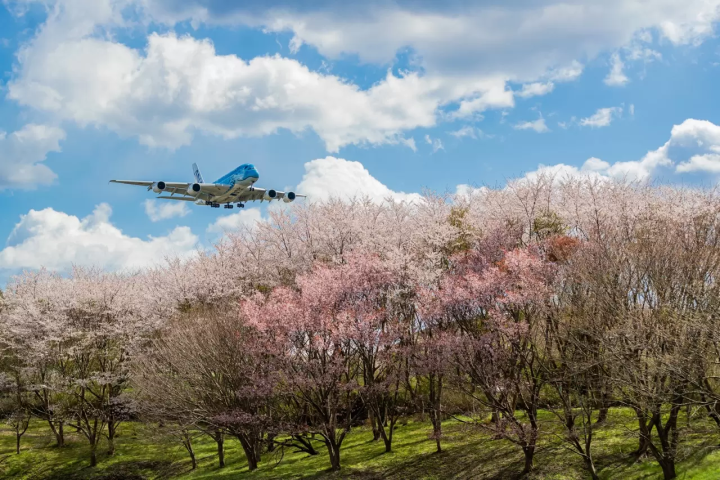
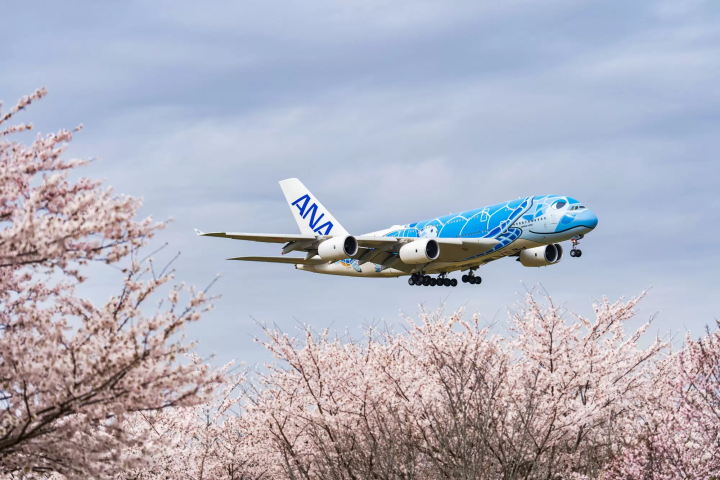
Positioned directly on an elevated bluff immediately north of the primary runways at Narita International Airport, Narita Sakura-no-Yama Park offers a synthesis of modern industrial logistics and classical Japanese natural beauty. Affectionately dubbed "the hill where you can see planes," the park acts as an unrivaled amphitheater for aviation enthusiasts and macro-photographers.
During the peak viewing window of late March to early April, the park’s diverse collection of cherry trees—encompassing Somei Yoshino, wild Yamazakura, Higanzakura, and weeping varieties—erupts into bloom. Photographers frequently position their lenses to capture commercial wide-body jets banking over or ascending directly through a framing of wind-swept pink petals. This striking juxtaposition of high-speed aerospace technology and ephemeral botanical fragility creates a distinctly memorable sensory experience.

6. Tokiwadaira Sakura Dori (Matsudo City)
- Peak Viewing Window: Late March to Early April
- Primary Cultivars: Somei Yoshino, Oshima-zakura
A triumph of urban planning and community forestry, Tokiwadaira Sakura Dori in Matsudo City was officially inducted into Japan’s Top 100 Roads in 1987. This residential and commercial avenue is flanked by a dense, mature arboricultural grid consisting primarily of Somei Yoshino and Oshima-zakura specimens.
During the peak operational window of late March to early April, the interlocking branches of approximately 600 trees form a continuous, three-kilometer (1.8-mile) floral tunnel overhead. To accommodate the massive influx of pedestrians, local authorities convert the avenue into a dedicated pedestrian-only zone during the annual Tokiwadaira Cherry Blossom Festival. Temporary food stalls line the route, offering regional street food while visitors stroll beneath the illuminated canopy.
7. Sakura Furusato Square (Sakura City)
- Peak Viewing Window: Late March to Early April (for concurrent viewing)
- Primary Cultivars: Somei Yoshino and Dutch Tulips
Sakura Furusato Square offers an aesthetic experience unique in eastern Japan. Anchored by a full-scale, operational Dutch windmill (Liefde) situated on the shores of Lake Inbanuma, the park consciously emulates a pastoral European landscape.

In terms of botanical scheduling, the park is engineered for a rare double-feature. While the park’s cherry blossoms target a peak from mid-March to early April, the adjacent fields are cultivated with hundreds of thousands of Dutch tulips designed to peak between late March and late April. Travelers who time their visits for the narrow window of late March through early April are rewarded with a vivid panorama featuring pink cherry blossoms in the foreground, vibrant multi-colored tulips in the mid-ground, and a classic European windmill turning on the horizon. This dynamic is further celebrated during the annual Sakura Tulip Festival held throughout the month of April.
8. Kangundzuka (Katsuura City)
- Peak Viewing Window: Late February to Early March
- Primary Cultivars: Kawazu-zakura
Perched on a strategic coastal promontory in Katsuura City, Kangundzuka carries a somber historical pedigree. The elevated mound serves as a memorial sanctuary erected to honor over 200 samurai from the Kumamoto domain who tragically perished when their transport vessel was wrecked off the Boso coast during the tumultuous final years of the Edo period (1603–1867).
Due to its commanding elevation, the site has long served as a traditional vantage point for locals gathering to witness the first sunrise of the New Year (Hatsuhinode). In late February, the location undergoes a radical transformation as its population of Kawazu-zakura trees reaches maturity.

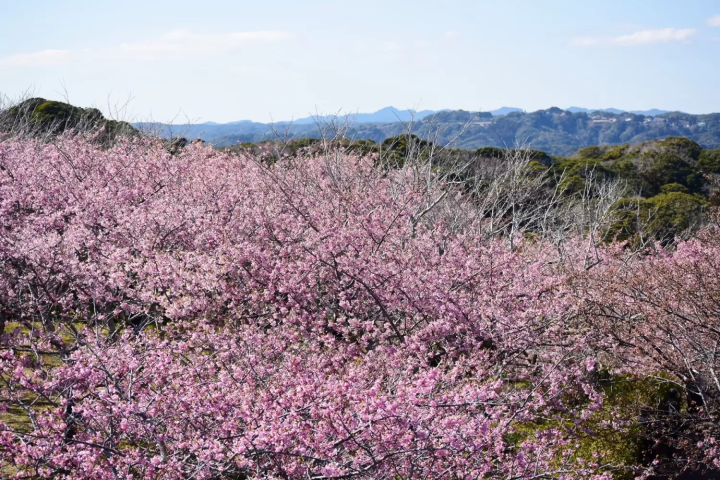
The approach to the memorial features a densely planted walking trail that forms a natural pink floral tunnel. Emerging from this tunnel, visitors encounter an uninterrupted panoramic vista where vibrant pink cherry blossoms frame the deep blue expanse of the Pacific Ocean, establishing Kangundzuka as one of Chiba’s premier hidden coastal gems.
9. Inohana Park (Chiba City)
- Peak Viewing Window: Late March to Early April
- Primary Cultivars: Somei Yoshino
Deeply anchored in the feudal history of the Kanto region, Inohana Park in Chiba City traces its origins back to 1126. It was during this era that Tsuneshige Chiba—patriarch of Tsunetane Chiba, a foundational military commander and key retainer to Minamoto no Yoritomo, the founder of the Kamakura Shogunate—constructed his fortified residence upon these grounds.
Converted into a formal historical park in 1959, the precinct is anchored by the Chiba City Folk Museum, architecturally styled to resemble a classic Japanese mountaintop castle. The grounds are populated by approximately 90 mature Somei Yoshino cherry trees.
During the peak viewing window of late March to early April, the annual Chiba Castle Cherry Blossom Festival galvanizes the local community. The event features professional illumination of the castle keep and surrounding flora, complemented by artisan food stalls, traditional musical performances, and historical reenactments.
10. Narita Yume Makoba / Dream Dairy Farm (Narita City)
- Peak Viewing Window: Late March to Early April
- Primary Cultivars: Mixed Specimen Varieties
Spanning an expansive pastoral footprint equivalent to roughly seven Tokyo Dome stadiums, Narita Yume Makoba (Dream Dairy Farm) blends agricultural tourism with seasonal horticulture. Designed as an interactive facility, the farm allows visitors to engage directly with livestock, including dairy cattle, draft horses, and rabbits, alongside seasonal agricultural workshops.
In the spring, approximately 300 cherry trees scattered across the rolling pastures burst into alignment with the birth cycle of the farm’s newborn animals. Peaking between late March and early April, the facility provides an undeniably distinct family-oriented hanami experience. Visitors can enjoy pastoral picnics against a backdrop of grazing livestock framed by sweeping canopies of pastel pink blossoms.

Comparative Metrics & Seasonal Reference Guide
To assist travelers, researchers, and tour operators in synthesizing logistical timelines, the following matrix outlines the operational profiles, primary cultivars, and peak viewing windows for each analyzed location:
| Destination | City / District | Primary Cultivars | Peak Viewing Window | Key Attraction / Event |
|---|---|---|---|---|
| Shinkawa Senbonzakura | Yachiyo City | Somei Yoshino, Kawazu, Yoko | Mid-Feb – Mid-Mar | 9km riverbank walk, Night Illumination |
| Hokoen Garden | Minamiboso City | Genchozakura (Winter) | Late Jan – Late Feb | Dual bloom with yellow canola flowers |
| Sakuma Dam Park | Kyonan Town | Yoritomo, Yaezakura, Somei Yoshino | Mid-Feb – Early April | 2,200 trees, family campsites |
| Shimizu Park | Noda City | Somei Yoshino, Shidarezakura | Late March – Early April | Top 100 Spot, lantern illuminations |
| Narita Sakura-no-Yama | Narita City | Somei Yoshino, Yamazakura | Late March – Early April | Low-altitude airplane photography |
| Tokiwadaira Sakura Dori | Matsudo City | Somei Yoshino, Oshima | Late March – Early April | 3km pedestrian tunnel, Top 100 Road |
| Sakura Furusato Square | Sakura City | Somei Yoshino, Tulips | Late March – Early April | Dutch windmill, simultaneous tulip bloom |
| Kangundzuka | Katsuura City | Kawazu-zakura | Late February | Pacific Ocean views, historical mound |
| Inohana Park | Chiba City | Somei Yoshino | Late March – Early April | Chiba Castle keep, historical festival |
| Narita Yume Makoba | Narita City | Mixed Specimen | Late March – Early April | Farm animals, newborn livestock season |
Future Outlook & Environmental Considerations
As climate anomalies continue to influence meteorological patterns across the Japanese archipelago, the phenology of sakura blossoming is experiencing accelerated shifts. Historically, the Japan Meteorological Agency (JMA) has noted a steady advancement in the average opening dates of Somei Yoshino trees nationwide, driven by incremental increases in late-winter and early-spring temperatures.
For Chiba Prefecture, these climatic shifts present both opportunities and challenges. While early-blooming cultivars such as the Kawazu-zakura at Kangundzuka and Genchozakura at Hokoen Garden remain relatively stable due to their lower chilling-requirement thresholds, standard urban and parkland plantings like those at Shimizu Park and Inohana Park are subject to increased volatility. A sudden late-winter warm spell followed by an unseasonal frost can truncate the blooming period or induce premature petal drop, threatening the structural integrity of seasonal tourism economies.
In response to these environmental pressures, regional destination management organizations (DMOs) throughout Chiba are adopting more adaptive horticultural management strategies. Arborists are increasingly diversifying park inventories by interplanting heat-resistant cultivars alongside traditional heritage trees. This multi-tiered planting strategy ensures that even if a primary Somei Yoshino canopy experiences a disrupted season, auxiliary species will compensate to maintain the aesthetic continuity of the landscape.
Furthermore, municipal authorities are moving toward sustainable tourism frameworks. High-density urban corridors like Tokiwadaira Sakura Dori and Narita Sakura-no-Yama Park are implementing structured pedestrian management protocols, shuttle services, and waste-reduction campaigns to protect root systems from soil compaction and environmental degradation.
Ultimately, Chiba Prefecture’s cherry blossom landscape remains a dynamic, resilient ecosystem. By balancing historical preservation with proactive environmental stewardship, the region guarantees that its sakura legacy will endure, offering future generations an uncompromised convergence of natural beauty, agricultural heritage, and maritime wonder.









Belum ada komentar. Jadilah yang pertama berkomentar!