

Published: August 25, 2026
Category: Cybersecurity & Gaming Intelligence
Author: Senior Technology & Security Correspondent
Executive Overview
As the global gaming community endures what is arguably the longest and most anticipated development cycle in video game history, malicious threat actors are capitalizing on player fatigue and desperation. With Rockstar Games’ Grand Theft Auto V (GTA 5) reigning supreme for over a decade as the second best-selling video game of all time—trailing only Minecraft—the appetite for its successor, Grand Theft Auto VI (GTA 6), has reached a fever pitch. Unfortunately, this unprecedented level of consumer excitement has also attracted the attention of opportunistic cybercriminals.
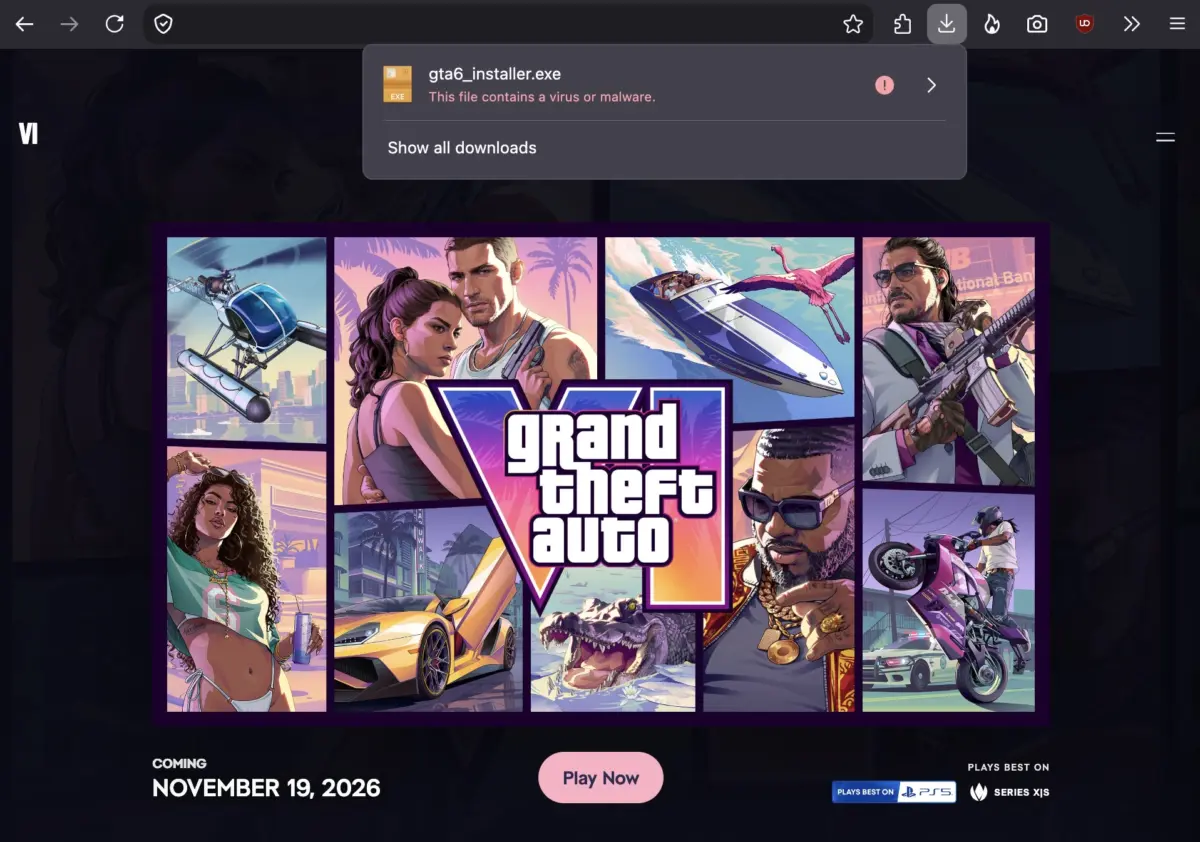
According to a newly published threat intelligence report from cybersecurity firm Malwarebytes, sophisticated hackers have launched targeted campaigns utilizing fraudulent websites that meticulously impersonate Rockstar Games. These deceptive portals promise eager fans an exclusive, playable GTA 6 demo or early-access installer. In reality, no such legitimate demo exists. Unsuspecting users who click the "Play Now" or download prompts are unknowingly injecting dangerous information-stealing malware directly into their systems.
This malware is designed to harvest sensitive personal data—including browser-saved passwords, authentication cookies, and active login sessions—effectively bypassing traditional multi-factor authentication (MFA) protocols. As the industry looks toward an anticipated November 19, 2026 release date, this wave of digital attacks serves as a severe warning about the intersection of pop-culture hype and modern cybercrime.
Detailed Chronology: The Anatomy of a Phishing Campaign
The exploitation of high-profile entertainment launches is not a novel concept, but the scale and technical execution of the GTA 6 campaign mark a significant escalation in gamer-targeted attacks.
Phase One: Capitalizing on Development Delays
The foundation for this malicious campaign was inadvertently laid by the protracted development timeline of Grand Theft Auto VI. Originally anticipated much earlier, the game has suffered through multiple high-profile delays, stretching fans’ patience to its absolute limit. In the information vacuum created by Rockstar Games’ tightly controlled communication strategy, rumors, unverified leaks, and speculation have flourished.
Cybercriminals identified this vacuum as the ideal environment for social engineering. By deploying Search Engine Optimization (SEO) poisoning techniques, typosquatting domains, and social media manipulation, threat actors successfully pushed fraudulent websites to the top of search engine results for queries related to "GTA 6 playable demo," "GTA 6 early access," and "Rockstar Games beta."
Phase Two: The Illusion of Authenticity
The malicious infrastructure uncovered by Malwarebytes researchers is chillingly convincing. The threat actors built pixel-perfect clones of Rockstar Games’ official portals, incorporating high-resolution promotional imagery, professional typography, and layout designs that mirror the publisher’s corporate aesthetic.

Visitors to these fraudulent domains are greeted with announcements regarding an "exclusive gameplay preview" or a "limited-time interactive demo." To reinforce the illusion, the sites feature fabricated user reviews, pseudo-legitimate download metrics, and instructions on how to install the software.
Phase Three: The Payload and the Breach
The trap is sprung the moment a user clicks the prominent "Play Now" or "Download Installer" button. Instead of initiating a game client setup, the download delivers an archive containing a disguised executable file.
Once executed, the software deploys an infostealer—a class of malware engineered for stealth and rapid data exfiltration. Unlike ransomware, which announces its presence by locking files and demanding payment, infostealers operate in the background like silent digital burglars. They systematically comb through local storage, scraping:
- Saved web browser credentials (usernames and passwords).
- Active session cookies across various platforms (gaming accounts, social media, email, and banking portals).
- Cryptocurrency wallet data.
- System telemetry and hardware identifiers.
By capturing active session tokens, these cybercriminals can bypass multi-factor authentication (MFA). They do not need to crack the user’s password or receive an SMS verification code; they simply clone the active session and impersonate the victim directly on the service provider’s servers.
Supporting Context & Metrics: The Scale of the GTA Phenomenon
To understand why Grand Theft Auto VI is uniquely positioned as a vector for cybercrime, one must examine the staggering commercial footprint of the franchise and the unique psychology of its consumer base.
The Legacy of GTA 5
Released originally in September 2013 for the PlayStation 3 and Xbox 360, Grand Theft Auto V has spanned three generations of console hardware. Its longevity is virtually unprecedented in the entertainment industry:
- Sales Milestones: GTA 5 has sold well over 190 million copies worldwide, generating billions of dollars in revenue.
- The Multiplayer Ecosystem: Grand Theft Auto Online has maintained a massive, active concurrent player base for over ten years, continually funded by microtransactions and major content updates.
- The Wait: The gap between GTA 5 and GTA 6 will exceed thirteen years by the time the latter hits store shelves. This generation-defining wait has created an entire subculture of dedicated content creators, dedicated leak hunters, and millions of casual fans desperate for any official media.
The Psychology of Vulnerability
Cybersecurity researchers note that high-stress, high-desire scenarios significantly impair human judgment. When individuals are emotionally invested in an event—such as the release of a generational video game—their cognitive defenses drop.
Phishing simulations consistently demonstrate that individuals are far more likely to click unverified links, ignore browser security warnings, and disable antivirus software if the perceived reward (in this case, playing GTA 6 months early) outweighs the perceived risk. Cybercriminals leverage this psychological leverage with clinical precision, creating a false sense of urgency ("Only 500 demo keys left!") to rush victims through the decision-making process.

Official Statements and Industry Response
As the Malwarebytes report circulated through cybersecurity circles, tech companies and media outlets rushed to issue advisories.
Rockstar Games has repeatedly emphasized that no public playable demo, beta test, or early-access build of Grand Theft Auto VI has been authorized or distributed. The developer maintains a strict policy regarding pre-release software access, limiting internal testing to closed environments under strict non-disclosure agreements. Any website claiming to offer a playable build of the game outside of official platform stores (such as the PlayStation Network or Xbox Games Store, when the time comes) should be treated as malicious.
Adding to the week’s developments, Netflix announced it will air an extended first look at Grand Theft Auto VI on Thursday via its Tudum platform. Industry analysts suggest this broadcast could provide long-awaited official footage, potentially invalidating circulating leaks and helping consumers distinguish between verified corporate announcements and fraudulent phishing attempts.
Security experts have reiterated baseline digital hygiene guidelines in response to the incident:
- Verify the Source: Always navigate directly to official publisher websites (e.g., rockstargames.com) rather than clicking links embedded in social media posts, unsolicited emails, or sponsored search results.
- Understand Demo Realities: AAA game developers rarely, if ever, distribute standalone playable PC or console demos via direct
.zipor.exedownloads from independent web servers. - Deploy Robust Endpoint Protection: Utilize modern antivirus and anti-malware solutions capable of heuristic analysis to flag suspicious installers before execution.
- Hardware Security Keys: Where possible, upgrade from SMS-based MFA to hardware-based security keys (like FIDO2/WebAuthn tokens), which are resistant to session-hijacking infostealers.
Future Outlook: A Precarious Road to November 19, 2026
With Grand Theft Auto VI officially slated for release on November 19, 2026, the cybersecurity landscape surrounding the gaming industry is entering a high-alert phase.
As the release date draws closer, threat actors are expected to diversify their attack vectors. Beyond fake demo sites, security analysts anticipate a surge in:
- Phishing Emails: Mass spam campaigns claiming to offer pre-order discounts, collector’s edition access, or beta keys.
- Malicious Mobile Apps: Fake "GTA 6 Companion" or "GTA 6 Mobile Port" applications distributed through third-party Android APK repositories.
- Social Media Scams: Livestreams on platforms like YouTube and Twitch utilizing deepfake footage of alleged gameplay, directing viewers to credential-harvesting login portals under the guise of "verification gates."
The gaming industry has grown into a financial behemoth that routinely eclipses the global box office and music industries combined. Consequently, it has become a primary target for organized cybercrime syndicates. The ongoing exploitation of the GTA 6 brand underscores a sobering modern reality: in the digital age, blockbuster entertainment and enterprise-grade cybersecurity are inextricably linked.
Until the game officially launches later this year, the onus remains on the consumer to navigate the digital wasteland with extreme caution—remembering that if an offer to play the most anticipated game in history sounds too good to be true, it is almost certainly a digital trap.









Belum ada komentar. Jadilah yang pertama berkomentar!