

Executive Overview
In the rapidly evolving landscape of autonomous aerial logistics, a quiet revolution is taking shape across the skies of southern India. Airbound, an innovative autonomous drone startup founded in 2023, has officially closed a formidable $37 million Series A funding round. Led by prominent venture capital firm Greenoaks, with strategic participation from retail and delivery juggernaut DoorDash, early-stage investor Lachy Groom, Lightspeed Venture Partners, and Humba Ventures, this latest financial injection arrives less than a year after the company secured an $8.65 million seed round. With this newly secured capital, the three-year-old enterprise has brought its total cumulative funding to nearly $50 million.
What sets Airbound apart in a crowded marketplace of drone technology companies is not merely its impressive capital accumulation or its youthful leadership—the company is spearheaded by visionary founder and CEO Naman Pushp—but its foundational engineering philosophy. While much of the drone delivery sector has historically struggled to achieve economic viability due to the high energy costs of lifting heavy airframes, Airbound is fundamentally rethinking aircraft architecture. By engineering vertical-flight drones that weigh less than the very payloads they carry, the startup is aggressively pursuing a disruptive economic goal: making aerial delivery as inexpensive as traditional road trucking.
As global commerce increasingly demands instantaneous, hyper-local fulfillment, the limitations of ground transportation—plagued by urban congestion, unpredictable routing, and batch-delay logistics—have become glaringly apparent. Airbound’s engineering breakthrough offers a compelling antidote. By bridging the efficiency gap between airborne transit and ground freight, the startup is positioning itself not just as a regional delivery operator, but as the premier original equipment manufacturer (OEM) for the global aerial logistics revolution—akin to the "Boeing of the drone industry."
Detailed Chronology & Funding Trajectory
The meteoric rise of Airbound offers a masterclass in modern deep-tech venture scaling. The journey began in 2023 when Naman Pushp founded the company with a singular, radical thesis: that the fundamental physics of conventional aircraft design were fundamentally flawed for last-mile and middle-mile logistics. Traditional fixed-wing and multi-rotor drones expend an exorbitant amount of energy simply carrying their own heavy structural weight, rendering high-volume, low-margin commercial delivery economically unfeasible.
Within a remarkably short operational window, Airbound transitioned from conceptual blueprints to physical hardware. By late 2024, the startup had captured the attention of top-tier global investors, culminating in an $8.65 million seed round that provided the runway necessary to transition its proprietary airframes from prototype testing to real-world operational deployments.
Throughout 2024 and 2025, Airbound’s development pace accelerated exponentially. The company established a sprawling 43,000-square-foot manufacturing and research facility in Bengaluru, bringing core engineering systems—including structural airframes, proprietary avionics, and vertical-flight control software—strictly in-house. This manufacturing independence has shielded the company from global supply chain vulnerabilities and allowed rapid iteration of its signature aircraft designs.
The culmination of these rapid milestones led directly to the recent $37 million Series A round. Beyond Greenoaks and DoorDash, the inclusion of seasoned tech investors underscores a broader industry conviction: that autonomous drone networks are no longer science fiction, but an imminent logistical necessity. Despite employing a lean yet specialized team of more than 150 professionals, Airbound remains deliberately pre-revenue, prioritizing long-term structural dominance and technological perfection over immediate commercial monetization.
Supporting Context & Metrics: Engineering Physics and Real-World Deployments
The Physics of Payload Parity
To understand Airbound’s disruptive potential, one must examine the core aerodynamic constraints that have plagued the drone industry for decades. Conventional aircraft suffer from an unfavorable payload-to-weight ratio. Heavy batteries, structural carbon composites, and complex mechanical linkages mean that a standard drone often spends up to 70% of its energy lifting its own dead weight.
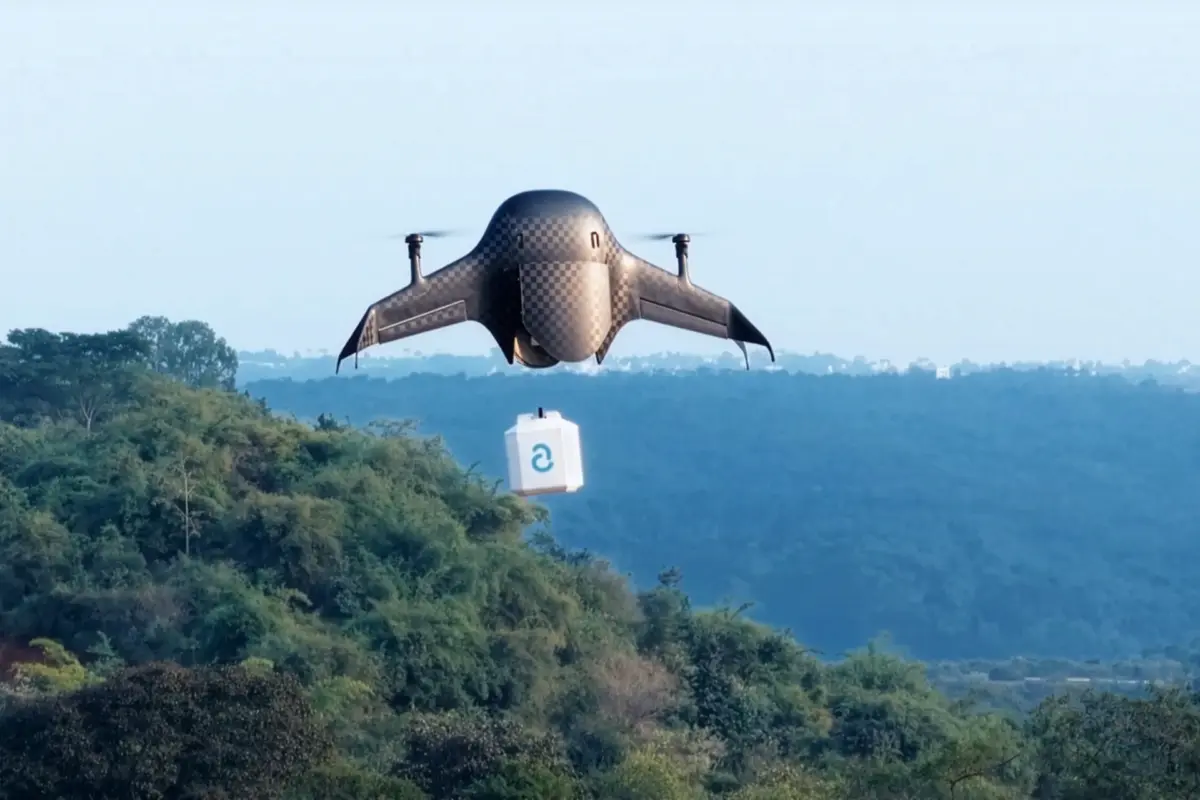
Airbound’s engineering team tackled this paradox head-on by developing an ultra-lightweight, rocket-like, tail-sitter architecture. The startup’s current operational aircraft model, designated as the TRT, weighs a mere 3.3 pounds (approx. 1.5 kg) yet is capable of hauling a payload of 2.2 pounds (approx. 1 kg). Pushing the boundaries of structural efficiency even further, Airbound is actively developing its next-generation aircraft, which will weigh approximately 6.6 pounds while boasting an impressive payload capacity of up to 11 pounds (5 kg).
The aircraft utilizes a vertical takeoff and landing (VTOL) tail-sitter mechanism. The drone rests and launches vertically in an upright position, lifting off without the need for traditional runways or expansive launch infrastructure. Once airborne, it transitions smoothly into an efficient horizontal flight profile. This dual capability ensures that Airbound’s network can operate seamlessly within dense urban environments and remote rural outposts alike, entirely unencumbered by infrastructural bottlenecks.
Operational Proof: Healthcare Logistics in Southern India
While theoretical engineering models are vital, Airbound has aggressively validated its technology in the crucible of real-world operations. To date, the startup has successfully completed more than 13,000 autonomous flights across the bustling southern Indian tech hubs of Bengaluru and Guntur.
Among these deployments, none is more critical than Airbound’s ongoing partnership with Narayana Health, a premier Indian hospital network. In this deployment, Airbound utilizes a single active drone to transport sensitive diagnostic blood and tissue samples between healthcare facilities separated by a 2.5-mile route.
The operational efficiencies realized through this deployment are staggering:
- Time Reduction: The autonomous drone completes the 2.5-mile transit in approximately seven minutes.
- The Ground Comparison: By contrast, traditional road transport via truck or motorcycle takes anywhere from three to five hours. This immense delay is not merely a product of traffic congestion; rather, road logistics require medical staff to accumulate and bundle a critical mass of samples before dispatching a vehicle, creating dangerous bottlenecks in patient diagnostics.
This foundational success has catalyzed an ambitious expansion. Narayana Health’s newly inaugurated Banashankari hospital in Bengaluru was purposefully designed without an on-site diagnostic laboratory or blood bank. Instead, the facility relies entirely on Airbound’s autonomous drone network to connect instantaneously with centralized medical laboratories, proving that infrastructure design can be radically decentralized through dependable aerial logistics.
Official Statements & Industry Vision
The philosophical underpinnings of Airbound are deeply rooted in long-term infrastructure building rather than short-term market capture. In recent interviews, founder and CEO Naman Pushp has articulated a clear, unyielding vision for the company’s trajectory.
"We want to build towards a world where everything has cost parity with trucking," Naman Pushp asserted, emphasizing that the economic barrier is the final frontier for drone adoption.
Addressing the company’s strategic positioning within the broader global logistics ecosystem, Pushp drew a distinct parallel to historical industrial titans:
"That’s the Boeing role — the aircraft airlines everywhere rely on, not the airline itself."
This philosophy explains why Airbound is consciously choosing to position itself as an OEM and network architect rather than attempting to dominate the consumer delivery front-end. By manufacturing the aircraft and providing the foundational orchestration software, Airbound enables third-party logistics firms, e-commerce giants, and healthcare providers to leverage autonomous aerial lanes without bearing the immense R&D burden of aircraft manufacturing.
Investors have echoed this strategic foresight. Representatives from Greenoaks and DoorDash noted that Airbound’s relentless focus on unit economics and ultra-lightweight structural engineering solves the exact scaling hurdles that have historically constrained the urban drone delivery market.
Future Outlook & The Road Ahead
As Airbound looks toward the horizon, its ambitions are expanding on a grand scale. The startup’s most ambitious project to date is a landmark agreement forged with the state government of Andhra Pradesh to construct a comprehensive three-city drone delivery network.
Designed to seamlessly integrate retail, e-commerce, and healthcare logistics, the network targets an astonishing output of 10,000 flights per day. Achieving this volume will require an active fleet ranging between 250 and 1,000 aircraft, with initial projections centering on an efficient fleet size of 250 drones depending on localized route topologies. Crucially, this initiative operates entirely free of government subsidies or direct state contracts; instead, the Andhra Pradesh government is collaborating directly with Airbound to establish the progressive regulatory frameworks necessary to govern high-density, autonomous low-altitude airspace.
Navigating Regulatory and Scaling Bottlenecks
Despite the overwhelming technical and financial momentum, Airbound’s leadership remains pragmatic about the hurdles that lie ahead. While the startup’s Bengaluru manufacturing facility possesses the industrial capacity to scale production rapidly—ensuring that hardware manufacturing will not become an operational bottleneck—external regulatory frameworks present a more complex challenge.
Specifically, securing regulatory certifications for Beyond Visual Line of Sight (BVLOS) operations remains the critical gatekeeper for commercial scale. Operating delivery networks across metropolitan spans requires robust, failsafe regulatory approvals that allow autonomous flight without direct human line-of-sight monitoring.
Furthermore, Airbound’s deliberate strategy to remain pre-revenue while employing a specialized workforce of over 150 engineers underscores a generational commitment to technological excellence.
"The goal is to be a giant in a few decades, not to make revenue as soon as we can," Pushp stated.
Conclusion
With $37 million in fresh capital, deep-pocketed strategic backers like DoorDash and Greenoaks, and a proven track record of over 13,000 autonomous flights, Airbound is no longer a speculative venture—it is a maturing industrial powerhouse. By successfully defying conventional aerodynamic constraints and driving the cost of flight down toward the economics of road freight, Airbound is poised to redefine how humanity moves goods through the lower skies. As regulatory horizons expand in tandem with its technological capabilities, the company is well on its way to cementing its legacy as the definitive aerospace backbone of the 21st-century logistics economy.








Belum ada komentar. Jadilah yang pertama berkomentar!