

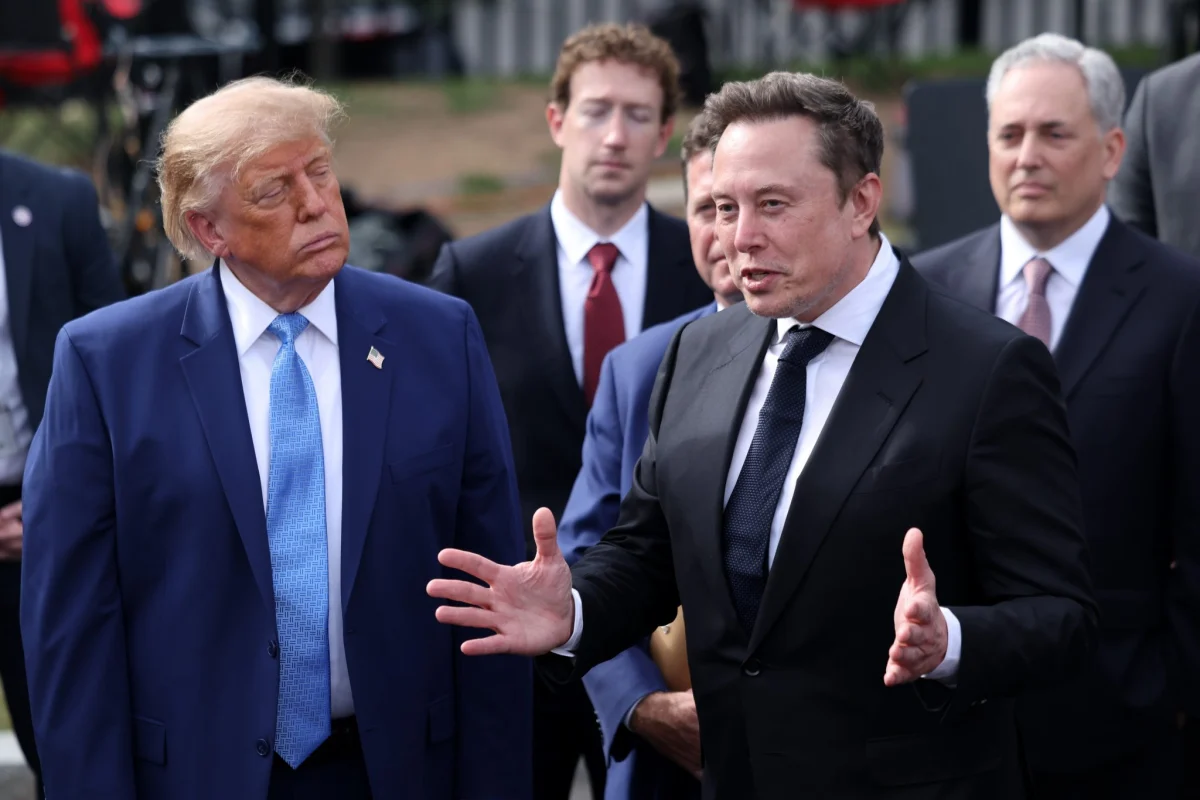
In a sweeping pivot that blurs the lines between federal policy, linguistic branding, and Silicon Valley theater, the Trump administration has officially outlawed the phrase "artificial intelligence" within official U.S. government lexicons, replacing it by executive order with the term "super intelligence."
This dramatic nomenclature shift served as the centerpiece of a high-stakes, star-studded summit in Washington, D.C., where President Donald Trump convened the nation’s foremost artificial intelligence titans—including industry luminaries like OpenAI’s leadership, Anthropic CEO Dario Amodei, Meta CEO Mark Zuckerberg, Amazon founder Jeff Bezos, and xAI/Tesla chief Elon Musk. The gathering culminated in the signing of the "Joint Commitment on Frontier Responsibilities," a voluntary pact ostensibly designed to establish safety parameters for the rapid advancement of frontier models.
However, behind the closed doors and the meme-generating photo ops, tech industry insiders and policy analysts are expressing deep skepticism. Far from a substantive regulatory framework, the newly minted agreement has already drawn international amusement and domestic critique for a glaring clerical error—misspelling "United States" on the official parchment signed by the president and tech executives. Furthermore, the pact carries zero legal enforceability, prompting President Trump to describe it instead as "morally binding"—a novel legal abstraction in federal governance.
This report unpacks the motivations, contradictions, and geopolitical ripples of the White House’s latest maneuver. Drawing from insights featured on TechCrunch’s Equity podcast—featuring hosts Anthony Ha, Kirsten Korosec, and Sean O’Kane—we examine whether this summit represents a genuine turning point in AI safety or merely an elaborate public relations campaign designed to rebrand the existential anxieties of the automation era.
Detailed Chronology: From Defense Department Cold Wars to Late-Night Dinners
The path to the White House AI summit was anything but linear, marked by sudden escalations, midnight reconciliations, and a whiplash-inducing reversal of federal rhetoric.
The Anti-Regulation Stance
Just weeks prior to the summit, President Trump adopted an aggressive, deregulatory posture regarding the domestic technology sector. In public remarks, the president dismissed industry warnings about existential threats, asserting that aggressive oversight would inadvertently cede American technological dominance to foreign rivals.
"We don’t need any of this, we need to lead in AI, we can’t constrain it in any way, we don’t need any regulation," Trump stated weeks prior, going so far as to suggest that domestic advocates for AI safety regulations were acting as foreign or partisan actors. For an administration championing unbridled American innovation, any conversation regarding systemic risk or guardrails was treated as an impediment to national progress.
The Anthropic Cold War and the 10 PM Intervention
At the epicenter of the administration’s earlier friction with the tech sector was Anthropic. The AI safety-focused startup had found itself isolated within the Washington establishment, particularly drawing the ire of the Department of Defense. Pentagon officials and administration surrogates—most notably high-ranking defense voices like Emil Michael—frequently took to social media to label Anthropic’s approach as "woke" and a direct national security risk, largely due to the firm’s insistence on embedding strict ethical guardrails and usage conditions into its models.
Despite deep-seated animosity from the defense apparatus, other corners of the executive branch—notably the Treasury Department—recognized the critical utility of Anthropic’s technology. This internal division created a fractured White House approach toward the company.
The ice began to crack unexpectedly when Anthropic CEO Dario Amodei was quietly summoned to the White House for a late-night, 10:00 PM sit-down dinner with President Trump. According to reports and subsequent interviews, the impromptu meeting bypassed traditional bureaucratic channels, illustrating the idiosyncratic nature of modern executive engagement where high-level policy directions can pivot on a single private audience.
The Summit and the "Morally Binding" Pact
The détente finalized at the midnight dinner paved the way for the broader industry luncheon days later. The guest list read like a roll call of global net worth and technological influence: Mark Zuckerberg, Jeff Bezos, Elon Musk, and Dario Amodei gathered under one roof to negotiate terms of coexistence with the federal government.
The resulting "Joint Commitment on Frontier Responsibilities," however, immediately became the target of ridicule. Observers quickly noted that the formal document featured a glaring typo, misspelling "the United States." More critically, legal scholars pointed out that the document lacks any statutory authority or regulatory teeth. Confronted with its lack of legal enforcement, President Trump waved off concerns, characterizing the document as "morally binding"—a designation with no precedent in administrative law.
Supporting Context & Metrics: The Anatomy of a Rebranding Exercise
To understand the true significance of the White House summit, analysts suggest looking past the text of the agreement and focusing on the underlying psychological and political strategy.
The Semantics of "Super Intelligence"
The codification of "super intelligence" over "artificial intelligence" is viewed by industry watchers as a calculated exercise in linguistic engineering. For years, public discourse surrounding AI has been dominated by dystopian narratives: mass job displacement, autonomous military escalation, algorithmic bias, and existential annihilation scenarios popularized by science fiction and academic warnings alike.
By legally and administratively scrubbing the term "artificial intelligence" from federal communications, the administration has attempted to divorce the technology from its baggage.
As Kirsten Korosec noted during the Equity podcast analysis, the implicit messaging of the rebranding campaign can be summarized as:
“AI is going to kill us, it’s scary, it is going to take jobs—but super intelligence is not.”
This semantic sleight-of-hand reframes the technology not as a synthetic, potentially dangerous mimicry of human thought, but as an ascendant, hyper-capable evolution of American industrial might—one that aligns cleanly with nationalist narratives of dominance and manifest destiny.
Internal Government Fractures
Despite the festive optics of the executive luncheon, deep institutional friction remains unaddressed. Sean O’Kane highlighted the persistent disconnect between the White House’s public outreach and the Department of Defense’s institutional posture:
- The Pentagon’s Hardline Stance: Defense officials continue to view companies like Anthropic with suspicion, particularly regarding intellectual property, data sovereignty, and restrictions on military deployment.
- The Treasury’s Pragmatism: Conversely, economic and treasury officials view frontier models as vital economic engines that must be secured and integrated into domestic financial infrastructure at all costs.
- The Social Media Front: Administration-aligned figures continue to publicly critique AI labs over ideological compliance and safety guardrails, demonstrating that a single presidential dinner is insufficient to harmonize a sprawling national security apparatus.
Official Statements & Reactions
The convergence of tech executives and political leadership generated a flurry of official commentary, highlighting the tension between corporate pragmatism and administrative showmanship.
-
On the Legal Weight of the Agreement:
"It is deeply non-binding. I mean, it is completely voluntary… Trump described it as ‘morally binding,’ which is just a level of abstraction and terminology that I’ve never heard of before."
— Sean O’Kane, Journalist, TechCrunch -
On the True Purpose of the Summit:
"The important and interesting thing is that just days ago, Anthropic was really in the doghouse… But the fact that this kind of gesture was needed seems significant, even if I don’t think the agreement itself is going to lead to any major changes."
— Anthony Ha, Host, Equity Podcast -
On the Rebranding Strategy:
"The big message was a rebranding effort around AI. AI is going to kill us, it’s scary, it is going to take jobs—but super intelligence is not."
— Kirsten Korosec, Senior Editor, TechCrunch
Future Outlook: What "Super Intelligence" Means for the Industry
As the dust settles on Washington’s latest high-tech spectacle, industry stakeholders are left to evaluate the practical implications of the administration’s new posture. Several key trajectories are emerging:
- Tokenistic Compliance vs. Real Governance: Because the "Joint Commitment on Frontier Responsibilities" relies entirely on voluntary adherence, major labs are unlikely to alter their core research and deployment roadmaps. However, signing the pact provides tech giants with a valuable public relations shield against future congressional scrutiny.
- The Weaponization of Terminology: Federal agencies, grant-making bodies, and defense contractors will now be forced to update their compliance documentation to reflect the mandated shift to "super intelligence." While this may seem like bureaucratic window dressing, it sets a precedent for how federal funding and regulatory oversight will categorize advanced computational systems moving forward.
- Persistent National Security Tensions: The ideological battle within the federal government—pitting defense hawks against economic modernizers—will continue to shape procurement contracts. Until the Department of Defense and Silicon Valley achieve a cohesive consensus on the boundaries of AI deployment in national security, friction points will persist regardless of executive photo opportunities.
Ultimately, while the transition from "artificial intelligence" to "super intelligence" may do little to alter the underlying mathematics of large language models or autonomous systems, it marks a profound milestone in how political power attempts to harness, pacify, and brand the defining technology of the 21st century.









Belum ada komentar. Jadilah yang pertama berkomentar!