

The San Francisco Bay Area music community experienced an extraordinary convergence of roots heritage, psychedelic experimentation, and modern counterculture during the first weekend of October. Anchored by the annual Hardly Strictly Bluegrass Festival in Golden Gate Park, the weekend evolved into a multi-venue cultural phenomenon highlighted by jamgrass phenom Billy Strings. Strings returned across the Bay for a massive, two-night sold-out run at the Oakland Arena on Friday, October 2, and Saturday, October 3. Operating effectively as unofficial "Outside the Park" late-night spectacles to complement the daytime festival programming, these arena dates underscored Strings’ unprecedented ascension from traditional acoustic circles to the upper echelons of arena-rock drawing power.
Drawing capacity crowds estimated between 12,000 and 14,000 attendees per night—utilizing a tailored arena configuration reminiscent of the historic Grateful Dead runs of the 1980s and 1990s—Strings demonstrated that acoustic-driven music can command the largest spaces in modern live entertainment. The weekend featured historic guest collaborations, including an appearance by Primus mastermind Les Claypool, deep archival covers, emotional tributes to fallen icons, and a vibrant parking-lot vending scene straight out of the golden era of counterculture touring. As Strings celebrated his 34th birthday on night two, the weekend served as a definitive statement on the enduring, borderless appeal of guitar-driven improvisational art.
Detailed Chronology
Friday, October 2: Ignition at the Oakland Arena
The weekend began early for dedicated music fanatics who spent their daytime hours traversing Golden Gate Park for the opening sets of Hardly Strictly Bluegrass. Catching performances by Sierra Hull, Los Lobos, My Morning Jacket, and a portion of Molly Tuttle’s set set a high standard, but the evening migration across the Bay Bridge to the Oakland Arena shifted the tempo into hyperdrive.

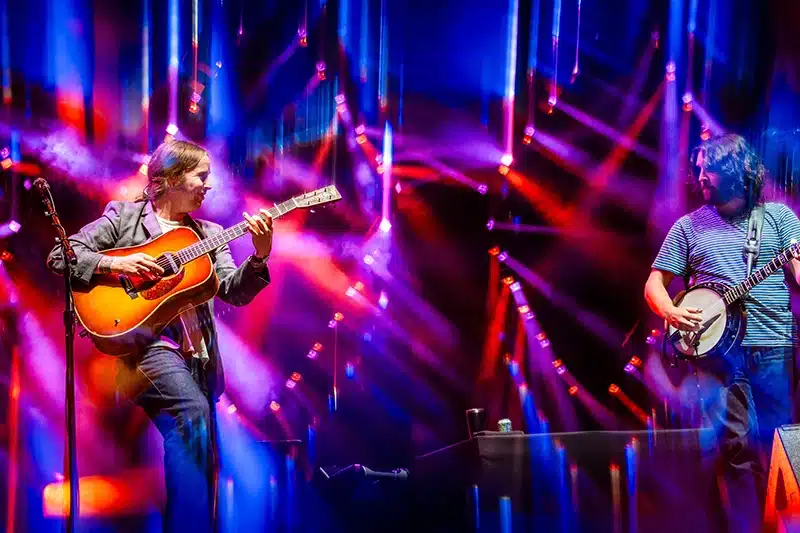
By 8:00 PM, the arena was swelling with palpable energy. Though the upper-tier sides traditionally utilized by the Grateful Dead were curtained off, the remaining footprint of the venue hummed with 13,000-plus eager fans. Strings and his tightly knit quartet—consisting of bassist Royal Masat, banjo player Billy Failing, mandolinist Jarrod Walker, and fiddler Alex Hargreaves—wasted no time establishing the evening’s trajectory. Launching the first set with the title track from his 2017 breakout record, Turmoil & Tinfoil, Strings led the ensemble into the deep end with a signature meditation on learning "how to fly on broken wings."
A soaring, 20-minute psychedelic light show accompanied a smoking improvisational voyage, highlighting the band’s telepathic interplay. Masat cut a striking figure onstage, clad in crisp white trousers, matching sunglasses, and a Phil Lesh tie-dye shirt—a nod to his growing status as a fashion icon within the jam community.
"How good is it to be back in the land of Oak? Me and the boys are all keyed up," Strings greeted the crowd after the opening jam settled.

The set smoothly transitioned into "I Wish I Wanted To" from his album So Much for Goodbyes, offering a laid-back reflection on restlessness before dipping into a resonant, 1914 jazz-blues standard, "The Saint Louis Blues." Instrumental highlights included "Malfunction Junction" from 2024’s Highway Prayers, which showcased the fluid dynamic chemistry of the group, and a closing run of "Seven Weeks in County" that left the room electrified.
The second set maintained the festive momentum. A soaring rendition of Billy Failing’s "So Many Miles" sparked widespread dancing, quickly followed by the emotional core of the set: "Remember to Cry," an upbeat yet poignant composition widely interpreted as a tribute to Strings’ mother, who passed away suddenly the previous year.
"Bluegrass music, it’s what’s for breakfast, lunch, and dinner," Strings remarked before delivering the debut-style energy of "I Like Train Songs."

The night’s crown jewel, however, was a rare bust-out of "Midnight Moonlight." Not performed by Strings in 485 shows, the Peter Rowan classic—famed for its origins in the legendary 1970s supergroup Old & In the Way alongside Jerry Garcia and David Grisman—ignited an incandescent fiddle solo from Hargreaves while Strings commanded the arrangement like a seasoned maestro.
Post-show revelry spilled into the parking lot, where a scaled-down "Shakedown Street" vending community thrived. Tents offered handcrafted apparel, local beverages, and counterculture merchandise, including tongue-in-cheek shirts merging the Pabst Blue Ribbon aesthetic with bold statements of praise for the band.
Saturday, October 3: The 34th Birthday Bonanza
Night two brought an even higher tier of anticipation, as the Bay Area music community converged on the Oakland Arena once more to celebrate Billy Strings’ 34th birthday. Many fans spent their afternoon back at Golden Gate Park, catching rare acoustic sets from San Francisco legends Hot Tuna, whose performance of "Good Shepherd" from Jefferson Airplane’s 1969 masterpiece Volunteers bridged historical eras of Bay Area counterculture.

Strings acknowledged his birthday early in the evening with characteristic self-deprecation. "I’m 34, I’m a big boy now," he quipped, offering a subtle nod to Tolkien lore—wherein Hobbits traditionally come of age at 33—celebrated famously during his 2022 Lord of the Rings themed Halloween run in Asheville.
"I’m happy to be with everyone in this beautiful place where lots of legendary shit has gone down," Strings told the roaring crowd, before introducing a surprise guest: local bass virtuoso Les Claypool of Primus.
Claypool sauntered onto the stage wielding an acoustic bass, sharing anecdotes of recently white-knuckle riding through Nashville in Strings’ green 1972 Chevelle. The duo then launched into a completely reimagined, jamgrass-adapted rendition of the Primus catalog, playfully retitled "Billy Was a Race Car Driver." The performance featured rapid-fire banjo, mandolin, and upright bass solos, punctuated by Claypool’s unmistakable slap-bass stylings.

The collaboration continued with a blues-inflected, darker-hued take on Primus’ "Over the Falls." This prelude culminated in a monumental, theater-scale jam on "All Fall Down," the folk staple popularized by John Hartford. Starting as a syncopated, blues-tinged groove, the song slowly constructed a towering wall of sound, culminating in blistering, psychedelic guitar shredding from Strings and intricate counterpoint from Claypool—cementing an instant-classic moment in arena history.
The second set opened with a touching tribute to late Grateful Dead rhythm guitarist Bob Weir, who passed away in January, and lyricist John Perry Barlow, who shared an October 3 birthday with Strings. Delivering a shimmering, emotionally charged version of "Cassidy," the band channeled the song’s ethos of letting life proceed by its own design.
An ambient jam space eventually dissolved into "Thirst Mutilator," a fan-favorite instrumental vehicle from Strings’ 2016 debut EP, which seamlessly segued into Bill Monroe’s traditional standard "On and On."

One of the evening’s most grounded, moving moments came when Strings shared the inspiration behind "Broken Doe." He recounted watching a three-legged deer near his home over a period of years, learning a quiet resilience from the animal that manifested in the mystical, blues-tinted lines: "They don’t know what we know, about being broken."
The momentum surged toward the finish line with Merle Travis and Doc Watson’s "Natural Born Gambling Man" and the relentless engine of "The Streamlined Cannon Ball." The night reached its zenith during "Meet Me at the Creek," a high-octane excursion that erupted into an incandescent, lava-hot display of improvisational mastery. Closing the set with "Must Be Seven" before reprising "Meet Me at the Creek"—a structuring nod to the Grateful Dead’s historic setlists—Strings bid the audience farewell:
"My name is Bill, it’s been a thrill, thank you."

Supporting Context & Metrics
The sheer scale of Billy Strings’ commercial and artistic footprint cannot be overstated. Playing to 12,000–14,000 capacity crowds at the Oakland Arena positions a bluegrass-instrumentation ensemble squarely in the territory previously dominated by legacy rock acts and modern stadium-level jam bands.
- Instrumentation: The core lineup maintains traditional bluegrass instrumentation—acoustic guitar, five-string banjo, mandolin, fiddle, and upright bass—yet systematically breaks genre boundaries by incorporating elements of heavy metal, thrash, bluegrass, jazz-blues, and avant-garde psychedelia.
- Collaborative Pedigree: Strings’ guest-star resume over recent years reads as a who’s who of modern rock royalty, including appearances alongside Phish, Tool, Widespread Panic, Dead & Company, The String Cheese Incident, Bob Dylan, and a recent high-profile collaboration with Pearl Jam at Southern California’s Ohana Festival.
- Archival Reach: The Oakland Arena run highlighted Strings’ extensive repertoire, bridging original compositions from Turmoil & Tinfoil, Highway Prayers, and So Much for Goodbyes with deep catalog choices like the 485-show bust-out of Peter Rowan’s "Midnight Moonlight" and historical nods to Bill Monroe, John Hartford, and Doc Watson.
Official Statements & Cultural Resonance
Throughout the weekend, the dialogue between artist and audience centered heavily on legacy, community, and the healing power of shared musical experiences.
Reflecting on the unique geographic history of the Bay Area, Strings emphasized his respect for the hallowed grounds of Oakland Arena, noting how special it was to build upon the foundation laid by generations of sonic pioneers. Guest artist Les Claypool echoed this sentiment, praising the cross-genre fluidity that allows artists from disparate stylistic backgrounds—ranging from thrash-funk to traditional mountain music—to find common ground on an acoustic stage.

Moreover, thematic elements within the songwriting, particularly illustrated by the genesis of "Broken Doe," served as communal touchstones. By transforming personal observations of resilience into shared anthems, Strings reinforced the therapeutic communal bond that defines the modern jam-band ecosystem.
Future Outlook
As Billy Strings closes out one of the most triumphant runs of his career, the horizon promises no slowdown in momentum. The artist continues to redefine the boundaries of acoustic music through ambitious conceptual curation and high-profile collaborations.
Upcoming milestones on the horizon include:
- Themed Holiday Runs: An impending Halloween residency in Baltimore featuring a thematic dive into He-Man and the Masters of the Universe.
- Philanthropic Partnerships: A two-night collaborative engagement with the Trey Anastasio Band in Worcester, Massachusetts, slated for November, designed to benefit Anastasio’s Divided Sky Foundation and its Vermont-based addiction recovery facility.
- Industry Rumors: Persistent, high-level buzz surrounding a potential studio and live collaboration with Australian psych-rock innovators King Gizzard & the Lizard Wizard, a project widely projected to be among the most anticipated and disruptive tickets of the touring calendar.
Ultimately, the Oakland Arena weekend proved that Billy Strings is not merely a caretaker of traditional mountain music, but a vital, modern architect expanding the metaphysical boundaries of guitar-driven art for generations to come.




Belum ada komentar. Jadilah yang pertama berkomentar!