

Executive Overview
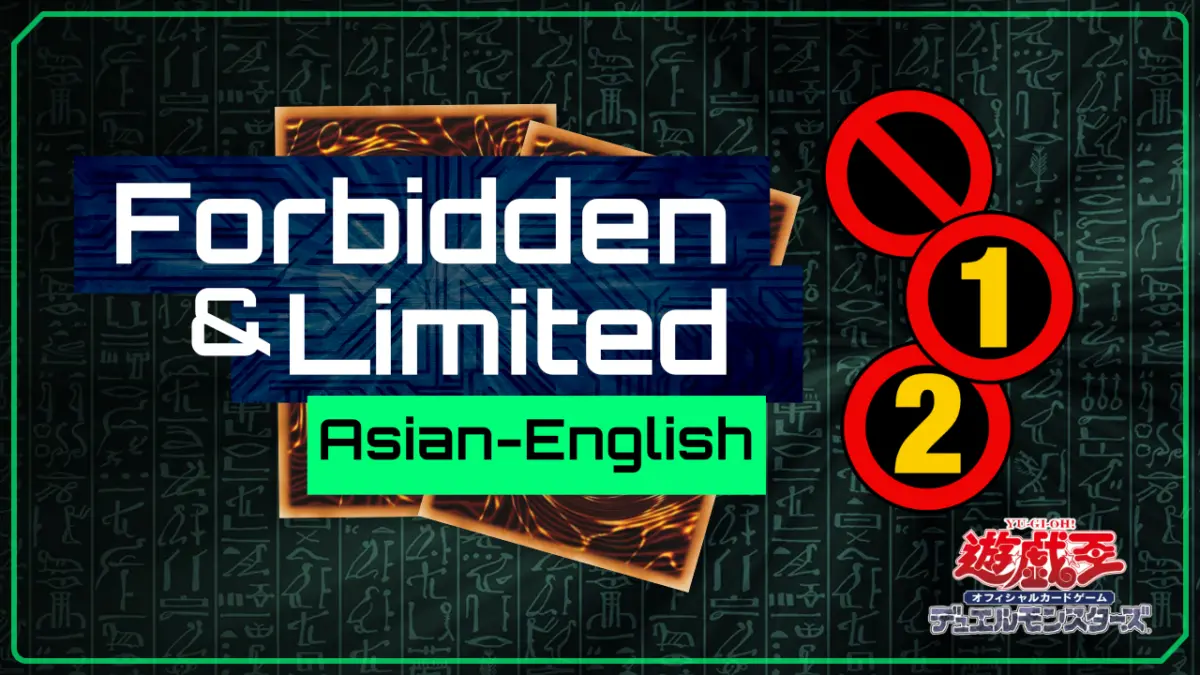
The competitive landscape of the Yu-Gi-Oh! Trading Card Game (TCG) is poised for a dramatic transformation following the official announcement of the Asian English (AE) Forbidden & Limited List, scheduled to take effect on October 1, 2026. Released via the official Asia Yu-Gi-Oh! communication channels, this quarterly regulatory update represents one of the most aggressive interventions by Konami’s design and balancing teams in recent memory.
At the heart of this update is a sweeping crackdown on systemic engine efficiency, ubiquitous hand traps, and dominant combo-enabling infrastructure that has long defined the upper echelons of competitive AE play. Most notably, the format’s premier disruptor and looping utility, PSY-Frame Lord Omega, has been relegated entirely to the Forbidden tier, moving swiftly from three copies down to zero. This outright ban signals a zero-tolerance policy toward disruptive hand-looping mechanics and degenerate resource deprivation strategies that stifle opponent agency before a single main phase action can be initiated.
Simultaneously, the regulatory framework has cast a wide net across both meta-defining staples and specific engine support cards. Universal power cards such as Maxx "C" and Droll & Lock Bird have seen severe restrictions, moving to one copy alongside foundational pieces of the Branded strategy, specifically Branded Fusion. Newer interactive components, such as the Kewl Tune theme—featuring Kewl Tune Cue and Kewl Tune Synchro—have also been hit preemptively, dropping directly from three to one to curb their overwhelming dominance right out of the gate.
Conversely, the list offers a glimmer of hope for legacy strategies and mid-tier contenders. Sky Striker Mobilize – Engage! edges closer to full liberation at two copies, offering a subtle nod to nostalgic control strategies, while Diabellstar the Black Witch returns entirely to full power at three copies, welcoming the Sinful Spoils engine back into the unrestricted fold.
This comprehensive report provides an exhaustive breakdown of the October 1, 2026, AE Forbidden & Limited List update. We will explore the mechanics of the banned and restricted cards, analyze the socio-competitive motivations driving Konami’s decisions, examine the ripple effects across regional metagames, and project the long-term trajectory of the Asian English format as it navigates this new era of card-pool governance.
Detailed Chronology and Breakdown of the October 2026 List
To fully understand the weight of the October 1, 2026 adjustments, one must analyze the specific mechanical interactions and metagame pressures dictating each tier change. Konami’s methodology relies heavily on tournament data, play-rate metrics, and community feedback gathered across diverse regional hubs utilizing the Asian English card pool. Below is the granular breakdown of every movement on the newly unveiled list.
1. Newly Forbidden: The Eradication of PSY-Frame Lord Omega
- Card: PSY-Frame Lord Omega
- Previous Status: Unlimited (3)
- New Status: Forbidden (0)
For years, PSY-Frame Lord Omega has walked a fine line between a versatile generic Synchro option and an engine of frustration in hand-looping and resource-stripping combos. As a Level 8 Synchro monster requiring no specific non-Tuner materials, Omega could be easily synthesized by a vast array of decks. Its quick effect—allowing it to banish itself and a random card from the opponent’s hand until the standby phase—has historically been weaponized not just for disruption, but for preemptive destruction of an opponent’s starting hand before they even draw for their turn.
Furthermore, Omega’s secondary trigger effect, which allows the player to attach a card from either graveyard to the controller’s banished psychic monster upon returning, created infinite recursive loops when paired with cards that facilitate extra deck recycling. By eliminating Omega entirely, Konami has targeted the root cause of countless un-interactive, solitaire-style board states. Duelists who relied on Omega to rip vital interaction pieces out of their opponents’ hands will now need to pivot toward alternative disruptive Synchro monsters, significantly altering Extra Deck space allocation across the format.
2. Newly Limited: The Clampdown on Staples and Engine Staples
The Limited tier has received the lion’s share of updates, targeting both format-defining hand traps and specific archetype engines that have overstayed their welcome at maximum capacity.
- Droll & Lock Bird (From 2 to 1)
- Context: A historical equalizer against search-heavy combo decks, Droll & Lock Bird has increasingly transformed from a defensive countermeasure into a format-stifling bottleneck. By reducing its availability to a single copy, Konami is attempting to strike a delicate balance: allowing players a narrow window to counter explosive search chains while preventing the card from completely locking opponents out of the game on turn one.
- Maxx "C" (From 2 to 1)
- Context: As the undisputed king of hand traps in OCG-derived formats, Maxx "C" has always dictated the pace of play. Moving the card from two copies down to a strict single copy reduces its sheer statistical draw-rate in opening hands. While the "C" remains legal—continuing to separate Asian English play from its TCG counterpart—this restriction mitigates its ubiquity, reducing the frequency with which duels are decided entirely by whether or not a player resolved or successfully negated this single card.
- Kewl Tune Cue & Kewl Tune Synchro (From 3 to 1)
- Context: Representing a swift regulatory strike against newer competitive offerings, both Kewl Tune Cue and Kewl Tune Synchro have been hammered down to a single copy. Preemptive hits of this magnitude indicate that Konami’s internal metrics flagged the Kewl Tune strategy as excessively potent, capable of establishing oppressive boards with too much consistency. Restricting these core pieces effectively slows the archetype down, forcing players to rely on alternate engines or exercise extreme resource management.
- Branded Fusion (From 2 to 1)
- Context: The Branded archetype has proven to be one of the most resilient and enduring strategies in modern Yu-Gi-Oh! history. Built around the sheer power of Branded Fusion—which allows players to fusion summon using materials straight from the deck—the deck has consistently claimed top tournament cuts. By cutting the spell card down to one copy, Konami is directly attacking the deck’s redundancy and recovery. Without multiple copies of their central spell, Branded players can no longer easily play through multiple interruptions to resolve their primary combo line, forcing the deck to adopt a much more cautious, high-risk playstyle.
3. Semi-Limited: Gradual Relief for Sky Striker
- Sky Striker Mobilize – Engage! (From 3 to 2)
- Context: The iconic spell card that defines the Sky Striker control strategy continues its cautious journey back toward full legality. Moving from three to two copies gives Sky Striker enthusiasts an additional vector of consistency without unleashing the full, unrestrained card-pool power that historically dominated competitive play. This incremental adjustment demonstrates Konami’s willingness to revitalize fan-favorite control archetypes in a measured, step-by-step fashion.
4. Unlimited: The Return of the Sinful Spoils Engine
- Diabellstar the Black Witch (From 2 to 3)
- Context: In a surprising counter-movement to the restrictions placed on other engines, Diabellstar the Black Witch has been completely freed, moving from two copies to three. Diabellstar and her associated Sinful Spoils package have served as a universal splashable engine for numerous strategies. By returning her to three, Konami is injecting flexibility back into the format, enabling players to leverage the engine for robust setup, interruption baiting, and graveyard loading. This move suggests that while Konami is willing to curb hyper-consistent combo decks and oppressive hand traps, they are also eager to open up creative deck-building avenues for mid-to-high-tier strategies.
Supporting Context, Statistics, and Metagame Metrics
To truly grasp the significance of the October 2026 update, one must examine the macroeconomic climate of the Asian English competitive circuit. Unlike the North American and European TCG formats—which operate under a completely independent Forbidden & Limited List featuring unique bans (such as the historical outright ban of Maxx "C")—the Asian English format sits in a fascinating middle ground, often mirroring the OCG’s card legality while catering specifically to English-language regional distribution.
The Problem with Infinite Recursion and Hand-Looping
Tournament analytics leading into the final quarter of 2026 highlighted a growing fatigue among competitive players regarding non-interactive board states. The persistence of PSY-Frame Lord Omega was a frequent talking point in player surveys and regional post-mortems. Statistical breakdowns of top-tier matches revealed that decks capable of looping Omega multiple times per turn boasted an astronomical win rate, primarily because stripping two to three cards from an opponent’s hand before they could play rendered even optimal opening hands unplayable. Konami’s decision to ban Omega outright is a direct statistical response to this lack of interaction—a philosophy that prioritizes back-and-forth dueling over absolute resource denial.
Engine Diversity vs. Engine Monopoly
The dual treatment of Branded Fusion and Diabellstar the Black Witch highlights an intricate balancing act regarding engine dominance. While the Branded strategy has enjoyed a prolonged reign as a top-tier contender, commanding massive representation in tournament Day 2 brackets, the Sinful Spoils engine had previously been reined in due to its overwhelming ubiquity. By freeing Diabellstar to three while simultaneously throttling Branded Fusion to one, Konami is deliberately engineering a shift in tournament meta-share. Players heavily invested in Branded will now need to innovate or transition to alternative fusion or link-based variants, whereas builders utilizing Diabellstar gain fresh tactical latitude.
Official Statements and Community Reception
The release of the October 1, 2026 list via the official Asia Yu-Gi-Oh! communication channels immediately ignited passionate discussions across global forums, social media, and local card shops (LCS) throughout Asia.
Tournament organizers and high-level competitors have largely praised the removal of PSY-Frame Lord Omega, citing it as a necessary step to modernize the format and remove degenerate looping mechanics. One prominent regional competitor noted:
"Omega has been a ticking time bomb for years. Every time a new deck gained the ability to easily pump out Level 8 Synchros, Omega was right there waiting to exploit it. Banning it cleans up the Extra Deck and forces players to earn their advantages through board presence rather than hand destruction."
However, reactions to the restrictions placed on universal staples like Maxx "C" and Droll & Lock Bird remain polarized. While casual and rogue-tier competitors welcomed the mitigation of these format-defining bottlenecks—arguing that fewer games will be decided by the resolution of a single hand trap—hardcore competitive veterans expressed concern over how combo-heavy decks will be kept in check without robust defensive tools.
Similarly, the swift limitation of the Kewl Tune archetype has left many modern-format players reeling. Preemptive hits are notoriously difficult to predict, and local communities are currently scrambling to re-evaluate their deck-building strategies ahead of the upcoming regional qualifier season.
Future Outlook: Navigating the Post-October 2026 Landscape
As the October 1, 2026 implementation date approaches, duelists across the Asian English circuit are frantically recalibrating their lists, testing new ratios, and experimenting with alternative engines. The immediate future of the format will undoubtedly be characterized by adaptation and discovery.
1. The Adaptation of Branded and the Rise of Rogue Contenders
With Branded Fusion restricted to a single copy, Branded players can no longer rely on raw statistical probability to draw their primary play-starter. Expect to see an increase in search-heavy engine variants, such as the incorporation of Fallen of Albaz support cards, fusion-retrieval mechanisms, and secondary engines like Despia or Bystial components to maintain offensive pressure. Meanwhile, the restriction of the Kewl Tune engine opens up breathing room for rogue and tier-2 strategies that were previously squeezed out of the competitive window.
2. Extra Deck Evolution Post-Omega
The absence of PSY-Frame Lord Omega leaves a gaping hole in countless Extra Decks. Players must now evaluate alternative Level 8 Synchro options that offer proactive disruption, defensive utility, or resource recovery. Monsters such as Baronne de Fluer (where legal), Borreload Savage Dragon, or archetype-specific boss monsters will see a surge in play as duelists search for reliable utility to fill the void left by the psychic machine.
3. A Healthier, More Interactive Meta?
Ultimately, Konami’s October 2026 update communicates a clear overarching vision: a format defined by tactical interaction, diverse engine utilization, and reduced reliance on degenerate hand-looping or over-centralized hand traps. While any major banlist inevitably brings growing pains and economic shifts for collectors and competitors alike, the long-term health of the Asian English format hinges on this ability to reinvent itself. As duelists sleeve up their adjusted decks for the upcoming competitive season, one thing is certain—the race to conquer the post-October 2026 meta has officially begun.






Belum ada komentar. Jadilah yang pertama berkomentar!