

Executive Overview
At the heart of Copenhagen’s annual TechBBQ conference, the discourse among Europe’s leading investors, startup founders, and ecosystem operators transcended the usual optimistic rhetoric of code optimization and product features. The central question dominating the airwaves of Scandinavia’s premier tech gathering was not simply what developers can build using artificial intelligence, but rather who should control it.
Across packed auditoriums, rooftop cocktail parties, and networking mixers, the tech community grappled with a sobering realization: Europe risks becoming a digital tenant in an ecosystem dominated by foreign powers. The underlying theme of this year’s conference, aptly titled "Emerging from Agency," served as a direct response to a growing geopolitical anxiety. With advanced foundation models remaining largely under the thumb of American and Chinese corporate and state interests, European stakeholders are increasingly waking up to the vulnerabilities of relying on imported digital infrastructure.
This deep-seated unease was catalyzed earlier this year when popular AI models—specifically Anthropic’s Mythos and Fable—were abruptly made unavailable to users outside the United States. For European software teams, the blackout was a sharp wake-up call, illustrating the fragility of depending on foreign APIs and cloud stacks.
As TechBBQ concluded on August 27, the prevailing sentiment was clear: Europe’s digital future cannot be secured by renting computing power and foundational intelligence. Instead, the continent must forge its own path toward technological independence, prioritizing local infrastructure, strict data privacy standards, and human-centric agency over unchecked technological acceleration.
Detailed Chronology: The Anatomy of TechBBQ 2026
Day One: Setting the Stage for Agency and Autonomy
The conference kicked off with a palpable sense of urgency. Attendees gathered at the main stages to unpack what "agency" truly means in an era defined by hyper-intelligent autonomous agents. The atmosphere was charged with debates concerning geopolitical dependencies. While some startup executives downplayed the short-term disruption caused by the temporary unavailability of American models like Mythos and Fable, others viewed it as a dangerous precursor to future economic and technological chokeholds.
"Relying on two other geopolitical powers for AI might cause severe headaches down the road, but for now, everything is still operational," one software executive confided over coffee. Yet, this complacent attitude was steadily challenged by investors and policymakers who argued that infrastructure dependency is a silent ticking clock for European competitiveness.
Day Two: Cross-Border Collaborations and Ethical Guardrails
As the conference progressed into its second day, the agenda broadened to encompass intersectional challenges, including a dedicated summit on fostering innovation and investment bridges between the Nordic and African tech ecosystems. Panels also turned their focus toward systemic gaps in European venture capital, exploring how to unlock larger pools of growth capital to prevent promising scale-ups from migrating across the Atlantic.
Parallel tracks examined the ethics of deep tech integration. A standout moment was a high-profile panel moderated on the intersection of privacy and artificial intelligence, featuring Signal President Meredith Whittaker. Whittaker delivered a blistering critique of the current trajectory of AI development, warning that the race to integrate conversational agents into foundational operating systems is manufacturing an unprecedented global surveillance apparatus.
Day Three: Economic Realities and the Human Element
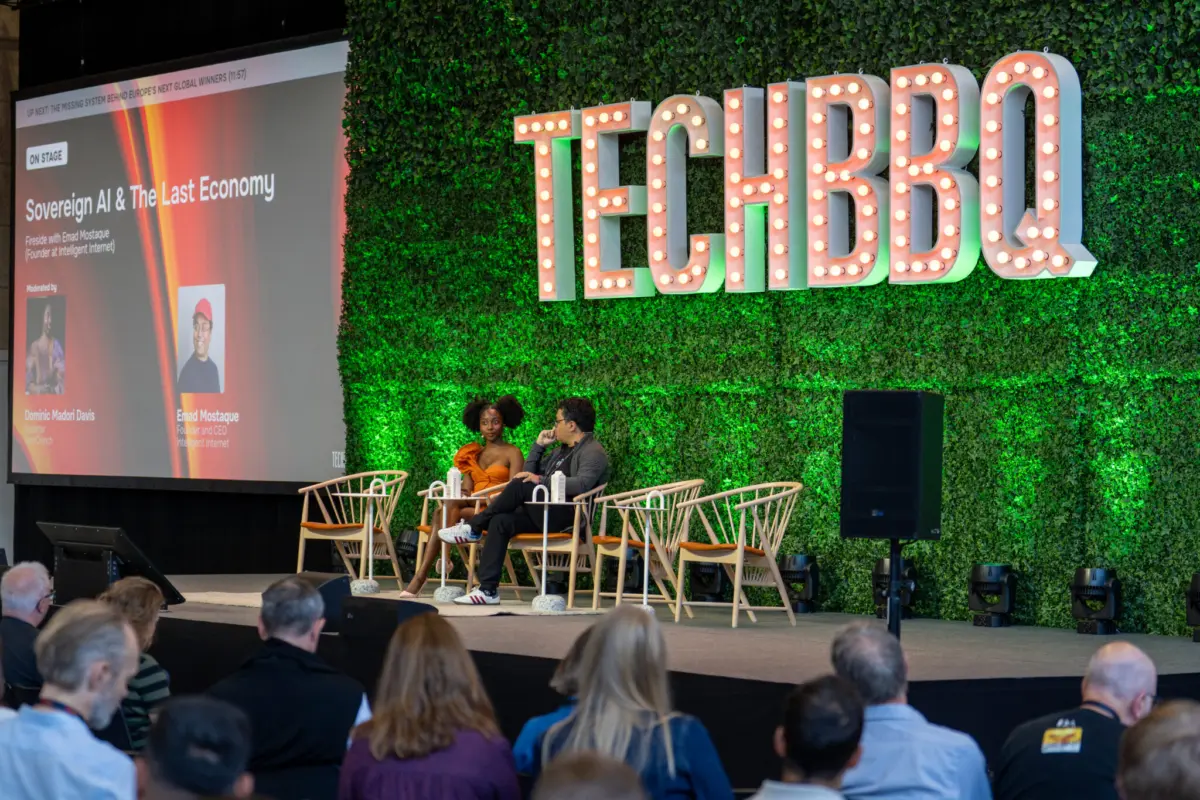
The final stretch of TechBBQ brought economic forecasts and societal implications to the forefront. A panel featuring Stability AI co-founder Emad Mostaque dissected the macroeconomic fallout of an agentic workforce. Mostaque challenged the audience to look beyond productivity metrics, warning that extreme centralization of AI power threatens individual and national sovereignty alike.
As the formal panels wound down, attendees transitioned to networking hubs across Copenhagen. From a sunset rooftop barbecue hosted by prominent ecosystem players like Lovable, Nvidia, OpenAI, AWS Startups, and HSBC, to a health-tech mixer at the cocktail bar Bird hosted by London’s Ada Ventures, the conversations shifted from existential dread to tangible collaboration. The conference officially culminated in a picturesque speakers’ dinner on an isolated Danish island, complete with fire dancers and international media debriefs, underscoring the enduring value of human connection in a digitalized world.
Supporting Context & Metrics: The Anatomy of Europe’s Dependency
To understand why the debate at TechBBQ resonated so deeply, one must examine the structural realities of the global AI landscape. Europe remains a regulatory superpower—pioneering frameworks like the European Union Artificial Intelligence Act—yet it lags significantly behind the United States and China in foundational compute capacity, hyper-scaler cloud infrastructure, and proprietary frontier model development.
The Infrastructure Gap
- Compute Concentration: Over 80% of global frontier AI models are trained on infrastructure located within the United States or China, heavily backed by hyper-scale cloud providers (e.g., Microsoft, Amazon, Google, and Alibaba).
- Venture Capital Disparity: Despite boasting world-class technical universities and vibrant regional hubs (from Stockholm’s "Lovable mafia" to Copenhagen and London), European startups frequently struggle to secure Series B and C funding rounds comparable in size to their Silicon Valley counterparts, often forcing them to relocate or accept foreign acquisition.
- The "Renting" Trap: As illustrated by the sudden restrictions on models like Mythos and Fable, European enterprises relying on foreign APIs operate at the mercy of shifting geopolitical strategies, corporate policy updates, and foreign regulatory interventions.
The Privacy Conundrum
The tension between digital convenience and data protection formed a recurring quantitative and qualitative baseline throughout the conference. European consumers and businesses have historically prioritized data privacy, a principle codified by GDPR. However, the commercial push toward agentic AI—systems that read emails, schedule meetings, and execute complex cross-platform workflows—demands unprecedented access to personal and enterprise data streams.
Official Statements & Expert Perspectives
The intellectual weight of TechBBQ 2026 was carried by prominent voices who challenged the tech sector’s prevailing dogmas. Their insights paint a vivid picture of a continent at a historical crossroads.
Ellen de Brever: On Human Judgment and Agency
Ellen de Brever, angel investor and head of partnerships at the Novo Nordisk Foundation Cellerator, encapsulated the philosophical pivot of the conference:
"TechBBQ’s theme of agency felt particularly timely this year as the conversation shifted from what AI can do to what we’re actually willing to let it do… The debates weren’t about smarter machines, but about human judgment and who gets to stay in the driver’s seat. The age of AI agents isn’t really a story about machines gaining agency. It’s a story about humans deciding what to give up."
De Brever also emphasized the irreplaceable nature of physical proximity in an increasingly virtualized industry:
"In a room full of conversations about machines, the most memorable moments still come from the simplest thing: human connection, face-to-face, building relationships, sharing ideas, and reminding each other of what technology can never quite replace."
Meredith Whittaker: On the Surveillance Economy
Signal President Meredith Whittaker offered an unvarnished critique of commercial AI assistants embedded directly into operating systems and messaging channels (such as ChatGPT integrations within consumer platforms):
"This era is creating a massive data collection apparatus. AI labs are using clever marketing to make people forget about the collateral consequences of acquiring so much data… There is still a huge market need for privacy. And particularly with the sovereignty concerns, we will have customers here."
Emad Mostaque: On National Sovereignty and Power Concentration
Emad Mostaque, co-founder of Stability AI and Intelligent Internet, addressed the geopolitical stakes of the AI race during his keynote discussion:
"Sovereignty is the ability to resist power being exerted over you."
Highlighting the dangerous accumulation of technological leverage in a handful of corporate labs, Mostaque added a stark warning for policymakers:
"Inevitably, every country will be run by AI, and the person that controls the AI controls the country."
Mia Negru: On Systemic Societal Overhaul
Reflecting on the cascading implications of automation, Mia Negru, advocacy and engagement director for the nonprofit Life With Artificials, shared a profound observation regarding the horizon of work and society:
"If intelligent agents perform cognitive work and robots increasingly perform physical work, we may be approaching something much bigger than another technological revolution. We may have to rethink ownership, work, democracy, economic participation, and eventually even who gets to participate in society."
Future Outlook: Where Does Europe Go From Here?
As the dust settles on TechBBQ 2026, the European tech ecosystem faces a definitive mandate. The conversations in Copenhagen proved that awareness of the "dependency trap" is no longer confined to academic circles or niche policy think tanks; it has permeated the boardrooms of venture capitalists and the sprint-planning sessions of early-stage founders.
Key Milestones for European Tech Independence:
- Investing in Sovereign Infrastructure: European nations must accelerate joint supercomputing initiatives (such as EuroHPC JU) to ensure local startups have access to sovereign compute power without depending on foreign cloud monoliths.
- Developing Indigenous Open-Source Models: By championing open-source foundational models built within Europe, the ecosystem can democratize access to advanced AI while maintaining compliance with local ethical and legal standards.
- Redefining Growth Capital: European institutional investors—pension funds, insurance giants, and sovereign wealth funds—must unlock deeper pools of risk capital to support homegrown scale-ups, mitigating the "brain drain" and preventing premature foreign buyouts.
- Prioritizing Privacy-First Architecture: As companies like Signal and regional privacy advocates demonstrated at TechBBQ, market demand for secure, non-extractive software remains exceptionally high. Europe is uniquely positioned to lead a global counter-movement centered on user sovereignty and data dignity.
Ultimately, the takeaway from Copenhagen is neither dystopian despair nor blind techno-optimism. It is a pragmatic call to action. Europe has the talent, the regulatory leadership, and the ethical clarity to shape its digital destiny. Whether it possesses the political will and financial muscle to reclaim control from foreign tech titans remains the defining question of our technological epoch.








Belum ada komentar. Jadilah yang pertama berkomentar!