The intersection of artificial intelligence and cryptocurrency trading has reached a monumental inflection point. Binance, the world’s largest cryptocurrency exchange by trading volume, with an expansive user base exceeding 300 million registered accounts, officially launched Agent OS. This groundbreaking platform enables autonomous AI agents to analyze complex financial markets, execute trades, and manage on-chain transactions on behalf of human users.
This development marks a decisive shift in the broader technological landscape. The AI industry is rapidly moving past passive chatbots designed to answer questions or generate text, transitioning firmly into the era of "agentic AI"—systems engineered to take physical or digital action, wield capital, and interact directly with economic infrastructure. By bridging popular large language models (LLMs) and developer tools with robust financial infrastructure, Binance is bringing autonomous software agents directly into the high-stakes business of managing real money.
However, empowering software algorithms to execute trades autonomously introduces a complex web of security, risk management, and accountability challenges. While Binance provides the foundational architecture via sub-accounts and customized application programming interfaces (APIs), the ultimate responsibility for keeping these autonomous digital workers in check falls squarely on the user. As exchanges race to build the ultimate developer ecosystem for AI-driven trading, the financial sector is forced to confront a profound question: How much autonomy should humans grant to machines when real wealth is on the line?
Detailed Chronology: The Evolution of Agent-Native Crypto Infrastructure
The launch of Agent OS did not happen in a vacuum; it is the culmination of a rapid, industry-wide race to integrate artificial intelligence directly into centralized and decentralized financial workflows. Over the past year, major global exchanges have systematically dismantled the barriers preventing AI applications from executing trades, shifting from experimental developer previews to production-grade agentic environments.
The Spring and Summer 2025 Wave
The movement toward agent-native exchange infrastructure accelerated significantly in early 2025 as major competitors sought to capture the growing overlap between artificial intelligence development and crypto trading:
March 2025 (Kraken): Kraken fired the opening salvo by launching an open-source command-line tool equipped with a built-in Model Context Protocol (MCP) server. This infrastructure allowed software developers to connect AI agents directly to Kraken’s ecosystem, enabling them to execute both spot and futures trades programmatically.
June 2025 (Coinbase): Coinbase followed closely with the rollout of Coinbase for Agents. This suite of tools connected external AI models directly to user accounts, granting them permissions to trade, settle payments, and execute sophisticated financial workflows under user-defined constraints.
Earlier in 2025 (OKX): OKX joined the fray by releasing an open-source MCP toolkit, effectively standardizing agentic trading capabilities across its platform and allowing external developers to build custom trading loops.
The August 2026 Breakthrough: Binance Enters the Fray
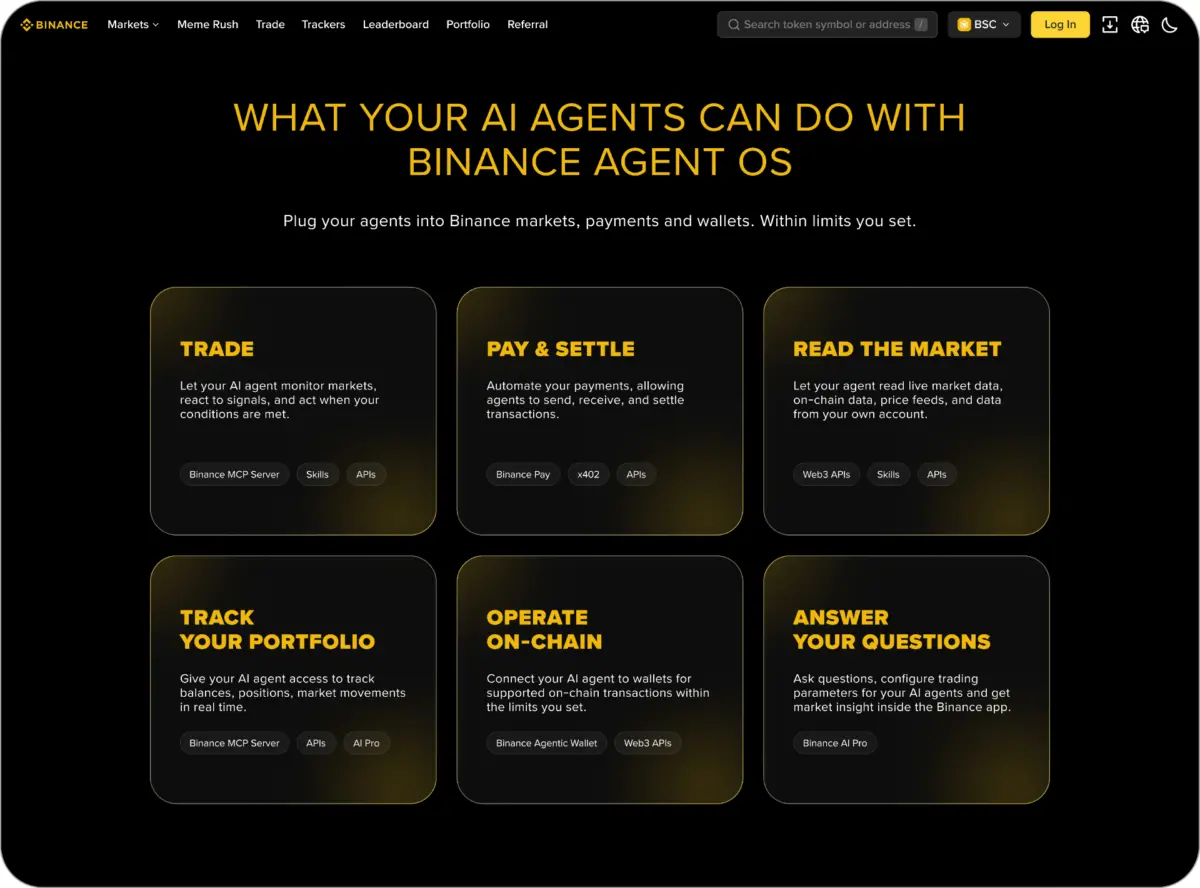
Against this backdrop of heightened competition, Binance’s launch of Agent OS on Thursday represents a massive scaling of the agentic trading trend. Bringing together Binance APIs, the Binance Wallet Agentic Hub, the Binance x402 transaction verification and payment facilitator API, and the Binance Skill Hub, Agent OS bridges the gap between raw AI reasoning and deep liquidity pools.
Crucially, the platform features native support for the Model Context Protocol (MCP), allowing it to seamlessly interface with industry-leading development environments and AI models, including OpenAI’s ChatGPT and Codex, Anthropic’s Claude Code, and Cursor. By plugging directly into these ecosystems, Agent OS allows users to authorize autonomous agents to read market data, monitor portfolio health, and execute high-frequency trading strategies without writing complex, bespoke integration scripts from scratch.
Supporting Context & Metrics: Architecture, Boundaries, and Safeguards
The technical architecture of Agent OS is designed to give developers maximum flexibility while attempting to insulate the broader exchange infrastructure from systemic software failures, rogue logic loops, or malicious exploits.
Sub-Accounts as the Primary Sandbox
At the core of Binance’s risk mitigation strategy is the sub-account. Rather than granting an AI agent free reign over a user’s primary portfolio—which typically holds long-term investments, staking assets, and primary liquidity—Agent OS requires users to provision dedicated sub-accounts specifically assigned to individual AI agents.
These sub-accounts can be finely tuned for specific trading activities, such as targeted spot trading or high-leverage futures positions. Most importantly, withdrawals from these sub-accounts are disabled by default. This design creates a rigorous security sandbox: if an agent’s logic fails, or if it falls victim to a market anomaly, the damage is strictly confined to the capital allocated within that specific sub-account. Furthermore, because Binance does not enforce a centralized exchange-wide loss cap on spot and futures trading within these sub-accounts, the total capital transferred into the sub-account serves as the user’s hard risk limit.
Wallet Limits and On-Chain Safeguards
While exchange-traded sub-accounts rely primarily on user-funded capitalization limits, Binance has implemented hardcoded daily caps for operations executed through its Agentic Wallet and decentralized finance (DeFi) integrations. These safety rails are designed to protect users interacting with smart contracts and external protocols:
Standard Token Swaps: Capped at a default maximum of $50,000 per day.
DeFi Transactions: Capped at a default maximum of $100,000 per day.
x402 Micro-Payments and Settlements: Restricted to a conservative $20 per day.
The Black Box Dilemma: The Limits of Exchange Visibility
One of the most profound technical challenges revealed during the rollout of Agent OS is the "black box" nature of AI reasoning. According to Binance product leadership, the actual decision-making process—the underlying prompt engineering, chain-of-thought analysis, and strategic calculus that leads an agent to execute a trade—occurs entirely outside Binance’s perimeter systems. This reasoning takes place either locally on the user’s personal computer or within the infrastructure of their chosen third-party AI application provider.
Consequently, Binance possesses limited visibility into why an agent made a specific trade. While the exchange can monitor the resulting transactional output, order book impact, and market behavior, it cannot independently verify whether a trade was executed due to sound technical analysis, hallucinations, or adversarial prompt-injection attacks. If a malicious actor manipulates an external AI model via prompt injection to dump a user’s portfolio, Binance’s systems will register the action as a valid API command authorized by the sub-account’s credentials. To combat this, Binance relies on its existing suite of anti-money laundering (AML), risk-control, and API security frameworks to flag anomalous transactional behavior at the exchange level.
Official Statements and Industry Perspectives
The release of Agent OS has sparked intense dialogue across the financial technology sector regarding the balance between user empowerment and platform liability.
Jeff Li, Vice President of Product at Binance, emphasized that the architecture of Agent OS was intentionally designed to distribute control back to the retail and institutional investor rather than granting blind autonomy to software algorithms.
"Instead of total freedom, we put the power in users’ hands to give them the granular access control of what they can do through the agent," Li stated in an interview. "We put [the control] at the account level to protect the users’ funds."
Li framed Agent OS as merely the foundational first step in a multi-year journey to seamlessly unify traditional crypto markets, programmatic trading loops, and decentralized finance under a cohesive developer framework.
Industry analysts point out that while platforms like Binance, Coinbase, and Kraken are laying the groundwork for hyper-efficient automated markets, they are effectively shifting the fiduciary burden onto the consumer. By requiring users to configure sub-accounts, establish precise trading permissions, and personally manage the risk thresholds of their AI workforce, exchanges are effectively positioning themselves as neutral infrastructure providers while leaving end-users to navigate the perils of algorithmic trading alone.
Future Outlook: The Road Ahead for Agentic Finance
The launch of Binance’s Agent OS signifies a major milestone in the evolution of digital asset markets, but it also opens the door to a myriad of complex future challenges and opportunities.
Beyond Simple Trading: Multi-Agent Ecosystems and Arbitrage
While the initial wave of agentic tools has focused heavily on automated trading, portfolio rebalancing, and spot execution, industry experts anticipate a rapid expansion into more complex financial engineering. Future iterations of AI agents operating on platforms like Agent OS are expected to engage in:
Real-Time Cross-Exchange Arbitrage: Autonomous agents constantly scanning global liquidity pools to instantly capture pricing discrepancies across centralized and decentralized exchanges.
Automated Yield Farming: Dynamic capital allocation protocols that shift user funds across various DeFi liquidity pools based on real-time APY fluctuations and smart-contract risk assessments.
Sentiment-Driven Risk Mitigation: Agents that consume real-time news feeds, social media sentiment, and macroeconomic data to automatically reduce leverage or exit positions ahead of major regulatory announcements or market crashes.
Regulatory and Security Headwinds
As autonomous agents manage larger pools of capital, regulatory scrutiny is virtually guaranteed to intensify. Financial watchdogs globally are already grappling with the legal implications of algorithmic liability—specifically, who bears responsibility when an autonomous AI system triggers a flash crash or executes illegal market manipulation strategies through automated cross-market arbitrage.
Furthermore, as the Model Context Protocol (MCP) and agentic APIs become standardized across the industry, cybersecurity researchers warn that bad actors will increasingly target the communication channels between AI models and exchange APIs. Protecting these systems will require advancements in cryptographic verification, decentralized identity (DID) for software agents, and real-time behavioral monitoring tools that can distinguish between legitimate high-frequency algorithmic strategies and malicious prompt-injection exploits.
Conclusion
Binance’s Agent OS has officially ushered the cryptocurrency market into the age of autonomous finance. By granting AI agents direct access to the world’s deepest liquidity pools and payment rails, the platform promises unprecedented efficiency, speed, and sophistication for traders. Yet, as software increasingly takes the wheel, the burden of vigilance remains unmistakably human. The success of agentic trading will ultimately depend not just on the intelligence of the algorithms, but on the robustness of the sandboxes built to contain them.









Belum ada komentar. Jadilah yang pertama berkomentar!