

Executive Overview
Elvis Costello opens his 1978 landmark album This Year’s Model with a jagged, two-minute burst of power-pop entitled “No Action.” The track is a masterclass in psychological stasis, fueled by romantic obsession, simmering resentment, and the maddening futility of being unable to break an internal loop. The narrator insists he wants nothing to do with someone he cannot stop thinking about; the guitars race, the verses tumble over one another, and despite all that frantic, white-knuckle energy, absolutely nobody gets anywhere. Everything is in motion, yet nothing changes.
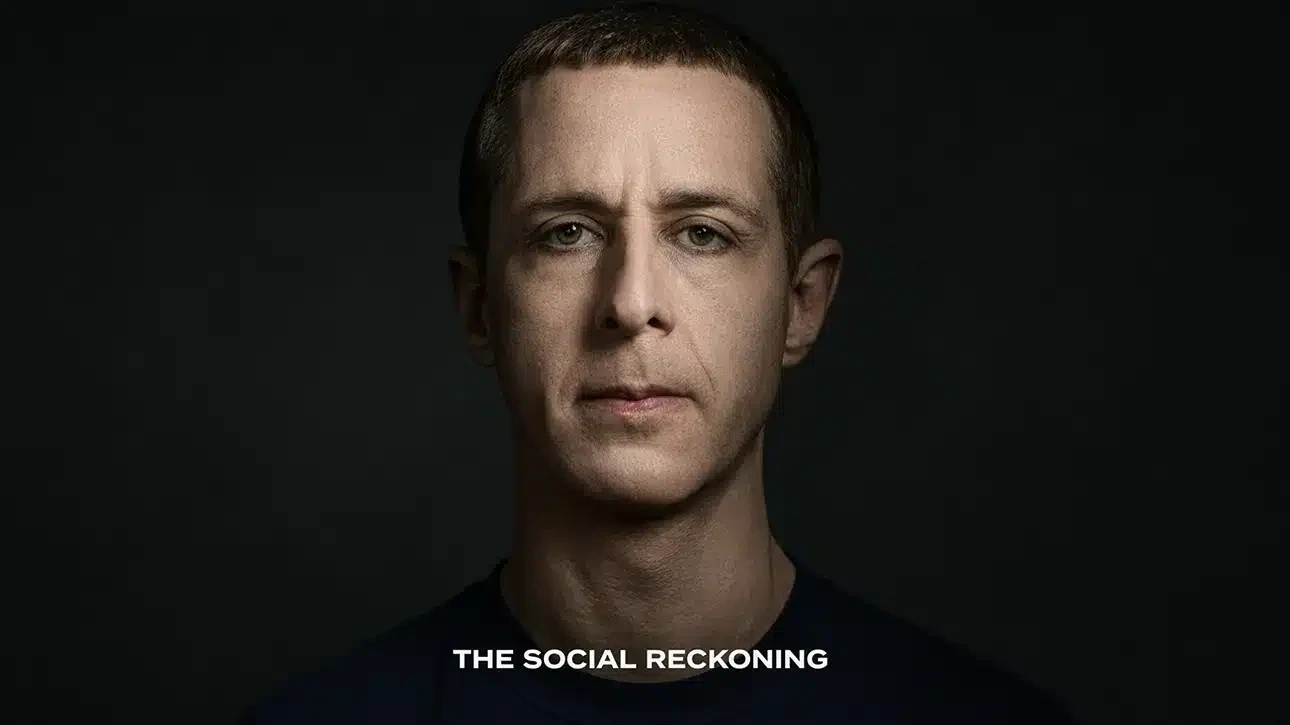
That persistent contradiction serves as a haunting refrain when watching Aaron Sorkin’s 2026 legal drama, The Social Reckoning.
Sorkin’s film arrives at a time of acute societal fatigue regarding big tech, corporate malfeasance, and the erosion of digital public discourse. Following the mechanics of the 2021 Facebook Files leak—spearheaded by whistleblower Frances Haugen and exposed by Wall Street Journal reporter Jeff Horwitz—the film promises an unflinching look at the inner machinery of surveillance capitalism. Yet, true to Sorkin’s signature style, the movie largely trades systemic critique for verbal gymnastics.
By filtering a multi-layered global crisis through a lens of hyper-articulate debate-club sparring, The Social Reckoning illustrates the limits of a specific brand of liberal political imagination. It suggests that if we can just craft a sufficiently devastating zinger or expose a logical fallacy, the underlying engine of capital will somehow stutter to a halt. As the film’s own postscript implicitly concedes, however, the machine continues to run entirely unbothered, leaving audiences with the intoxicating illusion of a moral victory while the material realities of platform capitalism remain stubbornly intact.
Detailed Chronology: From the Server Rooms to the Screening Room
To understand the dramatic architecture of The Social Reckoning, one must trace the real-world events that inspired it—and the distinct ways Sorkin’s screenplay compresses, sterilizes, and ultimately sanitizes them.
Phase 1: The Leak and the Investigation (2019–2021)
The narrative anchors itself in the high-stakes, highly precarious real-world collaboration between whistleblower Frances Haugen and Wall Street Journal journalists like Jeff Horwitz. In late 2019 and early 2020, Haugen—a former product manager on Facebook’s civic integrity team—began quietly copying tens of thousands of internal documents, research papers, and slide decks. These files laid bare the company’s internal awareness of its platforms’ toxic effects: the deliberate boosting of sensationalist and extremist content, the exacerbation of body-image issues among teenage girls, and the inability to police foreign influence campaigns in developing nations.
In September 2021, the Wall Street Journal published “The Facebook Files,” a landmark investigative series that broke open the black box of social media governance. Weeks later, Haugen stepped out of the shadows during a 60 Minutes interview and subsequently testified before the U.S. Senate, putting a human face to corporate negligence.
Phase 2: The Sorkin Translation
In Sorkin’s cinematic retelling, however, the grit, paranoia, and grinding logistical nightmare of leaking classified data are ironed out into a sleek, metronomic exhibition match. Haugen (portrayed by Mikey Madison) and Horwitz (Jeremy Allen White) spend less time navigating the genuine terror of taking on a trillion-dollar corporate apparatus and more time engaging in petty, hyper-verbal sparring over who possesses the intellectual authority to interpret the data. Madison’s raw, feral intensity is scrubbed clean into clipped exposition, while White’s coiled, anxious energy is reduced to pedantic hand-wringing.
Phase 3: The Omission of January 6 and Political Reality
The film’s structural avoidance of political reality reaches its apex in its depiction of the January 6, 2021, Capitol insurrection. Sorkin frames the radicalization arc leading up to the riot almost exclusively as an algorithmic malfunction—a glitch in the code that prioritized engagement over civic stability.
Notably, Sorkin made the conscious, highly publicized decision to entirely omit Donald Trump from the narrative. Explaining the choice, Sorkin insisted he wanted to keep his "hands clean" of partisan distractions. But excising the central political actor from an explicitly political insurrection does not achieve objectivity; it renders the history incoherent. The events of January 6 did not emerge spontaneously from an unmonitored newsfeed; they were organized by political leaders, extremist factions, and calculated disinformation campaigns. By reducing the crisis to bad data management, Sorkin neatly fits the drama into his preferred framework: if the problem is merely technical mismanagement, the solution requires nothing more than smarter people making better policy choices.
Supporting Context & Metrics: The Anatomy of Surveillance Capitalism
To critique The Social Reckoning is to confront the core thesis of cultural theorist Mark Fisher’s Capitalist Realism (2009): our political and artistic imagination has become so thoroughly colonized by capital that even our fiercest cultural criticisms struggle to envision any alternative to tinkering with the existing machine.
The Profitability of Outrage
Surveillance capitalism is not a broken system; it is a hyper-efficient one. Its foundational business model relies on harvesting user data, monetizing attention, and optimizing for high-arousal emotional states—predominantly anger, fear, and moral outrage.
[User Engagement] ──> [Data Harvesting] ──> [Algorithmic Amplification of Outrage] ──> [Ad Revenue Maximization]When an enterprise is structurally incentivized to maximize engagement at all costs, harmful outcomes—such as the mental health toll on adolescent users or the acceleration of political polarization—are not isolated bugs. They are features. Consequently, congressional hearings, sharp cross-examinations, and better executive leadership cannot resolve the fundamental structural contradiction between public well-being and private profit accumulation.
The Reality of Post-Hearing Accountability
Sorkin’s film builds toward a triumphant climax in the congressional hearing room, treating public exposure as a substantive moral victory. Yet, the film’s own historical postscript undercuts this narrative triumph.
Consider the trajectory of content moderation and platform accountability in the years following Haugen’s testimony:
- The Hollowed-Out Guardrails: Despite intense legislative scrutiny, Meta and other major tech conglomerates routinely scaled back their trust and safety teams, citing economic restructuring and efficiency.
- The Retreat from Fact-Checking: By March 2025, Meta formally began testing and rolling back traditional third-party fact-checking frameworks on platforms like Facebook, Instagram, and Threads, pivoting toward decentralized models like "Community Notes" that shift the burden of moderation onto unpaid users.
- Capital Resilience: Throughout these legislative and public relations crises, Meta’s stock value and ad revenues continued to surge, demonstrating that the corporate entity was expertly engineered to absorb, survive, and monetize being exposed.
Official Statements and Industry Discourse
The release of The Social Reckoning has sparked a robust debate among media critics, political scientists, and industry observers regarding the responsibilities of biographical drama and the limits of corporate critique.
In a panel discussion following the film’s fall festival circuit premiere, director Aaron Sorkin defended his narrative choices, emphasizing the primacy of character-driven dramatic momentum over exhaustive geopolitical accounting:
"When you’re trying to condense a multi-layered global crisis into a two-hour theatrical experience, you have to find the human friction. The story of Frances Haugen and Jeff Horwitz isn’t just about spreadsheets and database architecture; it’s about the staggering personal cost of speaking truth to power. If we bogged the audience down with every partisan crosscurrent and legislative loophole, we’d be making a documentary, not a drama."
Conversely, media analysts and investigative journalists have pushed back against the film’s tidy moral conclusions. Writing for cultural and political journals, critics have noted the stark contrast between Sorkin’s approach and earlier cinematic treatments of whistleblowing, such as Michael Mann’s The Insider (1999).
In The Insider, Mann understood that whistleblowing does not liberate the truth; rather, it paints an inescapable target on the whistleblower’s back. The central conflict in Mann’s film eventually turns inward, exposing CBS’s corporate cowardice and dramatizing journalism not as an untouchable bastion of civic virtue, but as an institution compromised by the very capital it seeks to interrogate.
As media scholar Dr. Elena Vance observed in a recent retrospective on cinematic journalism:
"Sorkin’s work treats the press and the whistleblower as secular saints armed with rhetorical perfection. Mann, on the other hand, understood the grinding, soul-crushing machinery of institutional self-preservation. One offers the cheap thrill of a devastating zinger; the other documents the agonizing logistical friction of bringing truth to light against insurmountable structural odds."
Future Outlook: Art After the Algorithm
As we look toward the horizon of digital governance and media criticism, The Social Reckoning stands as a revealing cultural artifact. It captures a specific generational anxiety: the profound desire to hold powerful, faceless corporations accountable through traditional democratic mechanisms, matched by an equal and opposite unwillingness to question the economic framework that birthed them.
The film’s ultimate takeaway is paradoxical. By showcasing brilliant performers like Mikey Madison and Jeremy Allen White trapped inside a script that values verbal agility over material stakes, it inadvertently mirrors the very system it critiques. It offers audiences the comforting, frictionless satisfaction of being on the right side of an argument, completely detached from the messy, unresolved realities of what being right actually accomplishes in the real world.
Ultimately, you cannot debate an algorithm into having a conscience. You cannot dismantle surveillance capitalism with a well-placed semicolon, nor can you reform a profit-driven attention economy while striding down a brightly lit corridor holding a paper cup of coffee. Until our storytellers—and our political culture—move past the intoxicating illusion that a clever retort is equivalent to structural reform, we will remain caught in Sorkin’s endless loop: all that manic energy, all those brilliant speeches, all that noise—and absolutely no action.








Belum ada komentar. Jadilah yang pertama berkomentar!