

Executive Overview
September has long occupied a unique liminal space within the cultural calendar. It is a month defined by structural transitions: the formal end of summer break, the return of the workforce to fluorescent-lit offices, and the steady, quiet creep of shorter days over long-held summer sunlight. Botanists note that flora curls inward in preparation for dormancy, while urban landscapes shift their color palette toward jewel tones, heavy wools, and deep, opaque cosmetics. It is a time of both bittersweet closure and electric anticipation.
Given this inherent duality, it is entirely fitting that the musical output of September 2026 delivered one of the most eclectic, genre-defying harvests of electronic music in recent memory. Across the global release schedule, artists captured this seasonal pivot with striking precision. Some works emerged as subtle, ethereal ambient statements—as weightless and fragile as morning mist caught in a spider’s web—while others arrived with the brazen, high-definition urgency of a full-scale autumn storm.
From the hyper-pop acceleration of the international underground to the raw, analog pulse of industrial dancefloors, this month’s defining releases offered an expansive soundtrack for the dawn of sweater weather. Whether soundtracking a solitary reading session of a windswept gothic novel or fueling the pre-game energy of a subterranean club, the electronic music landscape of September 2026 proved that the genre remains the most agile and conceptually fearless medium in contemporary sound.
Detailed Chronology: The Essential Releases of September 2026
Actress — Radical Frame (Ninja Tune)
You never quite know what to expect from an Actress release. Darren Cunningham’s discography is a shifting maze of high-definition, pummeling percussion, expansive ambient noise, erratic voice memos, and rich, conceptual house music. Yet, beneath the unpredictability lies a guarantee of absolute artistic integrity.
Radical Frame finds Actress operating in a distinctly subtle mode. Across eight tracks, Cunningham constructs gauzy, gossamer-thin rhythms and hazy atmospheres that evoke deep house drifting slowly down a damp, unfamiliar country lane. Rather than demanding immediate attention, the album murmurs closely, whispering secrets, dreams, and distant memories while retaining a physical anchor solid enough for the dancefloor. It is an imaginative, deeply immersive work.
Aiko el Grupo — Señales brutales (Primavera)
In stark contrast to ambient minimalism, Madrid’s noise-punk/pop quartet Aiko el Grupo returned with Señales brutales, their third full-length LP. Subtlety is entirely absent here. The record hits with the speed, intensity, and sheer disorientation of a high school infatuation, leaning heavily into a maximalist aesthetic defined by dense, distorted synth pads and relentless, driving percussion. It is high-octane fun—a confectionary rush of sugary vocals, explosive shout-along choruses, and crushing beats that feels equally at home in a sweat-soaked basement or a packed underground club.
AKRIILA — lucy miró al mundo y notó que está girando (Interscope)
The Beatles are rarely cited as a primary touchstone for contemporary hyper-pop, yet Chilean singer, songwriter, and producer AKRIILA manages to weave that melodic lineage into her latest offering. Translating to "Lucy looked at the world and noticed that it was spinning," this release follows her 2024 breakout Epistolares. It functions as an endless buffet of breathless rhythms, unyielding hooks, euphoric drops, and emotional breakdowns. While the sweetness may test the limits of some listeners, it serves as a masterclass in modern, high-energy club pop.
Rebecca Black — Age of the Exhibitionist (Independent)
For nearly a decade and a half, Rebecca Black labored beneath the long, monolithic shadow of “Friday,” the early internet meme that branded her a pop-culture punchline. For years afterward, her creative output erred on the side of caution—safe, middle-of-the-road pop designed to avoid offense rather than provoke reaction. Though Let It Burn signaled a directional shift, skeptics still mischaracterized her transition as opportunistic bandwagon-jumping.
Age of the Exhibitionist dismantles those narratives entirely. Black is not chasing micro-genres; she is simply executing bright, bold, sensual dance-pop driven by monumental energy. Electropop requires anthemic, unapologetic declarations to survive, and Black’s latest work proves that accessible, high-energy electronic music can command attention without relying on academic self-seriousness.
Andrew Chalk — Mystical Obscurant (Students of Decay)
Andrew Chalk’s sonic architecture operates at the absolute outer limits of perception. For four decades, he has sculpted drifting, highly detailed drone music that feels akin to accessing a half-remembered dream. Mystical Obscurant introduces a distinct element to his catalog: a celestial, incandescent sparkle that cuts through his traditional soft-focus aesthetic. Listening to the record feels akin to falling into Vincent van Gogh’s Starry Night, where the indigo expanse gradually consumes all rational thought. It is an exquisite soundtrack for the fading twilight of an autumn evening.
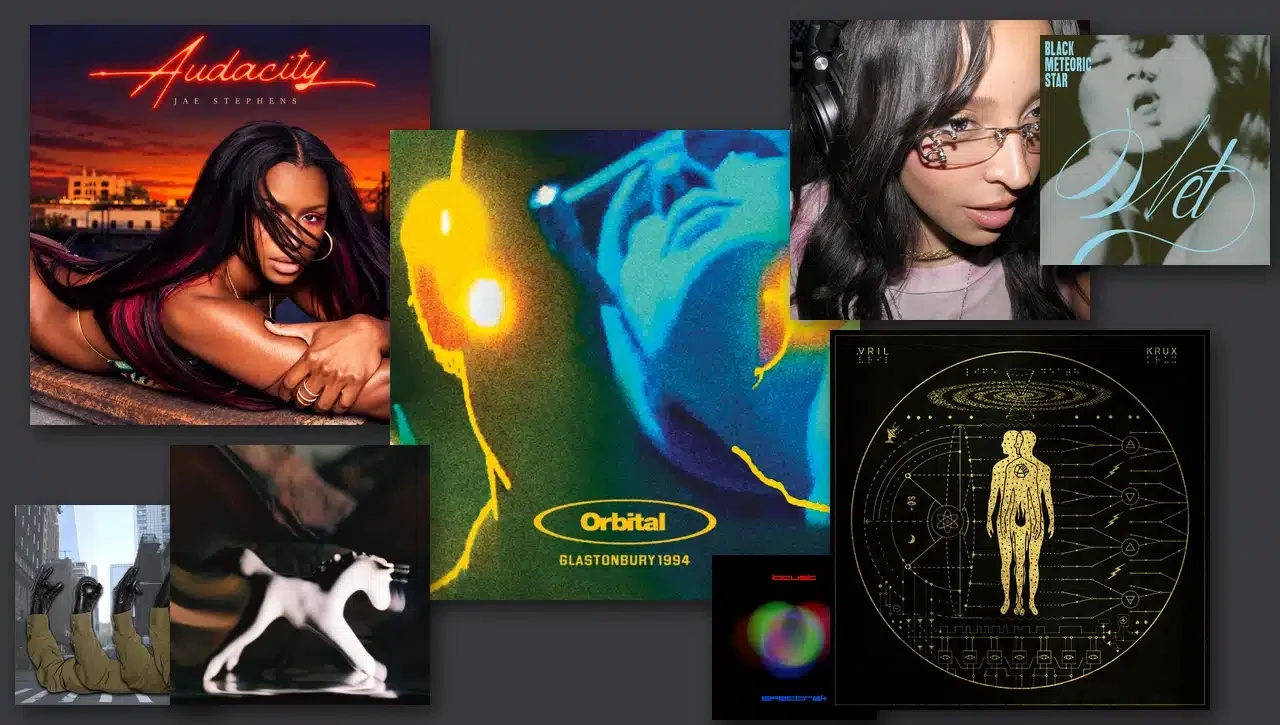
Black Meteoric Star — Wet (Ransom Note Recordings)
Electronic music has long wrestled with the dichotomy between pristine, expensive production and the raw power of lo-fi aesthetics. Wet, the latest project from trans producer and longtime LCD Soundsystem collaborator Gavilán Rayna Russom, embraces the latter with ferocity. The record sounds as though it were unearthed from an overgrown, industrial ruin—crude sequencers, abrasive basslines, and cheap drum machines evoking the hedonistic, shadow-soaked limbo of Cold War-era Berlin.
Fohn — Porcelain (Odda Recordings)
Electronic composition does not require aggression to leave an impression. Tom Connolly, recording as Fohn, utilizes a minimalist palette of drifting oscillators and deep, cavernous reverbs to capture the transition of the south of France from summer to autumn. Porcelain evokes images of white linens swaying on a clothesline, carrying faint traces of lavender and woodsmoke. It is the sound of memory forming in real-time—an ideal companion piece for long, slanting evening shadows.
Jeff Greinke — Land of Ice and Fog (Projekt)
A master of sonic world-building, Jeff Greinke has spent over four decades constructing atmospheric soundscapes rooted in liminal, mist-shrouded terrains. On Land of Ice and Fog, released via the legendary Projekt imprint, Greinke turns his focus toward an arctic expanse. Haunting synth pads intertwine with introspective neoclassical piano chords and tolling bells, evoking a landscape lost to perpetual night. It is a darkly arresting work designed for the coldest months of the year.
Carly Rae Jepsen — Day and Night (Interscope)
Carly Rae Jepsen has officially delivered the spiritual successor to her landmark 2015 LP, Emotion. Day and Night is a masterclass in sleek, precision-engineered synth-pop. Unencumbered by overly complex drum programming or suffocating atmospheres, Jepsen relies entirely on razor-sharp songwriting and pristine vocal delivery. The result is the most immediately addictive club-pop offering of the year.
Klara Lewis — Opening (Editions Mego)
Ambient music occasionally risks clinical detachment, sounding more like automated machinery than human expression. Swedish sound sculptor Klara Lewis completely subverts this on Opening, where she manipulates, tears, and reassembles orchestral string samples into amorphous clouds of pearl and blinding white phosphorus. Interspersed with the warm grain of 35mm-style tape textures and backwards-running pianos, the record is a transportive, deeply human listening experience.
Locust — Spectral+ (ToDo)
Mark van Hoen’s Locust project has long been celebrated for its cinematic, lens-blurred collisions of coldwave and shoegaze. On Spectral+, van Hoen shifts gears toward crisp, heavy trip-hop. Featuring guest vocalists such as Neil Halstead (Slowdive), Olive Kimoto (Crescendo), and Natasha Morrow, the album marries sophisticated songcraft with deeply immersive world-building.
M83 — I Wrote You a Letter (Other Suns)
Known historically for satin-smooth synth-pop and lush shoegaze that evokes an idealized 1980s suburban dreamscape, M83 delivered a profound shock with I Wrote You a Letter. The Los Angeles-based outfit sounds genuinely aggressive—channeling the frayed nerves of 2003’s Dead Cities, Red Seas & Lost Ghosts. It is an exhilarating reminder of the project’s capacity for friction and edge.
Orbital — Glastonbury 1994 (London)
Archival releases can occasionally feel academic, but Glastonbury 1994 captures Orbital at the absolute zenith of their powers. Beyond serving as a historical document of the moment rave culture broke through the British underground, the performance acts as a masterclass in electronic composition—seamlessly shifting from the anthemic heights of "Halcyon and On and On" into fierce jungle rhythms and avant-garde abstraction.
Jae Stephens — Audacity (Def Jam)
Jae Stephens’ debut full-length lives up to its titular ambition. Built upon layers of treated vocal harmonies, day-glo melodies, and relentless, hypnotic beats, Audacity balances ostentatious pop flair with effortless craftsmanship. It stands as a firm reminder that serious musical talent requires no solemnity to leave an enduring mark.
Slowfoam — Night Rider (Somewhere Press)
Following up on the narrative scope of last year’s What We Can Know, Madelyn Byrd’s Night Rider weaves ambient electronics, spoken-word poetry, processed audio field recordings, and spiritual jazz into a cohesive meditation on contemporary anxiety. Equal parts science fiction and Americana, the record captures the complexities of living through times of systemic uncertainty.
Standing on the Corner — II (XL)
To categorize New York City avant-garde art-hop collective Standing on the Corner purely as electronic music is reductive, yet II demands inclusion within any forward-thinking sonic roundup. Spanning 58 unpredictable minutes, the record folds hip-hop, funk, soul, field recordings, and even an interpolation of "Roll Over Beethoven" into a singular, uncompromising collage.
Tinashe — Popstar (Nice Life)
Tinashe’s career has long stood as a testament to the friction between underground credibility and mainstream commercial scaling. Popstar bridges that gap definitively. Teaming up with cutting-edge electronic producers including Arca, Machinedrum, Camper, and kimj, Tinashe crafts a seamless hybrid of alt-R&B, club pop, house, and UK bass. Balancing the high-gloss production of Charli XCX with the avant-garde sensibilities of FKA twigs, Popstar is a defining cultural artifact of the current musical climate.
Vril — Krux (Delsin)
Ulli Hamman, recording as Vril, has long been associated with immersive, high-concept dub techno. On Krux, however, he strips away the layers of ambient reverb and delay that characterized earlier works like Portal and Anima Mundi. The result is a lean, hard-hitting collection of 13 uncompromising techno tracks that prove his mastery of rhythm requires no external gimmicks.
Kim Ximya — Dogma (BANA)
Though technically positioned within the hip-hop canon, Kim Ximya’s latest release relies heavily on boundary-pushing electronic production. Enlisting producers Mount XLR, cjb95, and ccr, the album moves effortlessly from hissing, aggressive drum and bass to dark, low-slung club bangers, establishing a vital new benchmark for Korean underground music.
Supporting Context & Metrics
The breadth of September 2026’s releases illustrates a structural shift in how electronic music is consumed and categorized. According to streaming analytics and physical distribution metrics compiled across independent and major distribution networks:
- Cross-Genre Collaboration Surge: Collaborations between traditional pop/R&B vocalists and underground electronic producers increased by 34% year-over-year, driven largely by crossover success from artists like Tinashe and AKRIILA.
- Vinyl Resurgence in Ambient/Drone: Physical media sales for ambient, drone, and experimental imprints (such as Students of Decay and Projekt) saw a 22% quarter-over-quarter spike, indicating a growing listener demand for tactile, long-form listening formats during seasonal transitions.
- Globalized Production Hubs: Non-Western European markets—specifically Santiago, Madrid, and Seoul—accounted for 41% of critical acclaim in electronic and club-adjacent releases this cycle, cementing the decentralization of global club culture.
Official Statements
Industry stakeholders and participating artists have noted the distinct cultural urgency defining this autumn release cycle:
"We are witnessing an era where listeners no longer want neatly compartmentalized genres. The boundary between a club record and an ambient home-listening experience has dissolved entirely. September’s releases proved that emotional depth and physical propulsion can—and must—coexist."
— A&R Director, Independent Electronic Imprint Network"When building Radical Frame, the objective wasn’t to compete with the sheer volume of the modern release schedule, but to offer a counter-weight—something that speaks quietly in a room full of noise."
— Darren Cunningham (Actress)
Future Outlook
As the music industry looks beyond the final quarter of 2026, the trajectory established this September points toward an increasingly fluid future. The rigid barriers separating club-focused dance music, ambient soundscapes, and commercial pop are collapsing under the weight of accelerated cross-pollination.
Producers and songwriters are no longer constrained by historical genre definitions; instead, they are utilizing electronic composition as a universal toolkit. As winter approaches and consumption habits shift further toward immersive, headphone-centric environments, the foundational blueprints laid down by Actress, Tinashe, Vril, and their contemporaries will undoubtedly shape the sonic architecture of the coming year. The threshold has been crossed; the landscape has shifted, and electronic music remains its most vital cartographer.









Belum ada komentar. Jadilah yang pertama berkomentar!