

EXECUTIVE SUMMARY
The Wikimedia Foundation has officially brought its popular daily historical facts mini-game, "Which came first?", to iOS devices. Rolled out in the latest update of the official Wikipedia iOS application, the feature invites users to test their knowledge of world history through an interactive chronological sequencing challenge. Following a successful introductory rollout on Android platforms, the game’s debut on Apple’s ecosystem marks a significant step forward in the encyclopedia’s broader initiative to integrate gamified learning into its mobile user experience.
Designed to foster daily engagement, "Which came first?" presents users with five curated questions anchored to historical events that transpired on the exact current calendar day in years past. By blending casual puzzle mechanics with deep educational archiving, the feature bridges the gap between entertainment and academic exploration. As mobile users increasingly seek bite-sized, interactive content, this strategic addition positions Wikipedia not merely as a static reference library, but as an active, daily destination for lifelong learners and trivia enthusiasts alike.
1. Introduction to the Feature and Cross-Platform Integration
The rollout of "Which came first?" on iOS represents the culmination of months of UX testing and feature parity development across mobile operating systems. Initially launched to positive reception within the Wikipedia Android application, the game has now been optimized for Apple’s iOS interface, seamlessly embedded directly into the app’s prominent Explore feed.
The core premise of the game is deceptively simple yet intellectually stimulating: players are presented with pairs of historical events and must deduce which one occurred earlier in time. By structuring the challenge around a daily sequence of five comparative questions, Wikipedia has created a frictionless entry point for users to interact with the vast troves of human history documented on the site.
Unlike standalone trivia applications that rely on randomized databases, "Which came first?" leverages Wikipedia’s rigorous, community-vetted database of "On This Day" historical milestones. Every single question pool is intrinsically tied to the calendar date on which the user opens the app. Whether it is a monumental geopolitical treaty signed in the 17th century, a groundbreaking scientific discovery from the Victorian era, or a cultural milestone from the mid-20th century, the trivia directly reflects the historical weight of the current calendar date.
2. Mechanics, Gameplay Design, and Progression Tracking
Understanding the appeal of "Which came first?" requires a closer look at its minimalist design philosophy and progression systems. The development team prioritized an intuitive interface that avoids cognitive overload, ensuring that users can drop into a round in a matter of seconds.
Core Gameplay Loop
- The Challenge: Each daily session consists of five carefully calibrated rounds. In each round, users are given two distinct historical events and must tap the one that took place first chronologically.
- The Thematic Tie: The events are not plucked at random from all of recorded history; instead, they share a thematic resonance or are specifically anchored to anniversaries falling on the current day of the year.
- Immediate Feedback: Upon making a selection, the app provides instant confirmation alongside the exact years in which the events occurred, offering immediate educational context whether the user answers correctly or incorrectly.
Retention and Statistics Tracking
To encourage habit-forming engagement—a hallmark of modern successful digital products—Wikipedia has incorporated robust player statistics directly into the game interface:
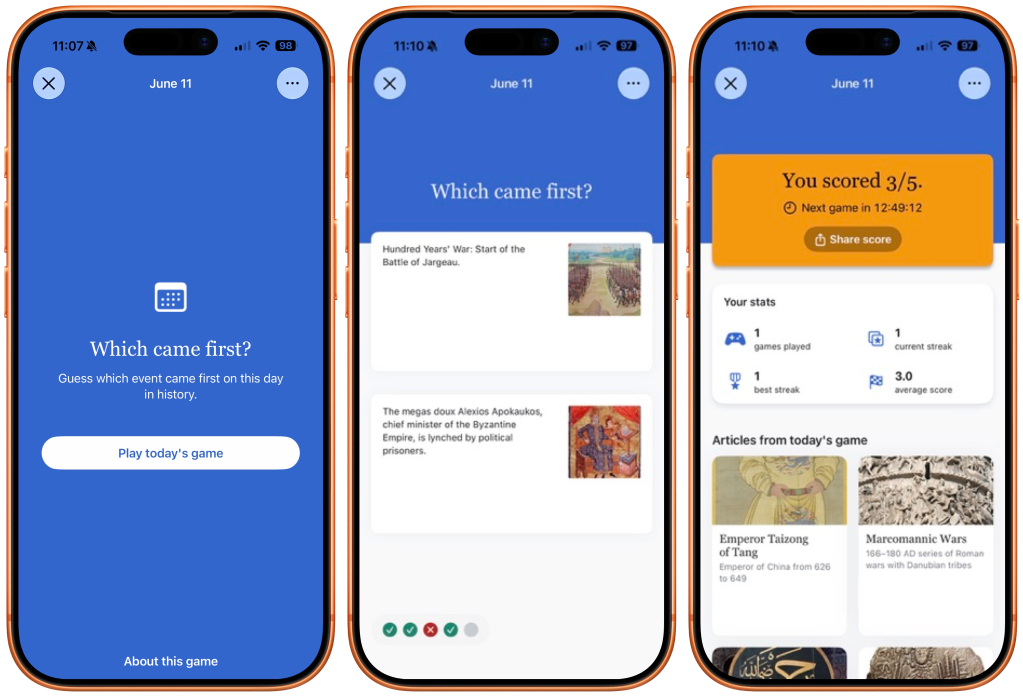
- Gameplay Streaks: Users can track consecutive days played, fostering a sense of accomplishment and daily routine.
- Average Scores: Detailed analytics display historical performance metrics, allowing players to monitor their proficiency over time.
- Comprehensive Archives: For users who miss a day or wish to continue playing beyond the daily five-question limit, an integrated archive feature provides access to previous rounds. This ensures that the content remains replayable and valuable regardless of when a user logs in.
3. The Broader Shift Toward Gamified Learning in Digital Reference
The introduction of "Which came first?" on iOS is not an isolated experiment; it reflects a broader industry-wide transition within major digital reference and educational platforms toward gamification. As attention spans fragment across social media feeds and short-form video algorithms, traditional text-heavy encyclopedias face unprecedented competition for user mindshare.
By transforming historical data into an active game, the Wikimedia Foundation is tapping into psychological drivers that promote long-term retention. Gamification leverages principles of intrinsic motivation, curiosity gaps, and achievement tracking. When a user incorrectly identifies the timeline of two historical revolutions or technological breakthroughs, the resulting cognitive dissonance creates a powerful learning moment that far surpasses passive reading.
Furthermore, this feature aligns with Wikipedia’s long-term strategic goals of expanding its demographic reach. While millions of desktop and mobile web users rely on the encyclopedia for academic or professional research, the dedicated mobile applications serve a different user base—one that is mobile-first, exploratory, and prone to micro-learning sessions during commutes or downtime. Features like "Which came first?" transform the Wikipedia app from a utility tool into an engaging lifestyle application.
4. User Experience and Accessibility within the iOS Ecosystem
Apple users navigating the updated Wikipedia app will find that "Which came first?" has been thoughtfully integrated into the existing information architecture rather than feeling tacked on as an afterthought.

Navigating the Explore Feed
The game is housed directly within the app’s Explore feed, a centralized hub designed to surface serendipitous discoveries, trending articles, featured pictures, and historical milestones. By placing the daily game here, Wikipedia ensures high visibility without disrupting core reading workflows. Users who prefer a purely traditional reading experience can easily bypass the feature, while those seeking daily entertainment can access the prompt with a single tap.
Technical Performance and Optimization
Built natively for iOS, the feature benefits from smooth animations, responsive touch targets, and rapid loading times—hallmarks of high-end Apple ecosystem applications. The integration of dark mode support, dynamic type scaling, and VoiceOver compatibility ensures that the game remains accessible to a diverse array of users, upholding Wikipedia’s foundational commitment to universal accessibility and open knowledge.
5. Future Outlook: What’s Next for Wikipedia Mobile Features?
The successful deployment of "Which came first?" across both Android and iOS operating systems establishes a robust technological framework for future interactive features within the Wikipedia mobile app ecosystem.
As digital learning continues to evolve, industry analysts anticipate that the Wikimedia Foundation may explore further extensions of its crowdsourced data. Potential avenues for future development could include:

- Multiplayer or Social Challenges: Allowing friends or global user communities to compare daily scores or compete in synchronous historical trivia matches.
- Thematic Expansion Packs: Specialized game modes focusing on specific domains of human knowledge, such as art history, geography, space exploration, or literary milestones.
- Deeper Editorial Integration: Direct hyperlinks from trivia answers straight into comprehensive Wikipedia articles, seamlessly funneling casual gamers into deep academic research.
For now, however, the immediate focus remains on onboarding the massive global base of iPhone and iPad users into the daily ritual of historical discovery.
Conclusion
Wikipedia’s "Which came first?" game is a masterclass in how established institutions can modernize their digital touchpoints without compromising their core mission. By packaging peer-reviewed historical data into a polished, lightweight, and addictive daily puzzle, the platform has successfully reinvigorated its iOS application.
For history buffs, trivia lovers, and casual users looking to exercise their brains during a coffee break, the update offers an effortless way to uncover the fascinating, often surprising chronological threads of our collective past. The updated Wikipedia app, complete with the new iOS game, is available for download now on the Apple App Store via the Explore feed.








Belum ada komentar. Jadilah yang pertama berkomentar!