

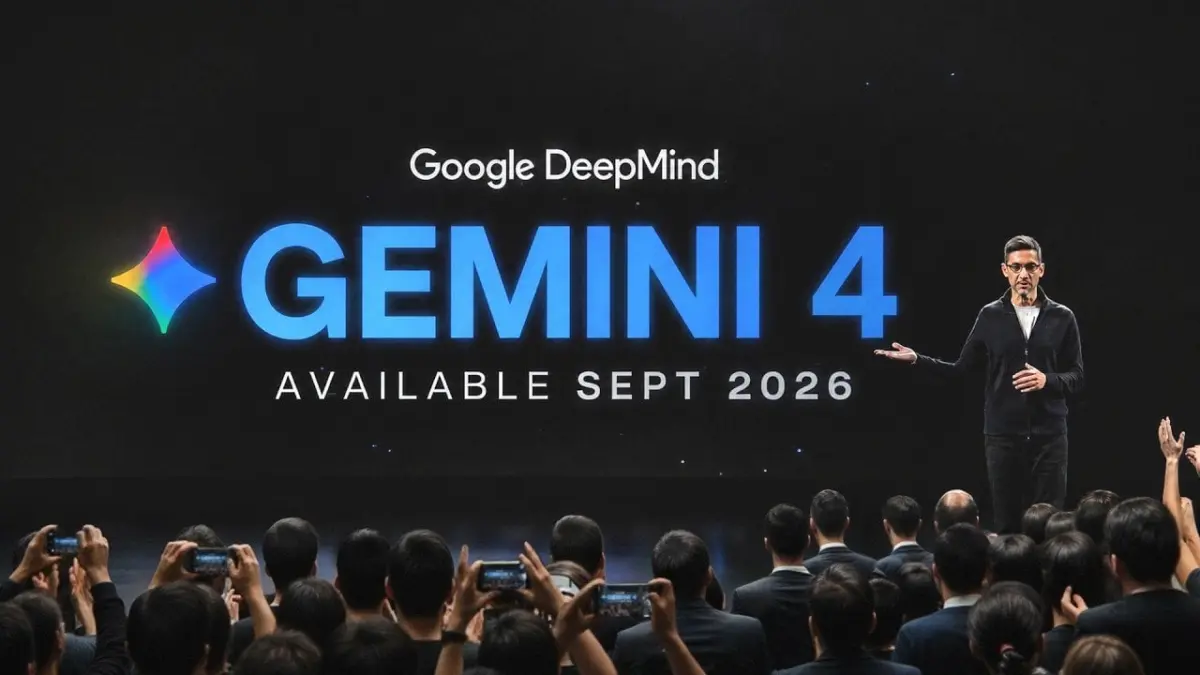
Executive Overview
Artificial intelligence development has officially entered a hyper-accelerated phase. During Alphabet’s recent Q2 earnings call, CEO Sundar Pichai dropped a major industry bombshell: the pre-training phase for Gemini 4, Google’s next-generation flagship AI model, has officially begun. While details regarding the model’s physical architecture, parameter counts, and technical makeup remain tightly under wraps, the mere confirmation of its development has sent ripples through the global tech sector.
As rival labs—including Anthropic with its iterative Claude systems and rising open-source contenders—push the boundaries of machine intelligence, Google is gearing up for its next evolutionary leap. Whispers from industry insiders suggest that Gemini 4 could shatter current data-processing limitations by introducing an unprecedented 10-million-token context window. If realized, this capability would allow users to ingest, analyze, and synthesize entire corporate libraries, hours of video content, and massive codebases in a single prompt.
However, transitioning from rumor to reality requires navigating complex engineering hurdles, internal structural shifts at Google DeepMind, and an increasingly cutthroat competitive landscape. This report offers an exhaustive analysis of what we know about Gemini 4, the current state of Google’s AI ecosystem, and what the future holds as the artificial intelligence arms race reaches a fever pitch.
1. Executive Overview: The Dawn of Gemini 4
The announcement of Gemini 4’s pre-training marks a pivotal milestone not just for Google, but for the entire generative AI paradigm. For the past several years, the race has been defined by incremental scaling laws—adding more parameters, increasing training compute, and slightly refining reasoning capabilities. With Gemini 4, Google is signaling that the era of raw computational scaling is expanding into structural efficiency and ultra-long-range data comprehension.
Despite Pichai’s confirmation that the model is actively training, Google has maintained a posture of strict operational secrecy. Technical specifications have not been published, and leadership has refrained from providing a concrete commercial release window. This lack of transparency has inadvertently fueled a robust ecosystem of speculation. Market analysts, independent researchers, and AI enthusiasts are parsing every available data point to project what Gemini 4 will look like when it eventually breaks cover.
What is clear, however, is that Gemini 4 is not being developed in a vacuum. It represents the apex of a broader corporate strategy that includes rapid iterations of existing models (such as the Gemini 3.5, 3.6, and 3.7 families), deep integration into ubiquitous products like Google Search, Workspace, and YouTube, and a concerted push into multimodal computing via the Omni product family.
2. Detailed Chronology: From Gemini 3 to the 4th Generation
To understand the trajectory of Gemini 4, it is necessary to examine the rapid cadence of Google’s recent releases, which have laid the groundwork for this upcoming flagship model.
The 2026 Release Cadence
Google’s AI development cycle has shifted into overdrive. Throughout mid-2026, the company systematically updated its mid-tier and developer-focused portfolios:
- Gemini 3.6 Flash (July 2026): Released to address surging enterprise demand for low-latency, cost-effective inference. This model proved crucial for developers building real-time applications where speed outweighs exhaustive deep reasoning.
- Gemini 3.7 Flash (August 2026): Building immediately on the heels of its predecessor, 3.7 Flash optimized token throughput and reduced operational costs even further, establishing a new baseline for affordable multimodal processing.
- Gemini 3.5 Pro (Targeted Testing): Concurrently, Google began private-beta testing for Gemini 3.5 Pro with select enterprise partners. Designed for high-complexity use cases such as advanced software engineering and legal document analysis, this model serves as a bridge toward the architectural leaps expected in the fourth generation.
The Pre-Training Phase: Building the Foundation
The confirmation of Gemini 4’s pre-training means the model is undergoing the most computationally intensive phase of its lifecycle. During pre-training, massive clusters of Tensor Processing Units (TPUs) ingest petabytes of text, code, images, audio, and video. The model analyzes statistical patterns across this data to build its core weights and foundational understanding of language, logic, and the physical world.
Following pre-training, Gemini 4 will face rigorous post-training phases, including Reinforcement Learning from Human Feedback (RLHF), safety red-teaming, alignment optimization, and inference efficiency profiling. Because this pipeline is notoriously complex, analysts predict an official commercial debut anywhere between late 2026 and mid-2027, heavily contingent upon the hurdles encountered during safety evaluations and performance benchmarking.
3. Supporting Context & Metrics: Chasing the 10-Million-Token Window
While official technical specs are non-existent, the rumor mill surrounding Gemini 4 centers on one transformative metric: the 10-million-token context window.
What is a Context Window and Why Does Scale Matter?
An AI’s context window dictates the amount of data—measured in tokens (roughly equivalent to three-quarters of a word)—that the model can hold in its "working memory" during a single interaction.
- Early models operated within a few thousand tokens (barely enough to read a short essay).
- Recent iterations expanded this to 1 million or 2 million tokens (capable of processing a novel or hours of audio).
- A 10-million-token window would elevate context capacities to an entirely different magnitude.
Implications of Ultra-Long Contexts
If Google successfully implements a 10-million-token window in Gemini 4, the practical use cases will transform enterprise workflows overnight:
- Full-Codebase Engineering: Developers could input an entire enterprise software repository—millions of lines of legacy code spanning hundreds of files—allowing the AI to trace bugs, refactor architecture, and write documentation with total contextual awareness.
- Cinematic and Long-Form Video Analysis: Media companies could upload hundreds of hours of raw video footage, allowing the model to index, edit, analyze, and generate narrative insights without losing track of early-scene details.
- Comprehensive Legal and Medical Discovery: Entire corporate discovery phases or decades of patient medical histories could be evaluated simultaneously, eliminating the blind spots inherent in chunked or retrieved data processing.
Alongside context expansion, rumors persist regarding an astronomical increase in total model parameters, positioning Gemini 4 to challenge or exceed the raw reasoning benchmarks set by competing frontier models.
4. Official Statements and Strategic Shifts at DeepMind
The development of Gemini 4 is occurring against a backdrop of significant organizational evolution within Google DeepMind. In August 2026, key leadership transitions were announced within the research subsidiary. While corporate restructuring is common in fast-moving tech giants, changes at the top of an AI research division often signal strategic realignments—shifting priorities between raw scaling, safety alignment, energy efficiency, and commercial deployment speed.
During the Q2 earnings call, Sundar Pichai emphasized Google’s dual commitment: pushing the scientific frontier while delivering practical, scalable tools to billions of users. Pichai noted that foundational research into models like Gemini 4 is deeply intertwined with infrastructure optimizations, ensuring that when the model launches, Google has the data-center capacity and TPU efficiency required to serve it globally without crippling operational costs.
Despite these high-level acknowledgments, Google has maintained a disciplined silence regarding leaks and speculation. Executives have repeatedly reminded stakeholders that early-stage pre-training metrics are fluid, and final product capabilities will depend entirely on how the model responds to post-training safety and alignment fine-tuning.
5. The Intensifying AI Landscape: Competition and Ecosystem Advantage
Gemini 4 will enter a vastly different ecosystem than its predecessors. The generative AI market has matured from a two-horse race into a brutal, multi-front war involving established tech giants, heavily funded startups, and agile open-source communities.
The Competitive Field
- Anthropic: Continuing to push conversational depth and coding safety with iterations of their Claude models (such as the anticipated Claude Fable series), focusing heavily on nuance, prompt adherence, and enterprise security.
- OpenAI & Meta: Constantly iterating on proprietary and open-weight architectures, driving down the cost of intelligence while raising the bar for reasoning and agentic workflows.
- Open-Source Challengers: Emerging models (such as Qwen and various open-weight ecosystems) are democratizing high-end AI capabilities, putting pressure on proprietary providers to justify their ecosystem costs.
Google’s Structural Advantage: Distribution
While competitors frequently leapfrog one another in raw benchmark scores, Google possesses a singular superpower that none of its direct rivals can match: mass distribution.
Through deep integration into foundational platforms like Google Search, YouTube, Android, Chrome, and Google Workspace, Google can deploy new AI capabilities directly to billions of active users instantly. If Gemini 4 is successfully woven into the Omni multimodal product family—allowing seamless transitions across text, audio, images, and video—it will not merely be a chatbot on a web browser, but an ambient infrastructure layer powering the digital world.
6. Future Outlook: Navigating the Road to Gemini 4
As the technology sector looks toward the horizon of late 2026 and mid-2027, navigating the AI landscape requires a balance of excitement and pragmatism.
For enterprise leaders, developers, and everyday users, the immediate focus should remain on tools that are accessible today. Google’s current offerings—including Gemini 3.6 Flash, 3.7 Flash, and the evolving Omni multimodal tools—provide immense practical utility, streamlining everything from automated content generation to complex data analytics. These models serve as the testing grounds and building blocks for what is to come.
When evaluating news surrounding Gemini 4, observers must maintain a healthy skepticism toward unverified leaks and sensationalized claims. While a 10-million-token context window and hyper-scale parameter counts are technically feasible within the trajectory of modern AI research, they remain speculative until officially demonstrated and benchmarked by Google DeepMind.
Conclusion:
Gemini 4 represents the next great crucible for Google. By pushing the boundaries of pre-training, memory capacity, and multimodal integration, the company is preparing to stake its claim on the next era of artificial intelligence. Whether it lives up to the soaring expectations of a 10-million-token window will soon be revealed as the model transitions from the silent depths of pre-training into the harsh, illuminating light of evaluation and deployment.








Belum ada komentar. Jadilah yang pertama berkomentar!