

Executive Overview
In the volatile landscape of post-war Japanese cinema, few figures burned as brightly, defiantly, or iconoclastically as Nagisa Ōshima. In 1960 alone, Ōshima delivered three blistering, formally radical features for the conservative Shochiku Studio—an extraordinary output that culminated in his outright termination. Now, the Criterion Collection has brought one of those volatile masterworks, Cruel Story of Youth (Seishun Zankoku Monogatari, 1960), to home video in a definitive Blu-ray and 4K UHD package.
Crucially, this release includes an essential bonus feature that matches, and in some aspects surpasses, the main attraction: Ōshima’s one-hour feature debut, A Town of Love and Hope (Ai to kibō no machi, 1959). Together, these works document the explosive genesis of a cinematic revolutionary whose career challenged the very foundations of Japanese societal norms, studio oversight, and political complacency.
This retrospective examines Ōshima’s foundational years at Shochiku, tracing a trajectory from his deceptively tender humanist debut to the dark, nihilistic dioramas of the Japanese New Wave. By contextualizing these early triumphs alongside later banned masterpieces like Night and Fog in Japan (Nihon no Yoru to Kiri, 1960), this article explores how Ōshima forged an independent path that permanently altered the global cinematic landscape.
Detailed Chronology: The Shochiku Rise and Fall (1959–1960)
To understand Nagisa Ōshima’s monumental impact on world cinema, one must trace the rapid, uncompromising escalation of his tenure at Shochiku Studio. His journey within the studio system was brief, lasting barely a year and a half, yet it produced a body of work that continues to define mid-century artistic rebellion.
1959: A Town of Love and Hope – The Humane, Hard-Edged Panorama
Originally intended to be titled The Boy Who Sold His Pigeons, Ōshima’s directorial debut opens on a bustling, urban landscape crowded with commuters, vehicles, and mechanical railroad barriers that continually regulate the rhythms of everyday life. Amidst this concrete labyrinth crouch impoverished street vendors, alongside the adolescent Masao (Hiroshi Fujikawa). Dressed in a sober school uniform that matches his quiet gravity, Masao faces a crushing crossroads: pursue high school to satisfy his ailing mother’s wishes, or enter the workforce immediately to relieve her from shining shoes. Today, he is minding her station while guarding a cage containing two pigeons.
The narrative engine of the film hinges on a poignant, recurring transaction. Masao repeatedly sells his pigeons to wealthy families—such as the outgoing high school sophomore Kyoko (Yuki Tominaga)—only for the homing birds to return to him, ready to be sold again. This cyclical racket mortifies Masao, particularly as his intellectually disabled younger sister breaks down in tears every time the birds vanish. Yet, he obeys his mother, who pragmatically notes that it is hardly their fault if the birds escape their new owners.
Operating within a widescreen black-and-white canvas, Ōshima populates the film with a kaleidoscope of complex characters reminiscent of a 19th-century social novel by Balzac, Zola, or Trollope. Figures like Miss Akiyama (Kakuko Chino) and Kyoko attempt to pull Masao out of his generational poverty, encouraging him to seek employment at an electronics factory owned by Kyoko’s father.
Despite its title, A Town of Love and Hope offers a tough, unvarnished humanism. Ōshima deftly illustrates how systemic poverty traps individuals within rigid social strata, rendering them incapable of truly understanding the interior lives of others. The film was a modest commercial and critical success, earning positive reviews that emboldened Shochiku executives to grant the young director further creative autonomy.
1960: Cruel Story of Youth – The Dark, Dissolute Diorama
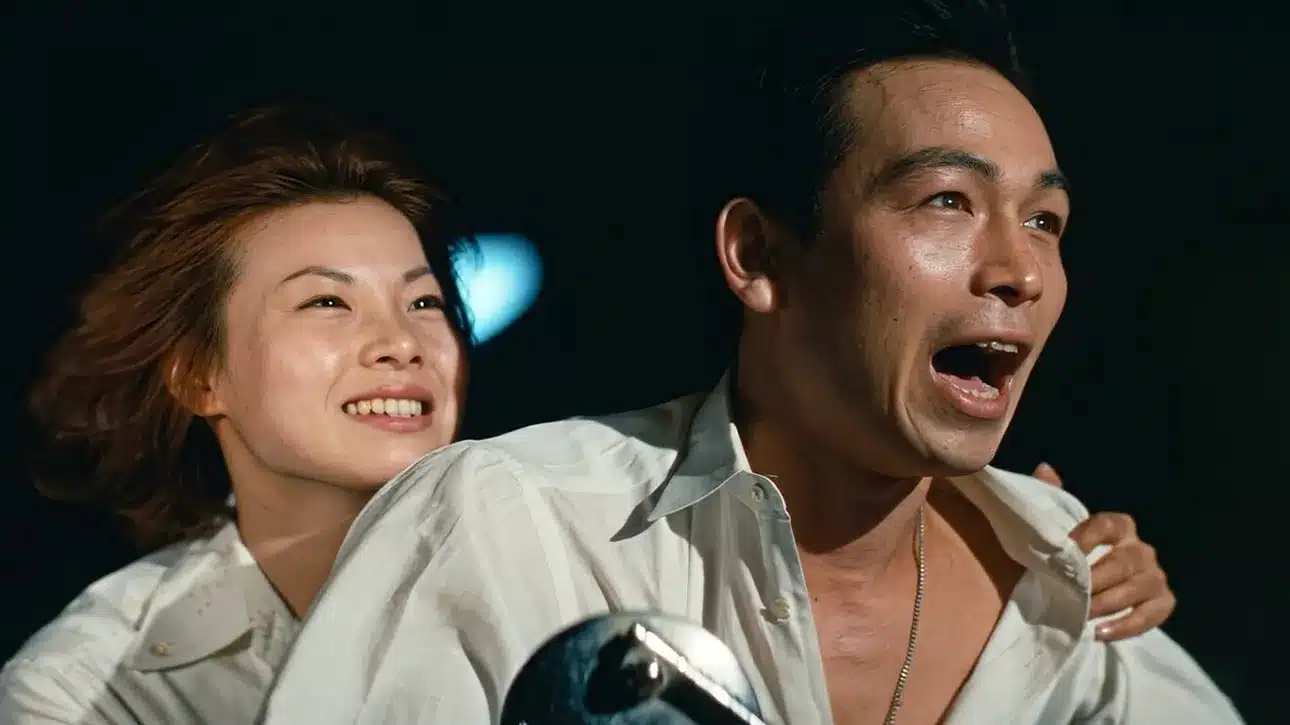
Buoyed by his debut’s reception, Ōshima plunged into Cruel Story of Youth, a project that traded the melancholic realism of A Town of Love and Hope for a violent, hyper-sexualized exploration of contemporary Japanese youth culture. Retaining the widescreen format, Ōshima introduced a vibrant, aggressive color palette to tell a harsher, near-nihilistic story.
The film opens at night on a crowded street as high schooler Makoto (Miyuki Kawano) and a friend hitch a ride with a stranger. After her friend exits, the middle-aged driver attempts to assault Makoto, only to be brutally beaten by Kiyoshi (Yusuke Kawazu), a tall, brooding delinquent who steps in like a surly knight-errant. Rather than staging clean, cathartic martial arts choreography, Ōshima utilizes jerky, handheld close-ups to convey the chaotic, desperate nature of physical violence.

As the plot unfurls, Kiyoshi introduces Makoto into a predatory underworld. In a sequence that is as formally majestic as it is morally disturbing, Kiyoshi pushes Makoto into a body of water filled with floating timber, dominating her until she submits. This act aligns with the taiyozoku ("sun tribe") pop-culture trend of the era, which depicted rebellious, amoral youth burning out brightly against societal expectations. Furthermore, Kiyoshi’s transactional approach to sex stems from his own gigolo work with middle-aged women in illicit love hotels.
When Makoto and Kiyoshi declare their mutual devotion, the film spirals into an outlaw-couple tragedy akin to a dark, modern Romeo and Juliet. Takashi Kawamata’s cinematography—characterized by lengthy tracking shots and frantic handheld pans—frames the doomed lovers not as subjects of moral condemnation, but as clinical case studies trapped within an oppressive socio-political superstructure.
1960: Night and Fog in Japan and the Ultimate Breach
The culmination of Ōshima’s tenure at Shochiku arrived with Night and Fog in Japan (Nihon no Yoru to Kiri, 1960), a devastating, iconoclastic critique of the Japanese political left. Set against the backdrop of the tumultuous 1960 US-Security Treaty protests, the film traps characters inside a bourgeois wedding reception where uninvited radical activists interrupt the proceedings to dissect the failures, dogmas, and ideological betrayals of "the movement."
Executed almost entirely through continuous, sinuous tracking shots and complex flashback structures, Night and Fog in Japan is a visual and intellectual tour de force. Terrified that the film’s direct engagement with contemporary political unrest would provoke right-wing backlash or disrupt industry stability, Shochiku executives pulled the film from theaters after a mere run of several days. This act of censorship effectively ended Ōshima’s relationship with the studio system, propelling him into a legendary career as an uncompromising independent filmmaker.
Supporting Context & Metrics: The Criterion Renaissance
The home video landscape for classic Japanese cinema has long been characterized by scarcity, particularly for Region 1 audiences. While figures like Akira Kurosawa and Yasujirō Ozu enjoy widespread availability, avant-garde and New Wave masters have often been relegated to out-of-print DVD box sets or boutique imports.
- The Criterion Collection’s Shima Holdings: With the recent release of Cruel Story of Youth on a combined Blu-ray and 4K UHD package, Criterion has expanded its stewardship of Ōshima’s filmography. This release joins previous definitive editions of Death by Hanging (1968), In the Realm of the Senses (1976), and Merry Christmas, Mr. Lawrence (1983).
- The Eclipse Legacy: In 2010, Criterion’s Eclipse sub-label released a five-DVD box set titled Ōshima’s Outlaw Sixties, which has since become a sought-after collector’s item on the secondary market.
- Critical Frameworks: Bonus materials accompanying the new release feature invaluable contextualization by film historian Tony Rayns, alongside liner notes by critic Chris Fujiwara. Rayns emphasizes that Ōshima’s four Shochiku features—A Town of Love and Hope, Cruel Story of Youth, The Sun’s Burial (1960), and Night and Fog in Japan—operate as an interconnected tetralogy that charts the moral and political decay of post-war Japan.
Official Statements and Critical Reception
The enduring power of Nagisa Ōshima’s early cinema lies in its refusal to offer comforting moral resolutions. Film scholars and preservationists have consistently praised his formal audacity and sociological acuity.
"Ōshima’s films do not judge their protagonists; they judge the societal structures that create them. In A Town of Love and Hope and Cruel Story of Youth, the camera acts as an unyielding witness to the collateral damage of modernization." — Film Historian Analysis
Reflecting on the volatile production environment of 1960, contemporary retrospectives emphasize that Ōshima’s dismissal from Shochiku was not merely an administrative dispute, but a historic turning point. It catalyzed the rise of Japanese independent cinema, proving that artistic integrity could survive outside the corporate studio apparatus. As critic Chris Fujiwara notes in the Criterion liner notes, Ōshima’s synthesis ofBrechtian distancing techniques with raw emotional intensity established a new vocabulary for political filmmaking worldwide.
Future Outlook: Preserving the New Wave Vanguard
The release of Cruel Story of Youth and its precious companion piece, A Town of Love and Hope, represents a major triumph for film preservation and physical media enthusiasts. However, significant gaps remain in the accessible catalog of Japanese New Wave masterworks.
- Expanding the Canon: Cinephiles and historians continue to advocate for high-definition restorations and wide-region releases of Ōshima’s missing Shochiku links, particularly The Sun’s Burial (1960).
- The Quest for Night and Fog in Japan: While Cruel Story of Youth has received state-of-the-art 4K restoration treatment, definitive, widely accessible editions of Ōshima’s banned masterwork Night and Fog in Japan remain high on the wishlists of international repertory programmers.
- Educational Outreach: As streaming platforms and boutique labels collaborate to bring these radical texts to modern audiences, contemporary filmmakers and students of cinema are finding fresh resonance in Ōshima’s exploration of youth alienation, economic precarity, and political disillusionment.
Ultimately, Nagisa Ōshima’s early films remind us that cinema can be an instrument of acute social diagnosis. By confronting uncomfortable truths with peerless stylistic panache, Ōshima ensured that his cinematic universe would remain forever young, dangerous, and vitally alive.









Belum ada komentar. Jadilah yang pertama berkomentar!