

Executive Overview
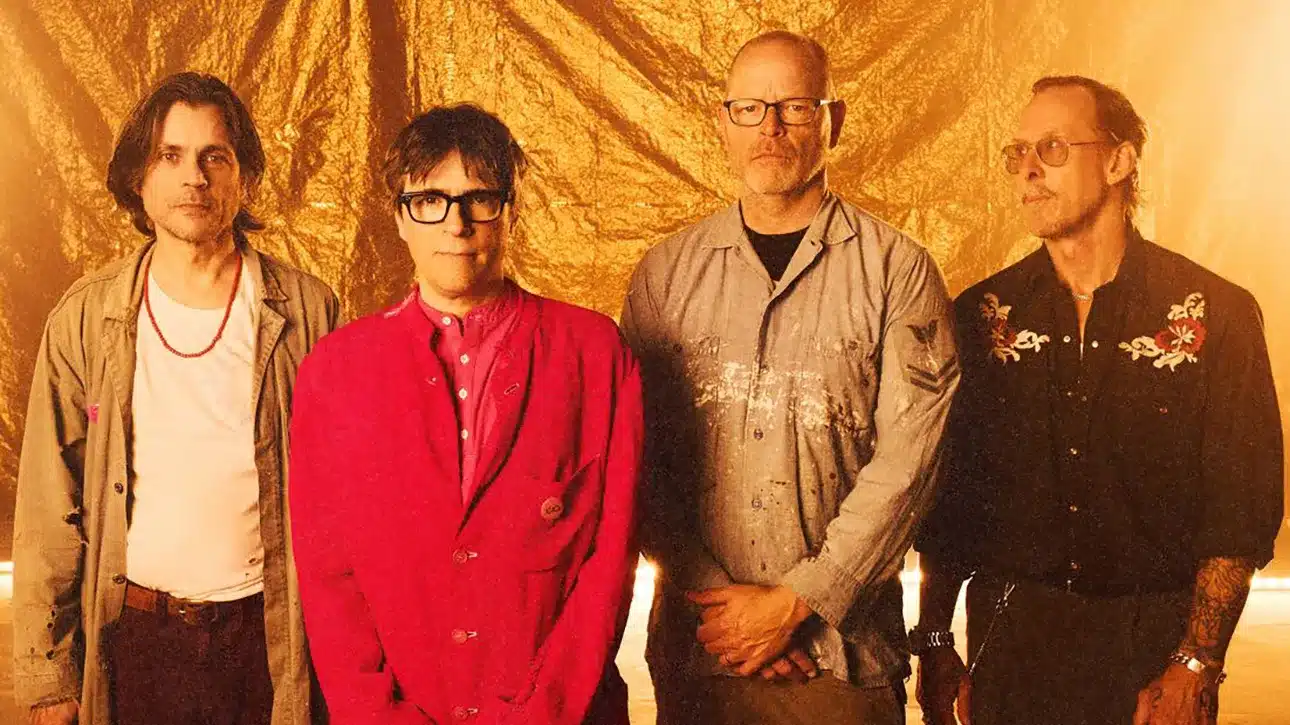
To understand the enduring cultural phenomenon of Weezer is to understand an ongoing identity crisis played out on the global stage. It is a dynamic immortalized in a classic December 2018 Saturday Night Live sketch, where actor Matt Damon and cast member Leslie Jones lock horns in a holiday dinner party debate. Damon embodies the "ride-or-die" fan, fiercely devoted to every stylistic pivot and sonic exploration. Jones champions the "purist" camp, maintaining that Weezer essentially ceased to exist after their first two mid-1990s masterpieces, Blue (1994) and Pinkerton (1996).
This dichotomy has defined the band’s trajectory for over three decades. Yet, as the band hurtles toward the release of their 20th studio album, Gold, this perpetual tug-of-war has taken on new meaning. Rather than fading into legacy-act obscurity, Rivers Cuomo and company used the chaotic landscape of the 2020s to author their most radically prolific, experimental, and creatively fearless era.
Between January 2021 and December 2022 alone, Weezer dropped a staggering six albums—culminating in the orchestral chamber-pop of OK Human, the glam-metal blast of Van Weezer, and the ambitious, season-spanning SZNZ tetralogy. Far from being a scattershot collection of vanity projects, this flurry of creativity captured a notoriously insular songwriter utilizing isolation, technological anxiety, and nostalgic yearning to craft some of the most compelling music of his career.
As recent singles like “Shine Again,” “We Might As Well Be Strangers,” and “C.E.O.” make waves ahead of Gold’s August release, critics and fans alike are forced to reconsider the rules of engagement for a band that refuses to stand still. This report examines Weezer’s 2020s renaissance, tracking their journey from lockdown innovation to the anticipated return of organic studio instrumentation.
Detailed Chronology: The Prolific 2020s and the Pandemic Catalyst
The Shadow of Expectations: Pre-2020 Trials
Between 2001 and 2019, Weezer released 11 studio albums to wildly mixed receptions. While classic tracks were scattered throughout this era, purists continually balked whenever the band strayed from the patented pop-grunge template that birthed “Buddy Holly” and “Say It Ain’t So.” In their eternal, paradoxical pursuit of mainstream success—despite an unshakeable indie identity—Weezer dipped their toes into hip-hop, R&B, and synth-pop.
For many, these experiments felt forced. Cuomo’s natural melodic inclinations, rooted in the Beatles, the Beach Boys, and Nirvana, occasionally sounded contrived when superimposed over modern drum machines and pseudo-rapping. The tipping point for many traditionalists arrived with Teal (2019), an unexpected covers album featuring a commercially dominant, note-for-note rendition of Toto’s “Africa.” To the purists, it felt like a senseless departure from the norm.
2021: OK Human and the Orchestral Turn
When OK Human landed in early 2021 amid the global COVID-19 pandemic, consumer expectations were exceptionally low. Arriving with the promise of a 38-piece orchestra and a complete absence of electric guitars, many feared it was the band’s final betrayal.
Instead, the record was a revelation. OK Human lacked guitars—the primary texture of the Weezer oeuvre—yet proved the band could be even more melodic without them. The lush orchestration provided countless counterpoints and allowed Cuomo’s vocals to inhabit a less cluttered canvas. Crucially, it marked a decisive break from digital production. Frustrated by software that made songs sound too exact, too polished, and too machine-like, the band recorded together in a studio using analog gear and classical instruments invented centuries before the digital age.
Thematically, the album grappled with our changing relationships with technology. Cuts like “Screens” and “Numbers” offered anecdotal musings on our asocial, hyper-digitized existence. Cuomo sang mournfully, "Numbers are out to get you," probing our collective obsession with social media metrics and validation without resorting to moralizing or preaching.
2021: Van Weezer and Glam-Metal Catharsis
Only four months after the chamber-pop introspection of OK Human, Weezer executed a dizzying 180-degree pivot with Van Weezer, a record built on guitar-propelled glam-metal.
If OK Human articulated adult reflections on entrapment, Van Weezer was its antithesis: a post-pandemic celebration of youthful abandon. Deploying Van Halen-style tapping and shredding on “The End of the Game,” and interpolating the chugging riff of Ozzy Osbourne’s “Crazy Train” into “Blue Dream,” the band indulged in irony and reverence alike. Tracks like “I Need Some of That” captured a Peter Pan-esque defiance: "Even if we blow up / We’re never gonna grow up." It provided the release, retreat, and electrified adrenaline fans craved after months of lockdown.
2022: The SZNZ Tetralogy
Weezer’s most ambitious project of the decade—and arguably their entire 34-year career—was SZNZ, a series of four mini-albums spanning the seasons of the year. Releasing seven songs on the first day of each season, the band delivered 28 tracks in 12 months.
- Spring (March): Embraced a "Ye Olde Weezer" aesthetic, utilizing mandolins, pan pipes, recorders, and acoustic guitars. Uplifting ballads like “A Little Bit of Love” and “The Sound of Drums” radiated post-lockdown liberation and springtime cheer.
- Summer (June): Flipped back to Marshall amps, channeling the youthful indignation of 1994. Tracks like “Blue Like Jazz” and “The Opposite of Me” delivered pure, unadulterated alt-rock muscle.
- Autumn (September/October): Veered into darker, Poe-inspired territory. The epic closer, “Run Raven Run,” featured labyrinthine arrangements, shifting tempos, and an ominous postscript complete with cough sounds—a subtle reminder of the pandemic’s grim real-world toll.
- Winter (December): Modeled loosely on the bleak emotional landscapes of Elliott Smith. It yielded some of Cuomo’s most poignant lyricism, notably “I Want a Dog,” a masterclass in self-deprecating vulnerability that reduced years of therapy into a devastatingly simple refrain.
Supporting Context & Metrics: The Anatomy of Cuomo’s Pen
To evaluate Weezer’s recent output is to examine a rare psychological consistency in modern rock. Critics frequently cast Weezer as miserabilists indulging in self-pity, overlooking Cuomo’s omnipresent sense of humor. Much like Morrissey, Cuomo uses incongruity humor to cushion dark self-reflections, injecting irony into bleak narratives.
Furthermore, the sheer volume of output during the pandemic era highlights a fascinating intersection between isolation and productivity. While lockdowns paralyzed many artists, Cuomo thrived. Given uninterrupted time and space, the notorious loner channeled perennial themes of isolation, escapism, and social withdrawal into contextual relevance.
Critical Reception Metrics (2021–2022)
- Total Studio Albums Released: 6 (OK Human, Van Weezer, SZNZ: Spring, SZNZ: Summer, SZNZ: Autumn, SZNZ: Winter)
- Total Songs Released in Two Years: 50+
- Primary Stylistic Experiments: 38-piece orchestral arrangements (analog tape), 1980s glam-metal shredding, acoustic folk-renaissance instrumentation.
- Polarization Index: High. While fan message boards celebrated the fearless experimentation, critical outlets remained divided, occasionally dismissing the rapid-fire releases as "nonsensical collages" (Exclaim! review of Autumn).
Official Statements and Industry Insights
In recent interviews leading up to the rollout of their upcoming 20th studio album, Gold, Rivers Cuomo and collaborators have offered telling glimpses into the band’s current operational philosophy.
Discussing the shift away from digital perfectionism that began with OK Human, Cuomo emphasized a renewed commitment to human imperfection in the recording studio. Insiders note that for Gold, the band has actively dispensed with click tracks, digital editing grids, and pitch correction in favor of capturing raw, live performances.
"We wanted to find that live energy again," Cuomo remarked in a recent promotional session. "For a long time, technology gave us the tools to make everything sound exact. But there is a magic in the push and pull of human musicians playing in a room together that you simply cannot program."
This sentiment echoes the overarching philosophy of the 2020s: a deliberate, conscious uncoupling from technological crutches in search of emotional authenticity. Whether this means a less pristine, less aggressively pop-oriented sound remains the central question haunting Weezer message boards worldwide.
Future Outlook: Anticipating Gold
As Weezer prepares to unveil Gold this August, the community is rife with speculation. Four years have passed since their last full-length LP—an eternity when measured against the breakneck pace of their 2021–2022 output.
Key questions dominating fan forums and industry analysis include:
- The Prolific Slowdown: Is the hyper-productive post-pandemic era officially drawing to a close, or is Gold merely the opening salvo of a new creative cycle?
- The Production Paradigm: Will the conscious retreat from digital tools result in a stripped-down, rootsier sound reminiscent of their earliest material, or will the band continue to integrate eclectic instrumentation?
- Collaborative Control: Given the influx of outside co-writers and producers in recent years, to what extent is Cuomo relinquishing creative control, and how does that shape the band’s identity?
Whatever Gold ultimately delivers, history has already rendered its verdict on this chapter of the band’s history. Regardless of whether one sits in Matt Damon’s camp of unflagging optimists or Leslie Jones’s camp of nostalgic purists, any objective overview of contemporary rock must recognize the 2020s as Weezer’s most productive, exploratory, and innovative decade. Their musical scope has broadened beyond all expectations, while Cuomo’s lyrical pen has grown ever sharper, ensuring that the intensely personal continues to translate into the universally timeless.








Belum ada komentar. Jadilah yang pertama berkomentar!